


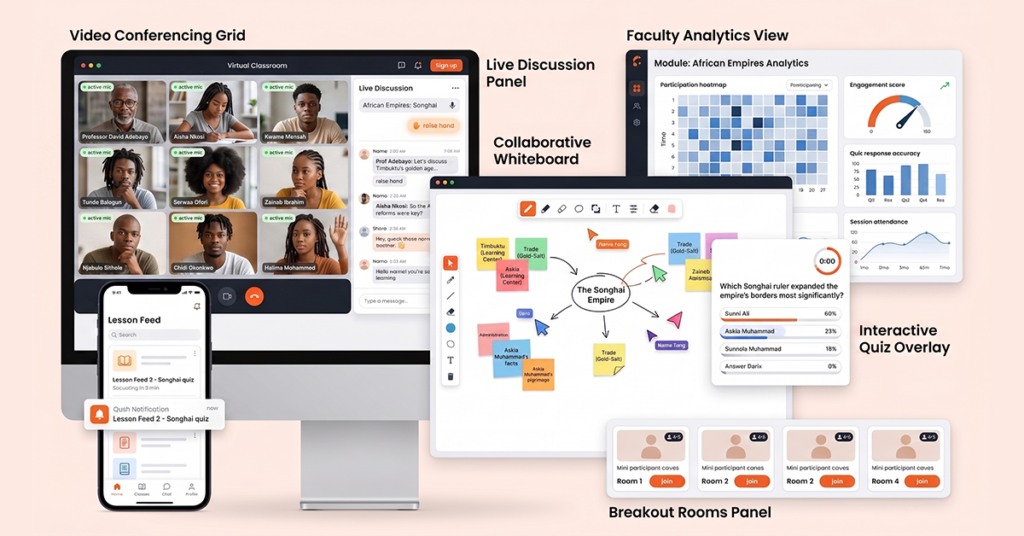
A dashboard full of green ticks can be deeply misleading. A student logs in on time, watches the lecture recording, and submits the assignment by the deadline. On paper, that looks like a model learner. In practice, it can just as easily describe someone who has quietly checked out: watching at double speed with the video muted, submitting work with the bare minimum of thought, and never once posting in a discussion forum or asking a question. Attendance, logins and completed assignments are the metrics most institutions track, and they are also the metrics least able to tell anyone whether real learning is happening.
That distinction matters more than most universities admit. The question worth asking is not how do we get students to log in, but how do we keep them genuinely participating once they are there. The honest answer involves engagement tools for virtual learning: the discussion prompts, live sessions, feedback loops and interactive activities that turn a course from something a student watches into something a student does.
Read More: From 100 to 10,000 Students: How Vigilearn Scales with Your Institution
What Are Engagement Tools for Virtual Learning?
Engagement tools for virtual learning are the features and activities within a digital course, such as live sessions, discussion forums, polls and collaborative projects, that give students genuine opportunities to participate, communicate and receive feedback rather than passively consume content. They exist to keep a student motivated across a term, not just present for a single session.
It is worth being clear that engagement extends well beyond video conferencing. A live class with cameras on but no interaction is still a passive experience; a well-designed asynchronous discussion, by contrast, can generate more genuine thinking than an hour of lecture. The tools that matter most are the ones that give students a reason to respond, contribute or collaborate, rather than simply attend.
Why Online Student Engagement Matters

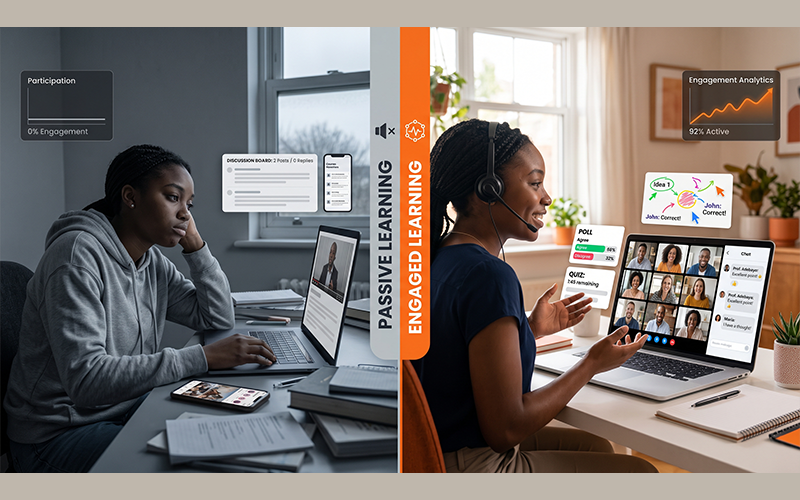
Institutions that treat engagement as a soft, secondary concern tend to discover its importance the hard way, through outcomes that are much harder to reverse than a quiet forum. The 2026 EDUCAUSE Students and Technology Report found that 56 per cent of students prefer course formats that combine in-person and online elements rather than either extreme, a clear signal that students expect their digital learning experience to hold their attention as effectively as a physical classroom does. When it does not, the consequences show up across several measurable outcomes:
- Retention suffers first, since disengaged students are the ones most likely to withdraw mid-course or mid-programme.
- Academic performance weakens as passive participation translates into shallower understanding, however complete the assignment record looks.
- Course completion rates fall when students who never truly engaged lose the motivation to finish.
- Student satisfaction drops, affecting everything from module evaluations to word-of-mouth reputation among prospective applicants.
- Faculty effectiveness is harder to demonstrate when instructors cannot see whether their teaching is actually landing.
The relationship runs in both directions. Genuine engagement does not just follow from good outcomes; it produces them, which is why the Online Learning Consortium’s quality framework places learner engagement at the centre of what it defines as effective online learning, alongside access and outcomes.
Read More: Student Engagement Tools for Virtual Classrooms
Why Students Become Disengaged Online
Disengagement rarely happens all at once. It tends to build gradually, through a series of small frictions that accumulate over a term until a student has quietly stopped participating in anything but the bare minimum. Several patterns recur across institutions:
- Passive lectures delivered as one-way video with no built-in prompt for response trains students to treat class time as something to half-watch rather than attend to.
- Limited interaction between students and instructors leaves questions unanswered and curiosity unrewarded.
- Poor mobile experience excludes students who rely on a phone as their primary device, particularly common outside wealthier markets.
- Lack of collaboration removes the peer accountability that keeps many students motivated in a physical classroom.
- Delayed instructor feedback breaks the loop between effort and response that sustains motivation.
- Technology complexity adds friction to tasks that should be simple, wearing down patience before the coursework even begins, particularly where digital classroom software demands more technical fluency than a student or instructor actually has.
- Low motivation, often the result of all the above rather than a separate cause, is where disengagement becomes visible as missed sessions and abandoned modules.
The Engagement Tools Every Modern University Needs

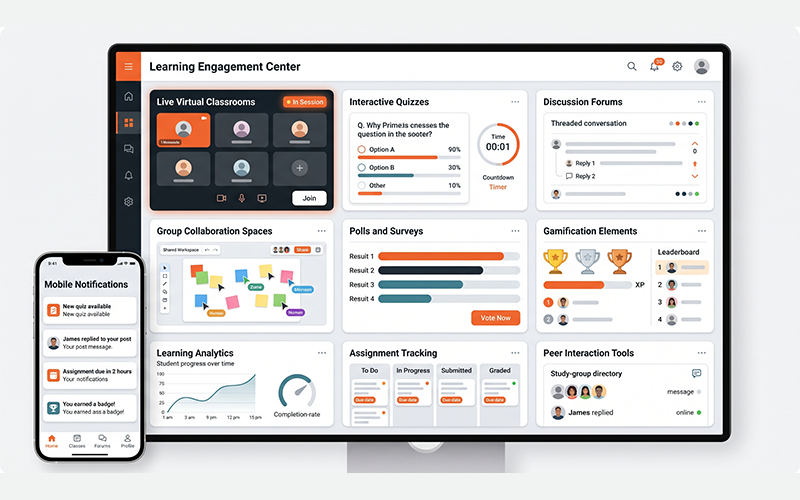
An effective LMS and eLearning Solutions platform should include tools that keep students actively involved throughout the learning journey, not just provide access to course materials. Essential features include:
- Live Virtual Classrooms: The best virtual classroom tools are judged by how much they invite a student to speak, not how clearly they broadcast a lecturer’s voice. Deliver real-time lectures with interactive features such as polls, breakout rooms and Q&A sessions that encourage participation instead of passive viewing.
- Discussion Forums: Create spaces where students can ask questions, exchange ideas and continue meaningful academic conversations beyond scheduled classes.
- Collaborative Workspaces: Enable students to work together on assignments, shared documents and group projects, promoting teamwork and accountability.
- Interactive Quizzes: Reinforce learning through regular knowledge checks and active recall, helping students retain information more effectively.
- Polls and Surveys: Give lecturers instant feedback on student understanding, allowing them to adjust lessons before misconceptions become bigger problems.
- Group Project Tools: Support structured collaboration with shared resources, task management and communication features that mirror real-world teamwork.
- Gamification Features: Motivate learners with badges, progress tracking, achievements and other incentives that encourage consistent participation.
- Learning Analytics: Provide instructors with real-time insights into student engagement, course progress and performance, enabling early intervention when learners begin to struggle.
- Mobile Notifications: Keep students informed about deadlines, announcements and upcoming activities through timely alerts on their mobile devices, helping them stay on track.
Measuring Engagement Beyond Attendance
Attendance and login data answer a narrow question: was the student present? They say almost nothing about whether the student was thinking. A more meaningful set of institutional KPIs looks at learning behaviour itself:
- Discussion participation, measured by the quality and frequency of contributions, not just logins to the forum.
- Assignment completion, tracked alongside the timing and pattern of submission, not just the final tally.
- Content interaction, such as how much of a recorded lecture is actually watched rather than simply opened.
- Assessment activity, including how students engage with practice quizzes and formative checks, not only graded exams.
- Peer collaboration, visible in group project activity and forum cross-replies between students, is often the clearest sign that online collaboration tools are being used as intended rather than sitting unused.
- Learning progress against course milestones, flagging students falling behind before a missed deadline makes it obvious.
- Faculty engagement, since an instructor’s own presence in a course strongly predicts how present their students remain.
Institutions that monitor these behaviours, rather than relying on attendance as a proxy, tend to spot student participation online declining while it is still reversible.
Read More: The Hidden Cost of a Disengaged Student: What the Data Actually Shows About Online Learning Drop-Off
Building an Integrated Digital Learning Experience
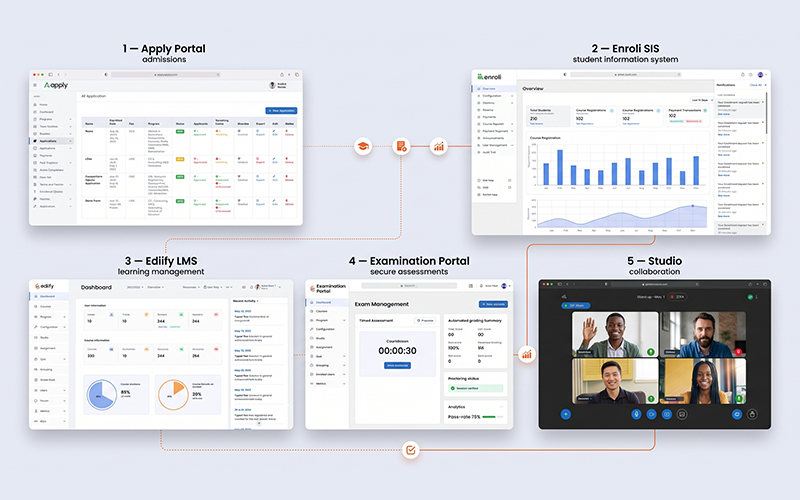
Engagement tools work best when they are not scattered across disconnected apps that a student has to juggle alongside coursework. Vigilearn’s Ediify LMS and Studio are built to function as one connected engagement ecosystem rather than two standalone tools: Ediify LMS hosts course content, assignments and analytics, while Studio provides the live, collaborative space for real-time sessions and group work, with both sharing the same student record. That same record extends into the Examination Portal for assessment, and Enroli SIS for enrolment and academic history, so a student’s engagement data follows them from enrolment through to assessment rather than resetting at every stage.
This integration matters because friction is one of the clearest causes of disengagement identified earlier. A student who has to switch between separate logins for lectures, discussion and live sessions is a student for whom every small barrier chips away at participation. A connected interactive learning platform, the kind that good higher education eLearning now depends on, removes that barrier by design, functioning as a single virtual learning platform rather than a set of tools stitched together after the fact.
How Vigilearn Improves Student Engagement
Vigilearn’s approach centres on interactive learning delivered through Ediify LMS, built so that content, discussion and assessment sit inside one coherent course experience rather than a collection of separate tools. Faculty collaboration is supported directly, since instructors can move between course materials and live teaching in Studio without leaving the platform their students already know. Virtual classrooms are designed for genuine two-way participation rather than one-way broadcast, and analytics run throughout the suite, giving faculty and administrators visibility into engagement patterns as they happen rather than after a term has ended.
The emphasis throughout stays on student participation and educational impact rather than a feature checklist, with the underlying platform built to scale from a single course pilot to university-wide delivery without losing that connection between teaching, engagement and assessment.
Student engagement doesn’t happen by accident. It requires the right digital learning environment, meaningful interaction, and connected technology. Book a Vigilearn demo to discover how Ediify LMS and Studio help universities create engaging virtual learning experiences that improve participation, retention, and academic success. Explore more insights on the Vigilearn Blog.
Frequently Asked Questions
What are engagement tools for virtual learning? Engagement tools for virtual learning are the features within a digital course, such as live sessions, discussion forums, polls and collaborative activities, that give students genuine opportunities to participate and receive feedback rather than passively consuming content.
How can universities improve online student engagement? Universities improve engagement by designing courses around participation rather than delivery: building in discussion, live interaction and prompt feedback, and monitoring learning behaviour so that disengagement is caught and addressed early.
Why do students lose interest in virtual classes? Students disengage due to passive lecture formats, limited interaction with instructors and peers, delayed feedback, poor mobile experience, and technology that adds friction to simple tasks, all of which erode motivation gradually over a term.
Which LMS features improve participation? Discussion forums, interactive quizzes, live virtual classrooms with real two-way interaction, collaborative project spaces and learning analytics all improve participation by giving students reasons to contribute rather than simply consume content.
How can institutions measure student engagement? Institutions should track discussion participation, content interaction, assessment activity and learning progress rather than attendance alone, since these behaviours reflect genuine involvement rather than mere presence in a course.
Can engagement tools improve course completion rates? Yes. Students who participate actively, through discussion, collaboration and regular feedback, are more likely to stay motivated across a full term, which directly supports higher completion and lower dropout rates.