



Choosing a learning management system should be a strategic decision. In practice, it is often a procurement one: driven by price comparisons, vendor demos, and the pressure to modernise quickly. That mismatch is expensive. According to recent edtech implementation research, 67% of universities that select the wrong LMS end up migrating within three years, at an average direct cost of $180,000. That figure does not account for lost academic productivity, frustrated faculty, or the student experience problems that accumulate along the way.
Understanding how to choose an LMS for universities in Africa carries particular weight because the stakes are higher and the margin for error is narrower. Infrastructure variability, mobile-first student populations, connectivity constraints, and limited IT capacity all mean that a platform built for a well-resourced campus in Europe may simply not perform in Lagos, Nairobi, or Accra. The Middle East and Africa LMS market was valued at $947 million in 2024 and is forecast to reach $3.1 billion by 2030. Vendors are paying attention. Institutions need to be equally rigorous.
Read More: Learning Management System for Universities: Why LMS Fail
Why Many Universities Make the Wrong LMS Decision

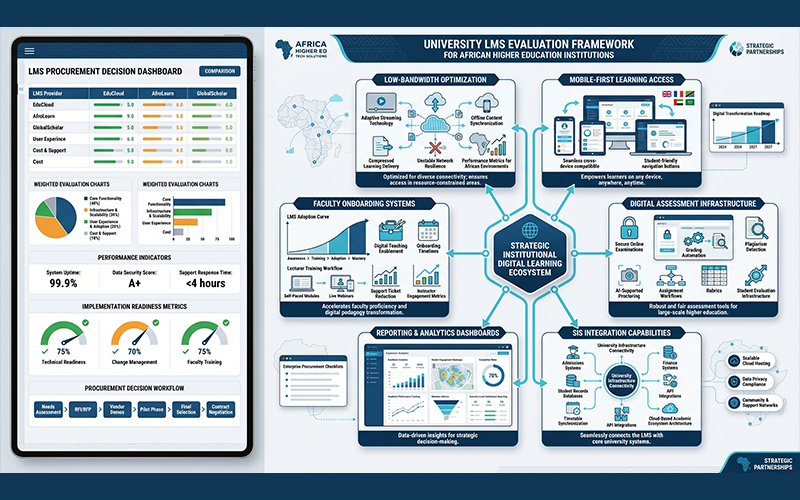
The failure patterns are consistent and largely avoidable. Most poor LMS decisions share one of five root causes:
- Buying on price alone, without modelling the total cost of ownership over three to five years.
- Choosing global brands without assessing fit for local infrastructure and student behaviour.
- Ignoring implementation complexity, assuming the vendor handles everything after purchase.
- Excluding faculty from evaluation, leading to adoption resistance after go-live.
- Underestimating student onboarding, particularly for first-generation digital learners.
The insight that experienced institutions consistently arrive at is this: most LMS failures happen after purchase, not during demos. A vendor demo shows a platform at its best, on optimal hardware, demonstrated by someone who knows every shortcut. What it does not show is how a lecturer with limited technical confidence builds a course at 10 pm, or how the system performs when 2,000 students log in simultaneously during an examination period. Evaluating for operational reality is the discipline that separates institutions that succeed with digital learning from those that struggle indefinitely.
A 10-Point LMS Evaluation Framework: How to Choose an LMS for Universities in Africa
Understanding how to choose an LMS for universities in Africa requires moving beyond feature checklists. Each criterion below comes with the question institutions should put directly to vendors and what a strong answer looks like.
1. Connectivity and low-bandwidth performance. Ask: Does the platform degrade gracefully under poor connectivity? Strong answer: the vendor can demonstrate offline functionality, lightweight mobile data consumption, and documented performance in bandwidth-constrained environments.
2. Mobile-first experience. The majority of students across sub-Saharan Africa access the internet primarily through smartphones. Ask: Is the mobile experience built natively or adapted from a desktop interface? Strong answer: a dedicated mobile app with full course access, notifications, and assignment submission.
3. Faculty adoption speed. Ask: How long does it take a non-technical lecturer to build and publish their first course? Strong answer: under two hours with no IT support required, backed by an accessible training programme.
4. Student engagement features. Look for: threaded discussion tools, push notifications, assignment workflows, and live session support. These are not luxury features; they are what determine whether students actually use the platform beyond downloading lecture slides.
5. SIS and admissions integration. Ask: Can the LMS sync bidirectionally with your student information system and admissions platform? Strong answer: documented API integration with your specific SIS, not a vague promise of “compatibility.”
6. Accreditation and reporting. Ask: Can the system generate audit-ready academic reports on demand? Strong answer: configurable reporting dashboards that produce documentation in formats your quality assurance body will accept.
7. Content creation capabilities. The platform should support video embedding, quiz builders, interactive modules, and structured digital course delivery without requiring third-party tools for basic functions.
8. Assessment and examination infrastructure. Ask: Does the LMS include integrated secure assessment, or is that a separate product? Strong answer: built-in examination workflows with grading pipelines, not a loosely connected third-party add-on.
9. Vendor support and African implementation experience. This is where global platforms frequently fall short. Ask: Can you name three African university implementations, and who is our local point of contact? Strong answer: a named implementation team, regional support hours, and verifiable references from institutions operating in comparable conditions.
10. Total cost of ownership. Ask vendors to model three-year and five-year costs, including licensing, implementation, server infrastructure, integrations, training, upgrades, and support. Cheap licensing can become an expensive operation, particularly with platforms that require significant IT maintenance.
Read More: Learning Management System for Universities: What to Look For
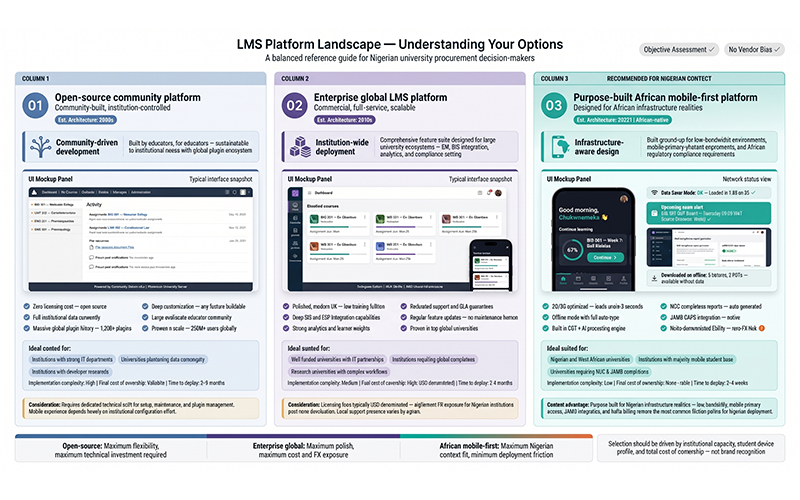
Moodle vs Canvas vs Purpose-Built African LMS Platforms
No comparison of this kind should pretend that one platform suits every institution. But institutions deserve an honest appraisal of what each approach actually involves.
Moodle is open-source and free to license, genuinely attractive for budget-constrained institutions. Its ecosystem is large, and its flexibility is real. The challenge is that flexibility comes at the cost of complexity. Self-hosted Moodle for a 2,000-user institution carries hidden annual operational costs between $85,000 and $122,000 when IT staffing, maintenance, and infrastructure are accounted for. Institutions without a dedicated technical team frequently end up with an under-maintained installation.
Canvas offers a modern interface and strong user experience, which aids faculty adoption. It is a managed platform, reducing the IT maintenance burden. The trade-off is cost: enterprise Canvas licensing typically ranges from $5 to $30 per student per year, and content migration from another system starts at $10,000. Localisation for African institutional contexts is limited, and support is primarily designed for North American and European clients.
Purpose-built African LMS platforms exist precisely because neither of the above options was designed with African institutional realities in mind. Regional optimisation, mobile-first architecture, local implementation support, and pricing structures that reflect African market conditions are genuine differentiators, not marketing language. The right question is not which platform is globally ranked highest, but which platform performs best in your specific operational environment.
The Real LMS Cost Most Vendors Do Not Explain
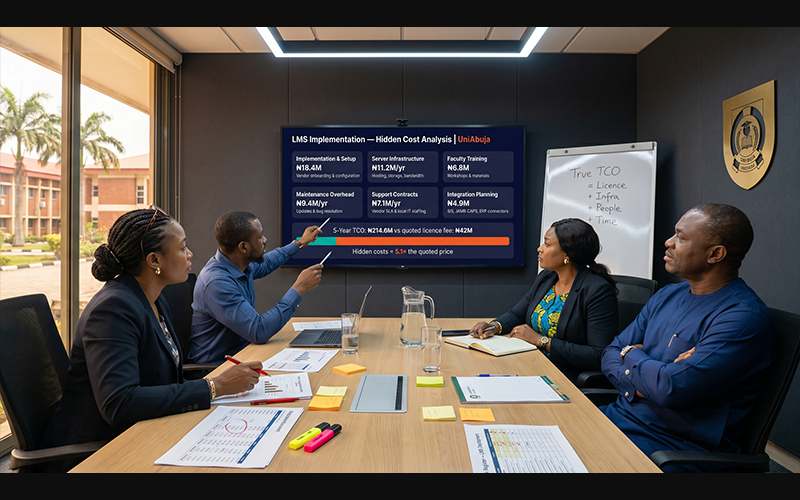
The licensing fee is the number vendors lead with. It is rarely the number that matters most over time. When universities model the total cost of ownership honestly, the following costs tend to be systematically underestimated:
- Implementation and initial configuration
- Server infrastructure and hosting (for self-hosted platforms)
- SIS and third-party tool integrations
- Faculty training and ongoing professional development
- Software upgrades and compatibility maintenance
- Technical support contracts and response SLAs
- Internal IT overhead and staff dependency
EDUCAUSE has consistently highlighted that LMS selection must account for full institutional context, not only feature functionality. The practical test: ask any vendor to provide a breakdown of what a comparable institution paid in year two and year three, not just at signing.
Why Ediify LMS Performs Well Against This Framework
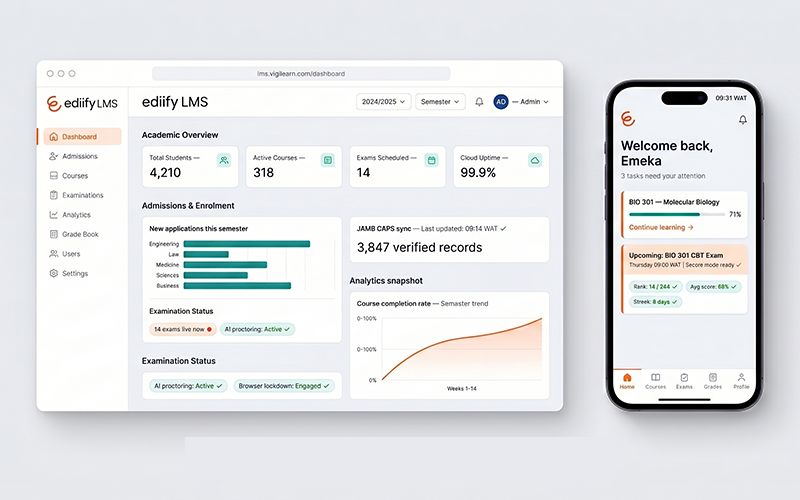
Ediify LMS by Vigilearn is designed specifically for African institutional workflows, which means the evaluation criteria above are the conditions it was built to meet rather than adapted for after the fact.
Its cloud-based deployment removes the IT infrastructure burden that makes self-hosted platforms operationally demanding. Low-bandwidth optimisation is built into the architecture, not bolted on. The mobile experience is designed for smartphone-first students, not scaled down from a desktop interface. And faculty adoption is supported through an implementation process that accounts for varying levels of digital confidence among teaching staff.
Critically, Ediify integrates with Vigilearn’s broader academic suite, including the Enroli SIS and the Examination Portal, which addresses the integration failures that undermine many standalone LMS deployments. Reporting outputs are structured for accreditation readiness, and support is provided by a team with direct experience of African university implementation contexts.
The credibility point worth stating plainly: not every LMS fits every institution equally. Ediify is the right fit for institutions that want a scalable, integrated, and operationally practical digital learning environment, built for the markets it serves.
What Universities Should Prioritise Before Signing Any LMS Contract
An LMS contract is a multi-year commitment with operational implications that extend well beyond the IT department. Before signing, institutions should ensure:
- Stakeholder alignment: faculty, student affairs, IT, and academic leadership should all have participated in the evaluation.
- Implementation planning: a detailed timeline with milestones, not a vague go-live date.
- Onboarding structure: how will lecturers be trained, over what period, and what ongoing support exists?
- Migration preparation: how will historical course data and student records be transferred from any existing system?
- Scalability requirements: model projected student numbers three to five years out, not just today’s enrolment.
- Support expectations: confirm response SLAs in writing and understand escalation procedures.
Successful LMS adoption is ultimately an operational achievement, not a technical one. Vigilearn supports institutions through each stage of this process. Read more on the Vigilearn blog for insight on LMS adoption, student data management, and digital transformation in African higher education.
Frequently Asked Questions
How do universities choose the right LMS? Start with an institutional needs assessment rather than a features list. Evaluate connectivity performance, mobile usability, faculty adoption speed, integration capability, and total cost of ownership. Include faculty and student representatives in the evaluation process.
What features should a university LMS include? Core requirements: mobile-first access, SIS integration, assessment and grading workflows, content creation tools, student engagement features, and accreditation-ready reporting. African institutions should also prioritise low-bandwidth performance and local implementation support.
What is the best LMS for African universities? There is no single answer. Institutions with strong IT teams may manage Moodle effectively. Institutions seeking a managed, integrated solution designed for African market conditions should evaluate purpose-built platforms like Ediify LMS. Fit matters more than global market share.
How much does LMS implementation cost? Direct licensing is only part of the picture. Total cost of ownership over three to five years, including hosting, training, integrations, and support, can vary dramatically. Self-hosted Moodle for a mid-size university may carry hidden costs exceeding $85,000 annually. Model the full number, not just the headline fee.
What is the difference between Moodle and a cloud-based LMS? Moodle requires your institution to manage its own hosting, maintenance, updates, and security. A cloud-based LMS like Ediify handles infrastructure centrally, reducing IT overhead and ensuring consistent performance across campuses without in-house technical management.
Compare EdiifyLMS with your current shortlist and evaluate what truly fits your institution. Book a demo with Vigilearn and explore a scalable LMS infrastructure designed for African higher education.