



Why Student Information Systems Matter in 2026
Institutions are dealing with massive volumes of data from admissions to graduation, from personal records to financial data; consequently, having a robust student information system for higher education is no longer optional. A modern SIS helps organise all that complexity into one unified, manageable ecosystem.
Higher ed goes beyond delivering lectures. Student lifecycle management, institutional planning, compliance, and resource optimisation now depend heavily on data. Without a reliable SIS, universities often find themselves stuck using spreadsheets, paper records, or disconnected systems. That leads to data duplication, lost files, and administrative confusion.
In 2026, higher education institutions would face even stronger pressure: growing student populations, more complex academic programs, increasing demand for accountability, and tighter regulations. In this context, a modern SIS becomes the foundation of a well-functioning campus, centralising data, enabling automation, and supporting holistic student lifecycle management.
Essential Features Every SIS Must Offer

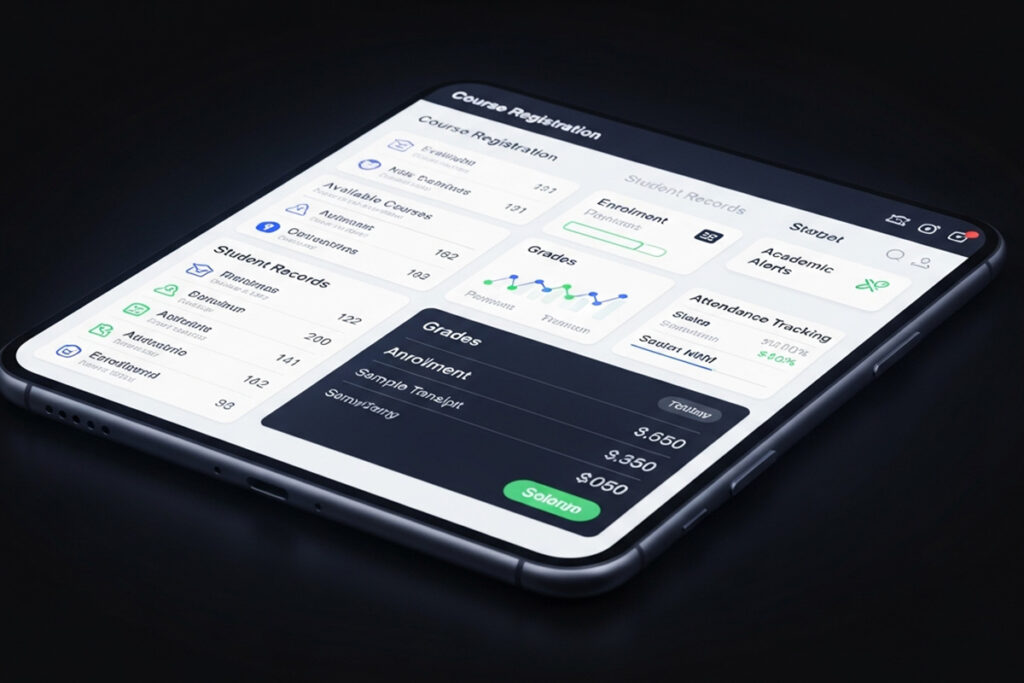
When selecting a Student Information System for Higher Education, certain core features are indispensable. These ensure that basic but critical academic and administrative workflows run smoothly.
Enrollment workflows and course registration
A good SIS should handle admission applications, documentation, seat allocation, and onboarding in an automated system. Once admitted, students must be able to register for courses, select electives, view course availability, and receive instant confirmation. This reduces long lines at registrar offices and speeds up the process significantly.
Student records and academic history
Personal details, contact information, prior academic credentials, and emergency contacts should all sit in a centralised database. From first registration through graduation (and even alumni tracking if applicable), the SIS must store complete and reliable academic histories. This centralisation eliminates the risk of lost files or scattered paper records.
Attendance tracking, grading, and transcript generation
Attendance, whether in-class or online, must be tracked in real time or near real time. Grading must also be managed within the system so that instructors can enter scores, compute GPAs, and generate official transcripts automatically. Reliable, instant updates prevent the delays common in manual grading systems and ensure fairness and transparency.
Payment tracking and financial management
Tuitions, fees, scholarships, payments, everything financial. Students and administrators must have clarity on fee status, payment history, outstanding balances, and receipts. An integrated payment module saves time, reduces errors, and gives transparency.
Communication tools and mobile access
The SIS should offer built-in communication channels, announcements, email or messaging, notifications for deadlines such as registration, fee payment, exam schedules, results, and so forth. Students and staff should have mobile access: many students rely on smartphones as their main internet device. Having mobile-friendly SIS access ensures that they stay informed without needing to visit offices physically.
Self-service student portal
Students should be able to log in, view their schedule, grades, and financial statements, and update personal information without the need to visit the registrar. This autonomy boosts student satisfaction and reduces administrative backlog.
Why Analytics and Automation Matter in Decision-Making

Beyond the basic features, a modern SIS’s power lies in analytics and automation. These capabilities enable institutions to shift from reactive to proactive management.
Dashboards for admissions, retention, and academic performance
With a properly configured SIS, institutional leaders can view real-time dashboards reflecting admission trends, application volume, acceptance rates, and enrollment numbers. They can also track retention, dropout rates, graduation timelines, and academic performance across departments. This kind of data empowers better resource allocation, timely interventions, and refined strategic planning.
For example, administrators might notice that a particular program has rising dropout rates after first-year exams. With data to back that up, they can commission remedial programs, peer counselling, or additional support for at-risk students. This is the kind of insight that only a unified SIS can reliably deliver.
Automated reminders, notifications, and academic alerts
Modern SIS platforms can send automated messages: reminders for tuition payment deadlines, alerts for registration windows, notifications for exam dates, or alerts when a student’s performance is slipping. By automating these communications, institutions reduce the risk of oversight and ensure timely action. This kind of automation also reduces reliance on manual calls or memos, freeing staff to focus on higher-value tasks.
Such automation contributes to improved student retention. Students who might otherwise miss deadlines or fall behind without realising quickly get flagged and supported. Interventions become timely rather than reactive.
Operational Efficiency and Transparency
Because all data enters the system once and is used many times across modules, duplication of effort is eliminated. Administrators can pull comprehensive reports with a few clicks. Whether for accreditation, regulatory compliance, departmental reviews, or student advising, there’s no need to manually reconcile spreadsheets or chase down paper files.
Integrations That Make or Break an SIS
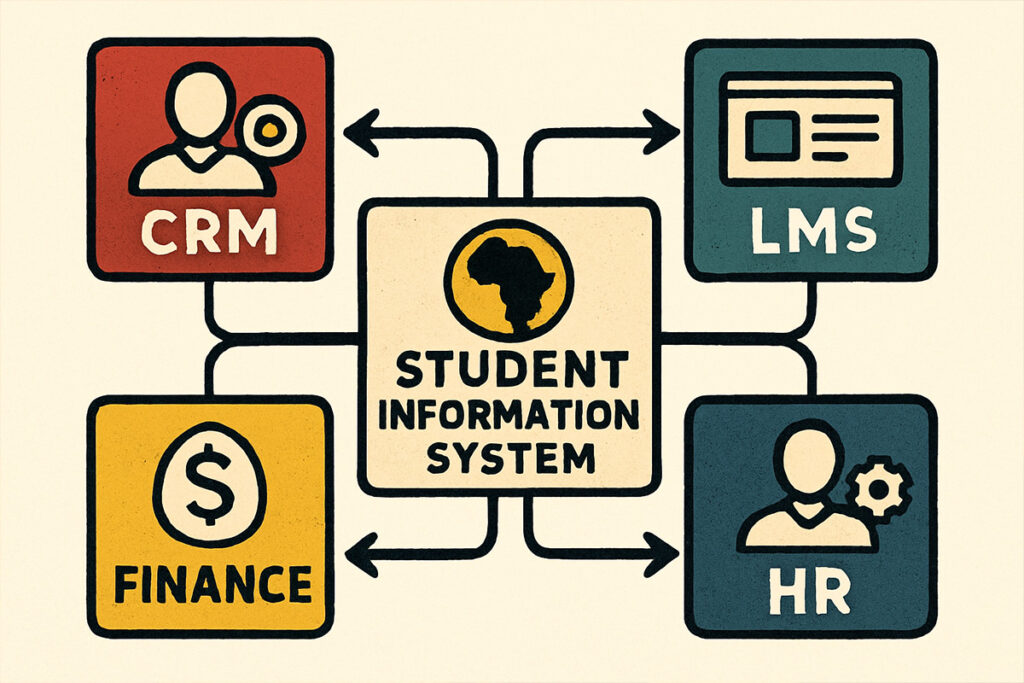
A Student Information System does not exist in isolation. In 2026, higher-ed operations demand seamless integration across many systems. The value of an SIS is greatly amplified (or limited) by how well it integrates with the rest of the campus tech ecosystem.
Learning Management Systems (LMS)
Classroom content, assignments, assessments, and course materials typically live within a learning management system. Integrating SIS with LMS ensures that enrollment data, course registrations, and student records stay in sync. When a student registers for a course in the SIS, that enrollment should automatically reflect in the LMS. This removes manual “imports” or reconciling class rosters.
When academic data (grades, attendance, completion status) flows between SIS and LMS, institutions can generate better analytics. They can monitor participation, progress, and performance holistically. For example, LMS engagement data combined with SIS academic records can help flag students at risk, something modern analytics-driven interventions rely on. Research already demonstrates how LMS data (like assignment submissions and content completion) can predict at-risk students with high accuracy.
CRM and Admissions Systems
For institutions that recruit broadly, especially private or international universities, a CRM system tracks prospective student enquiries, marketing campaigns, communications, application statuses, and conversion pipelines. An SIS that integrates with CRM ensures that once a candidate becomes an admitted student, their data flows smoothly into the SIS without duplication or manual re-entry.
Finance, Billing and Payment Systems
Some institutions use separate finance or ERP systems for fee collection, accounting, payroll, and budgeting. A well-integrated SIS ensures financial data (tuition payments, scholarships, fee balances) syncs with institutional financial systems. This integration makes reporting, audits, and budgeting easier and more accurate.
HR and Staff Management Systems
Faculty and staff data, teaching assignments, payroll, workload, and credentials may live in separate HR platforms. Tying that with SIS can help link academic outcomes to faculty assignments, evaluate workload distribution, and support planning for course offerings based on available staff.
Authentication and Identity Systems
An SIS should integrate with campus authentication systems (single sign-on, identity management) to give secure, role-based access. Students, faculty, and staff must have access to relevant modules without compromising data privacy.
For African universities, including those in Nigeria, West Africa, or other developing contexts, smooth data flow between systems is even more critical. Real-world infrastructure challenges, data privacy concerns, limited IT capacity, and often fragmented legacy systems make integrations a must rather than a luxury. That is why, in designing our own solution, Enroli SIS, we prioritised interoperability: the system is built to connect with LMS, finance modules, authentication layers, and future ERP additions so that African universities can operate with modern digital efficiency while dealing with local constraints.
Integration, or the lack thereof, can make or break the utility of an SIS. A platform that cannot communicate with other systems quickly becomes a silo, defeating the purpose of centralised data.
What Decision-Makers Should Evaluate Before Buying

When your institution is ready to choose a Student Information System for Higher Education, decision-makers should move beyond marketing brochures and focus on practical evaluation. Here is a checklist to guide procurement and implementation decisions:
- Scalability: Can the system handle growth? As enrollment grows, will SIS performance hold up? Will it support adding campuses, new departments, and expanded academic offerings without degradation of speed or reliability?
- Local support and onboarding: Especially in regions like Africa, local support is critical. Evaluate whether the vendor offers local onboarding assistance, training for administrators and faculty, and ongoing technical support. Will there be service-level guarantees?
- Cloud hosting and security: Ideally, a modern SIS should be cloud-based for accessibility and resilience. Evaluate hosting environment, data backup strategies, disaster recovery, encryption, and compliance with data privacy regulations. Security must be a priority.
- API availability and integration capacity: Does the SIS offer APIs and connectors to integrate with LMS, CRM, finance, HR, authentication systems, etc.? Without that, you risk siloed data and increased manual work.
- Total cost of ownership (TCO): This includes licensing, hosting, maintenance, onboarding/training, support, and any customisation required. Some SIS solutions may seem affordable initially, but require high costs when scaled or customised, or demand costly on-prem hardware.
- User experience (UX) and accessibility: How intuitive is the interface for students, faculty, and admin staff? Is there mobile access? Is the system friendly to staff who may not be tech-savvy? A complex, clunky UI may lead to low adoption, user frustration, and ultimately fail to deliver expected benefits.
- Compliance and audit readiness: Can the SIS generate reports for accreditation agencies, regulatory authorities, or internal audits? Can it track data changes (audit logs), manage access control, and ensure privacy?
- Vendor reputation and track record: What are other institutions saying? Has the vendor successfully implemented SIS in contexts similar to yours (e.g. African universities, resource-limited environments, multilingual contexts)? References and case studies matter.
This kind of evaluation helps ensure that the SIS you pick is not just powerful on paper but practical and sustainable in your institutional context.
In 2026, choosing the right SIS will be more than just selecting software. It will be about building the foundation for a modern, efficient, and student-centred institution. Done right, it can deliver clarity, speed, accuracy, and strategic power and in 2026, that will make all the difference.
At Vigilearn, we understand these dynamics deeply. Our Enroli SIS is built to meet the demands of modern higher education, especially in contexts where resources are limited, but aspirations are high. If you’d like to explore how Enroli SIS can transform campus operations, you can start here.