



Every admissions cycle begins with ambition. Universities want to attract the right students, process applications efficiently, and convert interest into enrollment before competitors do. Yet for many institutions, the admissions office remains one of the most operationally strained departments on campus. Spreadsheets, email chains, manual document checks, disconnected systems, and delayed approvals continue to slow down decision-making at a time when applicants expect near-instant responses.
The consequences are larger than administrative inconvenience. Slow admissions processing affects institutional growth, student satisfaction, and revenue. Today’s applicants compare universities not only by academic reputation but also by experience. If communication is delayed or the application journey feels frustrating, students move on quickly. According to EDUCAUSE, digital transformation has become a strategic priority for higher education institutions seeking operational efficiency and improved student experience. Universities that modernise admissions processes are no longer simply improving workflow; they are protecting enrollment outcomes.
Read More: University Admission Management System: A Complete Guide
The Admissions Bottleneck Is Costing Universities Students
Application delays create friction at the worst possible moment in the student journey. A prospective student who submits an application is actively interested. However, when institutions take days or weeks to acknowledge submissions, request missing documents, or communicate next steps, enthusiasm begins to fade.


Manual admissions systems typically create problems such as:
- Delayed application acknowledgment
- Inconsistent communication with applicants
- Human errors during document review
- Difficulty tracking application status
- Slow internal approvals and routing
- Missed follow-ups with qualified candidates
These inefficiencies directly affect enrollment conversion. In competitive higher education markets, speed matters. Students increasingly expect digital-first experiences similar to those offered by banks, airlines, and e-commerce platforms. Universities that cannot meet these expectations risk losing applicants to institutions with faster and more transparent admissions systems.
The pressure on universities is also increasing globally. The World Economic Forum notes that digital transformation in higher education has accelerated significantly, driven by changing student expectations and the need for greater accessibility. Admissions is now one of the clearest operational areas where institutions can modernise quickly and see measurable impact.
What Manual Admissions Actually Costs an Institution
Many universities underestimate the true cost of manual admissions processing because the inefficiencies are distributed across multiple teams. Admissions officers, registry staff, faculty reviewers, finance departments, and ICT teams often work independently, creating fragmented workflows and duplicated effort.
Consider the operational burden of processing a single application manually:
- Reviewing application forms
- Confirming document uploads
- Sending acknowledgment emails
- Conducting eligibility checks
- Routing applications to reviewers
- Following up on incomplete submissions
- Updating spreadsheets and databases
- Communicating admission decisions
When multiplied across thousands of applications, these tasks consume enormous staff time.
Manual systems also increase the likelihood of errors. Missing documents may go unnoticed. Applications may be routed to the wrong department. Follow-up emails may never be sent. In peak admission periods, staff burnout becomes common, particularly when institutions rely heavily on email and spreadsheet-based coordination.
The financial implications are equally significant. Delayed admissions processing can reduce conversion rates, leading to lost tuition revenue. Institutions may also incur higher operational costs through overtime, temporary staffing, and repetitive administrative work.
A recent report highlighted by ITPro found that many universities still struggle with fragmented digital ecosystems and outdated systems, despite increasing investments in digital transformation. The report identified administrative complexity and disconnected processes as major barriers to improving student experience.
Ultimately, admissions inefficiency affects institutional reputation. Applicants interpret slow communication as disorganisation. For universities competing for top talent, that perception matters.
Read More: Student Data Management System for Modern Universities
The 6 Stages of Admissions That Can Be Automated
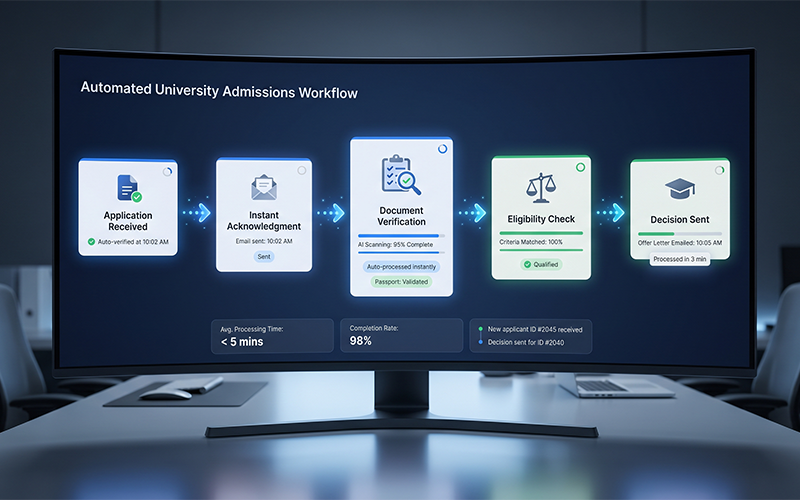
Modern admissions automation for universities focuses on eliminating repetitive manual tasks while improving speed, visibility, and consistency throughout the admissions lifecycle.
1. Application Receipt and Instant Acknowledgment
With an automated admissions system, applications are captured instantly through an online portal. Once submitted, applicants immediately receive confirmation emails and next-step instructions.
This eliminates uncertainty for students while reducing administrative workload for admissions staff.
What automation saves:
- Manual acknowledgment emails
- Delayed response times
- Lost applications
- Applicant anxiety and confusion
2. Document Completeness Check
One of the biggest causes of admissions delay is incomplete documentation. Automation allows institutions to define required documents based on programme type, applicant category, or entry requirements.
The system automatically flags missing items and prompts applicants to complete submissions before progressing.
Benefits include:
- Faster application validation
- Reduced back-and-forth communication
- Improved processing accuracy
- Better compliance and audit trails
3. Academic Eligibility Screening
An automated admissions workflow can screen applicants against predefined eligibility criteria such as grades, qualifications, or programme requirements.
Rather than manually reviewing every submission from scratch, admissions teams can prioritise qualified candidates immediately.
This reduces:
- Initial screening workload
- Human inconsistency in evaluation
- Processing delays during high-volume periods
Automation does not replace academic judgment; it streamlines repetitive checks so staff can focus on higher-value decision-making.
4. Review Routing and Shortlisting

In many universities, applications move slowly between departments because approvals depend on manual coordination. Automated workflow routing ensures applications are assigned automatically to relevant reviewers or faculties.
Admissions teams gain real-time visibility into:
- Pending reviews
- Approval bottlenecks
- Reviewer turnaround times
- Application status across departments
This dramatically improves accountability and processing speed.
5. Decision Communication
Once decisions are finalised, applicants can automatically receive admission updates through email, SMS, or portal notifications.
Communication templates help institutions maintain consistency while reducing repetitive administrative tasks.
Automation improves:
- Response speed
- Applicant engagement
- Communication accuracy
- Conversion opportunities
Institutions can also automate follow-ups for admitted students who have not yet accepted offers.
6. Enrollment Confirmation and Onboarding Trigger
Admissions should not end with an offer letter. The most effective university enrollment automation systems continue into onboarding.
Once students accept admission offers, the system can automatically trigger:
- Payment instructions
- Enrollment documentation
- Student onboarding workflows
- Integration with student information systems
This creates a seamless transition from applicant to enrolled student.
How Vigilearn’s Apply Portal Automates Admissions
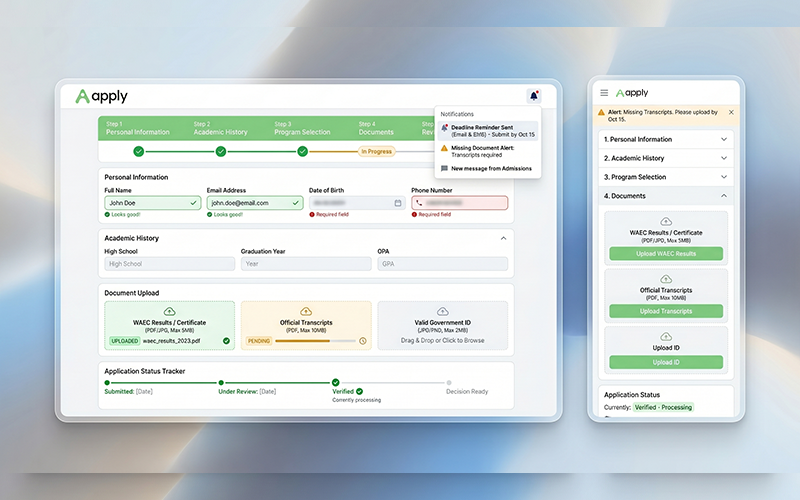
Apply Portal by Vigilearn is designed specifically to help institutions modernise admissions management without creating operational disruption.
The platform centralises the entire digital admissions process into a single, structured workflow. Instead of relying on fragmented communication and disconnected spreadsheets, universities gain a unified admissions environment with real-time visibility.
Key capabilities include:
Centralised Admissions Dashboard
Admissions teams can monitor application volumes, processing stages, pending actions, and conversion metrics from a single dashboard.
This improves oversight while helping institutions identify bottlenecks early.
Workflow Automation
Applications move automatically through predefined stages based on institutional rules and approval structures.
This eliminates manual routing delays and improves processing consistency.
Automated Communication
The platform supports automated applicant communication, including:
- Application acknowledgment
- Missing document reminders
- Admission updates
- Enrollment instructions
Consistent communication improves applicant experience while reducing staff workload.
Document Tracking and Verification
Institutions can track uploaded documents, monitor completion status, and reduce errors associated with manual verification processes.
This is particularly valuable during peak admissions periods when teams process large application volumes.
Reporting and Visibility
Admissions leaders gain access to actionable reporting and analytics that support data-driven decision-making.
Institutions can monitor:
- Application conversion rates
- Processing timelines
- Enrollment trends
- Reviewer performance
- Admission pipeline health
As universities increasingly prioritise digital transformation, integrated platforms like Enroli SIS and Apply Portal help create connected student lifecycle management rather than isolated administrative systems.
Additional insights on higher education technology and institutional digital transformation can also be explored on the Vigilearn Blog.
Implementation and Change Management
Technology implementation is rarely just a technology issue. In many institutions, the real challenge is adapting long-established processes and workflows.
Successful admissions automation depends on:
- Clear process mapping
- Staff onboarding and training
- Stakeholder alignment
- Phased implementation
- Ongoing technical support
The good news is that modern university admissions automation software is designed for gradual transition, not disruptive replacement. Institutions can automate workflows incrementally while maintaining operational continuity.
According to the World Economic Forum, higher education institutions that successfully embrace digital transformation combine technology adoption with organisational readiness and staff capability development.
When implementation is managed properly, automation reduces pressure on teams rather than creating additional complexity.
Frequently Asked Questions
- What is admissions automation in universities?
Admissions automation uses software to manage application processing, document verification, follow-ups, decision updates, and enrollment workflows without manual delays.
- How does admissions automation improve university enrollment?
It reduces response time, improves applicant experience, lowers application drop-offs, and helps universities convert more applications into enrollments.
- Which parts of the admissions process can be automated?
Application acknowledgment, document review, eligibility checks, reviewer routing, decision communication, enrollment confirmation, and onboarding can all be automated.
- Is admissions automation expensive to implement?
The greater cost is often manual inefficiency. Modern systems like Apply Portal help institutions reduce administrative workload, improve operational efficiency, and increase enrollment conversion.
Smarter Admissions Starts with Better Systems
With the right admissions automation for universities, institutions can reduce processing time by up to 70%, improve applicant experience, and free admissions teams to focus on strategic enrollment growth instead of repetitive administration.
See Vigilearn’s admissions automation in action. Book a 30-minute product demo and discover how smarter workflows can transform your admissions process.