



For many institutions, the admissions journey begins with a spreadsheet. It feels familiar, flexible, and affordable. At low application volumes, Excel or Google Sheets can appear to do the job just fine. Rows represent applicants, columns track stages, and filters offer a sense of order. Early on, this approach feels efficient, even empowering.
The trouble starts when growth arrives. As application numbers increase, admissions spreadsheets quickly become harder to manage. Files multiply, versions conflict, and small errors begin to carry real consequences. What once worked for a few hundred applications now struggles under the weight of thousands. Instead of enabling visibility, the spreadsheet becomes a source of anxiety for admissions teams trying to keep up.
At scale, the biggest issue is the absence of a single source of truth. Data lives in multiple files, on different devices, edited by different people at different times. No one is ever entirely sure which version is correct. Teams lose confidence in the data, and when confidence disappears, decision-making slows.
The problem is not that spreadsheets are inherently bad, but that they were never designed to support a complex, high-volume admissions environment.
Read more: Why Manual Admission Processes Are Costing Universities Time and Money
Why Admissions Spreadsheets Break Down


At the heart of the issue is scale. Admissions spreadsheets are built for static data, not dynamic workflows. Once multiple stakeholders are involved, cracks begin to show. Different team members create their own copies to work faster or avoid overwriting someone else’s changes. Before long, there are several versions of the same file, all claiming to be current.
Access conflicts make things worse. Two officers updating the same applicant record can overwrite each other’s work. Important notes disappear. Status updates revert without explanation. Without clear ownership of data, accountability becomes blurred, and mistakes become harder to trace.
There is also the risk of data loss. A corrupted file, an accidental deletion, or a misplaced attachment can erase weeks of work. Because spreadsheets are not purpose-built systems, they lack robust audit trails, automated backups, and structured permissions. For institutions handling sensitive applicant information, this is more than an inconvenience; it is a governance and compliance concern.
These breakdowns are not the result of poor staff performance. They are structural limitations of relying on admissions spreadsheets for a process that demands reliability, collaboration, and real-time accuracy.
Manual Admissions Tracking Errors

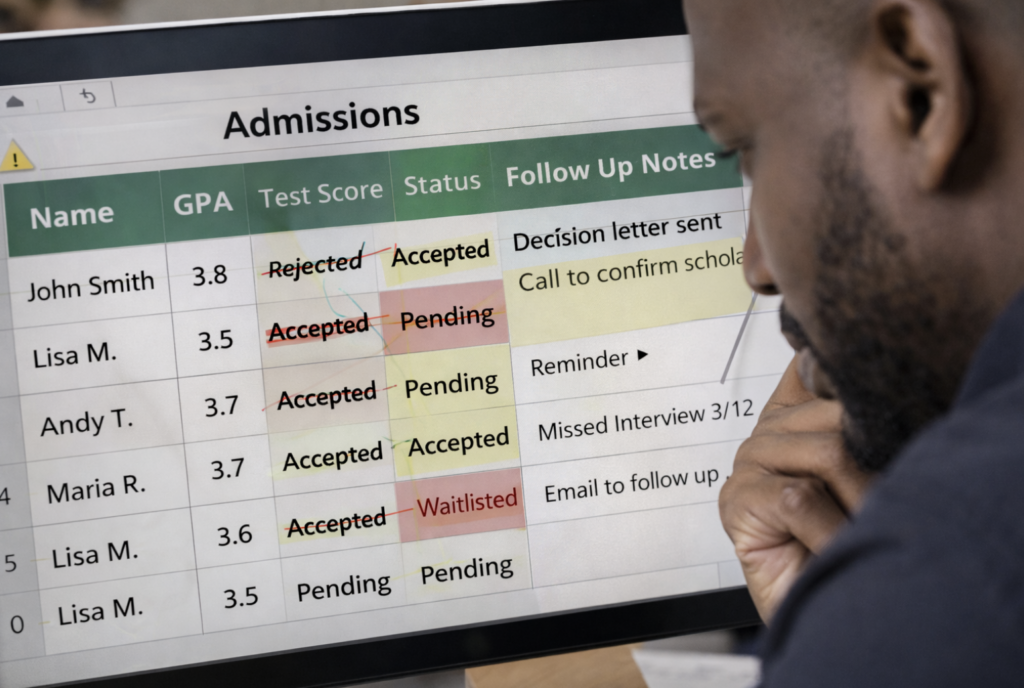
When institutions depend on manual admissions tracking, errors are almost inevitable. Follow-up emails are missed because a column was not updated. Applicants are marked at the wrong stage, leading to confusion and unnecessary delays. Decisions that should take days stretch into weeks because files need to be cross-checked manually.
Human error plays a significant role here. Admissions teams are often under pressure, especially during peak cycles. Fatigue increases the likelihood of mistakes, from entering incorrect data to forgetting critical steps altogether. Without system-enforced checks, spreadsheets rely entirely on individual diligence.
Accountability also suffers. When something goes wrong, it is difficult to determine where the breakdown occurred. Was the applicant never contacted, or was the update simply not recorded? Did a decision delay happen because of workload, or because information was missing? Manual processes rarely provide clear answers, leaving teams frustrated and applicants dissatisfied.
Impact on University Admissions Workflow

These challenges ripple across the entire university admissions workflow. Processing times slow down as staff spend hours reconciling data instead of reviewing applications. What should be a streamlined journey becomes fragmented, with each step dependent on manual updates.
Applicants feel the impact directly. Delayed responses, inconsistent communication, and unclear status updates erode trust. In a competitive admissions landscape, experience matters. Prospective students compare institutions not just on academic offerings, but on how efficiently and respectfully they are treated during the application process.
Reporting is another casualty. With data scattered across files, generating accurate reports becomes a labour-intensive task. Leadership lacks real-time insight into funnel performance, acceptance rates, or bottlenecks. According to perspectives shared by organisations like EDUCAUSE, data-driven decision-making is critical for modern higher education, yet spreadsheets make this unnecessarily difficult.
Ultimately, institutions risk losing qualified applicants. When decisions are delayed or communication falters, students accept offers elsewhere. What begins as an operational issue quietly turns into a revenue and reputation problem.
Moving From Admissions Spreadsheets to Automation

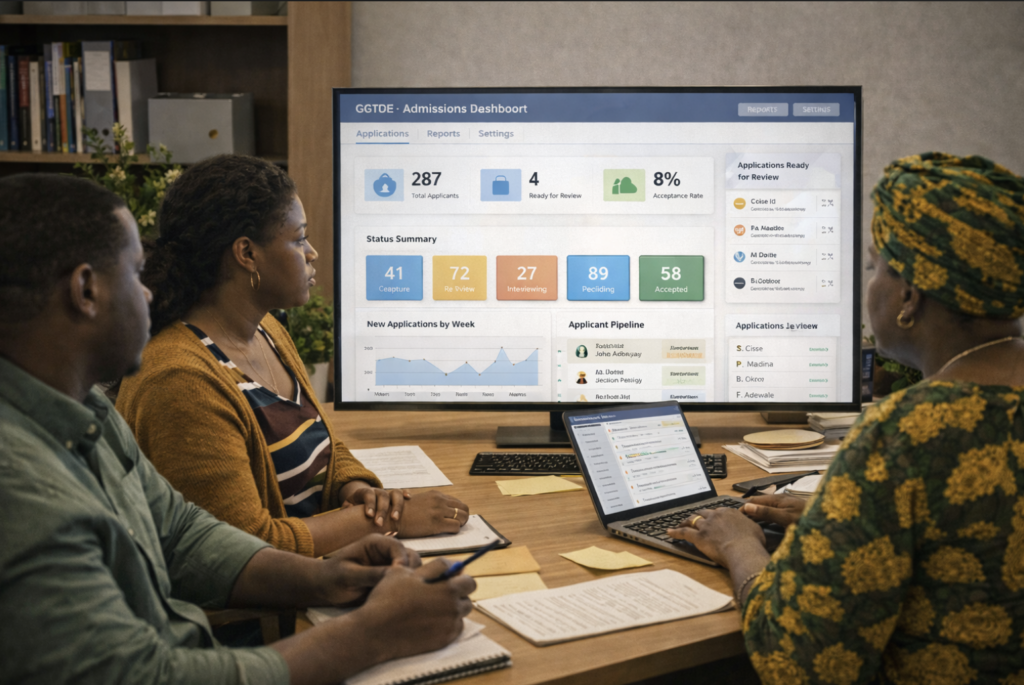
The alternative is not more complex spreadsheets, but admissions process automation. Purpose-built systems are designed to handle volume, complexity, and collaboration without sacrificing accuracy. Centralised applicant data ensures everyone works from the same information at the same time.
Role-based access clarifies responsibility. Admissions officers, reviewers, and managers see only what they need, reducing errors and improving accountability. Automated status updates remove guesswork, ensuring that every applicant’s journey is accurately reflected without constant manual input.
Real-time dashboards replace manual reporting. Instead of waiting days for compiled figures, leaders can see application volumes, decision timelines, and conversion rates instantly. Clean reporting supports strategic planning and helps institutions respond quickly to changing trends, a capability frequently emphasised in higher education technology research by firms like Gartner.
Automation does not remove the human element from admissions. It removes friction, allowing teams to focus on evaluation, engagement, and thoughtful decision-making rather than administrative maintenance.
How Vigilearn Replaces Admissions Spreadsheets
Vigilearn approaches admissions as an integrated, end-to-end process. The Apply Portal serves as a single system where all applicant data lives securely and consistently. There are no competing files, no version confusion, and no uncertainty about data accuracy.
Automated workflows guide applications through clearly defined stages. From submission to review, decision, and enrollment, every step is visible and traceable. Admissions officers always know what needs attention next, and applicants receive timely updates without manual intervention.
Clear stage visibility improves collaboration across teams. Managers can monitor progress without interrupting staff, while leadership gains confidence in the numbers informing strategic decisions. Most importantly, the administrative workload is significantly reduced, freeing teams to focus on quality rather than quantity.
As institutions grow, Vigilearn scales with them. What starts with hundreds of applications can comfortably support thousands, without the chaos that admissions spreadsheets inevitably introduce. By replacing fragmented tools with a unified platform, institutions regain control of their admissions operations.
For institutions ready to grow without losing control, the next step is clear. Explore how purpose-built admissions systems can support your goals by learning more at Vigilearn or browsing insights on the Vigilearn blog. Growth should feel intentional, not overwhelming.