



There is a server room somewhere on an African university campus right now that is costing far more than anyone budgeted. The hardware is ageing. The IT team is stretched. The last major software update took three weeks to roll out, and some departments are still waiting. This is not a unique situation; it is the daily reality for scores of institutions across the continent that still rely on on-premises infrastructure to run their academic operations.
The conversation is shifting, though, and it is shifting quickly. A 2022 industry assessment found that 32% of African universities had already adopted cloud computing, with another 25% planning to do so. As Africa’s e-learning market races toward a projected value of $7.7 billion by 2033, the infrastructure question is no longer theoretical. For university leaders weighing whether a cloud-based university management system in Africa makes sense for their institution, the evidence is becoming difficult to ignore.
Read more: How to Streamline Academic Operations with Cloud-Based Solutions
The Legacy Problem: What On-Premise Systems Are Costing African Universities

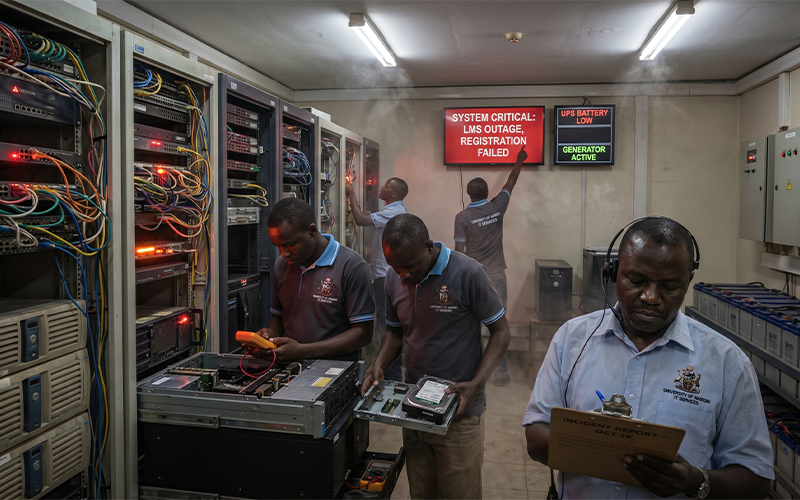
On-premise systems carry costs that rarely appear on a single line item. The server hardware itself is just the beginning. Institutions must also budget for electricity, physical security, cooling systems, licences, routine maintenance, and eventual hardware refresh cycles, typically every three to five years. Forrester Research estimates that 80% of IT spending in organisations running legacy infrastructure goes toward maintenance, leaving only 20% for new initiatives.
For universities already operating under tight budgets, that ratio is particularly damaging. Every naira, cedi, or shilling spent keeping a server running is money not going into curriculum development, faculty support, or student services. Beyond the financial drain, on-premise systems create structural vulnerabilities:
- Slow update cycles: New features or security patches require internal IT involvement and scheduled downtime.
- Single points of failure: A hardware fault or power outage can take critical systems offline for hours or days.
- Backup risks: Without automated, off-site backups, data loss events can be catastrophic and irreversible.
- IT dependency: Every configuration change, access request, or integration relies on a small internal team that is already stretched.
The hidden costs compound quickly. When you factor in infrastructure maintenance, staffing, power consumption, and security management, independent TCO analyses show that fully loaded on-premise deployments can cost 30–40% more over five years than equivalent cloud solutions. For institutions in Nigeria, Ghana, Kenya, and across the continent, that gap has real consequences.
What Cloud Actually Means for University Operations

The term “cloud” gets used loosely, so it is worth being precise. A cloud-based university management system in Africa means the software runs on remote servers managed by a vendor, accessed securely via the internet. There are no physical servers to procure, no on-site infrastructure to maintain, and no internal team required to push updates. The platform is simply available, updated, and supported as part of a service agreement.
For university administrators, this translates into a fundamentally different operational model. Instead of managing infrastructure, IT teams focus on strategy, integration, and user support. Updates happen in the background. New features are available institution-wide simultaneously. And if a staff member needs to access the student information system from a satellite campus in a different city, they can.
The security question comes up in almost every migration conversation, and rightly so. The honest answer is that well-built cloud platforms are typically more secure than most on-premise deployments, not less. They employ encryption in transit and at rest, automated backups with geographic redundancy, role-based access controls, and continuous security monitoring. A university’s internal IT team, however capable, rarely has the resources to maintain that level of security around the clock.
Read more: Hybrid Learning in Universities: Managing Flexible Education Models
6 Operational Advantages of Cloud-Based University Platforms

1. Lower Total Cost of Ownership
With no hardware to purchase or refresh, infrastructure costs are replaced by predictable subscription fees. IT budgets become easier to plan, and capital expenditure shifts to operational expenditure, which is more manageable for most institutions.
2. Faster Deployment and Updates
Cloud platforms eliminate the long installation cycles and version-control headaches of on-premise software. A new module or improvement is deployed centrally and available to every user immediately, with no downtime required.
3. Anywhere Access
Students, faculty, and administrators can access the system from any device with an internet connection. This matters enormously in a continent where Sub-Saharan Africa is projected to reach 518 million mobile internet users by 2030. A student managing their enrolment from a mobile phone in a rural area and a lecturer uploading grades from home are both fully supported.
4. Disaster Recovery and Automated Backups
Cloud platforms back up data continuously and store it across multiple locations. If a physical disaster, power failure, or cyberattack occurs, data can be restored quickly. On-premise systems, unless specifically configured with off-site backup solutions, rarely offer the same protection.
5. No Dedicated Server Infrastructure
Departments can scale up during high-demand periods, such as admissions or examination season, without procuring additional hardware. Capacity scales with need, and institutions only pay for what they use.
6. Vendor-Managed Security and Compliance
Security patches, compliance updates, and threat monitoring are handled by the vendor’s dedicated team. This removes an enormous burden from internal IT staff and reduces the institution’s exposure to evolving cyber threats.
The Migration Conversation: What IT Teams Actually Worry About
Migration anxiety is real, and dismissing it does not help anyone. The concerns that IT teams and registrars raise most often are legitimate: Will data be lost during transfer? Will staff know how to use the new system? What happens to current integrations? How long will the transition take?
The good news is that modern cloud migration processes are designed specifically to manage these risks. The approach that works best for most institutions involves:
- Phased rollout: Moving one function at a time, starting with lower-risk areas, so staff build confidence incrementally.
- Parallel operation: Running both systems simultaneously during a defined transition period, so there is always a fallback.
- Sandbox testing: Staff interact with the new system in a safe environment before it goes live.
- Dedicated onboarding support: Vendor teams provide training, documentation, and hands-on support throughout the process.
The transition requires planning and commitment. But “complex” is not the same as “unmanageable,” and the operational risk of staying on ageing infrastructure grows with each passing year.
Real Institutions Making the Move: What It Looks Like in Practice
The shift is not hypothetical. Across the continent, universities are making documented, deliberate decisions to move away from on-premise infrastructure.
The most thoroughly documented case is the University of Cape Town (UCT), Africa’s top-ranked university. In 2021, UCT launched a formal Learning Platforms Update Project, explicitly citing the need for a cloud-hosted LMS to increase availability and reduce IT risks. Following a rigorous procurement process, UCT selected D2L Brightspace, rebranded internally as Amathuba (meaning “opportunities” in isiXhosa). The migration away from its legacy Vula platform was completed in a phased rollout across 2022, 2023, and 2024, with all courses fully transitioned to the cloud-based platform by 2025. The project is a textbook example of how a large, complex institution can manage cloud migration deliberately and successfully.
Further north, Makerere University in Uganda, consistently ranked the leading university in East Africa, has also invested in cloud infrastructure. In March 2026, Makerere and the Research and Education Network for Uganda (RENU) commissioned the National AI Research Cloud, a platform providing high-performance computing and secure cloud storage for research and academic workloads. The investment reflects a broader institutional recognition that cloud infrastructure is foundational, not optional, for universities aiming to compete at a regional and global level.
These institutions are not outliers. They are early signals of a continent-wide direction of travel.
Why Cloud Adoption Is Accelerating Across African Higher Education
The structural drivers behind cloud adoption in African higher education are not going away. Africa’s e-learning market is valued at $3.4 billion and growing at nearly 20% annually, driven by mobile penetration, falling data costs, and policy support for digital curricula. Students increasingly arrive at university expecting digital-first experiences: online admissions, mobile access to timetables and results, and hybrid learning options.
Universities with distributed campuses face an added dimension. Managing student records, examination schedules, and academic workflows across multiple physical locations is genuinely difficult on a centralised on-premise system. Cloud infrastructure handles distributed access elegantly, making it far easier to deliver consistent services regardless of where a student or staff member is located.
The shift is not just about technology modernisation. It is about operational sustainability. Institutions that cannot adapt their digital infrastructure will find it increasingly difficult to compete for students, attract quality faculty, and deliver the kind of academic experience that the next generation expects.
Vigilearn: A Cloud-Native Platform Built for African Institutions
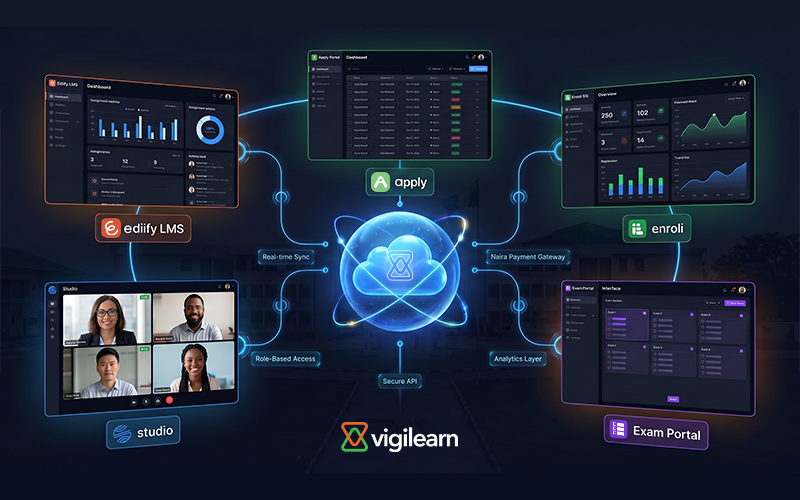
Vigilearn is an integrated cloud-native ecosystem built specifically for the African higher education context. Rather than adapting platforms designed for other markets, Vigilearn’s product suite was architected from the ground up with the needs of African institutions in mind.
The ecosystem includes:
- Ediify LMS: A learning management system for delivering, managing, and tracking academic content.
- Enroli SIS: A student information system for managing admissions, enrolment, and academic records.
- Apply Portal: A streamlined digital admissions workflow.
- Examination Portal: Secure, scalable management of assessments and results.
- Studio: Tools for creating and publishing digital course content.
Each product is cloud-native, meaning updates, security management, and scaling all happen centrally. Institutions do not need to manage infrastructure or coordinate internal IT teams for routine operations. The platform is designed for uptime reliability, with data security and disaster recovery built into the architecture, not added as an afterthought.
FAQ
What is a cloud-based university management system?
It is a suite of software tools, such as a student information system, LMS, and admissions portal, hosted on remote servers and accessed via the internet, rather than installed on physical hardware at the institution.
Why are universities moving away from on-premise systems?
On-premise systems carry high maintenance costs, require dedicated IT staff, are slow to update, and create data security risks. Cloud platforms reduce these burdens while improving access and scalability.
Is cloud software secure for universities?
Yes, when provided by a reputable vendor. Enterprise cloud platforms use encryption, automated backups, access controls, and continuous monitoring, typically exceeding the security standards of most on-premise deployments.
What are the benefits of SaaS platforms in higher education?
Lower total cost of ownership, faster deployment, anywhere access, automatic updates, built-in disaster recovery, and the ability to scale without additional infrastructure investment.
Ready to Modernise?
Vigilearn is a fully cloud-based university management system built for African institutions. If your institution is still managing operations on ageing on-premise infrastructure, or simply looking for a more scalable, reliable platform, the conversation is worth having.
Book a demo and explore how modern cloud infrastructure can simplify your university’s operations and support long-term growth. You can also visit the Vigilearn blog for more insights on digital transformation in African higher education.