


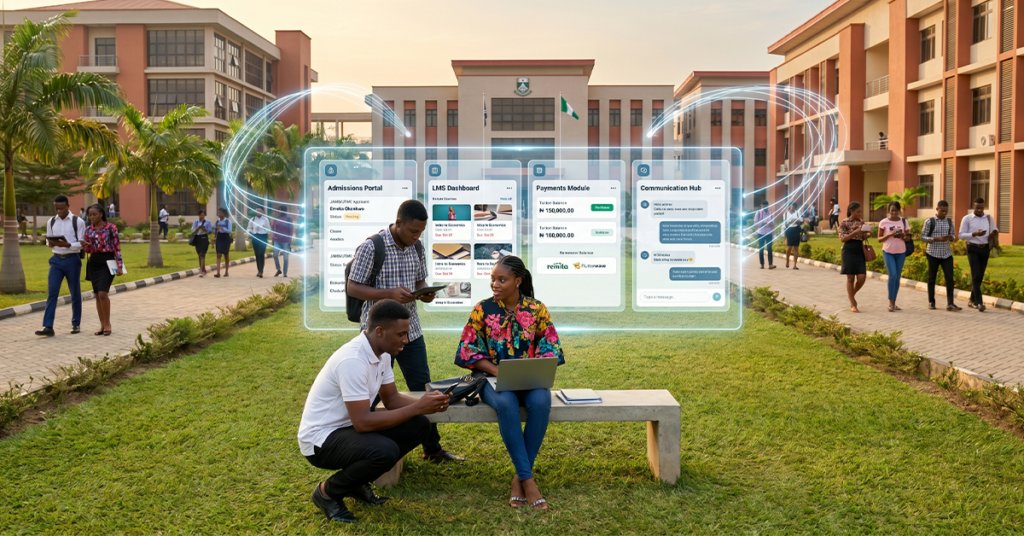
Before your newest student set foot on campus, their digital life is seamless and frictionless; they had already filed a tax return on their phone, tracked a food delivery in real time, streamed three seasons of a show, and moved money across banks without speaking to anyone. Then they enrolled at your institution and are handed a form to fill in by hand.
This is the tension every university leader across Africa must reckon with. Students arrive with expectations shaped not by other universities, but by the best digital experiences available anywhere. The conversation around the digital campus university Africa space is no longer about possibility; it is about urgency. According to a survey by Open Access Government, only 23% of students felt their university’s digital experience compared to technology standards in other areas of their lives, and 93% wanted learning and campus services combined into a single digital experience. The gap has only widened since.
Read More: Hybrid Learning in Universities: Managing Flexible Education Models
What Your Students Were Doing Before They Enrolled With You

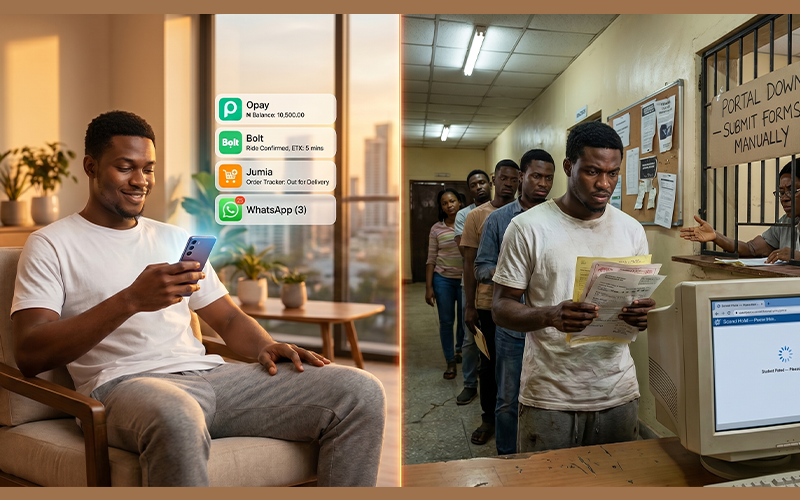
Think about the last time you struggled with a slow website and simply left. Students do the same with university portals. The generation now entering African universities grew up with Opay, Flutterwave, Jumia, Bolt, and Netflix. They do not experience digital tools as a privilege; they experience poor digital tools as a failure.
In 2024, 51% of Sub-Saharan Africans owned smartphones, a figure projected to reach 88% by 2030. These students are fluent in technology. When they encounter manual admission processes, unresponsive portals, and disconnected payment systems, their frustration is not with technology. It is with your institution’s failure to meet a standard that they already consider basic.
One question worth sitting with: would you accept this experience as a paying customer of any other service?
What a Digital Campus Actually Means
There is a common misunderstanding worth addressing directly. A digital campus university Africa model is not simply an institution that has adopted a learning management system. Installing an LMS or uploading lecture slides to a portal is not digital transformation; it is digitisation of a single layer, and nowhere near sufficient.
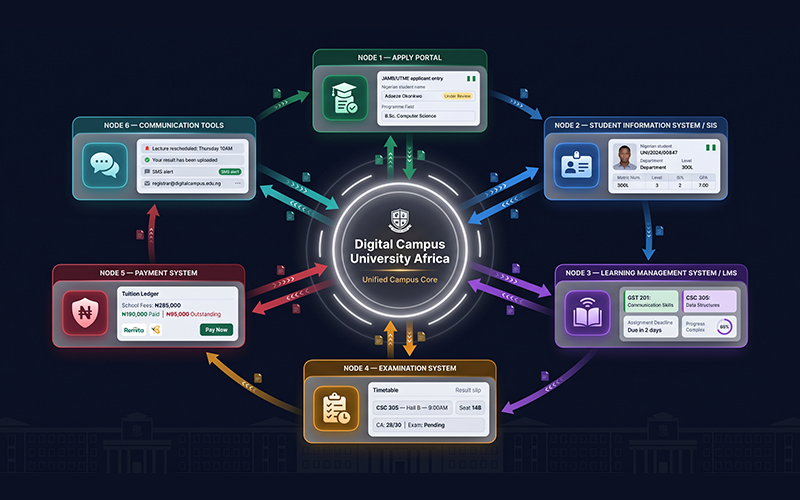
A true digital campus is a connected ecosystem where every system that touches the student lifecycle communicates with the others, shares data in real time, and removes friction at every stage. The full infrastructure includes:
- Application and admissions portal: where prospective students discover, apply, upload documents, and receive updates
- Student Information System (SIS): the central database managing student records, registrations, transcripts, and academic history
- Learning Management System (LMS): where courses are delivered, assignments submitted, and progress tracked
- Examination system: covering scheduling, proctoring, grading, and results release
- Payment infrastructure: for tuition, accommodation, and miscellaneous fees, with digital receipts and financial reporting
- Communication tools: messaging, announcements, and notifications across channels
- Content creation tools: enabling faculty to build rich, interactive course material
- Alumni management system: for career support, networking, and institutional fundraising
None of these systems is optional. And they must work together. A student who pays their fees should have access unlocked in the SIS automatically, which then activates their LMS enrolment. When systems are siloed or manual, every step becomes a bottleneck, a source of frustration, and a drain on institutional capacity.
The 4 Student Journeys That Must Be Fully Digital
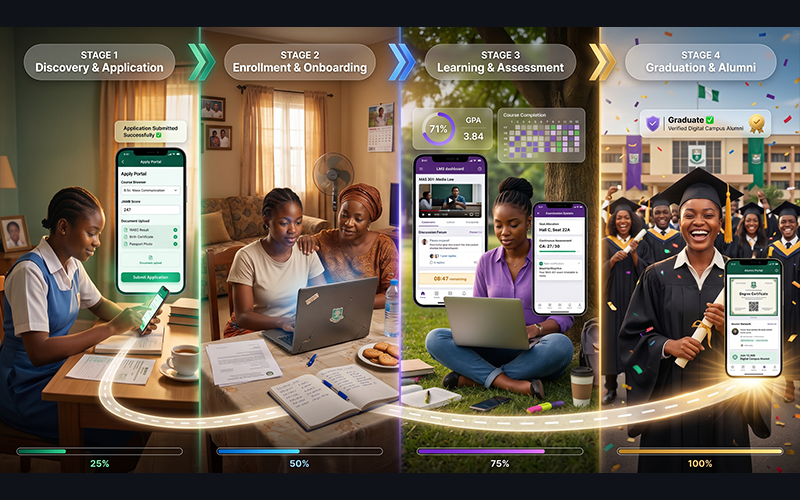
Understanding where the gaps are requires following the student’s experience from beginning to end.
1. Discovery and Application: A prospective student finds your institution online and decides to apply. If the process involves printing forms, visiting an office, or waiting weeks for a response, you have already lost students to competitors who offer instant, mobile-friendly applications. Every friction point here reduces conversion.
2. Enrolment and Onboarding: Once accepted, the student must submit documents, pay fees, select courses, and access their learning environment. Without integrated systems, this can take weeks across multiple offices. Students in 2025 expect it to happen in hours.
3. Learning and Assessment: This is where most institutions have invested the most, and still fall short. An LMS that crashes during exam week, assignments that won’t submit on mobile, or results that take months to appear are not minor inconveniences; they directly affect student outcomes and institutional reputation.
4. Graduation and Alumni Engagement: The student journey does not end at graduation. Digital certificate issuance, alumni networks, and career platforms all form part of a complete digital campus. Institutions that neglect this stage miss a significant long-term opportunity for both brand-building and fundraising.
What Happens to Institutions That Don’t Catch Up
The consequences of inaction are not abstract. In 2024, 71% of colleges and universities identified enrolment as a primary risk, and digital experience was consistently named as a factor in student choice. When two universities offer the same programme, students will choose the one with the better digital experience.
As of 2024, 75% of higher education institutions lacked a comprehensive digital strategy, meaning the institutions that move now will hold a meaningful competitive advantage. Beyond enrolment, poor digital infrastructure means faculty spend time on administration instead of teaching, data lives in inconsistent silos, and accreditation bodies increasingly demand evidence of digital governance. Students talk, too. In an age of reviews and social media, a reputation for broken portals spreads fast.
How Vigilearn Powers the Complete Digital Campus
Vigilearn has been built to address this challenge, and its architecture reflects a clear understanding that fragmented tools create fragmented experiences.
The platform maps directly onto the full student lifecycle:
- Apply handles digital admissions from inquiry to offer letter
- Enroli SIS manages all student records, registration, and academic data in one place
- Ediify LMS delivers courses, assignments, and learning content with a clean, mobile-responsive interface
- Examination Portal supports secure, scalable assessment from scheduling to results
- Studio enables content creation so faculty can build engaging course material without technical expertise
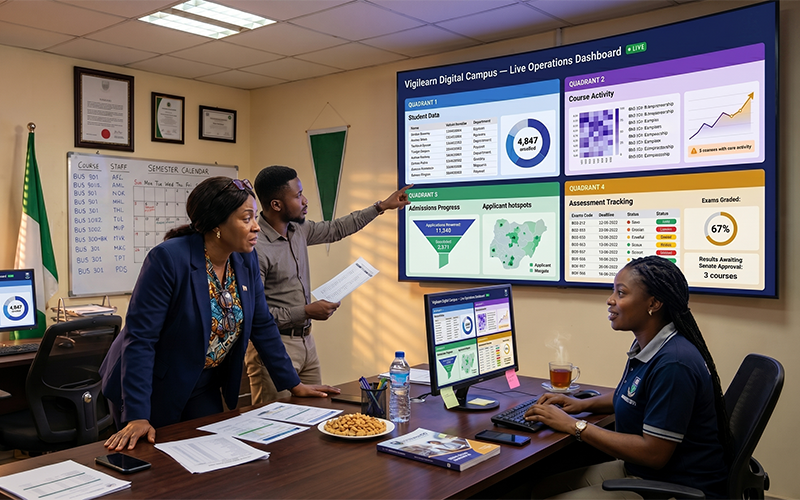
Crucially, these are not separate products that happen to share a brand. They are integrated components of a single platform, meaning data flows seamlessly between them. A student’s payment unlocks their access automatically. An academic decision in the SIS is reflected immediately in the LMS. This is what it means to build a genuine digital campus university Africa model: one system, one student record, one real-time picture of institutional operations. Explore the full suite at vigilearn.com/products.
Implementation: What Building a Digital Campus Looks Like
The most common reason institutions delay is fear of disruption. With Vigilearn, a typical rollout follows a structured 60 to 90-day process:
- System audit: Understanding current infrastructure and gaps
- Platform configuration: Setting up Vigilearn to match institutional workflows
- Data migration: Moving existing student and academic data securely
- Staff training: Equipping administrators and faculty to use the platform confidently
- Go-live: Launching with a defined cohort before full rollout
- Optimisation: Refining based on real usage data in the weeks that follow
This is a structured, supported transition, not a rip-and-replace exercise. It respects what already works while replacing what is holding the institution back.
Frequently Asked Questions
What is a digital campus in a university?
A digital campus is a fully integrated ecosystem covering admissions, student records, learning delivery, assessment, payments, and alumni engagement. It is not a single tool, but a connected infrastructure where all systems share data seamlessly.
Why do universities in Africa need digital infrastructure?
Africa’s tertiary enrolment is projected to double by 2030, and student expectations are set by digital-first consumer experiences. Without modern infrastructure, institutions cannot scale, retain students, or compete.
What systems are required for a digital campus?
At minimum: an admissions portal, Student Information System, Learning Management System, examination platform, payment gateway, and communication tools, all integrated rather than siloed.
How long does it take to build a digital campus?
With Vigilearn, most institutions are fully operational within 60 to 90 days, depending on existing system complexity and student population size.
Your Institution in 90 Days
Africa’s higher education sector is at an inflexion point. Between 2020 and 2040, the number of young Africans completing tertiary education is expected to double, from 103 million to 240 million. That is an extraordinary opportunity, but only for institutions ready to receive those students with the experience they already expect.
The digital campus university Africa conversation is not about chasing trends. It is about meeting a generation of students exactly where they are: online, on mobile, and unwilling to accept systems that waste their time.
Vigilearn helps your institution make this transition without disruption or fragmented tooling. Book a consultation today and let us show you what your institution could look like in 90 days. Explore the full platform or visit the Vigilearn blog for more on digital transformation in African higher education.