



Most admissions offices can tell you exactly how many enquiries they received last cycle. Fewer can tell you, with any precision, how many of those enquiries turned into completed applications, and fewer still can explain why the gap between the two is so wide. The instinctive response is to spend more on recruitment: more adverts, more fairs, more outreach to schools and agents. That instinct usually misses the actual problem.
Universities rarely have an application problem. They have a conversion problem. Enquiries arrive in healthy numbers, applications start, and then a portion of prospective students simply disappear somewhere between the enquiry form and the enrolment desk. In the United States, research from Harvard’s Strategic Data Project has found that 10 to 40 per cent of college-intending students who say they plan to enrol never actually turn up in the autumn, a pattern researchers call summer melt. The underlying cause in most cases is not a change of heart. It is friction: slow forms, unclear next steps, and silence at the moments when a prospective student most needs a response. Student enrolment automation exists to close that gap, and it is worth institutions treating it as a growth strategy rather than a back-office upgrade.
Read More: The University That Runs Itself: What Autonomous Campus Management Actually Looks Like
What Is Student Enrolment Automation?
Student enrolment automation is the use of connected software to manage a prospective student’s journey from first enquiry through to confirmed enrolment, automatically handling application forms, document collection, verification, communication and status updates so that staff can focus on decisions rather than data entry. It covers every stage of the pipeline: enquiry capture, application submission, document review, applicant communication, the admission decision itself, and final registration.
Crucially, automation does not remove human judgement from the process. Admissions officers still decide who is offered a place. What changes is everything around that decision: the acknowledgement that arrives the moment a form is submitted, the reminder sent when a document is missing, the notification the instant a decision is made. Admission automation system software, sometimes described as enrollment management software, handles the repetitive, time-sensitive parts of the journey so that staff time goes toward evaluating applicants, not chasing paperwork. Done well, it turns student admission management from a scramble of spreadsheets into a single, trackable process.
Where Universities Lose Students


Drop-off rarely happens because a student changes their mind about attending university. It happens because the process asks too much of them, too slowly, in too many places. Several patterns show up again and again in admissions data:
- Slow application forms that take too long to complete, or that time out and lose a student’s progress partway through.
- Manual follow-ups that depend on a staff member remembering to chase a missing transcript, rather than a system doing it automatically.
- Poor communication that leaves applicants unsure whether their application has even been received.
- Multiple disconnected systems for enquiries, applications and records, each requiring the same information to be entered again.
- No application tracking, which forces students to email or call the admissions office just to find out where they stand.
- Document confusion, where requirements are unclear, and files are rejected without explanation, adding cycles of resubmission.
Each of these points removes a little more confidence from a prospective student who has other options. A digital admissions platform exists precisely to close these gaps before they cost an institution an applicant it had already attracted.
What Student Enrolment Automation Looks Like
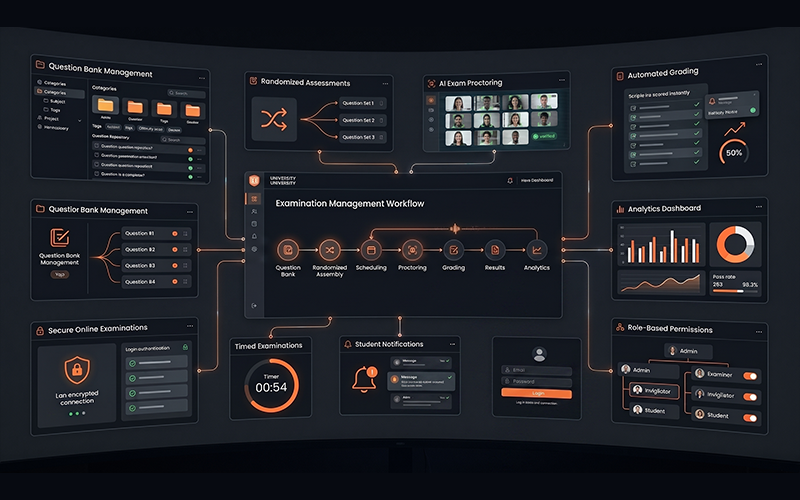
Walking through the journey end to end shows how much of it can move faster without losing rigour. A prospective student submits an enquiry, and the system captures it instantly rather than routing it through a shared inbox. An application record is created automatically, pre-filled with whatever the enquiry already told the institution. Documents are uploaded directly into the applicant’s file, with the system checking for completeness rather than a staff member doing so manually. Automated notifications keep the applicant informed at every step, from confirmation of receipt to a request for a missing item. The application then reaches an admissions officer for review, already organised and complete. Once a decision is made, the applicant is notified immediately, and on acceptance, registration begins inside the same connected record rather than a fresh set of forms.
None of these stages removes the institution’s control over who is admitted. What they remove is the delay between each step, which is where most applicants are lost.
Read More: The Digital Campus Is Not the Future. It’s What Your Students Are Already Expecting Today
Features That Actually Improve Enrolment
It is easy to list the features of an admissions platform. It is more useful to ask what each one is actually solving for. An online application portal reduces the effort required to start and finish an application, which matters because every additional field or page is a chance for a student to abandon the process. Workflow automation removes the manual handoffs between enquiry, review and decision that otherwise depend on someone remembering to act. Document verification checks submissions against requirements automatically, cutting the back-and-forth that comes from unclear or incomplete files.
Real-time status tracking gives applicants visibility into where they stand without needing to contact the admissions office, which reduces both their anxiety and the office’s inbox. Automated reminders re-engage applicants who have started but not finished a step, catching drop-off before it becomes permanent. Analytics dashboards show where in the funnel applicants are stalling, turning a guess about “low conversion” into a specific, fixable bottleneck. CRM integration ties all of this together, keeping a single record of every interaction a prospective student has had with the institution. A properly configured university CRM is one of the clearest examples of higher education automation paying off in practice. Gartner research has pointed to CRM as one of the technologies most directly aligned with enrolment and retention goals in higher education, precisely because it centralises information that would otherwise be scattered across separate systems.
Why Connected Systems Matter
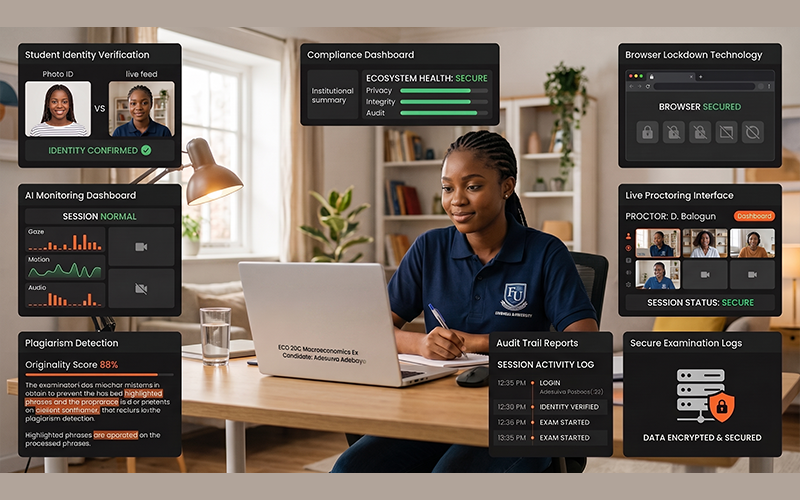
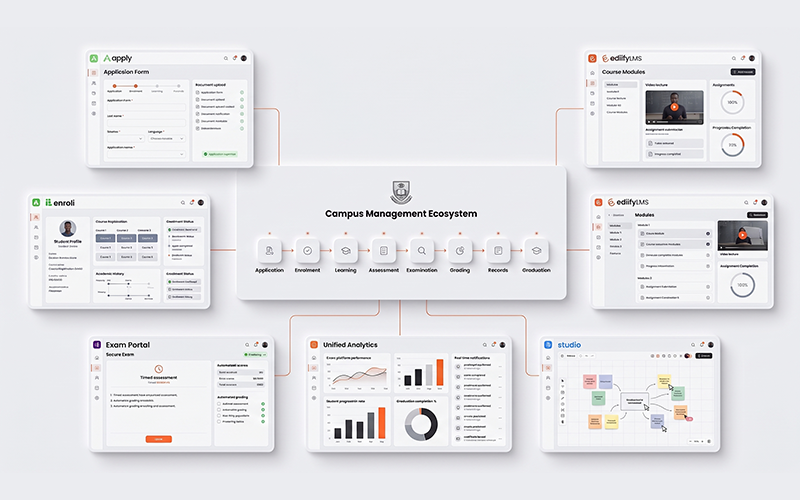
An admissions platform delivers far more value when it is not an island. Vigilearn’s Apply and Enroli SIS work together as a connected front and back end of the enrolment journey, with Apply managing enquiries and applications and Enroli SIS taking over enrolment, records and academic administration the moment a student is admitted. From there, the same record extends into Ediify LMS for teaching and Examination Portal for assessment, so a student’s identity and history follow them from first enquiry through to graduation rather than being rebuilt at every stage.
This matters because a disconnected system creates exactly the kind of friction that drives drop-off in the first place. Every time a student’s information has to be re-entered into a new platform, there is a chance of error, delay or duplication. A connected university enrollment software stack, built around genuine student lifecycle management, removes that risk by design, not as an afterthought bolted on once problems appear.
KPIs Every Admissions Team Should Track
Institutions that manage enrolment with data, rather than assumptions, tend to catch problems while they are still fixable. The metrics worth tracking consistently include:
- Application completion rate, which shows how many started applications are actually finished.
- Time to admission, from submission to decision, since delay is one of the clearest predictors of drop-off.
- Offer acceptance rate, which reveals whether admitted students are converting into enrolled ones.
- Conversion rate at each stage of the funnel, from enquiry to application to enrolment.
- Enrolment growth year on year, set against recruitment spend to judge real efficiency.
- Processing time for documents and decisions, a direct measure of administrative load.
- Student satisfaction with the application experience itself, often the earliest signal of a problem elsewhere.
A 2025 EDUCAUSE Review analysis of Gartner’s CIO survey data found that improving the student experience is now the outcome higher education leaders most commonly cite when justifying digital technology investment. Enrolment KPIs are where that ambition becomes measurable.
Read More: From 100 to 10,000 Students: How Vigilearn Scales with Your Institution
How Vigilearn Supports Student Enrolment Automation
Vigilearn’s approach to admissions centres on workflow automation that removes repetitive manual work from the enquiry-to-enrolment journey, alongside a better applicant experience built from fast, clear communication rather than silence between form submission and decision. Institutional visibility comes from analytics that show exactly where a funnel is losing applicants, rather than leaving admissions teams to guess. Reporting is built in rather than assembled after the fact, and the underlying platform is designed to scale from a single faculty intake to university-wide admissions without needing to be replaced as an institution grows.
The goal throughout is institutional growth, not a longer feature list. Apply, and Enroli SIS working together mean an institution can see, measure and improve every stage of the enrolment journey as one connected process, rather than as a series of separate administrative tasks.
Admissions shouldn’t end with collecting applications. They should guide every prospective student from enquiry to enrolment through a fast, connected and transparent experience. Book a Vigilearn demo to see how Apply and Enroli SIS help institutions automate admissions, improve conversion rates, and deliver a seamless enrolment journey. Explore more insights on the Vigilearn Blog.
Frequently Asked Questions
What is student enrolment automation? Student enrolment automation is the use of connected software to manage the full admissions journey, from enquiry to enrolment, automatically handling forms, document collection, verification and communication so staff can focus on decisions rather than paperwork.
How does admissions automation work? It works by connecting each stage of the applicant journey, so that an enquiry automatically creates an application record, documents are checked as they arrive, and applicants receive instant updates, rather than each step depending on manual follow-up.
Can automation reduce application drop-offs? Yes. Most drop-off comes from delay and uncertainty rather than a genuine change of mind. Automated reminders, instant confirmations and clear status tracking address exactly the friction points that cause applicants to disengage.
What software is used for university admissions? Universities typically use a combination of an admissions or CRM platform for enquiries and applications, alongside a student information system for enrolment and records, ideally connected so data does not need to be re-entered between them.
How does enrolment automation improve student experience? It replaces silence and uncertainty with clear, timely communication: instant confirmations, real-time status tracking, and prompt decisions, all of which reduce the anxiety that leads prospective students to disengage or choose another institution.
Can enrolment software integrate with LMS and SIS? Yes. A well-connected enrolment platform shares student data with the learning management system and student information system, so a student’s identity and history carry through from admission to enrolment, teaching and assessment.