


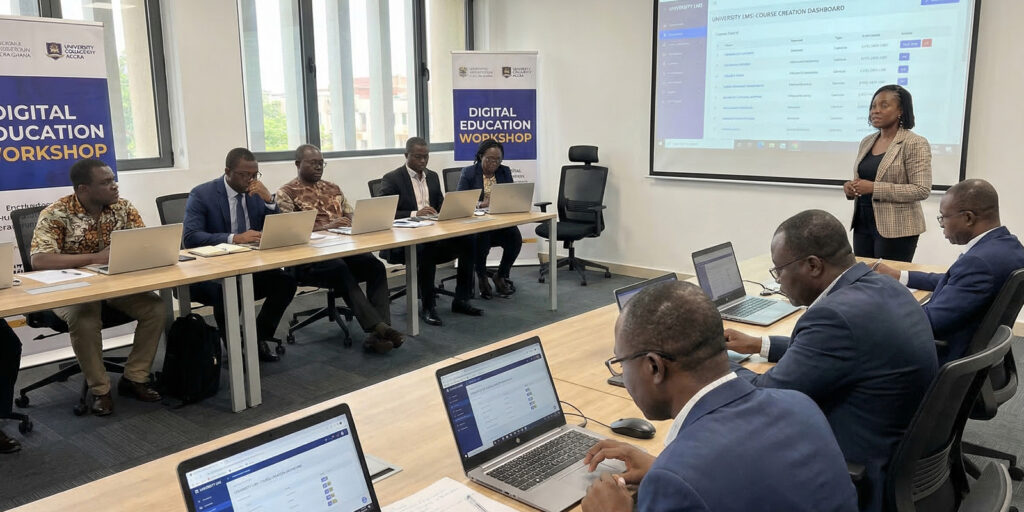
The shift to digital education has been one of the most significant transformations in the history of higher education. Yet amid all the investment in platforms, infrastructure, and digital content, one critical variable is frequently underserved: the faculty member sitting in front of a screen, trying to figure out how to make all of it work. Faculty training for online teaching is not a supplementary concern. It is the foundation upon which every digital learning initiative either stands or collapses.
The numbers make this clear. According to Bay View Analytics, 35% of faculty now teach across more than one modality, and the proportion teaching at least partly online has grown substantially since 2019. Yet institutional support has not always kept pace. Many educators were handed login credentials to a learning management system and expected to deliver compelling, student-centred digital experiences with minimal preparation. The result, across institutions worldwide, has been uneven course quality, frustrated instructors, and disengaged students. Structured, thoughtful faculty training for digital learning changes this equation entirely.
Read more: Learning Management System for Universities: What to Look For
Why Faculty Training for Online Teaching Matters


When universities expanded digital learning rapidly, particularly during the COVID-19 pandemic, most did so out of necessity rather than strategy. Courses moved online almost overnight. Faculty adapted as best they could, but adaptation is not the same as preparation. Research consistently shows that insufficient training in LMS platform usage is one of the primary barriers to effective digital instruction, alongside a lack of technical support and limited familiarity with online pedagogy.
What is often missed in institutional planning is that moving a course online is not simply a matter of recording lectures or uploading slides. Online teaching requires a different kind of thinking: about pacing, interaction design, assessment, accessibility, and the unique ways in which students engage in asynchronous environments. Without structured online teaching training programmes, even experienced, accomplished lecturers can find themselves ill-equipped for the digital classroom. Institutions that understand this invest in faculty training for online teaching as a core part of their digital strategy, not an afterthought.
Challenges Faculty Face When Adopting Digital Learning Platforms

It is worth being honest about what adopting a new LMS actually feels like from a faculty perspective. The learning curve is real, and the stakes are high. Instructors who have spent years developing their craft in physical classrooms must now navigate unfamiliar interfaces, rethink how they present content, and manage student communication across digital channels, often without meaningful support.
The most commonly reported challenges include:
- Navigating LMS interfaces: Course displays, grading workflows, and communication tools vary significantly across platforms. Faculty accustomed to one system can find a new LMS disorienting, even when the underlying logic is similar.
- Adapting materials for digital delivery: A well-structured lecture does not automatically translate into an effective online module. Content must be restructured for asynchronous learners, which requires skills many instructors have never been taught.
- Maintaining student engagement: In virtual classrooms, the natural feedback loops of in-person teaching disappear. Instructors must work harder and more deliberately to gauge student understanding and sustain participation.
- Time pressure: A study on faculty professional development in technology-mediated environments found that most lecturers identify time as their single greatest barrier to adopting new digital tools. Training that ignores this reality will not succeed.
These are not trivial inconveniences. They directly affect teaching quality, student outcomes, and the credibility of an institution’s digital offering.
Read more: How Data Analytics in LMS Platforms Boost Learner Success Rates
Skills Faculty Need for Effective Online Teaching
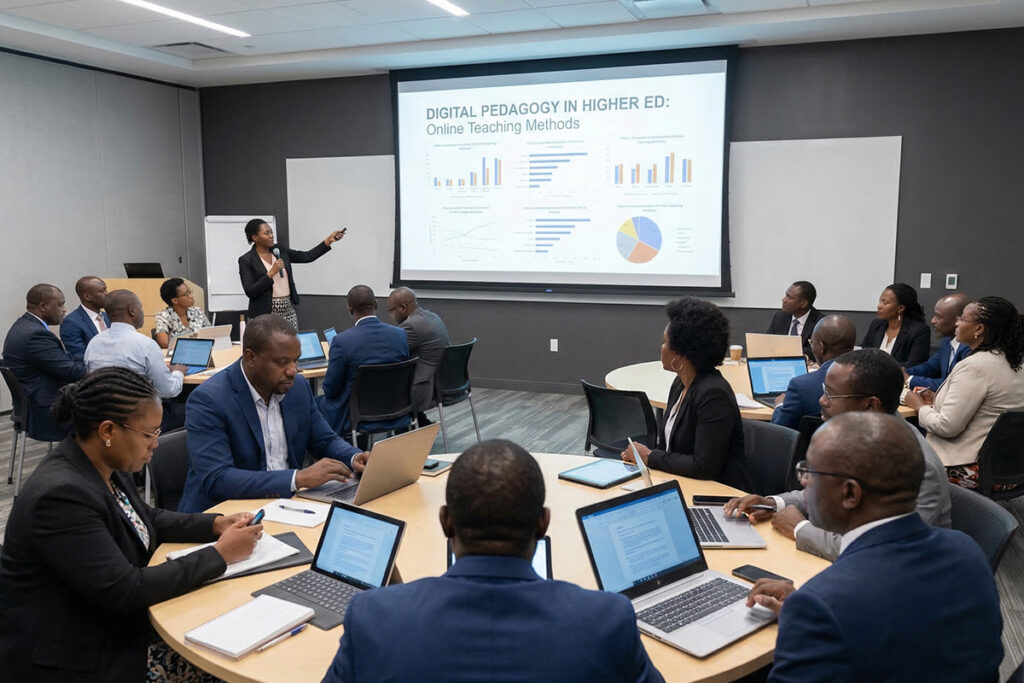
Instructor training for LMS platforms must go beyond button-clicking and interface orientation. The skills required for effective online instruction span both the technical and the pedagogical, and institutions need to develop both deliberately.
Key competencies include:
- Instructional design for online learning: Understanding how to structure content into digestible, logically sequenced modules that guide learners through material without the aid of real-time instruction.
- Facilitating asynchronous discussion: Creating discussion prompts that generate genuine critical thinking, and knowing how to respond in ways that sustain conversation rather than close it down.
- Creating multimedia learning materials: Video, audio, annotated readings, and interactive assessments all serve different learning styles. Faculty need the skills and tools to build varied content without excessive technical burden.
- Digital assessment design: Evaluating learning online requires rethinking traditional exams. Formative assessments, rubric-based grading tools, and peer review mechanisms are all valuable, and all require intentional training.
Edutopia has long documented how these skills, when developed and supported, lead to measurably better learning outcomes. The relationship is not theoretical. Trained instructors design better courses, and better courses produce more engaged, higher-performing students.
How Universities Can Design Faculty Training Programmes
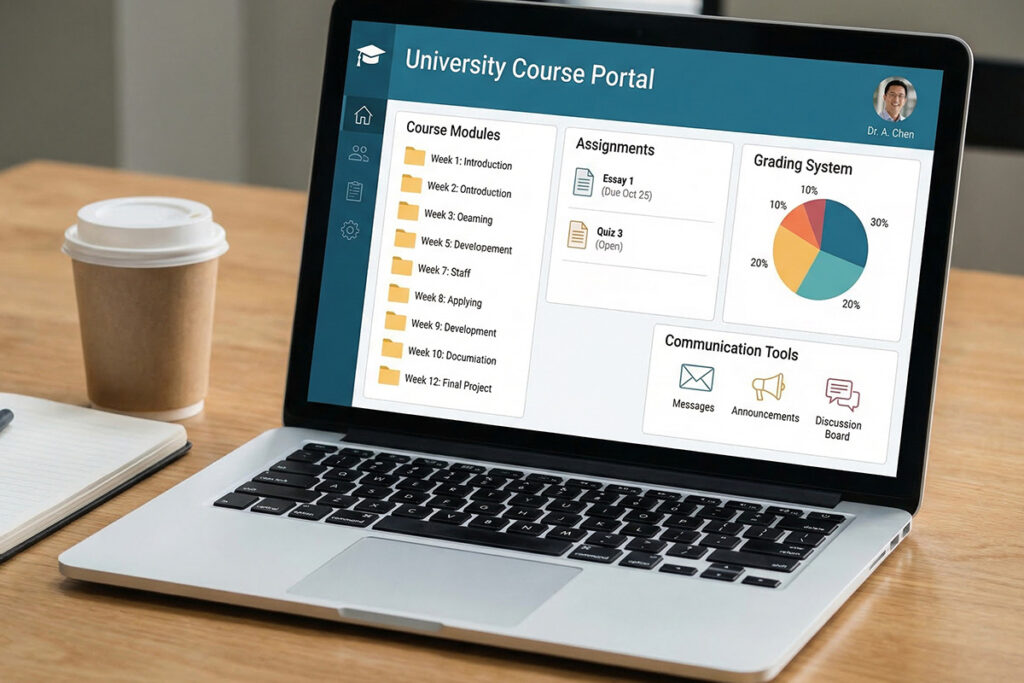
Effective online teaching training programmes do not happen by accident. They require institutional commitment, dedicated resources, and a clear understanding of what faculty actually need. The most successful programmes tend to share a few structural features.
Structured onboarding for new instructors is the logical starting point. Any faculty member tasked with teaching an online or hybrid course should complete a baseline orientation that covers both platform mechanics and fundamental principles of digital pedagogy before their course begins.
LMS training workshops should be practical and hands-on, focused on the specific platform the institution uses, rather than digital teaching in the abstract. Short, task-based sessions, such as “how to build an assignment workflow” or “how to set up a gradebook,” are often more effective than comprehensive overviews delivered in a single sitting.
Digital pedagogy courses go deeper, addressing the theoretical and practical dimensions of online course design. These may be delivered over several weeks and can include peer collaboration, where faculty review and critique each other’s course structures.
Continuous professional development is what separates institutions with strong digital cultures from those where online teaching remains peripheral. EDUCAUSE research consistently finds that ongoing, community-based professional learning is far more effective than one-off training events. Webinars, faculty learning communities, and annual digital teaching reviews all contribute to sustained growth.
The Role of Learning Platforms in Faculty Training for Digital Learning

It would be a mistake to think of the LMS solely as a delivery mechanism for student courses. Well-designed digital platforms are also powerful instruments for instructor development. The right platform reduces friction dramatically, allowing faculty to concentrate on pedagogy rather than troubleshooting.
Platforms that support effective instructor training for LMS use tend to offer:
- Centralised course management: A single, intuitive dashboard where faculty can build, update, and monitor courses without toggling between multiple systems.
- Integrated content creation tools: Built-in editors, media upload tools, and assessment builders that do not require separate software.
- Streamlined assignment and grading workflows: Clear, consistent processes for receiving submissions, applying rubrics, and returning feedback efficiently.
- Communication tools: Announcement functions, messaging, and discussion boards that keep faculty connected to students without fragmenting communication across platforms.
When platforms are genuinely intuitive, faculty adoption accelerates. When they are not, even the best training programmes face unnecessary resistance.
Benefits of Strong Faculty Training for Institutions
The institutional case for investment in faculty training for online teaching is compelling. The returns are visible across multiple dimensions of performance.
Institutions that commit to structured online teaching training programmes report improved course delivery consistency, where students experience a more coherent, reliable learning journey regardless of which instructor they are assigned. Student engagement improves when instructors know how to use digital tools purposefully rather than tentatively. According to EDUCAUSE research, 74% of faculty agree that the LMS is critical to their teaching, and 87% of students wish their instructors used the LMS more actively. These figures point to an alignment problem that training directly addresses.
Beyond the classroom, well-trained faculty are more confident adopters of new digital tools, making future platform transitions and technology upgrades considerably smoother. Institutions also protect their reputations. In an increasingly competitive higher education landscape, the quality of online course delivery is becoming a differentiator that prospective students and accreditation bodies take seriously.
How Vigilearn Supports Faculty Adoption of Digital Learning Platforms
Vigilearn Technologies provides institutions and their faculty with tools that make the transition to digital teaching genuinely manageable, rather than overwhelming.
For instructors, Vigilearn offers an intuitive LMS interface that reduces the technical burden of getting started. Course creation tools allow faculty to build and organise content without requiring specialist technical knowledge, while integrated communication features keep the connection between instructors and students consistent and structured. Analytics capabilities give faculty visibility into how students are engaging with their courses, enabling timely intervention rather than end-of-semester regret.
Crucially, Vigilearn is built to support not just course delivery but institutional digital strategy. When faculty have access to a platform that works with their teaching practice rather than against it, the training investment made by universities yields faster, more durable results. Faculty training for digital learning and the right platform are not separate interventions; they work best together.
For institutions ready to build a stronger digital learning culture, exploring what a purpose-built LMS can do is a practical and important step. You can learn more on the Vigilearn blog.