

Most business leaders will tell you, without hesitation, that their people are their greatest asset. Far fewer can tell you, with any precision, what their organisation is doing to develop those people week by week. The gap between intention and infrastructure is wide, and for many organisations it is widening. Workforce skills are evolving faster than most training programmes can keep pace with, compliance requirements are growing in complexity, and the cost of getting employee development wrong, measured in turnover, productivity loss, and disengagement, is higher than most budget conversations acknowledge.
HR training software sits at the centre of any credible response to these pressures. In simple terms, it is a digital platform that enables organisations to design, assign, track, and evaluate employee learning at scale, replacing ad-hoc workshops and manual spreadsheets with a structured, data-driven system. But the organisations extracting real value from these platforms understand that it is not merely an administrative tool. Used well, HR training software is the operational foundation of a learning culture, and according to the LinkedIn 2024 Workplace Learning Report, 90% of organisations are concerned about employee retention, and providing learning opportunities is the number one retention strategy they are deploying. That is not a coincidence. It is a signal about where competitive advantage is being built.
Read more: Employee Training Software: What HR Teams Should Look For
Why the Stakes Around Employee Learning Have Never Been Higher


Before examining what good HR training software looks like, it is worth understanding the full weight of getting employee development wrong. Turnover is the most measurable consequence. According to both SHRM and Gallup, the cost of replacing an individual employee can range from 50% to 200% of their annual salary, depending on role and seniority.
What makes this particularly pressing is that much of the turnover driving these costs is preventable, and learning investment is one of the most reliable levers. 94% of employees say they would stay at a company longer if it invested in their career development. Furthermore, companies with a strong learning culture see a 57% employee retention rate, compared to just 27% in organisations with a moderate learning culture. The investment case is not complicated. The execution, without the right infrastructure, often is.
Why Manual Training Processes Cannot Scale
Many organisations recognise the value of structured employee development in principle, yet continue to manage it through processes designed for a small, static workforce. The results are predictable.
When training records live across inboxes, shared drives, and disconnected spreadsheets, there is no single source of truth. Compliance gaps go undetected until an audit surfaces them. Managers have no visibility into who is behind on mandatory certifications. New joiners receive an inconsistent onboarding experience depending on who is available to induct them. And when senior leadership asks what return the business is getting from its training budget, the honest answer is almost always: we do not have the data to know.
In 2024, US-based organisations spent an average of $1,254 per participant on employee learning, a substantial investment by any measure. Pouring that investment through a broken delivery and tracking system is not a training strategy; it is managed waste. The shift to dedicated workforce training systems is not a luxury for large enterprises; it is the minimum infrastructure for any organisation serious about developing its people consistently and demonstrating that the investment is working.
Key Features of Modern Employee Training Software

Evaluating employee training software effectively means looking beyond the feature list and asking a more pointed question: Does this platform support the full learning lifecycle, from initial assignment to outcome measurement? Decision-makers should look for the following as a baseline:
- Role-based learning pathways: Automated content assignment based on job function, department, or seniority level, ensuring that every employee receives training relevant to their current role from day one.
- Course creation and content management: The ability to build, upload, and update training materials in multiple formats, including video, assessments, and interactive modules, without depending on technical support for routine changes.
- Compliance and certification tracking: Automated expiry alerts, mandatory module assignments, and audit-ready records that remove regulatory management from the HR team’s daily to-do list.
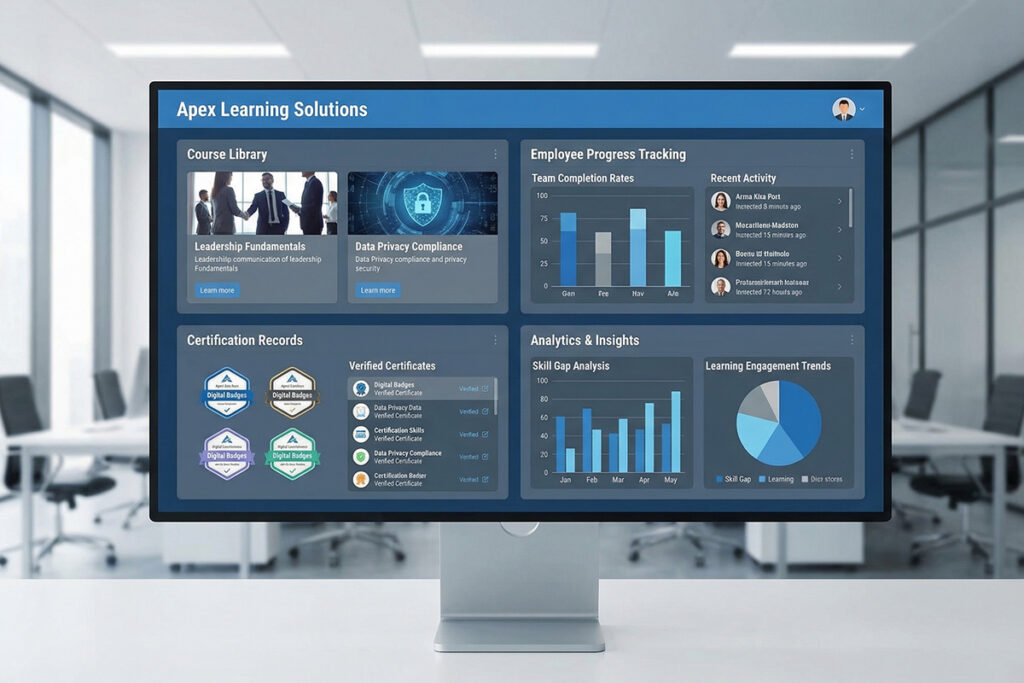
- Progress dashboards: Real-time visibility into completion rates, time-on-task, and assessment scores, accessible to both HR teams and line managers without requiring bespoke reports.
- Reporting and analytics: The ability to connect training activity to business outcomes, answering the question that every leadership team eventually asks: What measurable difference is this making?
These capabilities transform HR training software from a content library into a genuine workforce intelligence infrastructure.
Read more: The ROI of Investing in Employee Training Through an LMS
The Organisational Benefits That Go Beyond the L&D Function
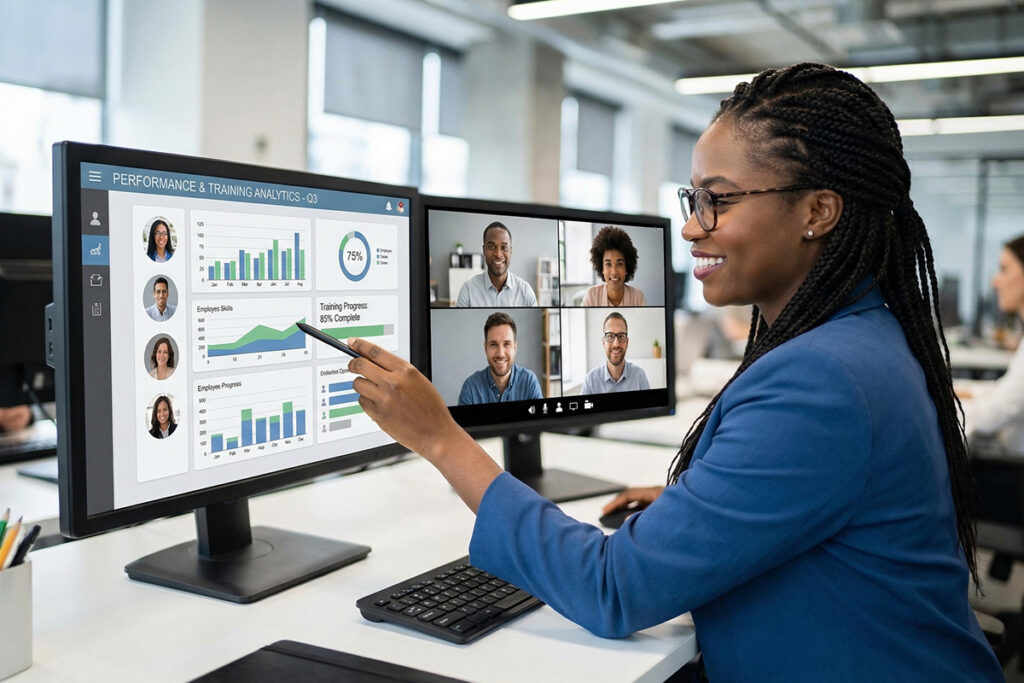
A well-implemented corporate learning platform reshapes operations across the business, not just within the HR team. The benefits deserve to be understood in concrete, functional terms.
Onboarding consistency at scale. One of the most costly inconsistencies in growing organisations is that the quality of the onboarding experience varies dramatically depending on the manager, the team, or the month in which someone joins. A digital platform removes that variability. SHRM research indicates that 90% of employees decide whether to remain with a company within their first six months. Getting onboarding right, every time, is not a nice-to-have; it is a retention intervention from day one.
Scalability without proportional cost. The marginal cost of adding a new learner to a digital training programme is negligible compared to replicating an instructor-led session. As an organisation grows from 50 employees to 500, the infrastructure of a corporate learning platform scales cleanly, without an equivalent increase in administrative overhead or per-head training cost.
Compliance as a managed process, not a fire drill. In regulated sectors, the ability to demonstrate that every relevant employee has completed mandatory training is a legal obligation. Automated tracking and instant reporting turn what was once a quarterly scramble into a continuous, low-effort compliance posture.
Visible, equitable development. When career development programmes are informal and undocumented, access to them is inevitably uneven, favouring those with the most visible relationships with senior leaders. A platform makes development structured, transparent, and consistently available to everyone, which matters especially for distributed and hybrid workforces.
Connecting the Corporate Learning Platform to Your Wider HR Ecosystem


The practical power of HR training software multiplies significantly when it operates as part of a connected HR ecosystem rather than as a standalone tool. Integration between a Learning Management System (LMS) and a Human Resource Information System (HRIS) is where administrative efficiency and strategic insight converge.
An integrated HRIS and LMS centralises HR and training operations in a unified platform, automating and tracking employee training progress while ensuring all employee information, training records, and other data are updated and accurate. In practice, this means that when a new employee joins an organisation, their details automatically populate in the LMS, enabling instant access to onboarding courses without manual intervention. Changes in employee status, such as promotions, transfers, or terminations, are reflected instantly across both systems, ensuring training assignments and HR records remain accurate.
The integrated system can automatically assign and track mandatory training based on an employee’s role, location, or other relevant factors, ensuring that all employees receive necessary compliance training and providing a centralised repository of training records that can easily generate comprehensive reports in the event of an audit. This level of automation does not just reduce administrative burden; it fundamentally changes what HR teams can do with their time, shifting focus from data management to strategic people development.
Measuring Whether Your Training Investment Is Actually Working

Investment without measurement is hope dressed up as strategy. One of the most significant capability gaps in corporate learning is the failure to connect training activity to outcome data. Completion rates are the most commonly tracked metric, and also among the least meaningful in isolation.
The metrics that actually tell a useful story include:
- Pre- and post-assessment performance: Quantifying knowledge gained within specific programmes, which also tells instructional designers where content is working and where it is not.
- Skill progression over time: Tracking whether capability in specific areas improves across successive learning cycles, not just within a single module.
- Performance review correlation: Cross-referencing training completion data with manager-rated performance scores over time to identify which programmes have the highest development impact.
- Retention by training engagement: Performance reviews (36%), employee productivity (34%), and employee retention (31%) are the top three metrics that L&D professionals use to track the business impact of training, which reflects a growing maturity in how organisations are approaching the question of training ROI.
Organisations that build measurement frameworks into their training design from the outset, rather than retrofitting them after launch, consistently derive more value from their investment and communicate that value more credibly to leadership.
How Vigilearn’s EdiifyLMS Supports Corporate Training
For organisations building or upgrading their employee development infrastructure, Vigilearn‘s EdiifyLMS for Corporates is purpose-built for the challenges described in this article. The platform provides centralised training management with the flexibility to meet organisations at different stages of their learning maturity, whether they are launching their first structured programme or seeking to integrate advanced analytics into an existing strategy.
Scalable training delivery ensures that content can be assigned, monitored, and updated across large and distributed workforces without proportional increases in administrative effort. Real-time reporting dashboards translate learning activity into actionable insight, giving HR leaders, line managers, and business owners the visibility needed to manage development as a strategic priority rather than a compliance exercise.