



There is a telling contradiction at the heart of higher education technology. Virtually every university has an LMS. According to EDUCAUSE, estimates of institutions running a learning management system consistently sit near 99 percent. Yet having a platform and genuinely using it are two very different things. Across campuses, LMS portals sit underused, faculty members log in only to upload a syllabus, and students complain that one lecturer’s course bears no resemblance in structure or quality to another’s. The investment is made. The adoption is not.
Understanding why is not as simple as blaming technology or budget. The LMS adoption challenges universities face are human, cultural, structural, and strategic all at once. As the global LMS market races toward $70.83 billion by 2030, the gap between what institutions pay for and what they actually use becomes harder to justify. This article examines the real barriers standing between universities and meaningful learning management system adoption, and offers practical direction for closing that gap.
Read more: Choosing the Right LMS for Your Institution
LMS Adoption Challenges: Why Implementation Is Only Half the Battle


Purchasing and installing an LMS is not the same as embedding digital learning into an institution’s culture. Research consistently shows that many universities deploy platforms without adequately addressing the human and organisational conditions that make adoption possible. A thematic literature review on barriers to LMS adoption found that successful LMS integration depends not just on technical provision but on institutional commitment, digital literacy, training support, and inclusive strategies. Without these foundations, even the most capable platform stalls.
The barriers cluster into recognisable patterns: faculty resistance, poor user experience, weak institutional strategy, integration failures, and inadequate infrastructure. Each is significant on its own. Together, they explain why so many universities experience LMS implementation issues years into what should have been a completed transition.
The Faculty Adoption Problem
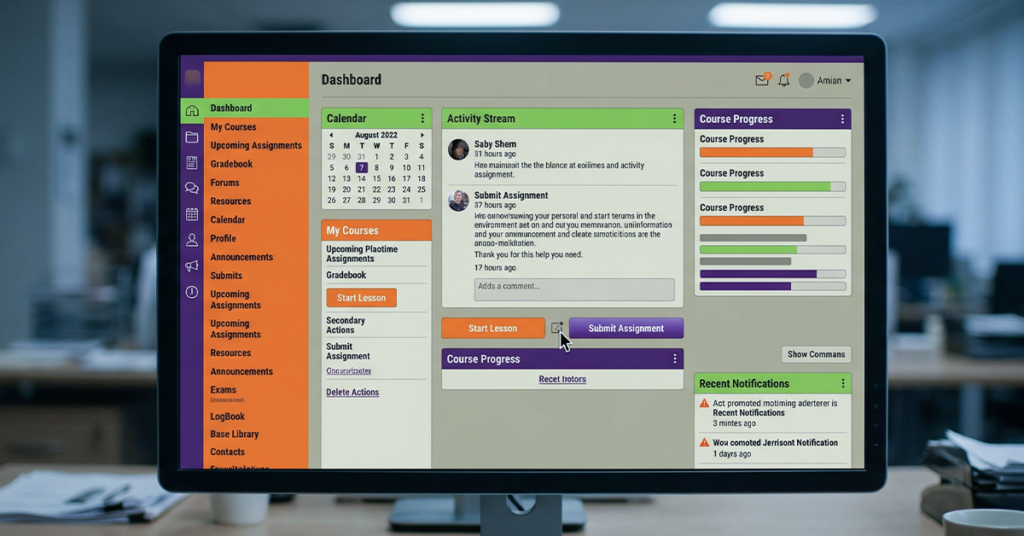
Faculty are the engine of any LMS. Without their active engagement, no amount of institutional messaging or student orientation will generate genuine digital learning. Yet resistance among teaching staff remains one of the most persistent LMS adoption challenges in higher education.
EDUCAUSE documented this directly: at many institutions, faculty resist LMS use because of a lack of technology skills, resistance to change, and concerns about academic freedom. Some instructors use the platform in the most minimal way possible, treating it as a file storage system rather than a dynamic teaching environment. The more advanced features, such as interactive assessments, discussion tools, and learning analytics, go almost entirely untouched.
This goes deeper than a preference for chalk-and-talk. Research on faculty LMS attitudes identifies three dimensions at play: functional concerns about whether the system helps teaching, individualistic anxieties about workload and confidence, and institutional factors such as whether leaders support and model the transition. EDUCAUSE is clear that faculty development must be ongoing and responsive, including one-to-one support and just-in-time training, not a single onboarding session ticked off the checklist.
Poor Platform Design and Digital Learning Challenges

Even willing faculty and motivated students will disengage if the platform itself is difficult to use. Complex navigation, inconsistent design, and counter-intuitive workflows create friction that accumulates quickly. When a lecturer cannot easily build a quiz or a student cannot locate last week’s materials without clicking through six menus, the LMS becomes an obstacle rather than an asset.
This is one of the more underappreciated digital learning challenges in higher education. Documented global studies identify system usability issues as a core barrier to LMS adoption among students, alongside low self-efficacy and insufficient motivation. Poor UX compounds all of these: when a platform feels opaque, users assume the problem is with them, confidence drops, and engagement follows. Institutions that select platforms based on cost or vendor familiarity rather than user experience evaluations often pay for that decision in adoption rates for years afterwards.
Read more: How Data Analytics in LMS Platforms Boost Learner Success Rates
LMS Adoption Challenges Rooted in Institutional Strategy (or the Lack of It)


Many universities launch an LMS without defining what success looks like. There is no measurable goal, no phased rollout plan, no leadership accountability, and no mechanism for tracking whether the investment is delivering value. The platform arrives, a few enthusiastic early adopters make the most of it, and everyone else waits to see what is required of them. Nothing formal is ever required. Adoption plateaus.
EDUCAUSE’s digital learning strategy framework describes a digital learning strategy as “a defined plan of technological systems, workforce development, and cultural changes” that must align with institutional mission. Without this, LMS implementation issues multiply because no one is accountable for resolving them. Strategy is not a luxury in learning management system adoption; it is the prerequisite.
Integration Failures and the Data Silo Effect
An LMS that does not communicate with an institution’s student information system or financial platform creates immediate operational problems. Enrolment data must be manually re-entered in multiple systems. Attendance captured in the LMS does not flow to the student record. Grade data sits in two places and sometimes disagrees. Research on LMS integration confirms that 52 percent of users cite the inability to integrate LMS platforms with other systems as a significant issue. When the LMS makes administrative work harder rather than easier, the motivation to use it more deeply evaporates.
LMS Adoption Challenges Driven by Infrastructure and Technical Support
In many institutions, particularly across sub-Saharan Africa and parts of Asia, the barriers to learning management system adoption are structural rather than cultural. Unreliable connectivity, insufficient device access among students, and inadequate server infrastructure mean that even a well-chosen LMS delivers a frustrating experience. The World Economic Forum has highlighted how the growing digital skills gap, combined with uneven infrastructure, means that the benefits of digital learning are not reaching institutions equally. When faculty and students cannot get timely help when something goes wrong, they stop trying to make it work at all.
How Universities Can Overcome LMS Adoption Challenges
The good news is that each of these barriers has a practical response. Universities that achieve genuine learning management system adoption tend to share these characteristics:
- Structured, ongoing faculty development: Training that is contextual, peer-supported, and built into teaching schedules rather than delivered as a one-time event.
- Intentional platform selection: Choosing an LMS based on user experience testing and pedagogical fit, not only cost.
- A documented digital learning strategy: Clear goals, phased implementation, leadership alignment, and defined metrics for measuring adoption progress.
- System integration from day one: Ensuring the LMS connects to the SIS and other institutional systems before launch, eliminating data duplication from the start.
- Responsive technical infrastructure: Cloud-based platforms, mobile accessibility, and a visible IT support function that faculty and students trust.
None of this is complicated in concept. The difficulty is sustaining the commitment to follow through on all of them simultaneously, which is why institutional leadership is the single most decisive variable in whether learning management system adoption succeeds or stalls.
How Vigilearn Addresses These Barriers
Vigilearn’s Ediify LMS platform was built with these LMS adoption challenges in mind. It is designed for intuitive use, reducing the friction that turns resistant faculty into non-adopters and frustrated students into disengaged ones. The interface is clean, navigation is deliberate, and the learning experience is structured around what educators and learners actually need rather than what a committee once decided to configure.
Beyond the platform itself, Vigilearn supports institutions through onboarding and training designed to meet faculty where they are. The infrastructure is cloud-based and scalable, built for the realities of higher education in high-growth, connectivity-variable markets. Ediify integrates with Vigilearn’s broader academic suite, including the Enroli SIS and the Examination Portal, addressing the integration failures that undermine so many standalone LMS deployments.
Explore more on the Vigilearn blog or request a free trial to see how the platform performs in practice.