


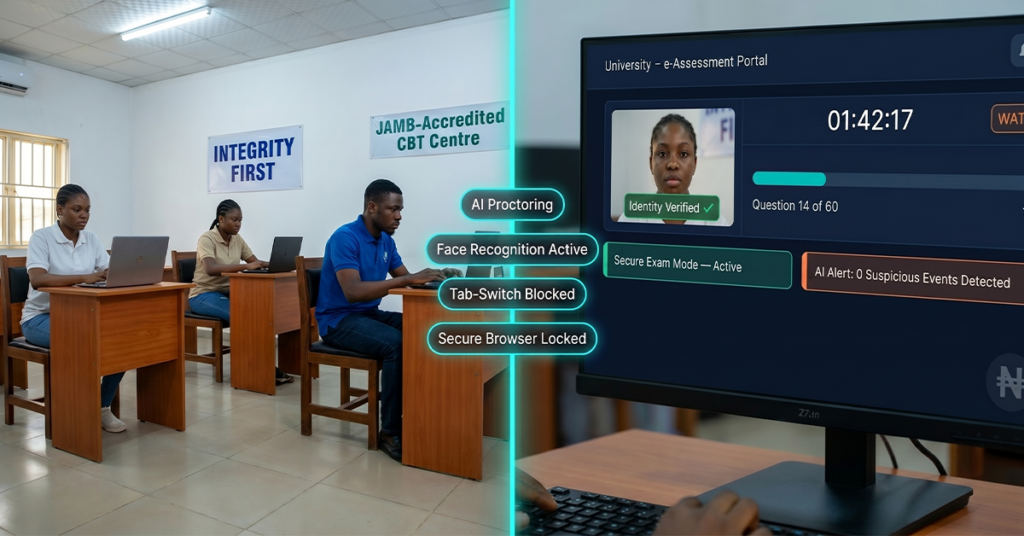
As African universities prepare to expand their online programmes to meet the demands of a growing student population, projected to surge by 64 million tertiary-aged individuals by 2034, the infrastructures supporting many of these institutions’ academic integrity have not kept pace. While some classrooms have gone digital, the examination halls, in many cases, have not. And that gap is where institutional credibility is quietly eroding.
But the scale of the opportunity is undeniable: Africa’s e-learning market reached USD 3.4 billion in 2024 and is forecast to nearly double by 2033. Over 60% of universities on the continent now offer online programmes. But expanding digital access without building equally robust online examination security creates a serious institutional liability. A degree that cannot be trusted is ultimately a degree that cannot be sold to employers, to regulators, or to future students.
Read More: Online Exam Management Systems for Universities in 2026
The Academic Integrity Problem Is Bigger Than Most Universities Realise

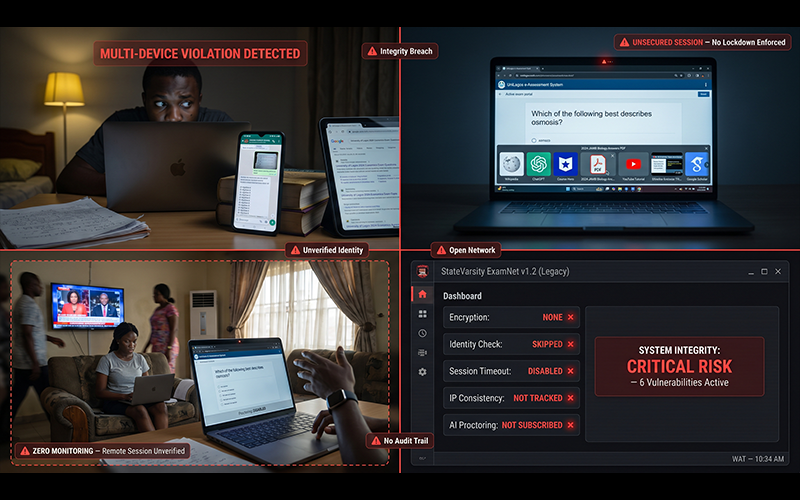
When a university moves its examinations online without the right controls, it does not simply introduce inconvenience. It opens the door to systemic academic dishonesty at a scale that would have been logistically impossible in a physical hall. A single student can share a question paper with a WhatsApp group in seconds. A proxy test-taker can sit an exam from a different city. An entire cohort can coordinate answers in real time.
Research published in the Second Handbook of Academic Integrity (Springer, 2024) documents the persistent challenges associated with examination malpractice across African universities, noting that the shift to online learning has intensified existing vulnerabilities rather than resolved them. During the COVID-19 period, one South African distance education university saw disciplinary cases spike dramatically: 68% of all cases over five years occurred in a single examination period in 2020, when online assessments replaced physical ones without adequate security controls. That is not an anomaly. It is a preview of what happens when digital assessments outpace digital integrity systems.
The consequences extend well beyond internal disciplinary processes. Employers lose confidence in graduate credentials. Accreditation bodies raise questions about assessment validity. International partners grow reluctant to recognise qualifications. And once institutional credibility is damaged, it takes years to rebuild.
The central question universities must confront is this: can you scale online learning without simultaneously scaling your academic integrity infrastructure? The answer, based on the evidence, is no.
The Specific Vulnerabilities in Most Online Examination Systems
Online examination security for universities in Africa is not simply a matter of putting existing papers on a digital platform. That approach may feel like modernisation, but it often creates more exposure than a traditional supervised exam. The critical weaknesses fall into four categories.
- Weak identity verification
Without biometric or multi-factor authentication, there is no reliable way to confirm that the person sitting an online exam is the enrolled student. Credential sharing and proxy test-taking are not hypothetical risks; they are documented patterns, particularly under assessment pressure.
- No live behavioural monitoring
Research from EDUCAUSE highlights that the most effective online proctoring models combine AI monitoring with human oversight to detect and prevent dishonest behaviour in real time. Without any monitoring layer, exam conditions are entirely unverified.
- Predictable question structures
When assessments reuse the same question sets and sequences across cohorts, students have both the motive and the means to share answers. Repeated patterns accelerate academic dishonesty at scale.
- Browser and device vulnerabilities
An unsecured exam environment allows students to switch browser tabs, search for answers, use secondary devices, or communicate externally during an assessment. These are not edge cases — they are easily exploited without lockdown controls.
- Weak audit trails
Many institutions cannot produce examination logs, attendance records, or integrity reports that would satisfy an accreditation review. The absence of documentation is itself a compliance problem.
A critical misconception also needs to be addressed: many institutions assume that because their assessments are delivered digitally, they are therefore secure. Digital delivery and digital security are not the same thing. In fact, an online exam without controls is routinely less secure than a supervised paper-based one.
Read More: Assessment Management System in Universities: Streamlining Exams and Evaluation
What Institutional-Grade Online Examination Security Actually Requires

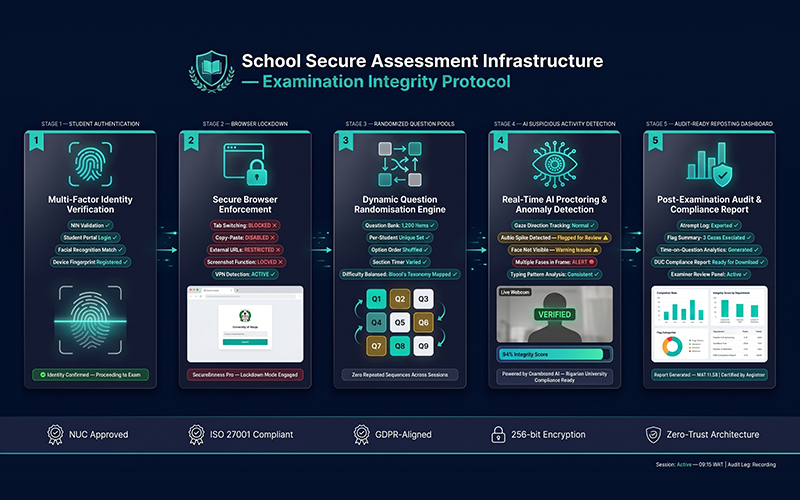
Genuine online examination security for universities in Africa requires a layered approach, not a single tool. Each layer addresses a specific vulnerability, and together they form a defensible assessment environment.
- Identity verification: Student authentication before and during assessments, using institutional credentials or multi-factor methods, to confirm that the right person is sitting the exam.
- Browser lockdown: Restricted exam environments that prevent tab switching, external browsing, screen sharing, and access to unauthorised applications during assessment windows.
- Randomised assessments: Question pools, time-randomised delivery, and dynamic sequencing that make it impractical to share questions or answers across sessions.
- Automated suspicious activity detection: AI-driven flagging of unusual behavioural patterns, session interruptions, and activity anomalies, with logs available for institutional review.
- Audit and accreditation reporting: Comprehensive exam logs, attendance records, and integrity reports that institutions can produce on demand for quality assurance reviews.
The key message here is architectural: academic integrity requires layered security, not a bolt-on solution. Institutions that approach this as a technology procurement decision rather than an institutional design decision will continue to be exposed.
Security Without Destroying the Student Experience
There is a legitimate tension at the heart of online examination security that institutions must manage thoughtfully. Overly restrictive systems frustrate students, overload technical support teams, and can create the very disruptions they are designed to prevent. A student who cannot load a locked browser, whose webcam fails at login, or who is flagged for innocent behaviour is not being assessed fairly, and the institution carries that liability too.
Effective examination systems balance rigour with accessibility. That means intuitive interfaces that do not require extensive technical training, mobile compatibility for students in bandwidth-constrained environments, clear examination workflows that reduce pre-assessment anxiety, and low-bandwidth optimisation for institutions operating in variable connectivity conditions. Security should support learning continuity, not create fear or friction. These are not competing values; they are complementary design requirements.
How Accreditation Bodies Evaluate Online Assessment Credibility
Quality assurance expectations for digital assessments are rising. As EDUCAUSE has noted, online proctoring has become a standard expectation for institutions seeking to demonstrate the integrity of their online programmes, yet guidance from accrediting bodies has not always kept pace with the technology available.
The Quality Assurance Agency (QAA) and regional accreditation bodies increasingly expect institutions to demonstrate secure assessment processes, verifiable student identity verification, and documented audit trails. For African universities seeking international recognition or seeking to attract students for cross-border programmes, this is not a peripheral concern. Online examination systems are now part of institutional reputation and compliance strategy. Institutions that cannot demonstrate assessment security will find it progressively harder to compete for students, partners, and accreditation status.
Vigilearn Examination Portal: How the System Works
Vigilearn’s Examination Portal is built specifically for the African institutional context, addressing the infrastructure realities, connectivity variability, and scale requirements that generic global platforms rarely account for.
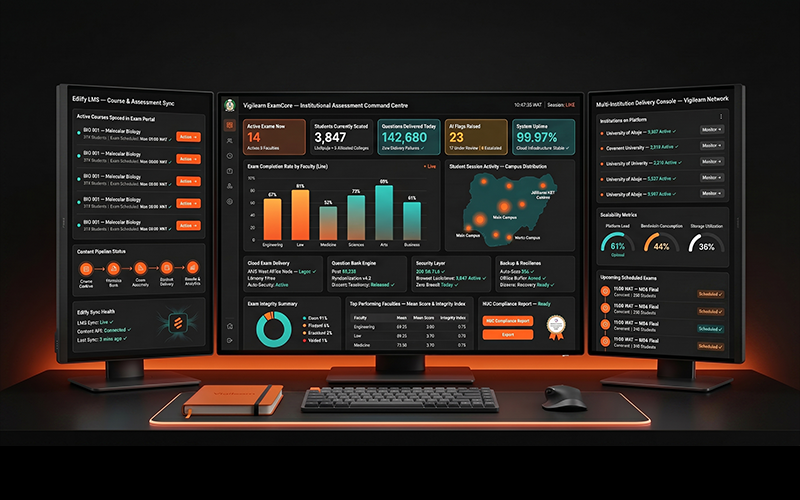
The system supports secure digital assessments with student authentication, randomised question delivery, monitoring workflows, and accreditation-ready reporting visibility. It integrates directly with the Ediify LMS and student records systems, creating a connected academic data environment rather than a standalone tool. Assessment delivery, attendance records, and integrity logs flow into the same institutional reporting infrastructure.
Key capabilities include cloud-based accessibility for scalable cohort delivery, randomised assessment pools that make paper-sharing impractical, automated activity monitoring, and documentation outputs that meet the reporting requirements of formal accreditation reviews. For institutions expanding their online programmes, it provides the infrastructure layer that makes growth sustainable rather than reputationally risky.
Why Secure Online Assessment Matters for the Future of African Higher Education
The trajectory is clear. Distance learning is expanding. Hybrid education is becoming the expectation rather than the exception. International programme credibility increasingly depends on demonstrable assessment standards. And as the World Economic Forum has highlighted, the future of education and employment is being shaped by digital transformation at an accelerating pace.
Universities that invest in trusted examination systems now will scale their online programmes with confidence. Those who do not will find their growth constrained by the high risks they chose to defer. The question is no longer whether African universities should take online examination security seriously. It is whether they can afford not to.
Frequently Asked Questions
How do universities secure online examinations? Effective security combines student identity verification, browser lockdown technology, randomised question pools, automated behavioural monitoring, and comprehensive audit logging. No single measure is sufficient; all layers work together to create a defensible assessment environment.
What is an online examination security university in Africa? It refers to the systems, processes, and policies that African universities use to ensure that digital assessments are conducted fairly, that the right students are sitting them, and that results are trustworthy enough to meet employer and accreditation expectations.
How can institutions prevent cheating in digital exams? By removing the opportunity: locking browsers, randomising questions, verifying identity, monitoring sessions for unusual activity, and maintaining audit trails that make post-hoc investigation possible.
What features should a secure online examination system include? Student authentication, browser lockdown, randomised assessment delivery, real-time or AI-assisted monitoring, detailed session logging, and reporting outputs compatible with accreditation documentation requirements.
Why does academic integrity matter in online learning? Because the value of a qualification depends entirely on whether it can be trusted. Employers, accreditation bodies, and partner institutions all make decisions based on the assumption that assessed outcomes reflect genuine student performance. Compromise that, and the degree itself loses value.
See how Vigilearn’s Examination Portal helps institutions protect academic integrity at scale. Book a demo and explore a secure, accreditation-ready online assessment infrastructure built for African universities.