


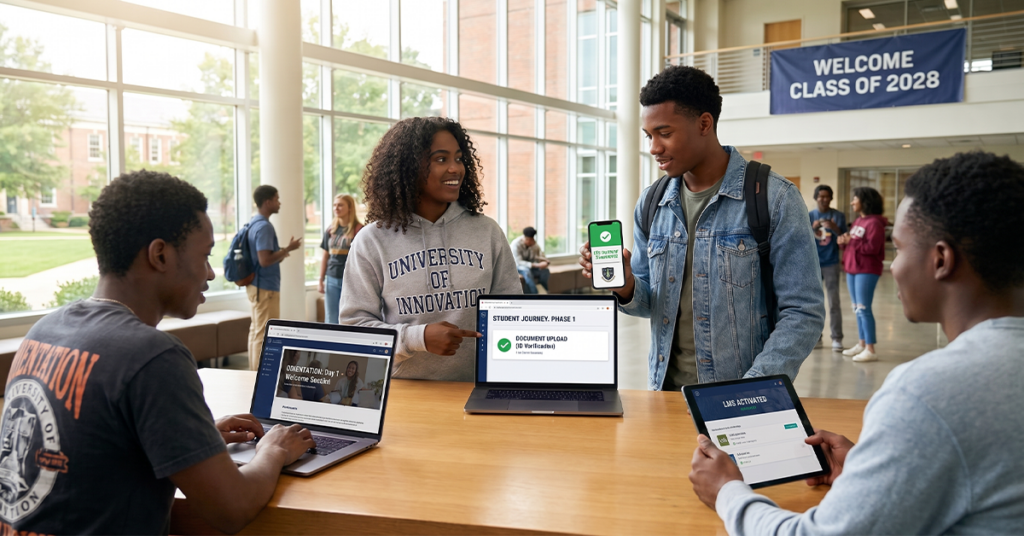
A new student accepts their offer, feeling relieved and excited. Within days, that excitement can curdle into confusion: which portal holds the fee payment link, where does the orientation schedule live, why has the LMS login not arrived yet? Good student onboarding software exists precisely to stop that excitement from evaporating before term even begins.
For university leaders, the first 90 days after admission are quietly one of the highest-stakes periods in the entire student lifecycle. This is when a student either settles into belonging or starts drifting towards disengagement, and much of that outcome depends on decisions made long before the first lecture: how clearly information is communicated, how easily documents are collected, and how connected the systems behind the scenes actually are.
Read More: Learning Analytics in Higher Education: How Universities Turn Student Data Into Better Outcomes
Why the First 90 Days Matter More Than Universities Think
Between accepting an offer and completing the first few weeks of classes, students face a wall of uncertainty. They do not yet know the campus, the systems, the people or the unwritten rules of how things work. Layered onto that uncertainty is genuine administrative complexity: fee payments, document verification, course registration, accommodation and orientation scheduling, often spread across departments that rarely talk to each other.
Communication gaps make this worse rather than better. As one Times Higher Education contributor observed, the outreach to new students often accelerates after they apply and becomes relentless once they accept their offer, to the point where many students grow numb to university notifications before they even set foot on campus. Ironically, more messages do not mean more clarity. They frequently mean less.
This is where student onboarding software earns its place as serious infrastructure rather than a nice-to-have add-on. Early engagement in these first weeks correlates strongly with what happens later. OECD data illustrates just how much is at stake: across OECD countries, only 43% of students who start a bachelor’s programme complete their degree within the theoretical duration of their course, and first-year dropout rates exceed 20% in several higher education systems. A confusing, fragmented start is not a minor inconvenience. For a meaningful share of students, it is the beginning of the end.
What Is Student Onboarding Software?

Student onboarding software is a digital system that guides new students from offer acceptance through to their first weeks of study, replacing scattered emails, spreadsheets and manual processes with a single, structured journey.
At its core, a well-designed platform typically combines a handful of connected functions:
- Digital onboarding workflows that sequence tasks logically, rather than sending every requirement at once
- Communication tools that deliver timely, relevant messages instead of generic mass emails
- Orientation content delivered digitally, so students can engage on their own schedule
- Task management, tracking what each student has completed and what remains outstanding
- Student self-service, allowing students to update details, upload documents and check their own status
- Document collection, replacing paper forms and email attachments with secure digital submission
- Progress tracking, giving both students and staff visibility into where each individual stands
Think of it as the digital equivalent of a well-briefed guide who meets every student at the door, rather than handing them a thick folder and wishing them luck.
Common Student Onboarding Challenges
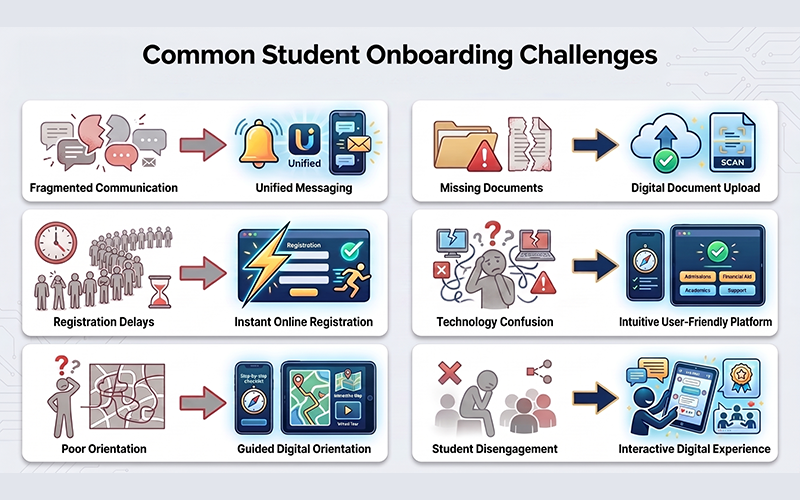
Even well-resourced institutions run into the same recurring problems. Fragmented communication tops the list: admissions, registry, finance and academic departments often send separate, uncoordinated messages, leaving students unsure which instruction takes priority. Missing documentation follows close behind, as students juggle transcripts, identification and financial forms across different portals with different deadlines.
Registration delays compound the frustration. A student who cannot register for courses on time often cannot access their timetable, their reading lists or their LMS account, creating a domino effect of confusion in the first week. Much of this stems from manual onboarding processes: spreadsheets updated by hand, paper forms scanned and emailed, and status checks that require a phone call to a busy registrar’s office.
Poor orientation design adds another layer. Institutions still relying on a single live event, rather than proper new student orientation software, tend to lose the students who could not attend on the day. Generic, one-size-fits-all sessions rarely account for the different needs of international students, first-generation students, transfer students or those studying remotely. UNESCO’s work on equity in higher education makes the point directly: as student populations diversify, equity and inclusion considerations need to be applied consistently across the entire student journey, not treated as an afterthought. When onboarding does not reflect that diversity, technology confusion and student disengagement quickly follow, and by the time a student feels truly lost, they may already be considering whether they made the right choice.
Building a Seamless Student Onboarding Journey
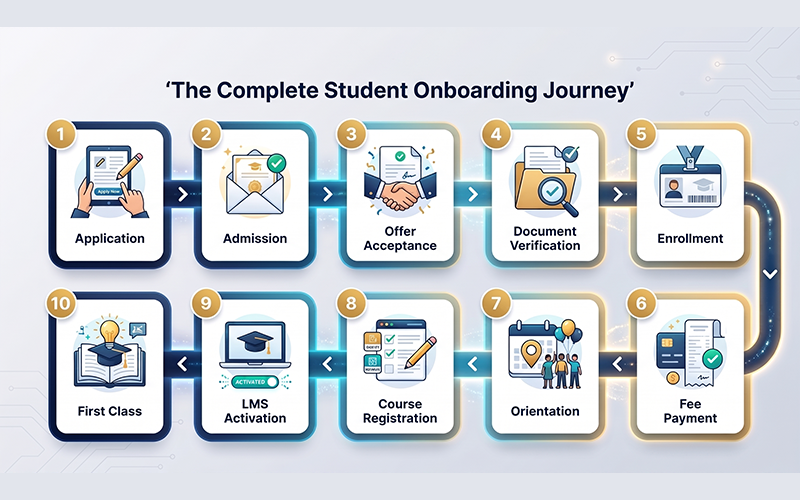
A strong university onboarding process is not a single event. It is a connected workflow that carries a student from their first application through to a settled first term. Mapped out, the student enrollment journey typically includes:
- Application submission and initial review
- Admission decision and offer communication
- Offer acceptance and confirmation of intent
- Document verification, including identification and prior academic records
- Formal enrolment into the institution’s student information system
- Fee payment, often the single biggest source of last-minute delay
- Orientation scheduling and delivery, ideally available on-demand
- Course registration, timed to avoid clashes with fee or document holds
- LMS activation, giving students access to their learning environment
- First class attendance
- Ongoing student support, extending well beyond week one
Together, these stages form a university welcome workflow that should feel invisible when it works and obvious when it does not. Each stage depends on the one before it. A delay in document verification pushes back enrolment; a delay in enrolment pushes back course registration; a delay in registration pushes back LMS activation. When these stages sit in separate, disconnected systems, a single bottleneck anywhere in the chain can derail the entire sequence. When they are connected, a completed step in one system can automatically trigger the next step, so momentum carries the student forward rather than stalling at each handover.
How Technology Improves Student Retention
The case for investing in onboarding technology is not just theoretical. A useful example comes from the University of Canterbury, which built a scalable digital pre-arrival course after surveying more than 4,500 students about their transition challenges. The results were striking: students who completed the programme achieved a 22% higher average GPA and a 7.3% higher pass rate than matched peers who did not engage with it, alongside measurable drops in first-week advising demand and student anxiety.
Automation delivers similar gains on the administrative side. EDUCAUSE’s 2025 Top 10 report describes one institution that automated its transcript process between its student information system and its CRM, cutting the average processing time from 11 days to 28 seconds. That kind of speed, applied across onboarding tasks rather than just transcripts, changes what students experience in their first weeks entirely.
Several capabilities consistently drive these improvements:
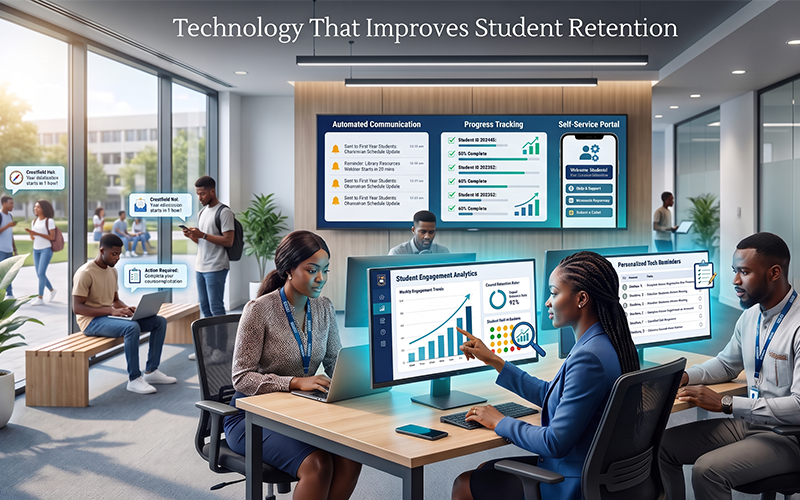
- Automated communication that reaches students at the right moment, rather than all at once
- Self-service portals that let students resolve routine queries without waiting for office hours
- Task reminders that reduce the number of students who simply forget a deadline
- Digital orientation that students can revisit as needed, rather than a single live session
- Personalised student journeys, adapting content to a student’s programme, background or location
- Early intervention, flagging disengagement before it becomes a formal risk
- Progress tracking, giving advisors a clear view of who needs support and when
The World Economic Forum has noted that data analytics and digital platforms are personalising education and breaking down barriers to access, a shift that applies just as directly to onboarding as it does to teaching. Gartner, meanwhile, frames this kind of connected approach through its guidance on building a unified, institution-wide view of the student across every touchpoint, rather than managing each interaction in isolation.
Read More: AI-Powered LMS: What It Actually Means for Universities in 2026
How Vigilearn Creates an End-to-End Student Experience
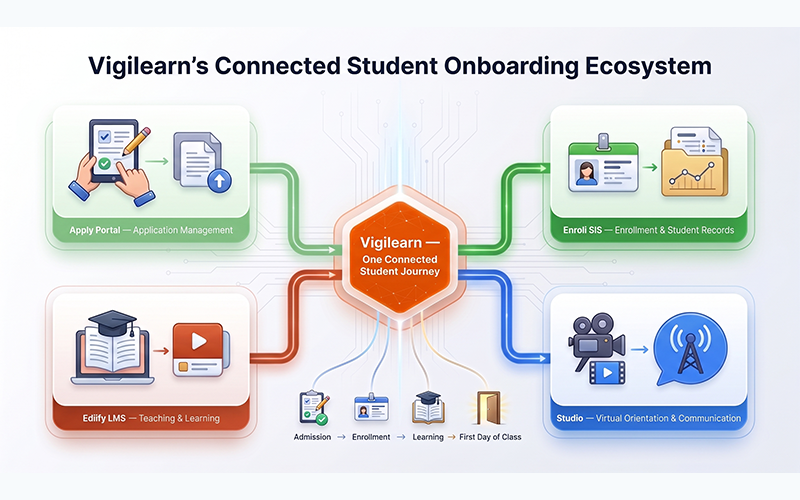
Most onboarding friction does not come from any single broken step. It comes from the gaps between systems that were never designed to talk to each other. Vigilearn’s connected ecosystem is built to close those gaps.
Apply Portal captures the relationship from the very beginning, managing applications, document submission and offer communication in one place, so nothing a prospective student submits gets lost in a separate inbox.
Enroli SIS, Vigilearn’s student information system, takes over from there, managing enrolment, academic records and the formal data that everything downstream depends on. Because it holds the authoritative student record, other systems can trust the information it provides rather than duplicating data entry.
Ediify LMS supports learning from day one, activating automatically once enrolment is confirmed, so students are never left waiting for access to course material after they have already paid fees and registered for classes.
Studio rounds out the ecosystem, providing virtual orientation sessions and ongoing communication, useful for institutions supporting international, remote or part-time students who cannot always attend in-person events.
Connected this way, a single action, such as confirming enrolment in Enroli SIS, can trigger the next stage automatically: LMS access opens, orientation content becomes available, and communication adjusts to reflect where that student actually stands. The student experiences one coherent journey, supported by what functions as a student success platform rather than four separate systems stitched together with manual effort.
Best Practices for University Onboarding
Technology alone will not fix onboarding friction; it needs to be applied deliberately. A few practices consistently separate institutions that get this right from those that do not.
- Personalise communication by programme, background and enrolment stage, rather than sending identical messages to every new student
- Design mobile-first, since most students will check onboarding tasks from a phone, often between other commitments
- Digitise documentation end to end, removing paper forms and scanned attachments wherever possible
- Schedule orientation flexibly, offering on-demand digital content alongside any live events
- Keep student support visible and easy to reach, particularly during the first two weeks of term
- Sustain engagement beyond week one, since onboarding that stops at orientation leaves students unsupported exactly when academic pressure begins to build
- Measure onboarding success using concrete indicators such as task completion rates, time to LMS activation and early-term engagement, not just attendance at a welcome event
Institutions that treat these as an integrated student onboarding checklist, rather than a set of disconnected initiatives, tend to see the clearest gains in both satisfaction and retention.
Bringing the First 90 Days Together
The first 90 days set the tone for everything that follows. Students who move through admission, enrolment and orientation without friction arrive at their first class feeling prepared and supported. Students who spend those same weeks chasing emails, resubmitting documents or waiting for system access often arrive already discouraged, and some do not arrive at all.
Create a connected student journey from application to graduation with Vigilearn. Our integrated Apply Portal, Enroli SIS, Ediify LMS and Studio help universities streamline onboarding, improve engagement and reduce student attrition through one unified digital ecosystem. Explore more on the Vigilearn blog or visit vigilearn.com to see how it works.
Frequently Asked Questions
What is student onboarding software? Student onboarding software is a digital system that guides new students from offer acceptance through enrolment, orientation and their first weeks of study, replacing manual, fragmented processes with a single connected workflow.
Why do students drop out before classes begin? Many students disengage during the gap between admission and their first class due to unclear communication, administrative delays and confusing systems, long before any academic challenges arise.
What should an onboarding checklist include? A complete checklist typically covers offer acceptance, document verification, enrolment, fee payment, orientation, course registration, LMS activation and early student support, sequenced so each step naturally leads into the next.
How can universities improve orientation? Offering orientation content on-demand and digitally, alongside any live sessions, ensures all students, including international, remote and first-generation students, can access what they need on their own schedule.
How does onboarding improve student retention? A seamless onboarding experience reduces early confusion and disengagement, the two factors most closely linked to first-year attrition, helping more students stay enrolled and engaged past their first term.