


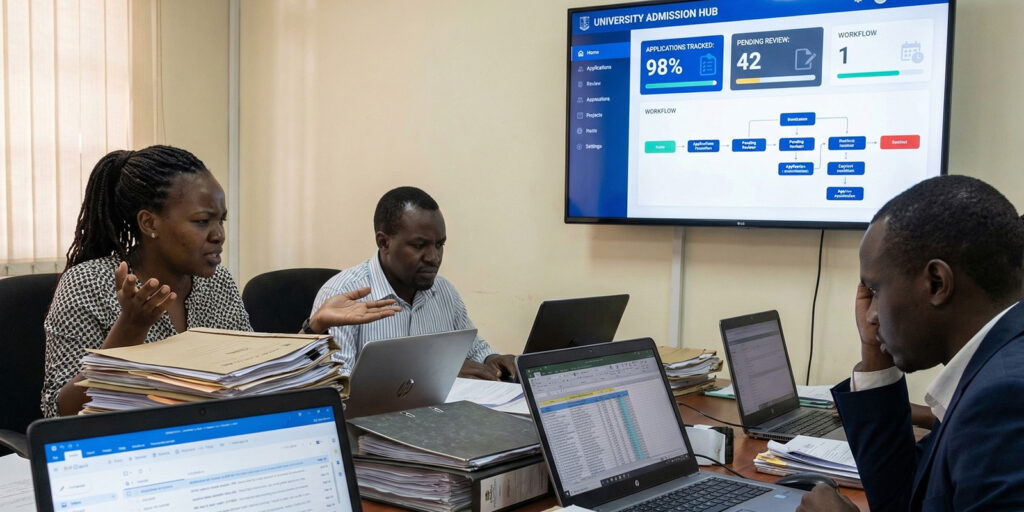
University admission challenges include operational, administrative, and communication issues that slow application processing, increase errors, and reduce enrollment conversion. These challenges often arise from manual workflows, fragmented data systems, and delayed communication between institutions and applicants.
For many universities, the admissions office operates as the first real interaction between the institution and prospective students. Yet behind the scenes, admission teams frequently juggle hundreds or even thousands of applications using spreadsheets, emails, and disconnected tools. What begins as a manageable process can quickly become chaotic during peak admission seasons.
Read more: University Admission Management System: A Complete Guide
Fragmented Application Tracking Systems


One of the most persistent admission challenges universities face is fragmented application tracking.
Many institutions receive applications through multiple channels. These may include email submissions, physical forms, third-party platforms, and online forms hosted on different systems. As a result, application data becomes scattered across spreadsheets, email threads, and departmental records.
This fragmentation creates several operational problems:
- Admission officers struggle to maintain a single source of truth
- Application status updates are difficult to track
- Leadership lacks visibility into the admission pipeline
- Reviewing and approving applications becomes slower
When data is dispersed across systems, even simple tasks become time-consuming. Staff members may spend hours consolidating information before any actual evaluation begins.
A digital admission system addresses this issue by centralising all application data within a single, structured workflow. Every application enters the same system, documents are stored in a unified repository, and admission officers can review submissions through a single dashboard.
This centralised visibility improves coordination across departments and significantly reduces processing delays.
Institutions adopting centralised admission platforms often find that decision timelines shorten, communication improves, and leadership gains clearer insight into application volumes and trends.
Manual Data Entry and Human Errors

Manual processes remain a major contributor to university admission challenges.
In traditional admission workflows, staff often transfer applicant information from forms into spreadsheets or internal databases. While this may seem manageable at small scales, it quickly becomes problematic when application volumes increase.
Manual entry introduces several risks:
- Incorrect student information
- Missing documents
- Duplicate applications
- Miscommunication between departments
Even minor errors can have serious consequences. A missing transcript or incorrectly recorded email address can delay an application decision or prevent important communications from reaching an applicant.
Technology addresses these issues through structured submission workflows. Modern admission platforms include features such as:
- Form validation to ensure fields are correctly completed
- Auto-save functionality that prevents data loss during submissions
- Duplicate detection systems that identify repeated applications
- Document verification checkpoints
These safeguards dramatically reduce the likelihood of administrative mistakes. More importantly, they allow admission staff to focus on evaluating applicants rather than correcting clerical errors.
Read more: Student Enrolment Automation in Universities
When institutions implement admission management software, the result is greater accuracy, improved record integrity, and significantly reduced administrative workload.
Slow Response Time to Applicants

Communication delays are another common admission bottleneck.
Many institutions still rely on manual communication workflows. When a student submits an application, staff may need to manually send confirmation emails, update application statuses, or respond to individual inquiries.
During peak admission periods, these tasks quickly accumulate.
Research from HubSpot indicates that 66% of customers expect a response within five minutes when contacting organisations, highlighting how modern users increasingly expect fast communication.
While university admissions differ from customer service, the expectation for timely responses remains relevant. Students today expect immediate acknowledgement that their application has been received and clarity about what happens next.
Without automation, admission teams often struggle with:
- Delayed acknowledgment emails
- High inquiry volumes
- Slow follow-up communication
- Frustrated applicants are unsure of their application status
Technology significantly improves this experience.
Automated university admissions systems can send instant confirmation emails once an application is submitted. Applicants can also access status dashboards showing document verification progress, review stages, and decision timelines.
Automated reminders further help applicants submit missing documents before deadlines.
These improvements reduce inquiry backlogs while creating a more transparent and reassuring application experience.
Lack of Real-Time Admission Data

Another major challenge universities face is limited visibility into their admission funnel.
Without centralised data systems, admission teams often struggle to answer critical questions:
- How many applications have been received?
- Which programs are attracting the most applicants?
- Where are applicants dropping off in the process?
- What is the likely enrollment yield?
Traditional spreadsheet tracking cannot provide real-time insights into these metrics.
This lack of visibility makes enrollment forecasting extremely difficult. Leadership may not recognise application shortfalls until it is too late to respond strategically.
Modern admission management software addresses this gap through analytics dashboards.
These dashboards provide:
- Real-time application tracking
- Admission funnel analysis
- Program-level performance insights
- Enrollment forecasting tools
With access to accurate data, institutions can identify trends earlier, adjust marketing strategies, and allocate admission resources more effectively. Data visibility transforms admissions from a reactive administrative process into a proactive strategic function.
Scalability Issues During Peak Admission Periods
Admission offices often experience dramatic spikes in workload during peak application periods.
When hundreds or thousands of applications arrive within short timeframes, traditional workflows begin to break down.
Common issues include:
- Staff overload
- Slower document verification
- Delayed application reviews
- Increased administrative errors
These challenges highlight why university admission challenges often intensify during the admission season.
Technology introduces scalability that manual systems cannot match.
With automated university admissions workflows, institutions can process large volumes of applications without proportionally increasing staff workload. Key automation capabilities include:
- Bulk document processing
- Rule-based eligibility screening
- Parallel review access for admission committees
- Automated applicant notifications
Instead of sequential manual reviews, applications can move through parallel evaluation stages, dramatically improving processing speed.
This scalability allows universities to handle growing applicant pools while maintaining consistent admission quality.
Compliance and Data Security Risks
Admission processes involve the collection of highly sensitive student information.
This includes:
- Academic transcripts
- Identification documents
- Personal contact details
- Financial information
When these documents are shared through email or stored in unsecured folders, institutions face serious compliance and security risks.
According to the International Organisation for Standardisation (ISO), organisations should implement strict information security controls to protect sensitive data and prevent unauthorised access. (See the ISO information security standards)
Without proper systems in place, universities risk:
- Data breaches
- Unauthorised document access
- Loss of sensitive applicant information
A secure digital admission system mitigates these risks through built-in security architecture. These systems typically include:
- Role-based access permissions
- Encrypted document storage
- Secure cloud infrastructure
- Detailed access logs
By adopting structured admission platforms, institutions protect both applicant data and their institutional reputation.
Improving Applicant Experience Through Technology

Admissions is not just an administrative process. It is also a critical stage in the student experience.
Applicants often form their first impressions of an institution during the application process. And when students encounter confusing forms, unclear requirements, or slow communication, they may reconsider their application altogether.
Technology improves the applicant journey by introducing:
- Self-service application dashboards
- Real-time status updates
- Structured document upload systems
- Automated deadline reminders
These tools provide transparency and reduce anxiety for applicants.
Instead of repeatedly contacting admission offices for updates, students can simply log into their portal and track their progress.
This improved experience directly impacts enrollment conversion rates. When the application process is smooth and transparent, applicants are more likely to complete submissions and ultimately accept admission offers.
Moving from Manual to Automated Admissions
Addressing university admission challenges does not require a complete institutional overhaul. Most universities transition gradually from manual systems to automated workflows.
A practical transition typically involves several steps:
- Implement a centralised application portal
This becomes the primary intake channel for all applications.
- Adopt admission management software
The system organises applications, documents, and communication.
- Integrate CRM and analytics tools
These systems track applicant engagement and admission funnel metrics.
- Automate communication workflows
Confirmation emails, reminders, and status updates are triggered automatically.
- Train admission staff
Staff members learn how to use dashboards, review workflows, and use reporting tools.
Institutions looking to modernise admissions should consider scalable platforms designed specifically for higher education environments.
Solutions like the systems offered on the Vigilearn help institutions digitise application processes, manage student records, and streamline academic administration.
Frequently Asked Questions
What are the most common university admission challenges?
Common university admission challenges include fragmented application tracking, manual data entry errors, delayed communication with applicants, lack of real-time admission analytics, scalability issues during peak admission periods, and data security risks associated with handling sensitive student documents.
How does a digital admission system reduce errors?
A digital admission system reduces errors by enforcing structured form submissions, validating required fields, detecting duplicate applications, and automatically organising documents. These automated checks minimise manual data entry mistakes and ensure applicant information is accurate and complete.
Can automated university admissions handle international applicants?
Yes. Automated university admissions systems are designed to scale across global applicant pools. They support structured document uploads, standardised verification workflows, and secure communication channels, making it easier for institutions to manage international applications efficiently.