



Every year, universities invest significantly in marketing, open days, and recruitment campaigns, only to watch a significant proportion of interested students quietly disappear before submitting an application. No email follow-up. No re-engagement. No second chance. The prospective student simply moves on, and that institution never knows exactly why. This is not a marketing problem. It is an admissions infrastructure problem. And if your institution still treats admissions as a back-office administrative process rather than a strategic growth system, the cost is almost certainly higher than your enrolment data is showing you.
The global higher education sector is under real pressure. EDUCAUSE identified the enrolment crisis as one of the top three institutional challenges facing universities in 2024, noting that too many institutions are managing complex enrolment workflows with outdated tools while student expectations for seamless digital experiences have never been higher. Research from EDUCAUSE’s Higher Education Trend Watch confirms that institutions are increasingly moving toward data-driven, technology-enabled admissions in response to these pressures. The universities making measurable gains are not simply spending more on recruitment. They are fixing the pipeline itself with a properly deployed university application portal system.
Read More: Student Lifecycle Management in Higher Education
Why Traditional Admission Processes Are Losing Students


Picture a prospective student who discovers your university through an advertisement, visits your website, and fills out an inquiry form. They are genuinely interested. They wait for a response. A few days pass. Eventually, a generic email arrives directing them to a PDF application form, several downloadable documents, and a list of email addresses for different departments. The experience is confusing, time-consuming, and feels nothing like the modern digital interactions this student has come to expect.
That drop-off between initial inquiry and submitted application is where universities lose the most ground, and it happens quietly. The core reasons are structural:
- Long, paper-based or multi-step forms that feel burdensome and unclear
- No automated follow-ups, leaving interested students without guidance or reminders
- No visibility for applicants into where they stand in the process
- Delayed responses that create anxiety and push students toward faster-responding competitors
Each of these is a conversion leak. And in the language of institutional finance, each unconverted inquiry represents lost tuition revenue, reduced programme viability, and weakened institutional capacity. A World Economic Forum analysis on the future of education underscores that students, especially digital natives, make institution selection decisions based partly on the quality of their pre-enrolment experience. A broken admissions process signals a broken institution.
What Is a University Apply Portal System?
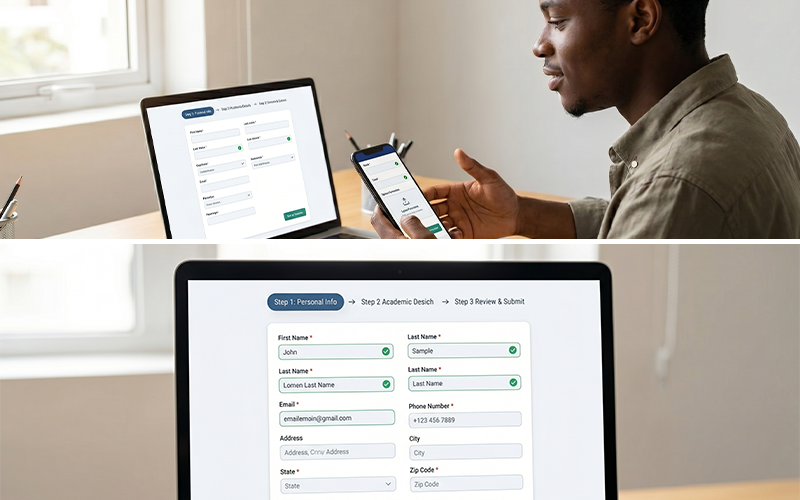
A university apply portal system is a centralised, web-based platform that manages the entire student admissions journey from first inquiry through to confirmed enrolment. It replaces disconnected emails, spreadsheets, and physical paperwork with a single, structured environment where applicants can submit forms, upload documents, track their application status in real time, communicate with the institution, and complete acceptance steps.
More importantly, a digital admission system for universities is not merely a digital filing cabinet. It is an active process engine. It automates the repetitive tasks that drain admissions staff time, flags incomplete applications, triggers follow-up communications at the right moments, and routes applications through the correct review workflows without manual hand-holding. The result is a system where neither the applicant nor the admissions team is left guessing.
Read More: Reducing Admission Errors Through Online Application Portals
Admissions as a Conversion Funnel
The most useful mental model for modern admissions is a conversion funnel: website traffic → inquiry → application started → application submitted → offer made → enrolment confirmed. Drop-offs are most severe between inquiry and submission, and between offer and confirmed enrolment. A university apply portal system addresses both gaps by reducing friction at every transition point, guiding applicants step by step, prompting action when needed, and keeping students informed so that uncertainty does not become abandonment.
Vigilearn’s Apply Portal was built with precisely this funnel logic in mind, treating each admissions touchpoint as an opportunity to retain a prospective student’s commitment and move them forward.
Key Features That Drive Enrolment
The features that matter in a university apply portal system are not about technical sophistication for its own sake. They matter because each one closes a specific conversion gap:

- Instant application access: Removing barriers to starting an application increases submission rates. A clean, mobile-friendly portal means students can begin from any device without downloading forms or visiting a campus.
- Automated follow-ups: Research on admissions automation consistently shows that timely, personalised reminders reduce application abandonment. When a student uploads three of four required documents and stops, an automated nudge at the right moment can recover that application entirely.
- Document tracking and checklists: Applicants see exactly what has been received and what remains outstanding. Admissions staff are freed from manually chasing submissions.
- Real-time status updates: Transparency reduces anxiety and inbound queries. When students know where they stand, they remain engaged rather than drifting toward alternatives.
- Structured workflow routing: Applications move automatically to the correct reviewer based on programme, nationality, or scholarship type, which eliminates the bottlenecks that slow decision-making and cost institutions offer.
The Measurable Benefits of a Digital Admission System
The case for university enrollment automation is not theoretical. As Full Fabric’s admissions research documents, institutions using centralised digital admission systems gain the ability to monitor conversion rates and drop-off points with granular precision, enabling a data-driven recruitment strategy rather than guesswork.
The concrete benefits span four areas: faster processing (structured workflows reduce time from submission to decision, directly improving yield); higher conversion rates (reduced friction and timely communication translate into more completed applications); better student experience (a polished portal communicates institutional quality from the very first interaction); and scalability (cloud-based systems handle growing volumes across new programmes and geographies without proportional staffing increases).
Read More: Read More: Common Admission Process Challenges and How Technology Solves Them
How Apply Portals Increase Enrolment Rates
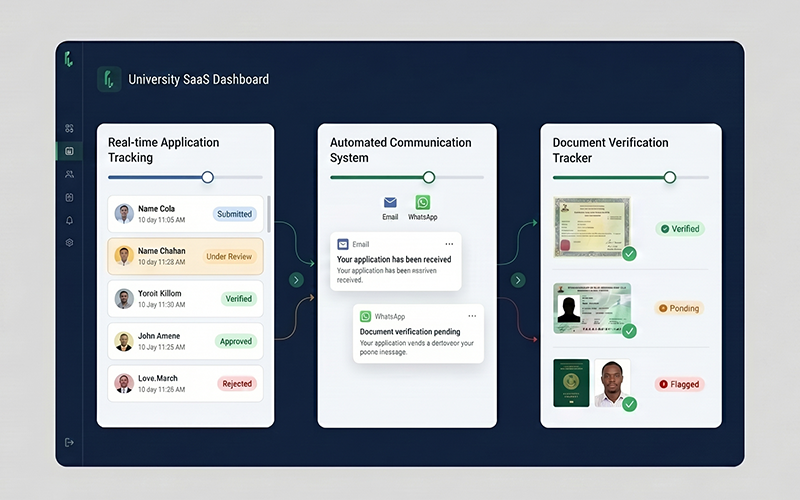
The mechanism is straightforward. A well-configured university application portal system reduces every form of friction that causes students to abandon applications or delay their commitment. It accelerates decision-making by automating the internal processes that create delays, and improves communication by ensuring applicants receive timely, relevant updates rather than extended silence.
Beyond the individual student experience, the system generates institutional intelligence. Admissions teams gain visibility into where applicants drop off, which programmes have strong interest but weak conversion, and which markets are underperforming. EDUCAUSE’s data-empowered institution research confirms that institutions using data to optimise enrolment strategies consistently outperform peers relying on legacy processes. The apply portal is the infrastructure that makes this possible.
How Vigilearn Enables Admission Growth
Vigilearn’s Apply Portal is an end-to-end university application portal system designed for institutions serious about converting interest into enrolment. It combines structured digital application workflows, live tracking for both applicants and admissions staff, automated reminders, and document management into one integrated environment.
Critically, it integrates with Learning Management Systems and Student Information Systems, ensuring the journey from application to enrolled student is seamless rather than a series of disconnected data handoffs. For universities managing multiple programmes, campuses, or international intake streams, this integration is not a convenience. It is a competitive necessity. The Vigilearn blog regularly publishes practical guidance on optimising admissions operations.
Ready to see what your admissions process can become? Book a demo with Vigilearn and discover how your institution can convert more applicants into enrolled students.