



In 2019, a single examination system failure at a major UK university led to a regulatory inquiry, a student compensation bill, and three months of headline coverage. The institution had done nothing dramatically reckless. It had simply relied on an assessment platform that was not built to handle institutional risk, only operational convenience. And when that system failed, the consequences stretched far beyond IT into the boardroom, the student union, and the regulator’s office.
That story is not exceptional. It is a preview of what happens when university leadership treats examination platforms as administrative tools rather than as the critical risk infrastructure they actually are. Most institutions invest carefully in cybersecurity, financial controls, and regulatory compliance. Yet when it comes to examination systems, the same rigorous thinking rarely applies. The result is a category of institutional risk that is poorly managed, poorly understood, and, when it materialises, extremely costly to contain.
Read More: Assessment Management System in Universities: Streamlining Exams and Evaluation
What University Examination System Failure Risk Actually Looks Like

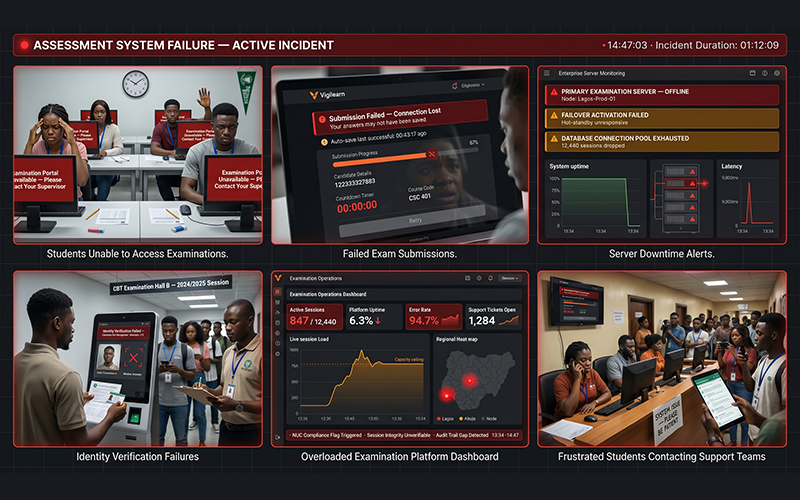
Understanding the university examination system failure risk begins with understanding its many forms. Most institutional leaders think of failure as a server going down mid-exam. That does happen, and it is disruptive. But the more consequential failures are often subtler, more systemic, and harder to recover from.
The most common failure scenarios include:
- System outages during live assessments: Students lose access mid-examination. Assessments are invalidated. Rescheduling creates cascading timetable disruptions.
- Lost or unsubmitted examination data: Submission failures leave records incomplete. Grade disputes follow. Appeals processes are triggered that can run for months.
- Identity verification failures: Wrong candidates are assessed. Unauthorised access occurs. The integrity of the entire cohort’s results becomes questionable.
- Platform performance degradation: Server overload causes slow response times or login failures at exactly the moments of peak demand, such as the first hour of a high-stakes examination sitting.
- Examination security breaches: Question papers are leaked. Unauthorised collaboration occurs. Data exposure creates both reputational and legal exposure.
The deeper issue is that institutions rarely plan for the cascading effects of any one of these failures. A submission error is not just a technical ticket; it is a compliance event, a student welfare issue, and potentially a media story. When ExamSoft’s platform experienced a severe technical meltdown during the US bar exams in July 2014, bar associations across nearly 20 states had to extend submission deadlines. The ensuing class-action lawsuits resulted in a $2.1 million settlement. The cause was simple: the platform was unprepared for the volume of simultaneous uploads. The consequences were anything but simple.
The Hidden Costs Most Universities Never Calculate
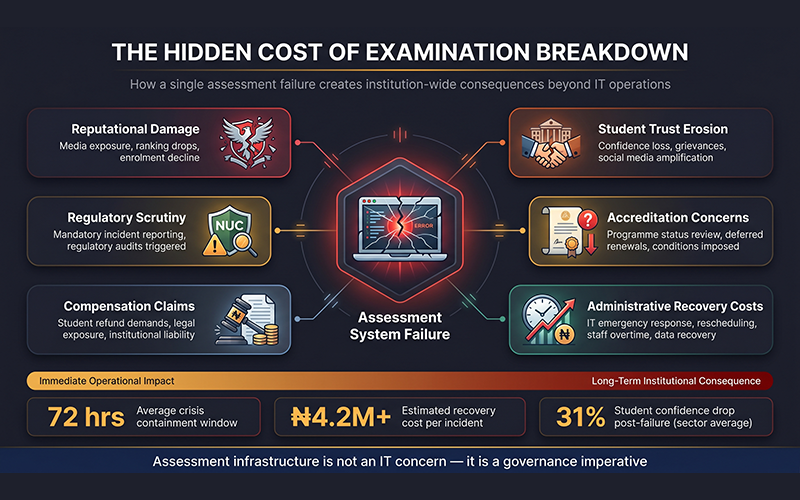
Here is where the conversation needs to shift. When institutions weigh the cost of examination infrastructure investment, they typically compare platform licensing fees. What they fail to model are the hidden costs of failure, which are significantly larger and far harder to recover from.
Reputational damage is the most persistent cost. As research from Meazure Learning confirms, media coverage of assessment failures rarely includes the recovery story. It covers the scandal, not the resolution. Social media amplifies failures in real time. A university that trends on social media for the wrong reasons during examination period can face enrollment perception impacts that persist for years.
Student trust erosion is a related but distinct cost. Students who experience examination failures do not simply move on. They file complaints. They share experiences. They factor institutional reliability into their decisions about postgraduate study and alumni engagement. In a competitive higher education market where institutions are increasingly competing on student experience, this is not a soft consideration. It is a strategic one.
Administrative recovery costs are substantial and almost always underestimated. Manual grading reviews, appeals processes, investigation workloads, and the additional staffing pressure of managing a major assessment incident can consume significant institutional resources for weeks or months. The cost of managing that recovery invariably exceeds the cost of the infrastructure that would have prevented it.
Regulatory and accreditation exposure is perhaps the most serious long-term risk. The UK Quality Code for Higher Education (2024) explicitly requires that assessment methods embody academic integrity and produce outcomes that are comparable and globally recognised. Examination failures that compromise the standard can trigger compliance reviews and quality audits at exactly the moments when institutions can least afford the distraction.
Legal liability completes the picture. Compensation cases at UK universities have seen initial offers of £1,000 eventually settled at £45,000 and above once the true scope of institutional fault became clear. Where assessment failures affect large cohorts of students, the exposure multiplies accordingly.
Read More: Online Exam Management Systems for Universities in 2026
Real-World Failures and What They Teach
The ExamSoft case is instructive but not isolated. In May 2026, the Canvas learning management platform was taken offline following a cyberattack by the hacking group ShinyHunters, affecting nearly 9,000 schools and universities worldwide. The University of Illinois postponed all final exams scheduled over an extended weekend. Penn State cancelled examinations. Baylor delayed assessments. Inside Higher Ed reported that the breach underscored how much of academia had come to rely on a single, centralised platform with insufficient redundancy. Each institution now faces the administrative, reputational, and student-welfare consequences of that dependency.
The lesson from both cases is the same: university examination system failure risk is not theoretical, and it does not announce itself in advance. It arrives at the worst possible moments, under the heaviest demand loads, and creates institution-wide crises from what initially appears to be a contained technical issue.
Why Examination Infrastructure Is a Risk Management Decision
There is a deeply embedded institutional assumption that examination platforms are IT purchases. They are evaluated on features, ease of use, and price. What they should be evaluated on is risk exposure.
Consider how universities approach other areas of institutional risk. Cybersecurity is treated as a board-level concern. Financial controls are subject to rigorous governance. Compliance systems receive dedicated resource and leadership attention. Examination infrastructure, by contrast, is often delegated to academic registries with modest IT support. That governance gap is the core problem.
The World Economic Forum’s Global Risk Report consistently highlights technology infrastructure failure as a major institutional risk across sectors. Higher education is not exempt. Examination systems are, by any reasonable definition, critical infrastructure. They determine whether students progress, graduate, and gain the credentials that shape their careers. When they fail, the consequences are institutional, not just operational.
The questions that risk-aware institutions should be asking are straightforward. Can assessments continue during a platform disruption? Can systems handle simultaneous demand from thousands of students? Can the institution demonstrate assessment integrity to an accreditation body if challenged? These are not IT questions. They are governance questions.
Read More: From 100 to 10,000 Students: How Vigilearn Scales with Your Institution
What Risk-Ready Examination Systems Require
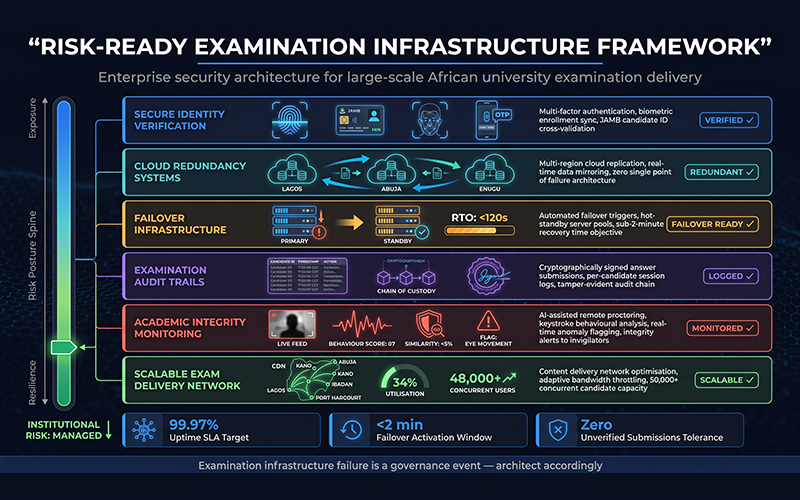
Institutions evaluating examination infrastructure should move away from feature-list comparisons and towards risk criteria. A genuinely risk-ready examination system must include:
- Redundant infrastructure: Backup systems and failover capabilities that activate automatically, not after a helpdesk ticket has been raised.
- Secure identity verification: Robust authentication controls that validate student identity without creating friction that itself becomes a failure point.
- Comprehensive audit trails: Complete examination records that support compliance reporting and can withstand scrutiny from regulators, accreditors, or legal proceedings.
- Assessment integrity controls: Randomised question delivery, access controls, and monitoring systems that prevent compromise without compromising the student experience.
- Scalable performance architecture: Cloud infrastructure capable of handling high-volume, peak-demand examination delivery without degradation.
Each of these is a risk mitigation measure. None of them is a luxury.
How Vigilearn Examination Portal Reduces Assessment Risk
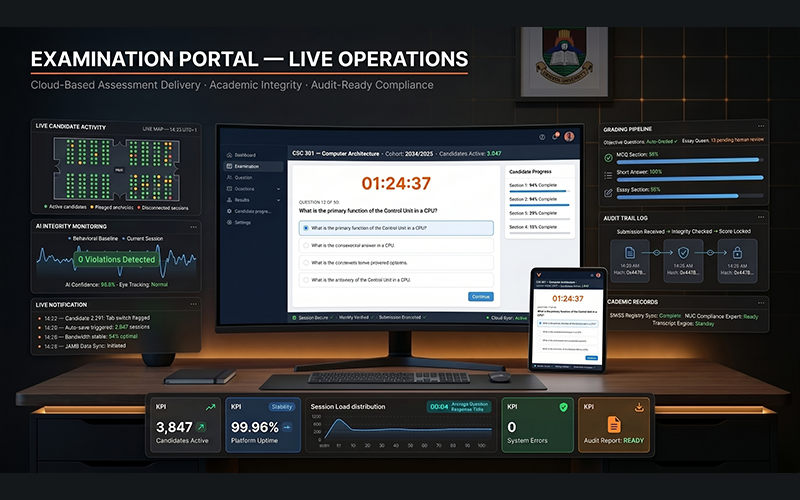
The Vigilearn Examination Portal is built around a single organising principle: examination infrastructure must protect institutional accountability, not just enable exam delivery. That distinction shapes every aspect of the platform.
Secure assessment delivery ensures that students have reliable access to examinations at the moment they need it, with the infrastructure redundancy to support it. Audit-ready reporting means institutions can demonstrate assessment traceability at any point, to any body requiring it. Identity verification controls are embedded into the examination workflow, strengthening integrity without creating barriers for legitimate candidates. Scalable cloud infrastructure handles high-volume examination sittings without performance degradation, because peak demand is precisely when reliability matters most.
Critically, the Vigilearn Examination Portal operates as part of a connected institutional ecosystem. It integrates with Ediify LMS and student management workflows, meaning assessment data does not exist in isolation. It sits within an academic reporting environment that supports institutional decision-making and compliance at scale. This is risk mitigation through infrastructure design, not just a feature set.
The Universities That Will Win Trust in the Digital Era
Online learning continues to expand across African higher education and globally. Hybrid assessment models are becoming standard. Student expectations of institutional systems are rising. The question institutions need to answer honestly is whether their current examination infrastructure is capable of meeting those expectations consistently, under pressure, at scale.
The universities that will build lasting trust in this era are those that make a deliberate decision to treat examination infrastructure as a strategic asset. Not an operational afterthought, procured on cost and forgotten about until something goes wrong. The EDUCAUSE community of higher education technology leaders has long advocated for this shift in institutional thinking, and the evidence increasingly supports it.
Assessment failure is an institutional risk event. It has reputational, regulatory, financial, and legal dimensions. Managing it well requires the same governance attention that institutions already apply to cybersecurity, financial integrity, and compliance. The infrastructure investment is modest. The cost of not making it is not.
Vigilearn helps institutions across African higher education reduce assessment risk, strengthen examination integrity, support accreditation requirements, and scale digital assessments with confidence. It is a trusted infrastructure for secure assessment delivery, built for the operational demands that modern institutions actually face.
Frequently Asked Questions
What happens when a university examination system fails? A failure can cascade into student access issues, invalid assessments, grade disputes, regulatory scrutiny, reputational damage, and legal liability. The consequences are rarely contained within the IT department.
How do universities reduce examination platform risk? By treating examination infrastructure as risk management infrastructure. This means investing in redundant systems, secure identity verification, audit-ready reporting, integrity controls, and scalable cloud architecture.
What are the consequences of online assessment failures? Consequences include student trust erosion, administrative recovery costs, compliance reviews, accreditation scrutiny, media coverage, and, in serious cases, legal claims and compensation obligations.
Why is examination infrastructure important for accreditation? Regulators and accreditation bodies, including the QAA, require that assessment methods embody academic integrity and produce outcomes that are comparable and recognised. Examination system failures directly threaten compliance with these standards.
What should institutions look for in a secure online exam platform? Redundant infrastructure, failover capability, secure identity verification, comprehensive audit trails, assessment integrity controls, and scalable performance under high demand. Evaluate on risk criteria, not feature lists.
How can universities improve examination integrity? Through platforms that combine identity verification controls, randomised question delivery, access management, and monitoring systems within a connected institutional ecosystem, rather than standalone tools with no audit capability.
Assessment failure is not an IT problem. It is an institutional risk event.
See how the Vigilearn Examination Portal helps universities eliminate assessment failure risk through secure, redundant, audit-ready examination infrastructure. Book a security-focused demo and explore how your institution can protect student trust, compliance, and academic integrity at scale.