
Every finance officer at a growing school knows the feeling: a spreadsheet with three hundred rows, half of them highlighted in red, and a WhatsApp group full of “please confirm you received my transfer” messages. This is what happens when school fee collection software never enters the picture, and institutions are left reconciling payments by hand, term after term.
It rarely starts this way. A school with sixty pupils and one bank account can manage fees on a notebook. But as enrolment climbs into the hundreds or thousands, and as parents pay through different banks, agents and mobile wallets, that simplicity disappears. Multiple payment channels create multiple proof-of-payment threads. Manual reconciliation eats into hours that finance teams should be spending on budgeting and reporting. Outstanding balances go unnoticed until a parent is halfway through the term, and administrators end up chasing payments instead of managing them.
Read More: School Management Software Cost: A Complete Pricing Guide
What Is School Fee Collection Software?
School fee collection software is a system that manages the entire lifecycle of student payments, not just the moment money changes hands. It covers fee invoicing, online payments, payment confirmation, automated reminders, digital receipts, running account balances and reconciliation reporting, all connected to a student’s record.
This distinction matters. A payment gateway processes a transaction and stops there. Proper school payment software goes further: it tells you who has paid, who is partially paid, who is overdue, and what that means for the institution’s cash flow, without anyone manually cross-checking a bank statement against an enrolment list. For institutions handling recurring tuition, exam fees, boarding charges or instalment plans, that difference defines whether the finance office spends its time on strategy or on data entry. It is also what separates a basic payment page from an actual tuition collection system built for the institution’s full billing cycle.
How Automated Fee Collection Works
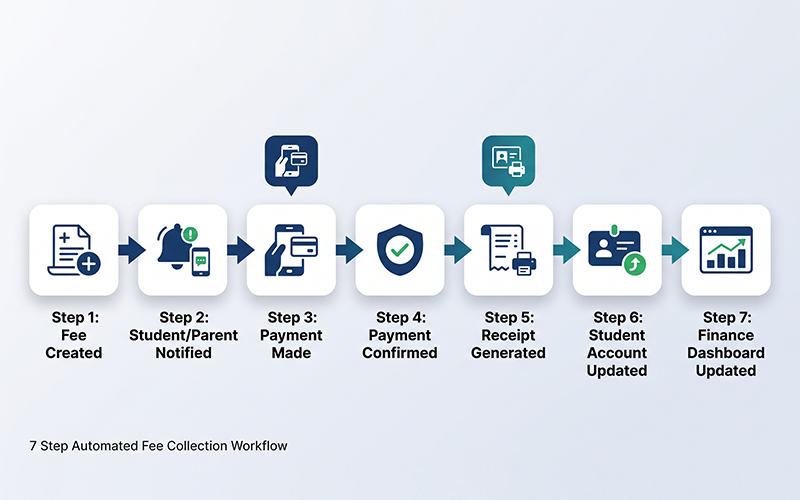
A typical automated workflow looks like this: a fee is created and assigned to a student → the student or parent is notified → payment is made through an available channel → the payment is confirmed → a receipt is generated automatically → the student’s account balance updates → the finance dashboard reflects the change in real time.
Each handoff that used to require a human checking a transfer, updating a ledger, and emailing a receipt is completed by the system instead. That is the real value of digital fee collection: it does not just move payments online; it removes the repetitive administrative steps between an invoice and a reconciled account. Institutions that adopt digital fee collection properly tend to notice the change first in how much less time finance staff spend on data entry.
Read More: How to Choose an LMS: A Practical Evaluation Checklist for Institutions
How Institutions Can Reduce Fee Payment Delays
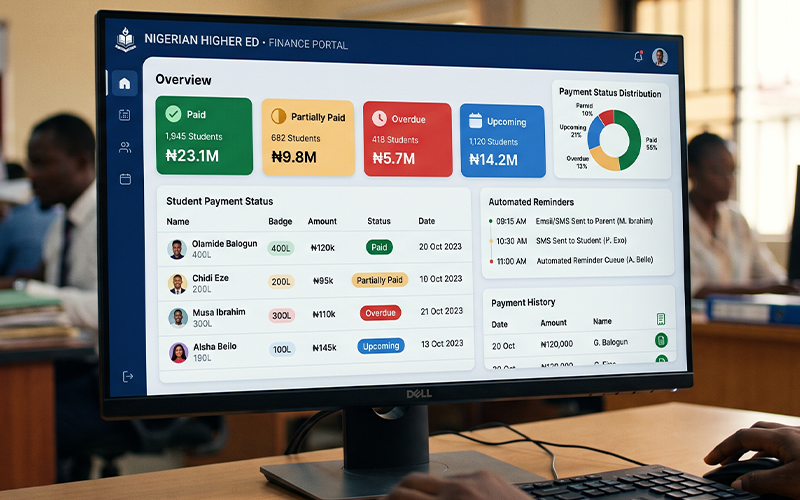
Payment convenience has a direct bearing on when, not just whether, fees get paid. Institutions that reduce friction tend to see fewer delays. A few things help consistently:
- Automated fee reminders sent ahead of and after deadlines, rather than one manual email at the start of term
- Multiple payment options so a parent is not stuck with a single, inconvenient channel
- Clear, visible deadlines and shareable payment links rather than instructions buried in a letter
- Real-time notifications confirming payment, so no one is left wondering if a transfer went through
- Self-service access to outstanding balances, so parents can check and settle without contacting the office
Between these, automated fee reminders tend to do the most work. A parent who receives a nudge three days before a deadline, and another the day after it passes, is far more likely to pay promptly than one relying on memory or a printed circular from six weeks earlier.
Fee Defaulter Management, the Constructive Way
Effective fee defaulter management is less about labelling families and more about giving finance teams a structured way to see who needs attention. Software can surface outstanding balances, overdue payments, partial payments and students approaching a deadline, all ranked by urgency, alongside each student’s payment history.
That structure changes how follow-up happens. Instead of checking every account individually, a finance team can review a short list of accounts genuinely falling behind and follow up with context: how much is owed, for how long, and what has already been paid. It turns a punitive-feeling chase into a manageable, evidence-based process, which tends to preserve the relationship with families rather than strain it.
Online School Payments and Multiple Payment Methods
Enabling online school payments means giving families more than one realistic way to pay. Depending on the institution, its country and its payment provider, this can include bank transfers, card payments, mobile payments and hosted payment links through a secure gateway. In much of Sub-Saharan Africa, mobile money is no longer a secondary channel: the region recorded 1.1 billion of the world’s roughly 2 billion registered mobile money accounts as of 2024, and mobile wallets carried around $1.4 trillion in transactions across the region in 2025 alone, according to GSMA’s State of the Industry Report on Mobile Money. For a school or university, that scale of adoption is a strong argument for supporting more than one payment rail. What matters more than the number of options, though, is that every channel routes through secure, PCI-compliant processing, so convenience never comes at the cost of financial safety.
How Fee Collection Software Helps Finance Teams
For finance teams, the benefit of a proper tuition collection system shows up in the back office as much as the front end. Automated reconciliation matches payments to invoices without manual entry. Digital receipts remove the need to issue and file paper copies. Financial and outstanding-balance reports are available on demand rather than compiled once a term. The net effect is that finance staff spend less time chasing payment records and more time on cash-flow planning, budgeting and reporting to school leadership or governing boards, work that actually requires their judgement.
Connecting Fee Collection With Student Information Systems
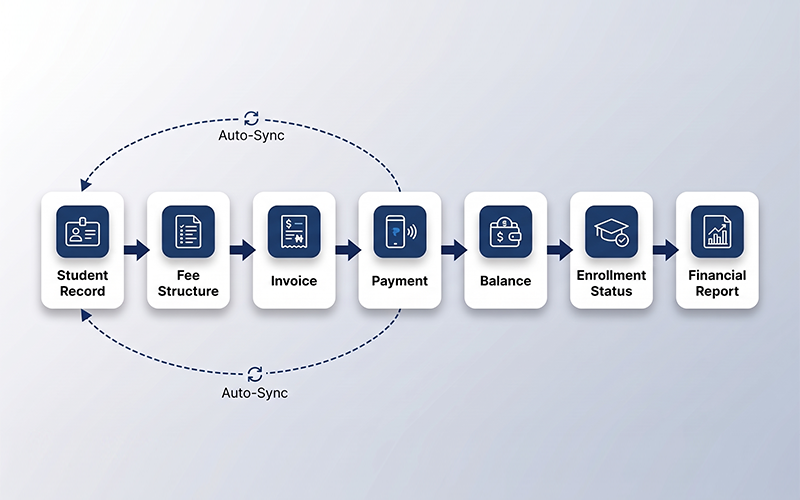
Payment data that lives apart from student records creates blind spots. If a finance system cannot see enrolment status, and a student information system cannot see outstanding balances, institutions end up making decisions on incomplete information: reissuing an ID card to a student with unpaid fees, or flagging a fully paid family as a defaulter because a receipt was never linked to their file.
A connected flow looks more like this: student record → fee structure → invoice → payment → balance → enrolment status → financial report. This is where student payment management becomes part of the same system as admissions and records, rather than a parallel spreadsheet. A student information system such as Enroli SIS is built to hold that link, so a payment update and an enrolment record are never two separate sources of truth. In practice, this is what good student payment management looks like: one record, updated once, visible to everyone who needs it.
Read More: Student Onboarding: How Universities Build a Seamless First 90 Days
How Vigilearn Supports the Student Payment Journey
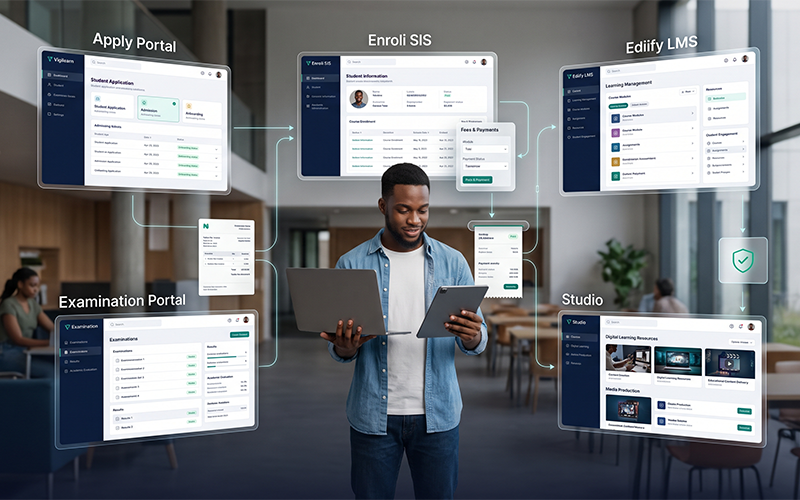
Fee collection does not happen in isolation from the rest of the student lifecycle, and Vigilearn’s ecosystem is built around that continuity. The Apply portal supports billing and fund collection from the point of application, so payment expectations are clear before a student even enrols. Enroli SIS allows institutions to collect fees online through payment gateways and keep that activity tied to each student’s record. From there, Ediify LMS, the Examination Portal and Studio carry the same student through learning, assessment and collaboration.
Positioned this way, payment is not a bolt-on feature. It is one stage in a connected lifecycle that runs from application through enrolment, learning and beyond, which is precisely the kind of automated tuition collection institutions need if they want fewer disconnected systems and fewer manual handoffs between them. It is also why automated tuition collection works best when it is designed as part of the student record, not bolted onto it after the fact.
What to Look for in Fee Collection Software
Before choosing a system, it helps to assess the full workflow rather than just the payment page. Look for:
- Reliable payment tracking and real-time balance visibility
- Automated reminders configurable by deadline and channel
- Student and parent self-service account access
- Digital receipts generated without manual input
- Reporting and reconciliation that update automatically
- Documented payment security and compliance standards
- Integration with existing student information systems
- Scalability as enrolment grows
- Role-based user access controls
- Responsive vendor support
Institutions that evaluate against this full list, rather than the payment gateway alone, tend to avoid the trap of buying a payment tool and still running the surrounding admin by hand.
Frequently Asked Questions
What is school fee collection software? It is a system that manages fee invoicing, online payments, reminders, receipts and reconciliation as one connected process, rather than a standalone payment page.
How does automated fee collection work? Once a fee is created, the system notifies the student or parent, processes payment, confirms it, issues a receipt and updates both the student account and the finance dashboard automatically.
How can schools reduce unpaid fees? By combining automated fee reminders, multiple payment options, visible deadlines and easy self-service access to balances, so paying is simple rather than a process parents have to chase down.
Can schools send automatic payment reminders? Yes. Most systems allow reminders to be scheduled before and after deadlines, reducing reliance on manual follow-up emails or calls.
What payment methods can schools accept online? This depends on the institution’s country and provider, but commonly includes bank transfers, card payments, mobile payments and secure payment links.
How does fee collection software help finance teams? It automates reconciliation and reporting, reducing manual data entry and giving finance teams real-time visibility into cash flow and outstanding balances.
Can fee collection software integrate with an SIS? It should. Linking payments to a student information system like Enroli SIS keeps enrolment status, records and financial data consistent across the institution.
Read More: Learning Analytics in Higher Education: How Universities Turn Student Data Into Better Outcomes
Bringing It Together
Managing student payments should not require finance teams to chase spreadsheets, receipts and payment confirmations term after term. The institutions that move away from that cycle are not simply the ones that put a payment button on their website; they are the ones that treat fee collection as a connected workflow, from invoice through to reconciliation and record update.
That is the shift school fee collection software is built for: fewer manual handoffs, clearer visibility into who has paid, and a finance team with time back for actual financial planning. If your institution is still reconciling fees by hand, it may be worth seeing what a connected system looks like in practice.
Request a demo to see how Vigilearn connects student administration, digital workflows and financial processes across one education technology ecosystem.
