
An online university application portal is a structured digital platform where applicants submit forms, upload documents, and track admission status in a guided workflow. Instead of sending documents through email or filling out disconnected forms, applicants move through a centralised system that organises information and validates submissions before they reach the admissions office.
Traditional admission processes often rely on spreadsheets, email exchanges, and manually collected documents. While these systems may function at a small scale, they frequently introduce errors when application volumes increase. Staff members must download files, rename documents, cross-check data, and manually track missing requirements. In such environments, mistakes are almost inevitable.
Across higher education institutions, admission teams regularly deal with misplaced transcripts, incomplete forms, duplicate applications, and misfiled records. These issues slow decision timelines and increase administrative workloads. Modern institutions are therefore shifting towards structured digital admission systems and university application software designed to reduce errors while improving application processing efficiency.
Read more: University Admission Management System: A Complete Guide
Common Admission Errors in Traditional Application Systems

Admission teams often spend more time correcting application errors than evaluating applicants. Traditional systems create multiple opportunities for mistakes because they depend heavily on manual processes.
Below are some of the most common issues institutions encounter.
Missing Documents: Applicants frequently forget to attach required materials such as transcripts, identification documents, or recommendation letters. When documents arrive through separate email threads, it becomes difficult for admission officers to match files to the correct application.
Incorrect Data Entry: Manual transcription of student information into spreadsheets or databases introduces the risk of human error. A single incorrect digit in an email address or identification number can disrupt communication or delay application processing.
Duplicate Applications: When institutions accept submissions through multiple channels, applicants sometimes submit the same application more than once. Admission staff must then spend additional time identifying and merging duplicate records.
Incomplete Forms Applicants occasionally skip sections in application forms, particularly when requirements are not clearly structured. Missing academic history or programme selections can delay evaluation.
Lost Emails: Email-based application processes create a fragmented information trail. Important attachments may end up buried in inboxes or spam folders, making it difficult to track submissions.
Delayed Verification: When applications arrive through various channels, verifying documents and confirming receipt becomes a slow, manual process. Admission teams must cross-check records across multiple files before making decisions.
Read more: Student Enrolment Automation in Universities
Impact on Admission Timelines
These errors have significant operational consequences: slower application processing, increased administrative workload, delayed admission decisions, and applicants left waiting for updates. By the time admission officers identify and correct these errors, valuable time in the admission cycle may already be lost.
How an Online University Application Portal Prevents Errors
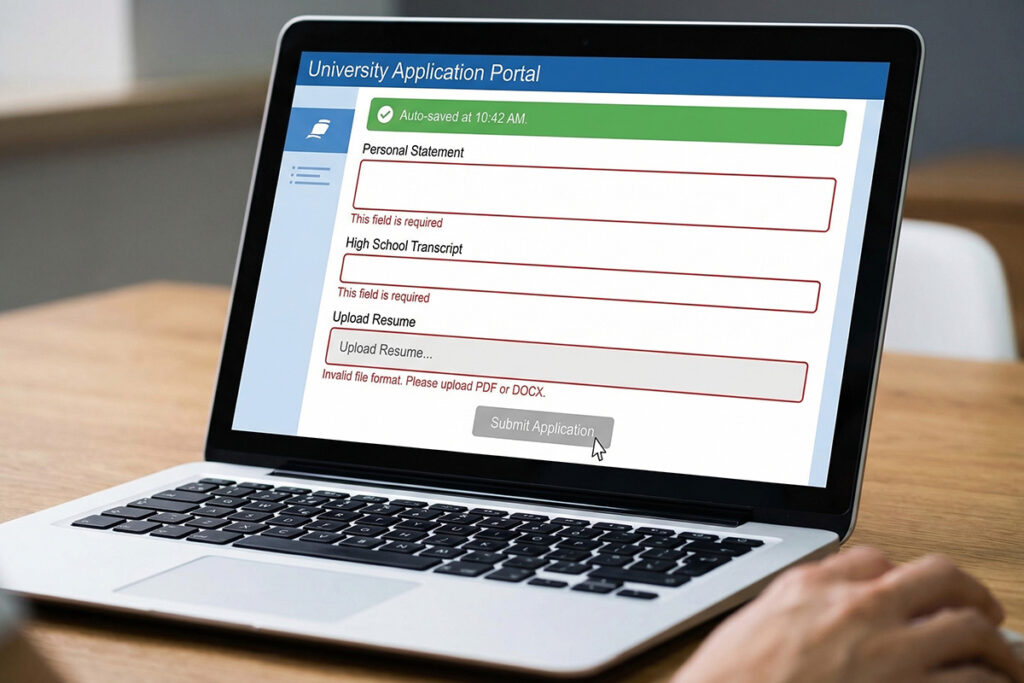
An online university application portal addresses many of the structural weaknesses found in traditional admission workflows. Instead of allowing applicants to submit incomplete or inconsistent information, the system guides them through a controlled and validated submission process.
Modern portals include several safeguards designed to reduce admission errors.
Mandatory Field Validation: Application forms cannot be submitted unless all required fields are completed. This ensures that essential information, such as academic history, personal identification details, and programme selections, is provided before submission.
Automated Document Checklists: Applicants see a clear list of required documents before submitting their application, and the system tracks whether each requirement has been fulfilled. Typical checklist items include academic transcripts, identification documents, a statement of purpose, and recommendation letters. Incomplete applications are flagged automatically.
File Format Restrictions: Applicants can only upload documents in accepted formats such as PDF or JPEG. This prevents corrupted or unsupported files from entering the system.
Real-Time Submission Confirmation: Once an application is submitted, the portal immediately sends confirmation to the applicant, eliminating uncertainty about whether documents were successfully received.
Auto-Save Features: Long application forms often cause frustration when applicants lose progress. Auto-save functionality ensures that information entered into the system is preserved even if the session is interrupted.
Status Tracking Dashboard: Applicants can track the progress of their application through a personal dashboard. This transparency reduces uncertainty and limits unnecessary follow-up emails.
These technical safeguards help ensure that the information reaching admission teams is structured, complete, and easier to process.
Structured Workflows That Improve Accuracy
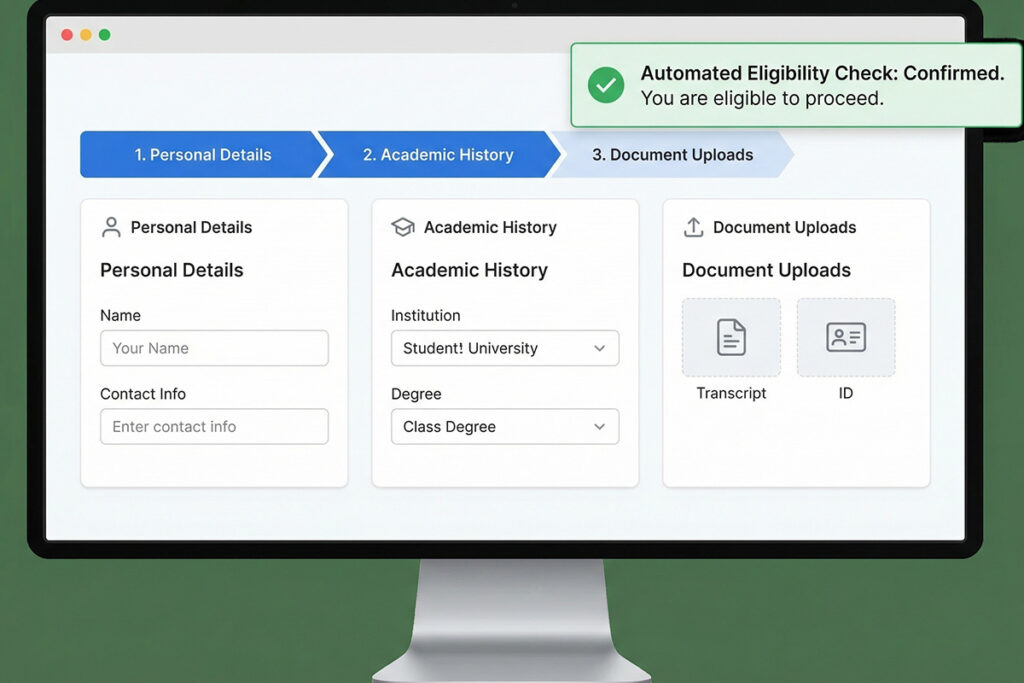
One of the most important advantages of modern admission platforms is structured workflow design. Instead of submitting a collection of documents without guidance, applicants move through a clearly organised process.
Step-by-Step Guided Forms: Application portals break the submission process into manageable stages, each focusing on a specific category of information: personal details, academic history, programme selection, document uploads, and a final review before submission. This structured approach reduces confusion and encourages applicants to complete all necessary steps.
Automated Eligibility Checks: Many institutions now use automated application processing to verify whether applicants meet basic admission criteria. For example, the system can automatically check minimum grade requirements, required prerequisite subjects, and age or programme eligibility. Applications that do not meet baseline criteria can be flagged for further review.
Programme-Specific Document Requirements: Different academic programmes often require different documents. An engineering programme may require mathematics transcripts, while an arts programme may require a portfolio. A digital admission system automatically adjusts document requirements based on the programme selected by the applicant.
Built-In Verification Processes: Some systems integrate document verification checkpoints that allow admission staff to confirm document authenticity before moving applications forward.
This structured workflow significantly improves data accuracy and ensures consistency across applications.
Improving Communication with Applicants

Communication breakdowns are another major contributor to admission errors. Without a centralised platform, admission teams must respond to numerous enquiries from applicants asking whether their application has been received, whether their documents are complete, and when a decision will be made.
An online university application portal reduces this communication burden by automating key notifications.
Automated Applicant Communication: Common automated messages include instant confirmation emails after submission, notifications when documents are reviewed, alerts for missing materials, and decision announcements.
Deadline Reminders: Automated reminders ensure applicants submit required documents before deadlines, helping to reduce the volume of incomplete applications.
Centralised Messaging System: Instead of relying on scattered email exchanges, some portals include built-in messaging tools that allow applicants and admission officers to communicate within the application system itself. This reduces confusion and provides a clear record of interactions.
Reporting and Audit Trails for Admission Teams

Accurate record-keeping is essential in university admissions. Institutions must be able to track how applications were reviewed and why decisions were made.
A robust online university application portal includes detailed reporting and audit features. These systems typically track application activity logs, reviewer decisions and comments, timestamped updates for each application stage, and document verification records.
Audit trails provide several advantages: clear evidence of admission decisions, easier handling of appeals or disputes, transparent review processes, and improved compliance with institutional policies. Organisations such as Educause have highlighted the role of digital systems in strengthening institutional accountability and governance in higher education.
When admission records are structured and traceable, institutions can maintain higher levels of transparency and trust.
Read more: How Universities Can Reduce Admission Processing Time
Scaling Without Increasing Administrative Errors

Many universities face increasing application volumes each year, yet expanding the admission team is not always feasible. Without technological support, higher application volumes typically lead to more administrative mistakes.
An online university application portal allows institutions to scale admissions without compromising accuracy. Modern university application software enables institutions to handle larger application pools through automation, with key capabilities including simultaneous high-volume intake, automatic categorisation and linking of uploaded documents, automated screening filters based on predefined criteria, and reduced manual intervention, freeing admission teams to focus on evaluating applicants rather than managing files.
Institutions seeking to modernise their admissions processes may benefit from platforms specifically designed to support scalable admission workflows, such as those offered by Vigilearn, which provides tools for digitising admission processes and centralising application management.
Frequently Asked Questions
What is an online university application portal?
An online university application portal is a digital platform where prospective students submit application forms, upload required documents, and track their admission status. The portal organises submissions into a structured workflow, helping institutions manage applications efficiently while reducing administrative errors.
How do online portals reduce admission mistakes?
Online portals reduce errors through form validation, automated document checklists, structured workflows, and automated application processing. These systems ensure applications are complete and accurate before reaching admission officers.
Can application portals handle international applicants?
Yes. Modern online university application portals are designed to support applicants from around the world. They support flexible document uploads, automated verification, and structured workflows to accommodate international academic records and admission requirements.