
Managing assessments in a university is a far more complex undertaking than most people outside of academia appreciate. At any given time, a single institution may be running hundreds of concurrent examinations across multiple faculties, processing thousands of scripts, coordinating invigilators, managing grade submissions, and trying to release results within tight academic calendars. All of that, while maintaining fairness, accuracy, and compliance. For decades, universities navigated this complexity almost entirely through manual processes: paper-based exams, physical mark sheets, hand-delivered scripts, and results compiled through spreadsheets. The cracks in that system were always visible. They have simply become impossible to ignore.
The shift towards digital infrastructure in education has changed expectations on every front. Students now expect timely feedback. Accreditation bodies expect verifiable, consistent records. Institutional leadership expects data that they can act on. An assessment management system sits at the heart of meeting all three. It is not simply software for conducting online exams; it is a structured digital framework that governs the entire lifecycle of academic evaluation, from question creation through to final grade publication and reporting.
Read more: Student Data Management System for Modern Universities
The Real Cost of Traditional Examination Systems

In traditional setups, lecturers spend considerable time manually setting papers, printing and distributing them, overseeing physical invigilation, collecting scripts, and grading individually. Results are then entered into registers, cross-checked manually, and eventually submitted to an academic registry. Every step in this chain carries risk: a mismarked script, a miscalculated total, a missing answer booklet, or a result published with an error.
Assessment practices continue to move away from limited and inefficient manual assessments in favour of faster, more secure digital processes. Institutions are no longer asking whether to integrate technology but rather how to integrate it best. The operational burden is simply too significant. For universities managing tens of thousands of students, especially across distributed campuses, the administrative overhead of paper-based exam management is both financially and logistically unsustainable.
There are fairness concerns, too. Inconsistent marking criteria between lecturers, a lack of standardised grading rubrics, and the absence of audit trails make it difficult to defend disputed results. Students lose trust in processes they cannot see. Institutions face reputational risk when errors surface publicly.
What an Assessment Management System Actually Includes
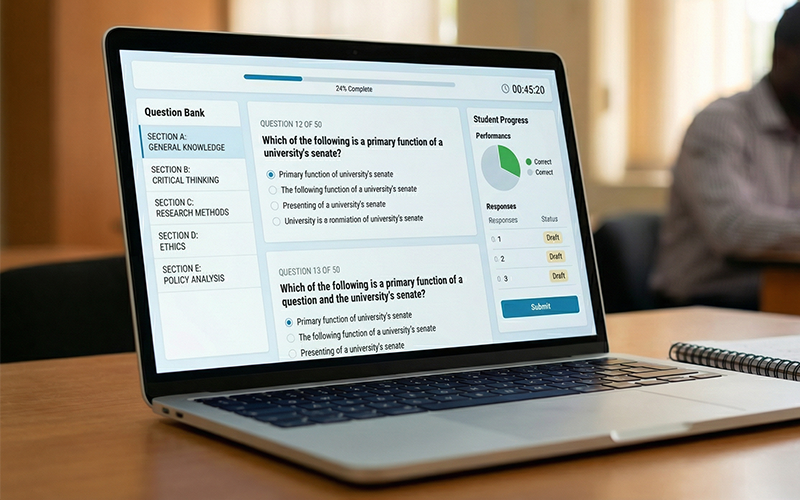
A well-built assessment management system is not a single tool; it is a suite of integrated capabilities that work together. The core components typically include:
- Question bank management: A centralised repository where educators create, categorise, and version-control assessment items. Questions can be tagged by topic, difficulty, and learning outcome, making it easy to assemble balanced papers quickly.
- Exam scheduling and delivery: Automated scheduling tools that allocate exam slots, notify students, and manage access windows for online test delivery.
- Varied question formats: From multiple-choice and short-answer to essay-based and case-study formats, a robust digital assessment platform supports diverse evaluation methods.
- Automated and manual grading: Objective questions can be marked instantly by the system, while subjective responses are routed to examiners through structured workflows.
- Results management and reporting: Grades are computed, moderated, and published through the platform, with analytics dashboards providing insights into performance trends across cohorts.
An examination management system provides an end-to-end solution for educators and administrators to create, administer, and evaluate exams, whether conducted online or offline, and can be integrated with existing learning management systems or function as a standalone application. That integration capability is particularly important. A standalone tool that does not communicate with other academic systems creates its own kind of inefficiency, which is discussed further below.
The Benefits of Switching to a Digital Assessment Platform

The advantages of adopting a digital assessment platform extend well beyond administrative convenience. They reshape the quality of evaluation itself.
Speed and accuracy are the most immediate gains. Automated grading of objective assessments eliminates human error and can return results to students within hours rather than weeks. By automating tasks like scheduling, grading, and publishing results, the time and effort required by educators to manage exams is significantly reduced.
Scalability is equally significant. A university with 5,000 students faces different operational demands than one with 50,000. A properly configured assessment management system handles both without proportionally increasing administrative overhead. Exams can be delivered simultaneously across multiple campuses or remotely, without compromising standardisation.
From the student experience perspective, the ability to receive timely, specific feedback transforms assessment from a one-directional test of knowledge into a genuine learning intervention. Analytics that surface common misconceptions allow educators to refine their teaching in real time. And for academic leadership, institution-wide performance data informs curriculum review, resource allocation, and accreditation submissions more reliably than any manually compiled report could.
Read more: Online Exam Management Systems for Universities in 2026
Ensuring Fairness and Integrity in Digital Assessments

Integrity is, understandably, the concern that gives many university leaders pause when considering online exam management software. If students cannot be physically supervised, what prevents dishonesty?
A majority of respondents (72%) in EDUCAUSE’s 2024 AI Landscape Study identified academic integrity as a teaching and learning element that has been at least somewhat impacted by AI. That concern is legitimate, and any credible digital assessment platform must address it seriously.
Modern systems deploy several layers of protection:
- Remote proctoring: AI-assisted monitoring that flags suspicious behaviour, combined with live or recorded oversight by human invigilators.
- Browser lockdown: Restricting students to the exam interface during testing, blocking access to other applications or websites.
- Plagiarism detection: Integrated tools that scan submitted text against academic databases and previous submissions.
- Randomised question delivery: Drawing different question sets for each student from a shared question bank, reducing the value of collusion.
- Audit trails: Time-stamped logs of every action taken within the system, providing a defensible record for dispute resolution.
Together, these mechanisms create an environment where integrity is protected not through physical presence alone, but through transparent, verifiable processes. Higher education technology leaders should empower instructors to develop authentic assessment methods that are facilitated by technology, recognising that the human element remains central. Technology supports fairness; it does not replace the judgment of educators in designing meaningful assessments.
Integration With Learning Platforms and Academic Systems
An assessment management system realises its full value when it works as part of a connected academic ecosystem rather than in isolation. Integration with a learning management system (LMS) means that assessments are embedded directly within the learning environment students already use, reducing friction and providing a more coherent academic journey.
Deeper integrations enable automated synchronisation of student enrolment data, so that when a student registers for a course, they are automatically assigned to the correct assessment schedule. Grades flow directly into student records systems, reducing manual entry and the transcription errors that accompany it. Reporting tools pull from a single source of truth, giving academic registrars, programme directors, and quality assurance teams consistent, reliable data.
An integration of an exam management system with a Student Information System enhances the versatility of the exam platform and offers students and faculty a more efficient examination experience, with steps including compatibility assessment, data synchronisation, and seamless workflow management. The institutions that benefit most from digital assessment are those that treat it as an infrastructure investment, not just a software purchase.
How Vigilearn Supports Assessment Management
Vigilearn is built with the operational realities of universities in mind. We offer a comprehensive assessment management system that covers the full examination cycle, from secure question bank construction through to automated grading, result publication, and performance reporting.
Through Vigilearn’s Examination Portal, institutions can schedule and deliver examinations online with flexible access controls, supporting both synchronous and asynchronous assessment formats. Automated grading tools handle objective assessments at scale, whilst structured workflows route subjective responses to the appropriate examiners. The platform’s reporting suite gives academic leadership meaningful analytics on student performance, cohort trends, and assessment integrity.
Importantly, Vigilearn is designed for integration, connecting with existing learning management systems and student information infrastructure to ensure that academic records remain accurate, centralised, and up to date. Institutions dealing with growing student populations, dispersed campuses, or increasing pressure from accreditation bodies will find particular value in a system that scales without sacrificing rigour.
To explore how these capabilities apply to your institution’s context, visit the Vigilearn blog for further insights on digital education management.