
There is a quiet crisis playing out across university campuses worldwide, and it rarely makes headlines. Lectures begin, registers are passed around, names are called out one by one, and somewhere in that daily ritual, critical data slips through the cracks. A student whose name is marked present may be sitting in a café three streets away, signed in by a classmate. Another student, genuinely struggling, drifts into irregular attendance over weeks before anyone notices. By the time administrative staff compile records and flag concerns, entire semesters have already been lost.
The case for a reliable student attendance tracking system has never been more urgent. An analysis of over 1.1 million students across 22 major research institutions found that the number of hours students spent attending classes, discussion sections, and labs declined dramatically between the 2018–2019 academic year and 2022–2023. At the same time, a study of 422 final-year Business and Management students in UK higher education found a significant positive correlation between attendance and final assessment scores, confirming that greater participation contributes meaningfully to academic outcomes. For university leaders, this is not merely an operational question. It is a student success question, and it demands a modern answer.
Read More: Faculty Training for Digital Learning Platforms: Preparing Educators for Modern Teaching
The Real Problems With Manual Attendance Tracking

Ask any lecturer who has spent the first ten minutes of a 50-minute class calling out names and waiting for mumbled responses. Manual attendance is not just inefficient; it is structurally broken. The problems are well-documented and consistent across institutions of all sizes.
Proxy attendance is perhaps the most damaging. Without a system that verifies physical presence, absent students can have classmates sign in on their behalf, undermining the credibility of attendance records and the integrity of in-person education. Paper registers and verbal roll calls are trivially easy to circumvent, and most lecturers have neither the time nor the means to catch it.
Beyond fraud, the operational burden is significant. Manual data entry introduces errors that compound across a semester. Records get lost, attendance sheets are misplaced, and aggregating data from hundreds of courses becomes a near-impossible administrative task. Traditional sign-in methods, including paper sheets, class calls, and non-dedicated spreadsheet tools, are a consistent source of frustration for educators and administrators alike. The third and most consequential problem is the absence of real-time insight. When attendance is logged manually and compiled weekly or monthly, the window for early intervention closes long before it is ever opened. A student who misses three consecutive weeks of lectures may not appear on anyone’s radar until results day.
What Is a Student Attendance Tracking System?
A student attendance tracking system is a digital platform that automates the recording, monitoring, and reporting of student presence across academic activities. Rather than relying on paper registers or verbal roll calls, the system captures attendance data electronically, links it to student records, and makes it immediately accessible to lecturers, administrators, and institutional leadership.
An ideal solution should make attendance nearly invisible in the classroom: instead of consuming five to ten minutes of teaching time, it should take only seconds, allowing instructors to focus fully on delivery and students to focus on learning. Critically, it must eliminate human errors, prevent proxy attendance, and feed data automatically into the systems universities already rely on, such as learning management systems (LMS) and student information systems (SIS).
Universities are shifting to automation for several interconnected reasons: growing enrolment numbers make manual systems impractical, regulatory compliance demands accurate records, and the rising emphasis on student success requires data-led early intervention. A digital attendance system for universities is no longer a luxury technology; it is institutional infrastructure.
Read More: Student Data Management System for Modern Universities
Types of Student Attendance Tracking Systems
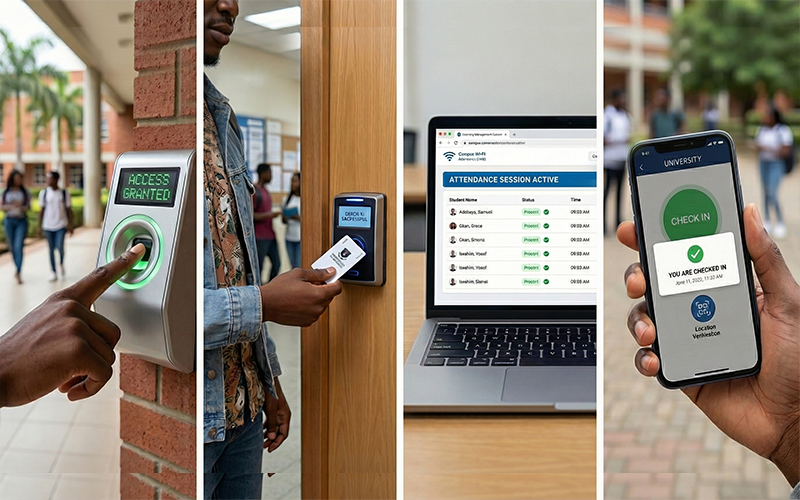
Different institutions have different contexts, and no single solution fits every campus. The most widely deployed approaches include:
Biometric systems use fingerprint scanning, facial recognition, or iris recognition to verify student identity at point of entry or within the classroom. Biometric attendance systems eliminate proxy attendance by requiring students to authenticate through their unique physical traits, so that present marking occurs only for those who are genuinely there. The trade-off is cost: hardware installation across large campuses represents a significant capital investment.
RFID and smart card tracking involve students tapping a card or key fob against a reader. The system logs the timestamp and location instantly. This approach scales well for high-traffic entry points but is less effective for lecture-by-lecture tracking without readers in every room.
LMS-based attendance tracking integrates directly into an institution’s existing learning management system. Lecturers manage attendance from within the same platform they use for course delivery, and data flows automatically into student records. This is typically the most cost-effective and scalable option for large universities.
Mobile-based check-ins allow students to mark their attendance via a smartphone app, using geolocation restrictions or time-limited codes to verify physical presence. Mobile apps offer accessible, reliable, and cost-effective solutions that address many of the challenges associated with older attendance methods, including the risk of proxy sign-ins and manual data errors.
The Benefits of Automated Attendance Tracking
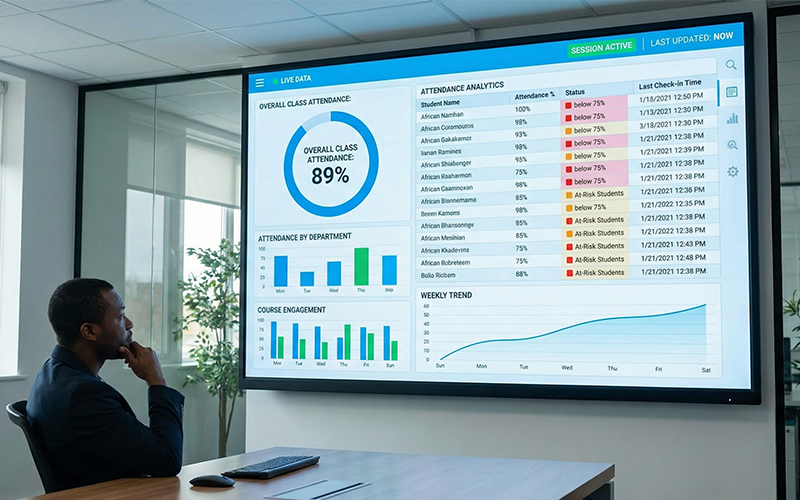
Switching to automated attendance tracking transforms both the efficiency and the intelligence of university attendance management. The core benefits are substantial:
- Tamper-proof accuracy: Digital records tied to verified identities eliminate proxy sign-ins and manual entry errors.
- Real-time monitoring: Lecturers and administrators can view attendance data the moment it is captured, not days or weeks later.
- Reduced administrative workload: Staff no longer need to compile, transfer, or manually analyse attendance records across departments.
- Improved compliance and reporting: Regulatory requirements, including visa compliance for international students, are met with reliable, auditable data.
- Early identification of at-risk students: Patterns of absence become visible early enough for meaningful intervention.
A good attendance management solution is a practical ally in meeting regulatory obligations while improving student retention and graduation rates. These are not abstract benefits. They translate directly into better outcomes for students and reduced operational risk for institutions.
Read More: Reducing Admission Errors Through Online Application Portals
Integration With Academic Systems
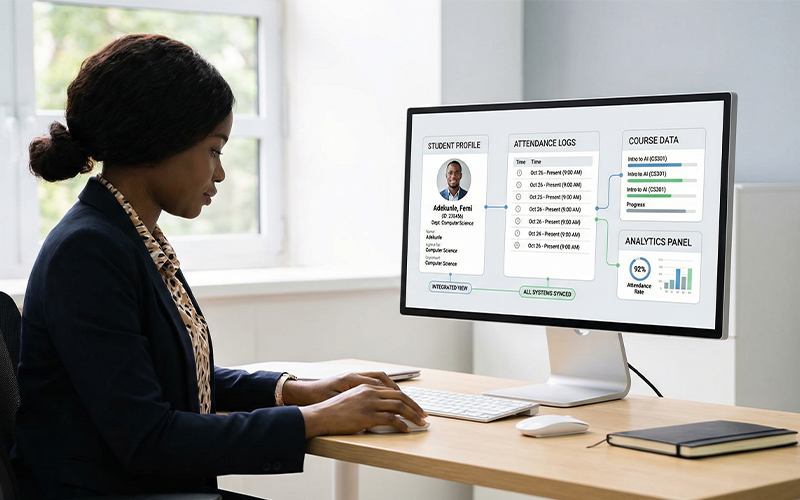
A student attendance tracking system only reaches its full potential when it does not operate in isolation. Integration with the wider university academic ecosystem, particularly the LMS and SIS, is what transforms attendance data from a compliance record into a genuine institutional intelligence tool.
Attendance data should flow automatically into the systems universities already use, such as LMS platforms or student information systems, enabling seamless data exchange without manual re-entry. When these systems are connected, a single platform can surface a student’s attendance record alongside their assignment submissions, grade history, and engagement metrics. Centralised dashboards give academic leaders a complete picture of student participation across departments, cohorts, and campuses.
Heads of department can identify courses with consistently low attendance, flag systemic issues, and allocate support resources where they are most needed. This is the difference between reactive administration and proactive university attendance management.
How Attendance Data Supports Better Decision-Making
The data produced by a digital attendance system for universities does more than confirm who was in the room. When analysed thoughtfully, attendance patterns become powerful predictors of student outcomes. Research using measured attendance data from nearly 1,000 undergraduate students at the Technical University of Denmark demonstrates that early and consistent class attendance strongly correlates with academic performance. Prior research consistently shows that attendance is one of the strongest predictors of class grades and student outcomes, creating a compelling case for institutions to monitor it rigorously and act on what they find.
For individual students, attendance trends are often the earliest visible sign of disengagement, mental health challenges, or external pressures. A system that flags unusual absence patterns automatically allows personal tutors and student support teams to intervene before problems escalate. This is automated attendance tracking in service of genuine pastoral care. At the institutional level, attendance data informs curriculum planning, resource allocation, timetabling decisions, and accreditation reporting. It enables leadership to correlate attendance with academic performance across programmes, identify structural barriers to engagement, and make evidence-based policy decisions.
How Vigilearn Enables Smart Attendance Tracking
Vigilearn is built for universities that need more than a register. As a comprehensive education technology platform, Vigilearn integrates student attendance tracking system functionality directly into its EdiifyLMS, enabling institutions to capture, monitor, and act on attendance data without toggling between disconnected systems.
Lecturers can log attendance within the same interface they use to deliver courses and manage assessments. Administrators access real-time dashboards that aggregate data across departments, courses, and campuses. Student support teams receive automatic alerts when attendance patterns suggest a student may be struggling. And institutional leaders get the reporting infrastructure they need for compliance, accreditation, and strategic planning.
Vigilearn’s approach to university attendance management is scalable: whether your institution has 500 students or 50,000, the system adapts. The platform is designed to integrate with existing academic workflows rather than disrupt them, making adoption straightforward for both technical and non-technical staff.
For universities ready to move beyond manual registers and disconnected spreadsheets, Vigilearn offers the kind of centralised, intelligent attendance infrastructure that modern higher education demands. Explore what is possible at vigilearn.com or visit the Vigilearn blog to read more on digital transformation in higher education.