Data. It’s everywhere. In the smartphones students carry, in the digital platforms teachers use, and in the silent patterns of success and struggle within classrooms. In a country as richly diverse and rapidly evolving as Nigeria, the promise of big data in education echoes with potential. But what does it truly mean? And how can it reshape how students learn, how educators teach, and how institutions decide?
To some, big data might appear as abstract numbers grappling in the cloud. To others, it is the spark that could illuminate every student’s unique learning journey. For Nigerian schools, from bustling urban universities to remote rural classrooms, leveraging data is not just another trend to jump on; it’s a necessity.
What is Big Data in Nigerian Education?
At its core, “big data” refers to extremely large volumes of structured and unstructured data that can be analysed computationally to reveal trends, patterns, and associations. In education, this spans attendance records, grades, digital interactions, learning platform usage, assessments, and more.
How it applies to schools and universities
In Nigeria some schools and universities are beginning to collect and channel immense streams of data, from students clicking through digital lessons to AI-powered quizzes that adapt in real time. These data streams enable insights such as which topics students struggle with most, who might benefit from extra support, and where institutional training gaps exist.
Importance of data-driven learning
When educators rely on data, decisions shift from gut instinct to informed strategy. Data-driven learning empowers personalised instruction, timely interventions, improved resource allocation, and institutional planning grounded in evidence, not guesswork.
How Big Data Improves Student Performance in Nigeria
Personalised Learning Paths
Big data transforms the concept of teaching from a one-size-fits-all model into a personalised journey. By analysing vast amounts of student data, such as assessment results, interaction times, topic difficulty, and preferred learning formats, educators can tailor learning materials to each learner’s unique profile. For instance, if a student excels in algebra but consistently underperforms in geometry, a big-data-powered platform can automatically deliver more geometry exercises, explain concepts differently, or adjust pacing until mastery is achieved. Over time, this targeted approach builds a stronger foundation, encouraging deeper understanding and sustained confidence, rather than simply advancing students at fixed intervals.
On the African continent, Malawi’s pilot of adaptive learning tablets developed by onebillion, a UK edtech non-profit company, stands out as a compelling example. Deployed in Mzimba district, these tablets deliver lessons in local languages, adjusting difficulty based on student responses. The result? Within 13 months, children gained the equivalent of 4.2 months of additional literacy learning relative to peers. Such gains not only attest to effectiveness but also underscore big data’s power to personalise learning at scale, even in low-resource settings.
Tracking Attendance and Grades Through Dashboards

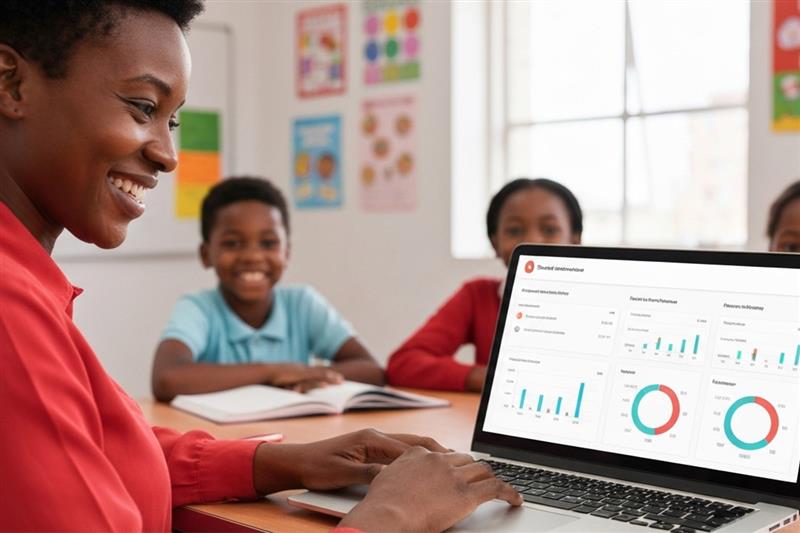
Attendance and academic performance tell powerful stories, whether in isolation or combination. With automated tracking systems, schools can compile data such as punctuality, frequency of class attendance, assignment completion rates, and grade progression seamlessly and continuously. When this information is aggregated across multiple classrooms or schools, it becomes far more than log entries; it becomes actionable intelligence. Patterns begin to reveal themselves: maybe a cluster of absences coincides with poor quiz scores, or community events influence dips in attendance.
Equally important, educators can access this information through intuitive dashboards. These visual tools highlight trends, rising absence rates, underperformance in specific subjects, or seasonal slumps, and trigger timely responses, such as sending alerts to teachers or parents. In broader systems, such dashboards can inform school administrators and policy makers about systemic issues: high dropout regions, teacher-attendance gaps, or resource-constrained schools.
Predicting At-Risk Students with Analytics
The true power of big data lies in predictive capability, the ability to identify early signs of trouble before they become full-blown crises. In Nigeria, researchers at Niger Delta University applied machine learning models, like multilayer perceptron (MLP), to historical student performance data and achieved approximately 98% accuracy in predicting low academic performance. Tailoring interventions based on these forecasts, such as extra tutoring or counselling, becomes not just possible, but precise.
Institutions across the country have explored similar efforts. At the University of Abuja, envisioning a Big Data–driven Early Warning System, researchers propose analysing metrics like attendance, assignment submission, and participation to flag students at risk of academic probation, thus enabling pre-emptive support. At Bayero University Kano, analytics are being studied to predict academic trends across the student population, offering university leaders a clearer view of who might need help before it’s too late.
Case Examples from Nigerian Schools and Universities: Real Applications of Big Data
While Nigeria’s implementation of full-scale big data systems in education is still in early stages, several noteworthy initiatives and research-based implementations illustrate how data-driven approaches are beginning to improve learning outcomes and institutional efficiency.
1. Machine Learning Models at Federal University, Oye-Ekiti
One compelling example comes from the Federal University Oye-Ekiti: researchers developed machine learning models, specifically M5P Decision Tree and Linear Regression Classifier, to forecast student performance in programming courses. These models were trained on data from students’ backgrounds, lecturers, facilities, attendance, even factors like erratic power supply and student health. The insights revealed that non-academic factors play a significant role in academic performance and can guide targeted interventions.
2. Clustering for Academic Monitoring
An earlier study utilized k-means clustering to classify students according to performance levels. Conducted in a private Nigerian higher-education institution, the technique enabled academic planners to track students’ progress and make data-driven decisions in real time, a keystone application of analytics for monitoring and improving educational outcomes.
Challenges of Using Big Data in Nigerian Education
Data privacy and storage issues
Collecting sensitive student data raises serious privacy concerns. Many institutions lack secure storage or data governance policies. Without encryption or clear consent frameworks, sensitive information can be exposed or misused.
Lack of digital infrastructure
Many schools, especially in rural or underfunded areas, lack reliable electricity, internet connectivity, or digital tools. Without consistent digital access, collecting and analysing big data becomes a bridge too far for many institutions.
Teacher training requirements
Even when data systems exist, educators often lack the training to interpret dashboards or utilise insights effectively. Building data literacy, a comfort with numbers, analytics, and digital tools, is a crucial hurdle.
Future of Big Data in Nigerian Education
Government support and policies
Nigeria’s education funding, though improving, still trails UNESCO’s recommendation of 15–20% of annual budgets. Yet, recent support includes a $1.08 billion World Bank loan approved in April 2025, with $500 million earmarked to enhance education quality. Such funding can catalyse digital infrastructure and data systems, but must be matched with policy frameworks to protect and leverage data effectively.
Role of EdTech platforms like Vigilearn Technologies
Platforms such as Vigilearn Technologies stand poised to lead the charge. By offering cloud-based learning environments, dashboards for teachers, and data-driven insights across subjects, EdTech can bring big data in Nigerian education into classrooms nationwide. Vigilearn Technologies can help shape personalised learning, early intervention, and institutional oversight, all supported by intuitive analytics.
Global best practices that Nigeria can adopt
Across the world, education systems leverage big data in transformative ways:
- UNESCO tracks global SDG-4 education metrics to guide policy.
- The World Bank employs service delivery data to enhance school oversight and accountability.
- The OECD’s Trends Shaping Education 2025 report explores how AI, big data, and digital transformation shape future education systems.
Nigeria can adapt these approaches, building national data standards, integrating analytics into teacher training, and monitoring learning outcomes via digital assessment tools.
Big data can help unlock every student’s potential if we dare to listen, invest, and adapt. The moment is now. Let’s co-create an education system that’s not only smarter, but profoundly more inclusive, responsive, and impactful.
By adopting data-driven tools like Vigilearn’s learning and management platforms, institutions can unlock personalised learning, early intervention, and smarter decision-making. The future of education in Nigeria will be shaped by how well we leverage data today, so don’t wait. Get in touch with Vigilearn to discover how we can help your institution transform student performance through big data.