
Ask any registrar how confident they are in last term’s attendance records, and the honest answer is usually somewhere between “reasonably” and “not entirely.” A biometric attendance system for schools exists precisely because paper registers and manual sign-in sheets leave too much room for error, and that gap becomes expensive once an institution needs to report accurate figures to accreditation bodies, parents or its own leadership.
The problem rarely announces itself. A teacher marks a register by voice roll call, a student signs in for a friend running late, a clerk transcribes paper records into a spreadsheet a week later. None of this is malicious; it is simply how manual systems behave under pressure. But the cumulative effect is attendance data nobody fully trusts, a real operational cost for institutions tracking absenteeism, verifying exam eligibility or monitoring staff hours, and part of the broader case for structured school attendance monitoring.
Read More: School Management Software Cost: A Complete Pricing Guide
What Is a Biometric Attendance System?
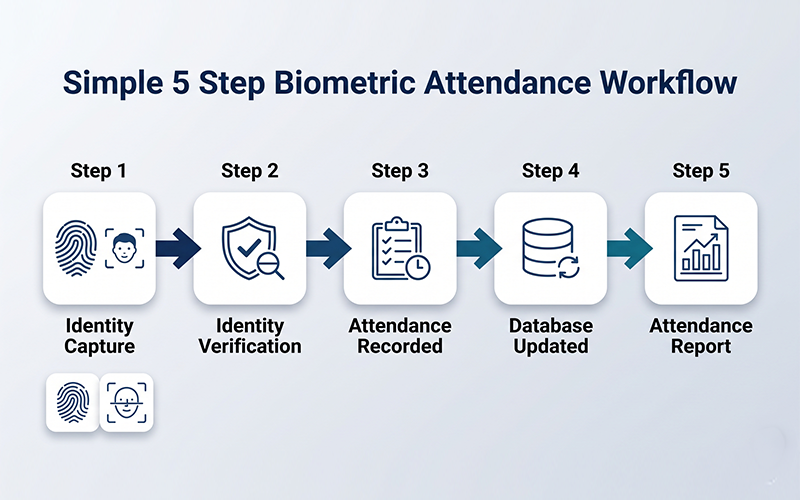
A biometric attendance system identifies individuals using a unique physical characteristic, most commonly a fingerprint or facial feature, rather than a signature or verbal confirmation someone else can give on their behalf. The basic process is straightforward: identity capture, where a fingerprint or facial image is scanned; identity verification, where the system matches that scan against a stored profile; attendance recorded, timestamped and logged; database update, where the record syncs to the student or staff file; and attendance report generation, which turns raw logs into something administrators can use.
Worth being precise about what this technology does and does not do. It verifies that the person present is who they claim to be. It does not, by itself, improve attendance rates or strengthen academic engagement. Those outcomes depend on what an institution does with the resulting data, whether it acts on patterns or lets accurate numbers sit unused in a dashboard.
Fingerprint vs Facial Recognition Attendance
Neither method is universally better; the right choice depends on the environment and the institution’s tolerance for hardware maintenance versus camera infrastructure.
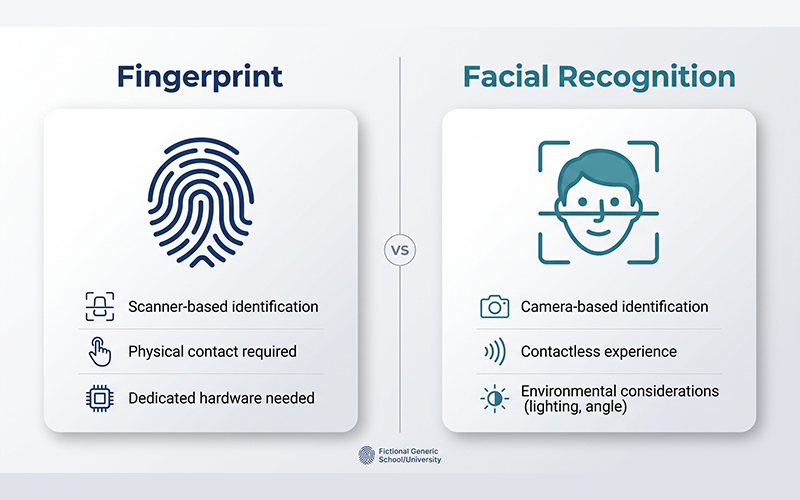
| Factor | Fingerprint | Facial Recognition |
| Identification method | Physical contact with a scanner | Contactless image capture |
| User experience | Brief pause per person | Faster for groups |
| Hardware | Dedicated fingerprint scanners | Cameras, sometimes existing CCTV |
| Environmental considerations | Dust, moisture, worn prints | Lighting, angle occlusion (masks, glasses) |
| Hygiene considerations | Shared touchpoint | Contactless |
| Deployment requirements | Simple, offline-capable | More processing power and calibration |
| Best use cases | Small to mid-sized entry points, staff clock-ins | High-traffic entry points, large halls |
Fingerprint systems tend to be cheaper at scale and more forgiving in low-connectivity settings, while facial recognition attendance moves larger groups through faster but raises lighting and consent questions covered further down.
Read More: Learning Analytics in Higher Education: How Universities Turn Student Data Into Better Outcomes
How Biometric Attendance Can Reduce Proxy Attendance
Proxy attendance, where one student answers for another, or a colleague signs a register on a co-worker’s behalf, is one of the most persistent weaknesses of manual systems. It happens quietly and is almost impossible to catch afterwards, since a name on a register offers no proof of who was physically present.
A fingerprint attendance system or facial recognition attendance supports proxy attendance prevention through identity verification tied to a unique physical characteristic, real-time records that timestamp each check-in, and audit trails harder to manipulate than a paper sheet. That said, biometrics are not a complete fix for attendance fraud: a student can still leave immediately after checking in. What biometrics changes is the reliability of the initial verification step, not everything that happens after it.
Student Attendance vs Staff Attendance
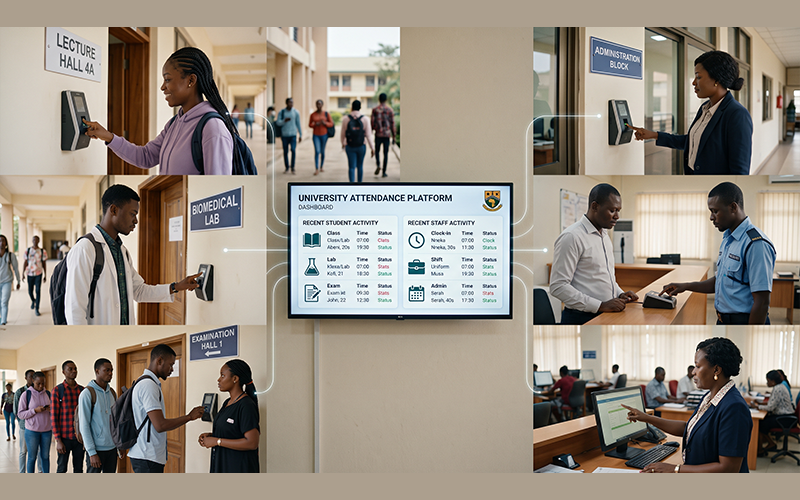
Institutions generally need to treat these as related but distinct use cases, since the policies and consequences differ.
Students: class attendance, examination attendance (where identity verification also protects exam integrity), laboratory sign-ins, and campus activity participation.
Staff: the priority shifts toward staff time and attendance software, recording work hours, managing shift-based attendance, and maintaining leave records for payroll and HR.
Because staff time tracking intersects with labour law and payroll in ways student attendance tracking does not, most institutions are better served configuring separate policies for each group rather than one blanket framework.
Read More: Student Onboarding: How Universities Build a Seamless First 90 Days
Connecting Attendance Data With School Management Systems
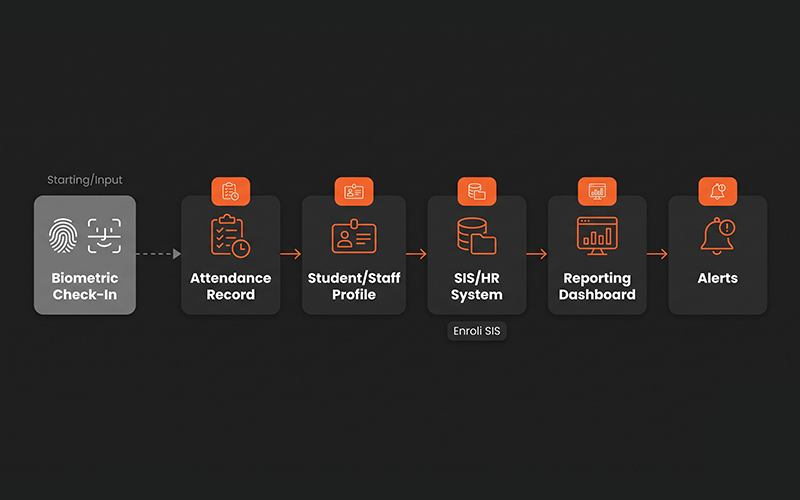
Attendance data sitting in a standalone biometric device has limited use. Its real value emerges when connected to the rest of an institution’s systems: a check-in generates a record, which updates the relevant profile, which feeds reporting dashboards, which can trigger alerts when a pattern warrants attention, a student missing consecutive classes, say.
This is where automated attendance management earns its name: the connection happens automatically instead of a clerk cross-referencing sheets against enrolment lists. A student information system such as Enroli SIS is designed to hold that link, keeping attendance tied to the same record as enrolment status.
Benefits of Automated Attendance Management
Done well, a well-implemented biometric attendance system for schools tends to deliver a fairly consistent set of gains:
- More accurate records, tied to verified identity rather than self-reported sign-ins
- Reduced manual work for teachers, registrars and HR staff
- Faster reporting, available on demand rather than compiled at term end
- Better visibility into absenteeism and lateness patterns as they develop
- Fewer opportunities for proxy attendance to go unnoticed
- Configurable alerts when someone crosses an attendance threshold
- Historical records supporting accreditation, audits and trend analysis
Worth restating the earlier caveat: none of this automatically improves academic outcomes. Accurate student attendance tracking gives an institution better information; what it does with that information determines whether the investment pays off.
Privacy, Security and Data Governance
This is the section institutions should not skip. Biometric identifiers are sensitive precisely because they cannot be changed the way a password can.
A few governance principles matter most for any biometric attendance system for schools:
- Lawful basis and consent, with parental consent processes where children are involved
- Data minimisation: collect and retain only what is operationally necessary, a template match rather than a raw, reusable image where possible
- Access controls and encryption for biometric templates, both at rest and in transit
- Retention limits, so data belonging to students or staff who have left does not linger indefinitely
The regulatory backdrop varies by country. In Nigeria, the Nigeria Data Protection Act 2023 classifies genetic and biometric data used to uniquely identify a person as sensitive personal data, triggering stricter processing requirements and, in most cases, explicit consent. Institutions operating in Nigeria should treat biometric attendance data with the same care as health records, and consult the Nigeria Data Protection Commission for current guidance. On the technical side, NIST’s biometric evaluation programmes test accuracy and interoperability across fingerprint and facial systems, useful reference points when assessing vendor claims. Facial recognition specifically has drawn wider scrutiny in education settings; a 2021 UN Human Rights Council report recommended states restrict facial recognition in schools on academic freedom grounds, a reminder that consent and necessity deserve real scrutiny, not just a procurement checkbox.
Read More: How to Choose an LMS: A Practical Evaluation Checklist for Institutions
What to Look for in a Biometric Attendance System
Before committing to a vendor, institutions should evaluate the full operating picture rather than accuracy claims alone:
- Identification accuracy under real classroom or campus conditions, not laboratory conditions
- Hardware reliability and expected maintenance needs
- Integration with existing student information and HR systems
- Reporting flexibility, including exportable, audit-ready formats
- Offline capability where connectivity cannot be guaranteed, plus real-time sync once it resumes
- Granular user management and role-based access
- Documented security practices and clear data protection commitments
- Scalability as enrolment or staff numbers grow, and responsive technical support
Pilot the system in the institution’s actual environment, its lighting, network reliability and entry-point congestion, before a full rollout. A system that performs well in a demonstration can behave differently in a crowded corridor at 7:45 on a Monday.
How Biometric Attendance Fits Into a Connected Education Ecosystem
Attendance is one operational layer within a longer chain: admissions, enrolment, student records, attendance, learning, assessment and results. Treated in isolation, attendance data tells an institution who showed up. Connected to the rest of the student journey, it informs academic support decisions, exam eligibility checks and institutional reporting alike.
Within Vigilearn’s ecosystem, this connective structure is the design principle. The Apply portal and Enroli SIS manage admissions and enrolment records, Ediify LMS carries the learning experience, the Examination Portal manages assessment, and Studio supports collaboration alongside it. Biometric attendance is not currently a built-in feature of these products, but the underlying logic, keeping every stage of the journey tied to one consistent record, is exactly the environment attendance data needs to be genuinely useful rather than another disconnected spreadsheet.
Read More: Digital Credentials and Verifiable Certificates: The Future of Academic Records
Frequently Asked Questions
What is a biometric attendance system for schools? A system that verifies identity using a fingerprint, facial feature or other approved biometric method, then logs and reports attendance from that verified check-in.
How does fingerprint attendance work? A fingerprint is scanned and matched against a stored template; a successful match logs a timestamped record tied to that individual.
Can facial recognition track student attendance? Yes, cameras match facial features against enrolled profiles, though accuracy can be affected by lighting, angle and obstructions such as masks.
Can biometric attendance prevent proxy attendance? It reduces certain forms significantly by requiring physical presence for verification, but cannot eliminate every form of attendance fraud, such as leaving right after checking in.
Is biometric attendance safe? It can be, provided institutions apply proper governance: encryption, access controls, data minimisation and clear retention policies, given biometric data is classified as sensitive personal data under most privacy laws.
Can biometric attendance track staff? Yes, staff time and attendance software on the same underlying technology is commonly used for clock-ins, shift tracking and leave records.
Can attendance data integrate with an SIS? It should. Attendance is far more useful tied to the same record used for enrolment and academic administration, rather than sitting in a standalone device.
What should schools consider before buying? Accuracy under real operating conditions, integration with existing systems, offline capability, data protection compliance and vendor support, tested through a pilot rather than assumed from a demo.
Bringing It Together
Accurate attendance starts with reliable identity verification and ends with useful institutional data. A biometric attendance system for schools solves the first half convincingly, replacing guesswork with verified, timestamped records for students and staff alike. The second half, turning that data into better support and decisions, depends on how thoughtfully an institution connects attendance to the rest of its records, and how seriously it treats the governance obligations that come with handling biometric data.
Vigilearn helps institutions build connected digital workflows across admissions, student records, learning and assessment, so attendance data has somewhere useful to go once it is captured. Request a demo to explore how your institution can modernise its education technology infrastructure.
