
Your company ran 100 compliance trainings last year. Can you prove, with a timestamp, a name, and a score, that every single one happened?
For many organisations, the honest answer is: not confidently. Training happened. People attended. Boxes were ticked. But the evidence that a regulator would actually accept sits scattered across spreadsheets, email inboxes, paper sign-off sheets, and disconnected systems that do not speak to each other. When an auditor walks in and asks for documented proof that your workforce completed mandatory training, the scramble begins. That scramble is not just operationally embarrassing. It is, in industries where compliance is a legal requirement, a material risk event. The corporate compliance training audit trail is not an administrative nicety. For organisations operating in financial services, healthcare, manufacturing, insurance, and professional services, it is the difference between demonstrating governance and facing regulatory consequences.
Read More: HR Training Software: How Organisations Manage Employee Learning
The Hidden Risk Sitting Inside Most Organisations

The corporate compliance training audit trail problem is not usually the result of deliberate negligence. It is the result of systems that were never designed for accountability at scale.
Consider how most organisations manage training records today:
- Spreadsheet tracking: Multiple versions exist across departments. Human error is routine. Records from role changes, transfers, or seasonal staff fall through the gaps.
- Email-based confirmation: No centralised proof of completion. No reporting capability. Training evidence exists only as long as the relevant email thread is preserved.
- Manual sign-off sheets: Paper records are misplaced. Physical storage creates retrieval challenges. Verification is inconsistent.
- Disconnected learning systems: Data sits in silos. Reporting gaps emerge between platforms. No single record reflects the full training picture for any given employee.
The critical insight is this: the absence of evidence creates a compliance problem even when training genuinely occurred. Regulators do not award credit for good intentions. As compliance documentation specialists at Coggno note, every completion must generate the same core fields: employee ID, course reference, regulation mapped, completion timestamp, assessment score, and attestation. If your current system cannot reliably produce that chain of information on demand, you have a corporate compliance training audit trail gap, and that gap is your liability.
When Documentation Fails, It Stops Being an HR Problem
Compliance documentation failures have a way of spreading. What starts as a missing training record quickly becomes a cross-functional crisis.
Legal teams find themselves unable to demonstrate compliance efforts in the event of a regulatory investigation or employee litigation. Without documented evidence of training delivery, mounting a due diligence defence becomes substantially harder. Risk management teams face increased regulatory exposure because their controls cannot be evidenced. Executive leadership confronts reputational consequences when compliance failures become public. Boards and governance committees are confronted with oversight failures that should have been visible long before an auditor arrived.
The sectors where this risk is most acute share one characteristic: regulators with teeth. In financial services, record-keeping failures carry severe penalties. In 2021, the SEC and CFTC fined JP Morgan $200 million for failing to preserve records of business communications, a case that demonstrated how documentation failures at the institutional level translate directly into nine-figure financial consequences. In healthcare, the picture is equally unforgiving: a 2024 US Office for Civil Rights resolution against a mid-sized medical group cited “no documented evidence of annual privacy training for 23 of 31 covered workforce members” as a specific factor in a $240,000 HIPAA settlement. In manufacturing, ISO 9001 Clause 7.2 explicitly requires organisations to maintain documented evidence of employee competence and training; without it, certification is at risk. Training records, in all of these environments, are governance records. They are not HR housekeeping.
What Regulators Actually Expect During Audits
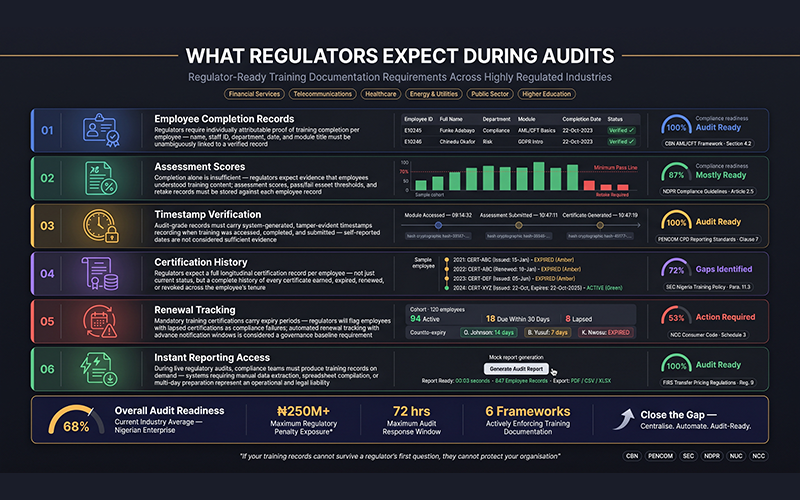
There is a persistent gap between how organisations think about compliance training and what regulators actually inspect. Understanding that gap is essential.
When an auditor requests training evidence, they are not looking for a spreadsheet that someone has been updating manually. They are looking for a verifiable chain of evidence that addresses several specific questions:
- Proof of completion: Who completed the training, and when?
- Assessment evidence: Did the employee pass? What score did they achieve?
- Timestamp verification: What was the exact date and time of completion?
- Training history: What prior attempts were made? When was the certification last renewed?
- Reporting accessibility: Can all of this be produced immediately, on demand?
OSHA penalties for serious violations can exceed $16,000 per violation, with wilful violations above $160,000 each. GDPR fines can reach 4% of annual global turnover or €20 million, whichever is higher. These are not theoretical maximums. They are active enforcement tools used by regulators who, by definition, audit evidence rather than intent.
The SHRM community of HR and compliance professionals consistently highlights audit readiness as a growing pressure, driven by expanding workforce complexity, hybrid working arrangements, and cross-border regulatory requirements that make consistent documentation harder to maintain with manual processes.
Read More: The ROI of Investing in Employee Training Through an LMS
The Real Cost of Poor Compliance Documentation
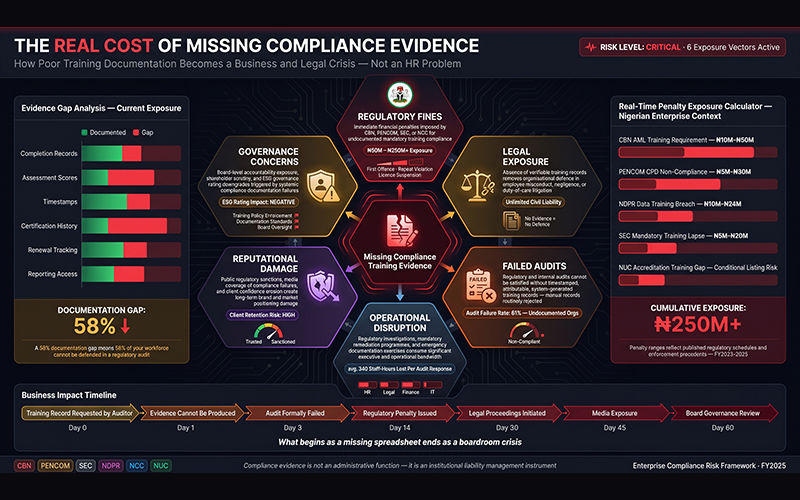
When organisations calculate the cost of compliance infrastructure, they typically weigh platform investment against operational benefit. What they rarely model is the cost of failure. That cost is measurable and significant across several dimensions:
- Regulatory penalties: Fines, sanctions, and corrective action requirements. These are public records and compounded with repeated findings.
- Legal exposure: When an employee brings a claim or a regulatory investigation opens, the inability to produce training records as evidence of due diligence creates a meaningful evidentiary disadvantage.
- Audit delays and remediation: Manual evidence gathering during an active audit is resource-intensive and disruptive. Emergency reporting exercises pull staff from operational responsibilities at exactly the wrong time.
- Operational disruption: Corrective action plans triggered by audit findings divert leadership attention and institutional resources for extended periods.
- Reputational damage: Stakeholder confidence responds to compliance failures. Research consistently shows that institutional credibility, once damaged by a documented compliance failure, takes years to recover rather than months.
The financial cost of recovery from a compliance documentation failure almost always exceeds the infrastructure investment that would have prevented it. That is not a financial argument for spending money. It is a risk argument for investing in the right infrastructure before the auditor arrives.
What a Regulator-Ready Compliance Infrastructure Looks Like
The organisations that handle compliance audits confidently have one thing in common: their documentation infrastructure was designed to generate evidence automatically, not retrospectively.
A genuinely audit-ready compliance system must include:
- Automated audit logs: Every training interaction recorded without manual intervention. No reliance on human memory or administrative follow-through.
- Completion verification: Attendance and assessment outcomes validated and stored, not just acknowledged.
- Assessment records: Scores, attempts, and pass or fail status are maintained with full history.
- Centralised compliance dashboard: A single source of truth that eliminates the multi-system retrieval problem.
- Automated reporting: Instant, formatted exports that match regulator expectations without additional processing.
- Historical record retention: Long-term evidence storage that survives staff turnover, system migrations, and organisational restructuring.
Compliance documentation should be automatic, not manual. Every manual step in the documentation chain is a potential failure point, and failure points accumulate in exact proportion to organisational scale.
Why Compliance Training Is Becoming a Data Management Challenge
The compliance landscape is not static. Organisations now manage larger and more geographically distributed workforces, hybrid teams that operate across jurisdictions with different regulatory requirements, recurring certification cycles, and an expanding list of mandatory training categories that includes data protection, workplace safety, anti-bribery, financial crime prevention, and increasingly, AI governance.
According to SHRM’s 2025 State of the Workplace Report, 57% of HR leaders reported that compliance-related workloads increased year-over-year, largely driven by new regulatory requirements and expanded oversight. That trend is not reversing. The volume of compliance data organisations must generate, store, and retrieve is growing, and manual processes are not designed to scale alongside it.
The World Economic Forum’s ongoing work on governance and institutional risk consistently highlights that regulatory requirements in highly connected, digitised economies are becoming more exacting, not less. Compliance risk does not diminish with workforce growth. It grows alongside it, and the organisations that manage it effectively are those that treat documentation as infrastructure rather than administration.
How Ediify LMS Creates a Corporate Compliance Training Audit Trail
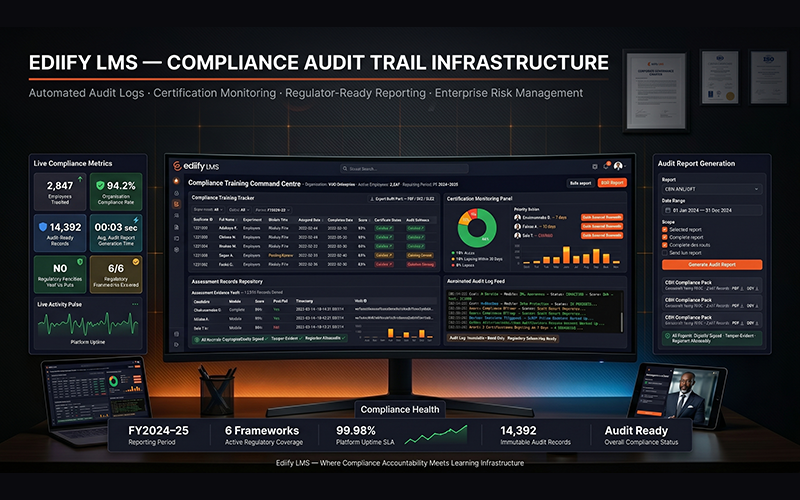
Ediify LMS is built around a clear principle: compliance documentation should be generated by the system, not by the people using it. Every training interaction is recorded. Completion is verified against assessment performance. The corporate compliance training audit trail is not something an administrator assembles after the fact. It is produced continuously, in the background, as a natural output of how the platform operates.
Practically, this means:
- Automated audit logs that capture every training interaction without requiring manual input or administrative follow-up.
- Compliance dashboards that provide real-time visibility across the entire workforce, by role, department, location, or training category.
- Assessment tracking that records scores, pass or fail status, and attempt history for every learner, linked to the specific regulation or standard the training addresses.
- Reporting automation that generates regulator-ready documentation instantly, without assembling records from multiple systems.
- Certification monitoring that tracks renewal dates, expiry status, and retraining requirements proactively, so compliance gaps are identified before they become audit findings.
Ediify operates as a compliance infrastructure rather than simply a learning platform. It functions as part of the broader Vigilearn ecosystem, connecting training delivery to student management workflows and institutional reporting. Evidence generation is not an afterthought. It is by design.
The Organisations That Will Pass Future Audits Easily
Future compliance environments will demand greater transparency, faster reporting, stronger governance documentation, and tighter audit trails across increasingly complex and distributed workforces. Regulators in financial services, healthcare, and professional services are investing in more sophisticated inspection capabilities. The compliance function is moving from periodic review to continuous scrutiny.
The organisations that will navigate this environment confidently are those that make audit readiness a permanent operational state rather than an event-driven exercise. They will not scramble to gather evidence when a regulator calls. They will produce it instantly, because their systems were built to generate it continuously.
Every compliance programme is only as strong as the evidence behind it. Ediify LMS automatically generates regulator-ready audit logs, compliance dashboards, and training records that stand up to scrutiny. Book a demo and discover how to eliminate corporate compliance training audit trail risk before the next audit arrives.
Frequently Asked Questions
What is a corporate compliance training audit trail? It is a complete, time-stamped record of who completed compliance training, when they completed it, what assessment score they achieved, and how that training maps to the relevant regulatory requirement. It is the evidentiary foundation that organisations must produce during regulatory inspections.
Why do regulators require training documentation? Because regulators audit evidence, not intentions. Demonstrating that training occurred, and that it was completed by the right people to the required standard, is the mechanism through which organisations prove they have exercised institutional due diligence.
How do companies prove compliance training occurred? Through timestamped completion records, assessment scores, and training history logs held in a centralised, tamper-resistant system. Regulators typically require these records to be produced on demand and to cover extended historical periods.
What records should compliance training systems maintain? Employee identity, course reference, mapped regulation or standard, completion date and time, assessment score, pass or fail status, attempt history, and certification renewal tracking. Every record should be tied to a specific employee and a specific regulatory obligation.
What is the risk of missing employee training records? Regulatory penalties, legal exposure in the event of employee claims or investigations, audit findings that trigger corrective action requirements, and reputational damage. The cost of missing records consistently exceeds the cost of the systems that would have prevented them.
How can LMS platforms improve compliance reporting? By automating evidence generation at the point of training delivery. A purpose-built compliance LMS records every interaction automatically, produces regulator-formatted reports on demand, and maintains historical records without administrative intervention, eliminating the documentation gaps that create audit risk.