
Digital identity verification has quietly become one of the hardest problems in government administration, not because verifying a single person is difficult, but because confirming that thousands of people in a database are real, unique and correctly linked to their records is. A ministry can have sound policy and capable staff, and still lose money and trust because its underlying records are unreliable.
The symptom shows up differently by sector. In payroll, it looks like salaries paid to people who no longer work, or never worked, for government. In education, it looks like enrolment figures that do not match classrooms, or certificates that cannot be traced to a real graduate. Both are versions of the same question: how does an institution know the person, student, worker or credential in front of it is genuine? As government services move online, digital identity verification is becoming a foundational layer of digital government infrastructure, not a one-off compliance task.
Read More: Biometric Attendance Systems: How Schools and Universities Track Attendance Accurately
What Is Digital Identity Verification?
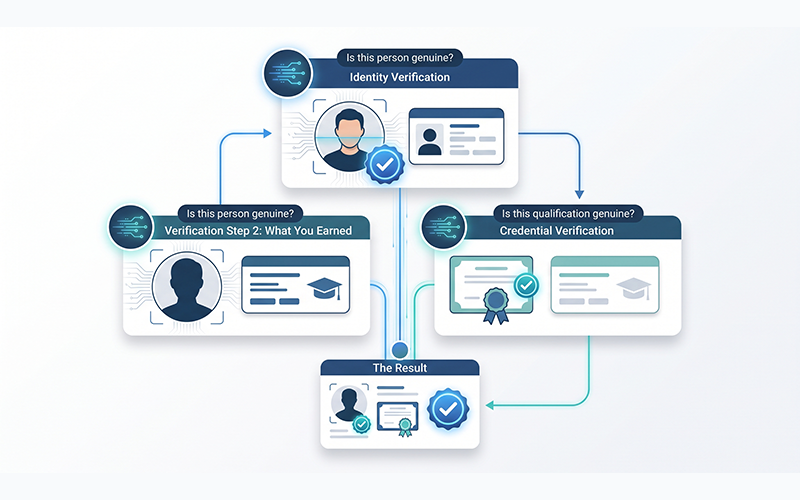
It is the process of confirming that a person is who they claim to be, using digital data rather than manual paper checks: the specific question of whether this person is who they claim to be. That is worth separating from three related terms that often get blurred together.
Identity authentication confirms that someone logging in now is the same person verified earlier, typically through a password, biometric or one-time code. Identity management is broader, covering how an institution creates, stores and retires identity records over time; a well-run identity management system needs governance as much as technology. Credential verification is different again: it confirms that a specific qualification is genuine, which is not the same as confirming who holds it. Effective digital identity for government treats all four as connected layers, not separate problems solved by separate teams.
Why Governments Need Digital Identity Verification
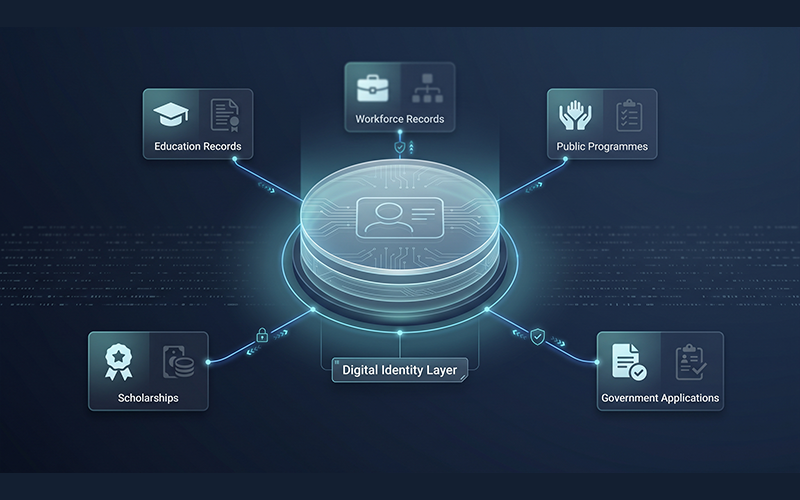
Government identity verification touches far more processes than most people realise: benefit disbursement, recruitment, scholarships, licensing, public programme applications and education records all depend on the same assumption, that the record matches a real, unique person. Public-sector records are especially exposed because so many agencies interact with the same citizens without sharing a common identity reference.
The value of one reliable identity across processes is straightforward. A citizen verified once, for a national ID, should not need re-verifying from scratch for every subsequent interaction, provided the right permissions and legal basis exist to reuse that verification. This is the practical case for government digital identity as shared infrastructure, and for treating an identity management system as a government asset rather than something each department rebuilds independently.
Read More: School Management Software Cost: A Complete Pricing Guide
The Ghost-Worker and Ghost-Student Problem
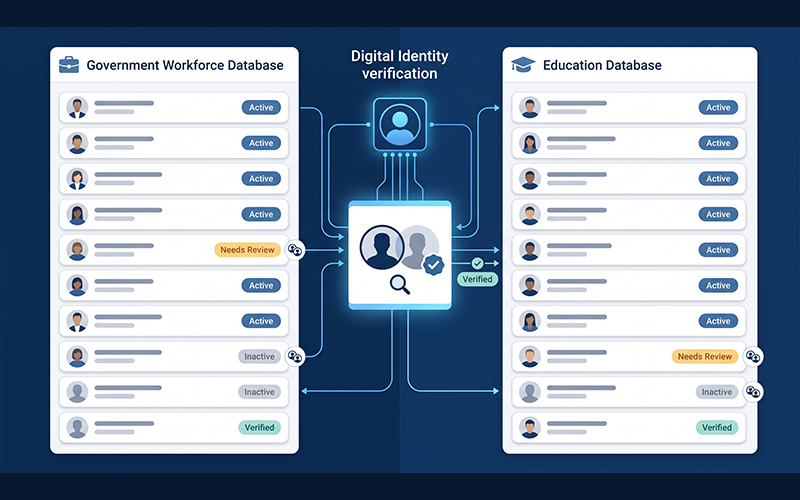
Ghost workers and ghost students illustrate what happens when identity records go unverified. A ghost worker is a name on a payroll with no real, active employee behind it; a ghost student is the same problem applied to enrolment and funding records. Both distort planning and drain resources meant for people who are actually there.
Nigeria’s experience with the Integrated Personnel and Payroll Information System (IPPIS) shows both the value and the limits of digitisation. The Independent Corrupt Practices and Other Related Offences Commission secured the final forfeiture of over ₦941 million linked to a payroll fraud investigation that traced fictitious personnel records across several federal ministries. IPPIS was introduced to reduce ghost workers and has delivered real savings, yet the case shows digitisation alone does not remove the underlying identity problem; it needs genuine identity matching alongside it. The risk is structurally similar in education wherever funding decisions rely on figures never checked against verified student identities.
How Government Identity Verification Works
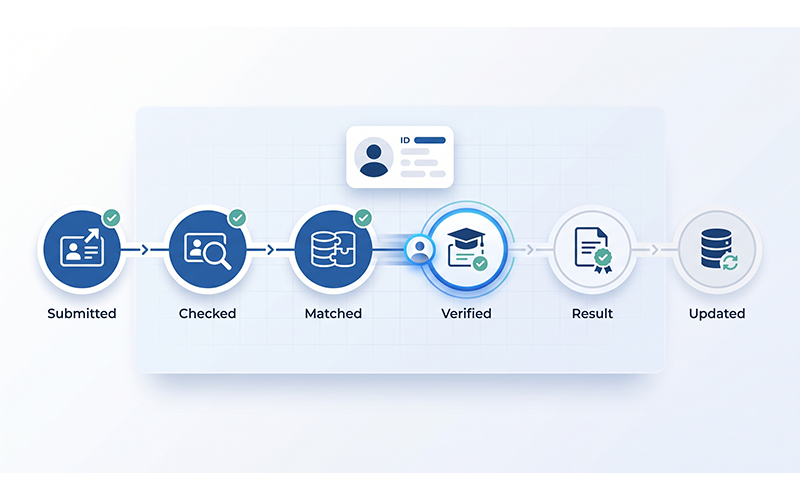
A typical government identity verification system follows a workflow along these lines:
- Identity submitted: the individual or an institution on their behalf provides identity data.
- Identity data checked: details are validated for completeness and format.
- Records matched: the data is compared against an authoritative source, such as a national ID database.
- Credential or status verified: any linked qualification, employment status or enrolment record is checked.
- Result returned: the requesting agency receives a match, mismatch or exception outcome.
- Record updated: the relevant government database reflects the verified status.
Verification can draw on multiple sources while respecting access controls, so an agency only sees fields it is legally permitted to see, not the full record. This is the mechanical core of e-KYC for government: fewer manual checks, more structured, auditable ones.
Connecting National ID With Government Services
Nigeria’s national identity system illustrates the scale of this challenge. NIMC’s enrolment figures reached over 127 million as of December 2025, part of a wider push under the World Bank’s Digital Identity for National Development programme. A national ID verification system at this scale becomes genuinely useful only once other government databases can query it reliably, which is what digital identity for government means in practice.
That integration depends on the specific systems, permissions and legal framework involved; it is not automatic, and should not be. Not every government database should share all identity information with every other database. Nigeria’s Nigeria Data Protection Act governs how personal data must be secured and shared, which is why a credible identity verification system needs access controls built in from the start.
Read More: Learning Analytics in Higher Education: How Universities Turn Student Data Into Better Outcomes
Digital Identity Verification in Education
Education is where fragmented identity causes some of the most persistent, quietly expensive problems. Student identity should ideally follow a learner from admissions through enrolment, assessment and graduation. In practice, it often resets at every stage, with new records created by systems never designed to talk to each other.
Nigeria’s Federal Ministry of Education has pushed hard on this at the credential level. The Nigeria Education Repository and Databank became mandatory nationwide in October 2025, and by early September 2026 its National Credential Verification Service had verified more than 115,000 academic credentials, each issued a National Credential Number. It shows what happens when a government treats education identity as infrastructure: certificates become checkable in real time rather than trusted on the strength of a physical document.
Verifiable Credentials: Moving Beyond Identity Checks
Identity verification confirms the person; credential verification confirms the qualification or record. They solve different problems and, ideally, work together.
Verifiable credentials are digital certificates that can be checked cryptographically rather than by phoning an institution or trusting a PDF. The W3C’s Verifiable Credentials Data Model, most recently updated in 2025, defines a standard way to express such credentials so a driving licence, degree certificate or professional qualification can be verified as tamper-evident and machine-readable, typically through a credential verification API rather than a manual letter. In education, 1EdTech’s Open Badges and Comprehensive Learner Record standards build on this same foundation, often including QR-based verification and unique credential identifiers a third party can check independently.
How Enroli Supports Digital Identity and Credential Verification
Enroli SIS, part of the Vigilearn suite, centralises student data, admissions and academic records for institutions handling large volumes of student information. Within Vigilearn’s positioning as sovereign infrastructure for institutional learning, Enroli is aimed at academic institutions, State Governments and Federal Ministry-level education systems that need a reliable, centralised record layer rather than fragmented spreadsheets across departments.
That record layer is where identity-linked academic records become possible: once student data sits in one governed system, connecting it to national identity infrastructure and credential verification standards, potentially through a credential verification API, becomes far more realistic. To be clear, Enroli does not replace a national identity authority such as NIMC, nor does it substitute for federal credential verification services such as NERD. It offers a properly structured record layer that institutions can connect to that infrastructure.
What Governments Should Look for in an Identity Verification System
Public-sector buyers evaluating an identity verification system, or the identity management system behind it, should look for:
- Accurate identity matching against authoritative sources
- Strong data security and encryption
- Granular privacy controls and role-based access
- Complete audit trails
- A well-documented credential verification API
- Genuine integration capability with existing government systems
- Scalability to national record volumes
- Fast verification turnaround
- Support for portable digital credentials
- Clear data residency terms
- Demonstrated reliability under real load
Missing audit trails or access controls tends to be the most damaging gap, since it undermines trust even when the matching itself works well.
Digital Identity and Data Sovereignty
Where identity data is stored and who controls access are not abstract questions for governments; they go to the heart of data sovereignty. Nigeria’s data protection framework, enforced by the Nigeria Data Protection Commission, sets out lawful bases for processing personal data and obligations on cross-border transfer, which matters for any e-KYC for government services handling citizen records.
Government ownership of identity infrastructure, rather than dependence on a single external vendor, is increasingly treated as a national interest. The National Information Technology Development Agency has been developing standards for government digital infrastructure, and any government digital identity system serving Nigerian institutions should start with local regulation, not a generic global template.
Read More: Student Enrolment Automation: How Universities Can Increase Applications and Reduce Drop-Offs
The Future of Government Identity Infrastructure
Several developments point toward identity as shared public infrastructure rather than a standalone feature. Portable digital credentials could let a citizen carry proof of identity across multiple government services without repeated re-verification. Interoperable systems and secure APIs could let a workforce record, an education record and a national ID verification system reference the same identity without duplicating data. Wider adoption of e-KYC for government could make real-time checking the default.
None of this is guaranteed, and adoption will vary by agency. What is clear is the direction: identity infrastructure supporting multiple public services, governed by clear rules on access and data sovereignty.
The underlying question rarely changes, whether the context is payroll, admissions, scholarships or credential checks: is this person, student, worker or qualification genuine? Reliable verification, at scale, is what removes the need for repeated manual checks. Governments that treat identity as shared infrastructure, properly governed and integrated with credential verification standards, tend to build public trust; those that leave it fragmented tend to rediscover the ghost-worker and ghost-student problem in a new form every few years. If your ministry, agency or institution is exploring how a government-facing student records platform can support this kind of infrastructure, Vigilearn offers Enroli SIS as a starting point, and you are welcome to request a free trial or get in touch to discuss your requirements.
Frequently Asked Questions
What is digital identity verification? The process of confirming, using digital data, that a person is who they claim to be, distinct from authentication, identity management and credential verification.
How does government identity verification work? Identity data is submitted, checked and matched against an authoritative source such as a national ID database, with results returned and the relevant record updated.
How can governments prevent ghost workers? By matching payroll records against verified identity data and enforcing access controls, as Nigeria’s IPPIS audits and ICPC investigations illustrate, alongside continued human oversight.
How can governments identify ghost students? By linking enrolment and funding records to verified student identities rather than relying on figures that are never checked against a verified source.
What is a national ID verification system? A system that lets government services confirm a person’s identity against an authoritative national database, such as NIMC’s National Identification Number system in Nigeria.
What are verifiable credentials? Digital certificates or records, built on standards such as W3C’s data model for verifiable digital credentials, that can be checked cryptographically rather than trusted on the strength of a physical document.
What is the difference between identity and credential verification? Identity verification confirms the person; credential verification confirms the qualification or record. Both are often needed together.
How can governments verify academic certificates? Through national credential verification infrastructure, such as Nigeria’s NERD and its National Credential Verification Service, which checks certificates against institutional records.
Can digital identity systems integrate with government databases? Yes, where the legal framework, permissions and technical integration exist, though this depends on each agency’s systems and should never mean unrestricted data sharing by default.
