
Why Does Edtech Matter in Emerging Markets?
Education is a key driver of individual opportunity and national development. Yet in many emerging markets, children do not receive the same educational experiences as those in wealthier countries. The gap is not just about what is taught but who gets taught, how frequently, with what tools, and under what conditions. When students lack quality learning environments, trained teachers, or even basic infrastructure, their ability to build skills, especially in reading, mathematics, and digital literacy, is severely hampered.
Developed nations have long benefited from stable infrastructure, abundant educational resources, higher teacher-to-student ratios, well-funded schools, and supplementary learning opportunities. In contrast, emerging markets often struggle with unstable electricity, sparse internet access, large class sizes, and limited proficiency in modern pedagogical techniques. Teachers may be undertrained or stretched thin. Funding from governments may be insufficient or inconsistently delivered. These challenges widen the educational divide between more and less privileged regions and between urban and rural areas.
Edtech has emerged as a powerful remedy to many of these problems. By leveraging technology, education solutions can scale more cost-effectively than physical infrastructure alone. Digital platforms, mobile learning, and online tools can reach more learners without building as many new brick-and-mortar schools. They can also support teachers, improve pedagogical quality, and deliver adaptive content.
Understanding the Learning Gap in Emerging Markets

To address the learning gap, we must first understand its dimensions. Some of the most serious barriers include:
- Infrastructure deficits. Many students in sub-Saharan Africa and parts of Asia lack access to reliable electricity, computers, or the internet at home or school. According to a UNICEF report, only 8 percent of students in sub-Saharan Africa have access to a computer at home. Furthermore, only 14% of people in sub-Saharan Africa have internet access at home.
- High data costs and connectivity gaps. Even where mobile broadband signals are available, many cannot afford data plans or hardware. For example, an analysis in Sierra Leone found that although 85 percent of the population was covered by mobile broadband, only 37 percent used the internet regularly, with high data costs being a major barrier.
- Teacher shortages and low quality of instruction. Some regions are missing millions of teachers. In sub-Saharan Africa, estimates suggest the need for tens of millions more teachers by 2030. Even among existing teachers, training in digital pedagogy, assessment methods, inclusive education, and continuous professional development is often inadequate.
- Unequal access by location, income, and gender. Learners in rural areas or in low-income households tend to have much poorer access to devices, connectivity, and often, qualified teachers. Girls can also be disproportionately affected. In West and Central Africa, only 5 percent of children and young people have internet access at home, compared with much higher rates in richer countries.
- Learning loss due to crises or prolonged school disruptions. When schools shut down or attendance is erratic, students fall behind. Without strong digital or alternative education delivery mechanisms, recovery is slow and inequitable across different communities. UNESCO and other agencies documented wide learning losses in regions without a remote learning infrastructure.
Affordable Digital Tools: Expanding Access to Quality Learning

Edtech can help overcome many of the barriers above by using tools designed for low resources. Here are tactics and examples.
- Mobile-first platforms and apps with low data needs. Many learners have access to mobile phones even when computers are unavailable. Platforms that run on Android, or even via messaging apps, can reach many more students. For instance, in Sierra Leone, a pilot project used a chatbot delivered through a messaging app that required 87 percent less data than typical web searches, yet provided curriculum-aligned content that teachers found relevant.
- Offline content and preloaded media. Where the internet is intermittent, content can be delivered via USBs, SD cards, or preloaded onto devices. Some edtech platforms or NGOs distribute tablets or devices with preloaded curriculum modules.
- SMS- and radio-based learning. For learners without smartphones or stable internet, simpler technologies work. SMS quizzes, radio broadcasts, or interactive voice response systems have been used to deliver lessons or reinforcement, especially during school closures or in very remote places.
- Peer learning and community groups. WhatsApp groups or local study clusters help students engage with content and each other, guided by teachers or facilitators, even when formal classes are disrupted. These informal networks can extend reach and build resilience.
For emerging markets, the viability of affordable digital tools also depends on localization: content in local languages, culturally relevant examples, and alignment with national curricula.
Teacher Training and Support Through Edtech
Teachers are central. No matter how good the platform or content, if teachers lack support, learning outcomes will remain weak.
- Virtual workshops, self-paced courses, micro-credentials. UNESCO’s Global Teacher Campus offers free online courses covering digital pedagogy, social-emotional learning, and curriculum management. These let teachers upgrade skills without leaving their community. Also, DSF Africa (Digital Skills Factory) delivers accredited e-learning courses for both students and teachers in various African countries. Since 2017, DSF has trained over 180,000 people in digital and 21st-century skills.
- Peer learning and mentoring. Teacher networks allow rural or isolated teachers to connect with more experienced peers, share best practices, observe digital lesson design, and adapt to new teaching tools. This kind of professional community fosters continuous adaptation.
- Tools for blended and hybrid learning. Edtech provides tools where teachers can mix in-class and online delivery, monitor student progress via dashboards, use digital assessments, and adjust instruction based on data. These teaching techniques often lead to stronger learning outcomes because they tailor to students’ pace and prior knowledge.
- Support for content design and pedagogy. Many teachers are trained in traditional lecture or memorization methods. Edtech can support more interactive, student-centred, inquiry-based learning. For example, STEM teacher training programs in Africa include practical demonstrations, lab or hands-on experiments, online simulations, and collaborative projects.
LMS and Virtual Classrooms: Reducing Infrastructure Barriers
Learning Management Systems (LMS) and virtual classrooms can radically reduce the costs and constraints of physical infrastructure.
- Cloud-based LMS. These systems do not require each school to host large servers or maintain expensive hardware. They allow for updates, backups, and maintenance to be centralized. Many LMS offerings are now SaaS (software as a service), reducing startup costs. According to a market report, over 78 percent of new LMS deployments in 2023 were cloud-based.
- Scalable virtual classrooms. Tools that support video conferencing, screen sharing, digital whiteboards, chat, etc., allow teachers to reach students remotely. Classrooms can be virtual with minimal investment in physical space. Even low-bandwidth options, audio-only or small video size, can help when connectivity is weak.
- Blended learning models. A mixture of offline and online learning often works best in emerging markets. Schools might meet a few times a week physically, complemented by digital assignments or virtual classes. This reduces transport cost, enables flexible scheduling, and makes better use of limited teacher time.
- Full online programs. In some cases, institutions run fully online courses, including degree programs, for local or regional learners. For example, uLesson’s Miva Open University in Nigeria provides degree programs delivered primarily online.
By leveraging LMS and virtual classrooms, learners in remote or underserved regions can access high quality instruction with fewer physical constraints.
Read more: Affordable Scalable LMS Solutions for Schools and Corporates
Government and Private Partnerships to Scale Edtech
Edtech does not operate in a vacuum. To achieve real scale, especially in emerging markets, collaboration between government, private sector, NGOs, and communities is essential.
- Public-private funding and policy alignment. Governments can set supportive policies (e.g. on internet regulation, teacher qualifications, curricula) and funding (grants, subsidies). Private companies bring innovation, technology, capital, and implementation capacity. Where governments and private entities have pooled resources, projects tend to reach more learners.
- Successful partnership models.
- In Kenya, the EdTech Africa Initiative is a public-private collaboration, involving USAID, Kenyan advisory councils, and universities, to strengthen higher education systems and foster innovation.
- The Mastercard Foundation EdTech Fellowship in Tanzania helps edtech start-ups scale, pairing innovation hubs and government or institutional partners.
- Infrastructure partnerships. Governments can partner with telecom companies to reduce data costs, zero-rate educational platforms, or build out broadband to schools and rural areas. Similarly, power provision (solar, micro-grids) for schools can be supported via joint projects.
- Scaling through local adaptation. Effective partnerships consider local languages, culture, and needs. A top-down model that ignores local context will struggle. For example, edtech platforms that localize content, adapt pedagogy, and involve local teacher feedback are more likely to succeed broadly.
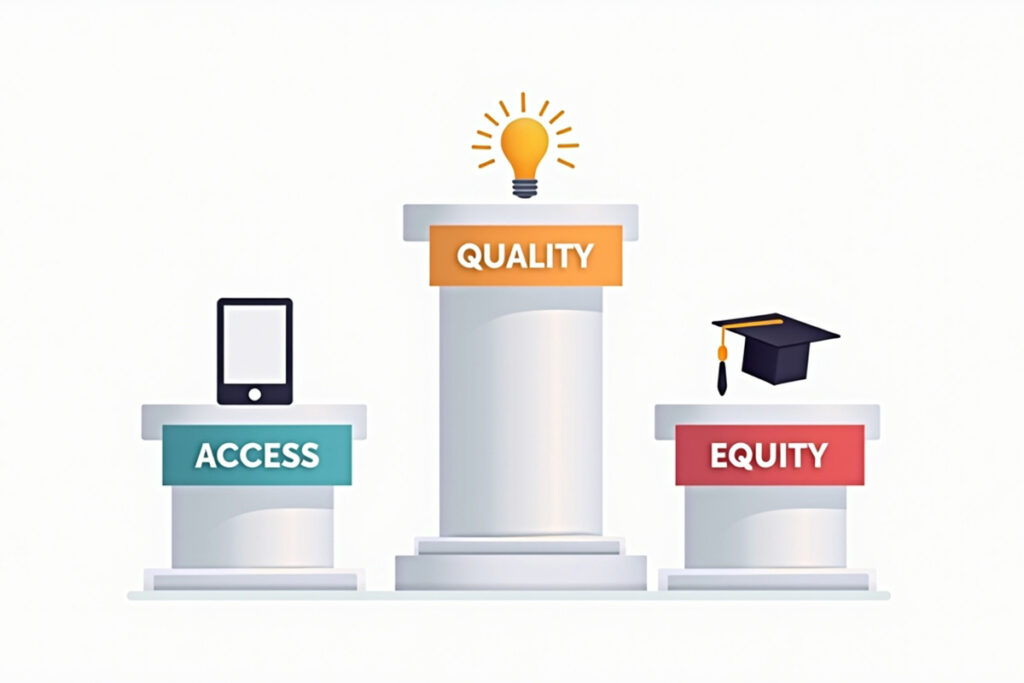
Education is the foundation upon which individuals build skills, understand the world, participate in society, and access opportunity. Edtech offers real paths to bridging gaps left by traditional education.
If edtech in emerging markets is done thoughtfully, it can make education not just more accessible but more equitable, more effective, and more resilient. That is a future worth building.