


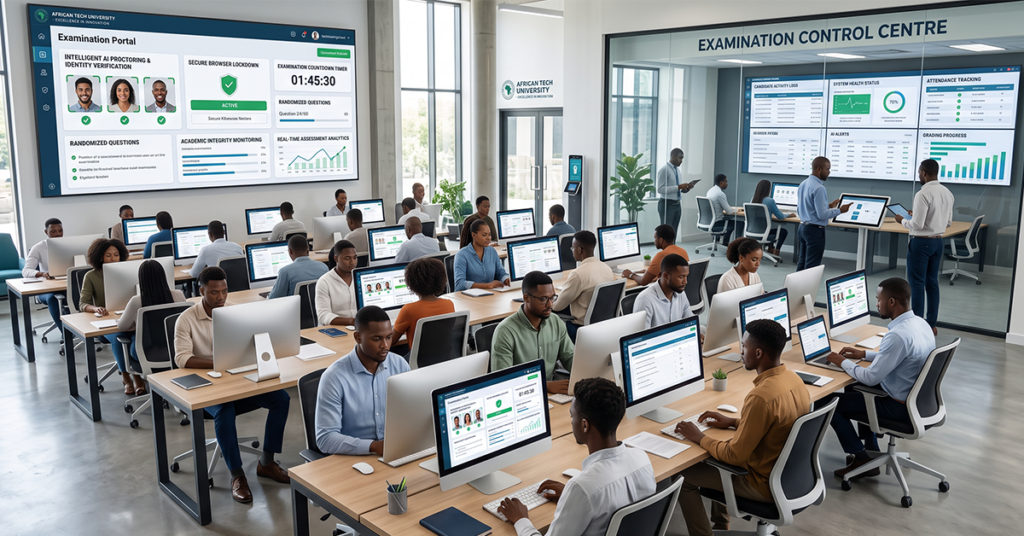
Many universities have embraced digital systems for admissions, learning and payments, yet during examination season, many of these same institutions revert to printed scripts, hand-carried answer booklets and grading that stretches on for weeks. An examination portal is the software layer that closes this gap: a secure, web-based system that lets universities schedule, deliver, mark and publish examinations online, with the same rigour and accountability as a physical exam hall, but without the paper.
The disconnect matters more than it might first appear. Every part of the student journey that touches assessment, from setting a timetable to releasing a transcript, has an operational cost when it is handled manually.
Read More: What Happens When an Exam Goes Wrong: The Hidden Institutional Cost of Assessment Failure
Exams Have Changed. Most Universities Haven’t.

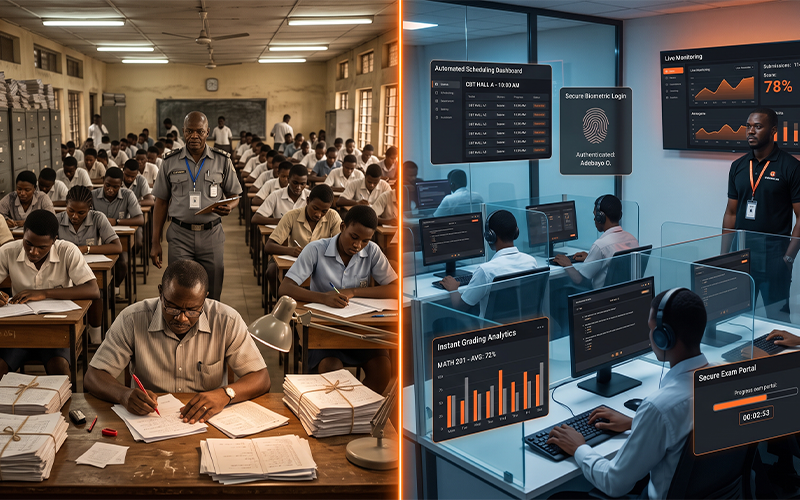
Students today apply online, learn through digital classrooms, and communicate with lecturers over chat and email. Their entire academic life, aside from one moment, has moved onto screens. That moment is the exam hall, where many institutions still print thousands of question papers, hire invigilators to walk between rows of desks, and box up scripts for manual marking.
This gap creates a real operational strain. Registrars juggle exam timetables across departments using shared spreadsheets, a task proper online exam management would handle automatically. Faculty mark hundreds of scripts by hand, often under tight turnaround pressure. Storage rooms fill with paper records kept for years to satisfy accreditation requirements. An examination portal does not simply digitise the paper; it restructures the process so that scheduling, delivery, marking and reporting happen inside one connected system rather than across disconnected tools and physical files.
What Is an Examination Portal?
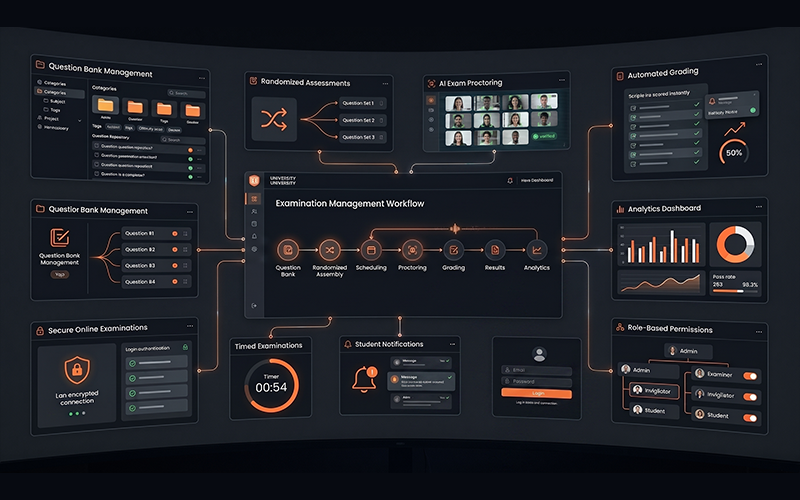
An examination portal is a secure online examination system that allows universities to create, schedule, deliver and grade assessments digitally, while managing question banks, invigilation, and result publishing from a single dashboard. It goes well beyond an online quiz tool: it combines scheduling, question management, automated grading, analytics and security controls into one platform built specifically for institutional assessment.
In practice, this means academic staff can build a question bank once and reuse it across cohorts and semesters, randomising question order to reduce collusion. Students sit timed assessments through a controlled interface. Objective questions are marked instantly, while subjective responses are routed to the right examiner with an audit trail attached. Results move through an approval workflow before being released, so the whole cycle, from setting the paper to publishing the transcript, is visible and traceable rather than scattered across email threads and shared drives.
Why Traditional Examination Processes Are Becoming Unsustainable
Paper-based assessment was workable when student numbers were smaller, and expectations for turnaround were more relaxed. Neither condition holds any longer. Several pressures make manual examination management increasingly difficult to justify:
- Manual scheduling conflicts. Coordinating exam halls, invigilators and overlapping courses by hand almost guarantees clashes as student numbers grow.
- Printing and logistics costs. Producing, transporting and storing thousands of question papers and answer scripts is expensive and difficult to scale.
- Human grading errors. Manual marking, even by experienced faculty, introduces inconsistency across large cohorts, particularly under time pressure.
- Delayed results. Manual collation of scores across departments can push result publication back by weeks, frustrating students and complicating academic calendars.
- Storage and retrieval challenges. Physical scripts must often be retained for years, consuming space and staff time whenever a query or appeal arises.
These pressures are not new. What has changed is that students, regulators and accreditation bodies now expect the same responsiveness from examinations as from admissions and course delivery. An online examination system that removes these bottlenecks is becoming a baseline expectation, not a convenience.
What Modern Universities Expect From an Examination Portal
Institutions evaluating a digital assessment platform in 2026 are typically looking for a specific set of capabilities, each addressing a distinct point of friction in the old process.
- Question bank management lets faculty build, tag and reuse questions by course, difficulty and topic, saving significant preparation time each semester.
- Randomised question delivery presents each student with a different sequence or selection of questions, reducing the value of copying from a neighbour.
- Automated grading scores objective items instantly and gives examiners structured tools for marking essays and long-form answers consistently.
- Timed assessments enforce start and end windows automatically, removing the need for manual invigilator timekeeping.
- Role-based permissions ensure that only authorised staff can create, edit or release papers and results, protecting the integrity of the process.
- Analytics dashboards show pass rates, question-level performance and grading turnaround, giving academic leadership visibility they rarely have with paper exams.
- Student notifications keep candidates informed about schedules, submission confirmations and result publication without additional administrative effort.
Together, these features form what is best understood as a full examination management system rather than a single testing tool: the goal is to manage the entire assessment lifecycle, not just the moment a student clicks submit.
Read More: Examination Integrity in the Age of Online Learning: How Universities Can Protect Academic Standards
Academic Integrity in the Digital Era
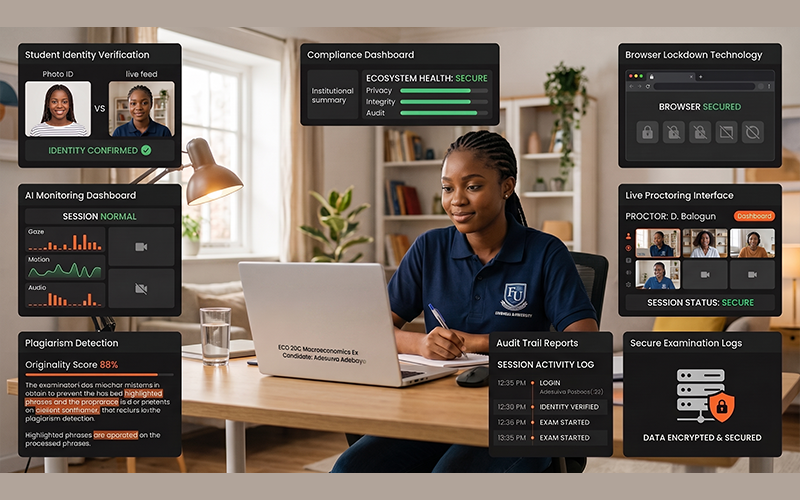
Any credible digital assessment platform has to prove it can deliver secure online examinations, and security is often the first concern raised when universities consider moving assessment online, and rightly so. The shift from face-to-face invigilated exams to online exams during the COVID-19 pandemic prompted widespread concern among students and academic staff about academic integrity, and that concern has not disappeared simply because the emergency phase has passed. A credible examination portal has to answer it directly, not with a single feature but with layered controls that work together.
These typically include identity verification at login, question randomisation so that no two students see an identical paper, browser lockdown to prevent access to other applications during the test, strict time controls, and detailed audit trails that record every action taken during an assessment. AI exam proctoring adds a further layer, flagging unusual behaviour such as repeated tab switching or irregular movement for human review, rather than replacing human judgement altogether. Institutions have long sought ways to replicate the integrity of a physical exam hall for students testing remotely, without requiring them to travel to a supervised facility, and the ambition behind these controls has stayed consistent even as the technology has matured.
It is worth framing this correctly for staff and students alike: these measures exist to give the institution and its accreditors confidence in the result, not to treat students as suspects. Positioned well, security becomes reassurance rather than surveillance, protecting the value of every credential the university awards.
How an Examination Portal Fits Into the Digital Campus
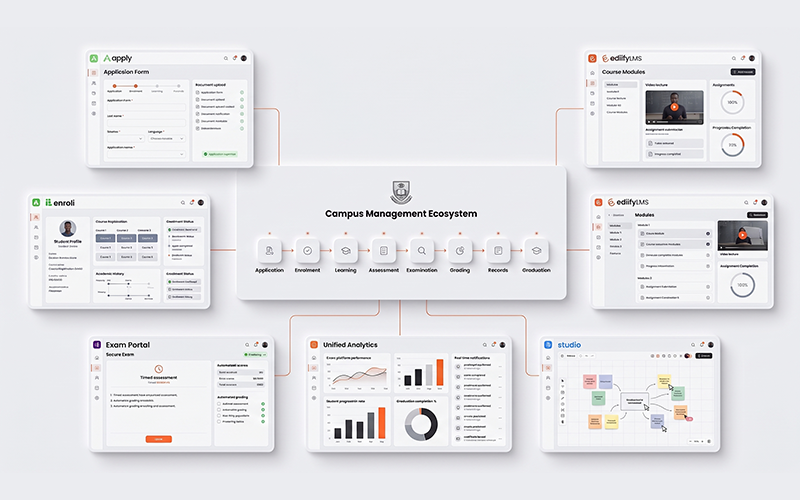
An examination portal delivers the most value when it is not a standalone tool bolted onto the side of the institution’s other systems. Vigilearn’s approach connects the Examination Portal directly with Apply, Enroli SIS and Ediify LMS, alongside collaboration tools such as Studio, so that a single student record follows a learner from application through to graduation.
Consider the full journey this makes possible. A prospective student applies through Apply. Once admitted, their record flows into Enroli SIS, the student information system that manages enrolment and academic records. Coursework and continuous assessment happen inside Ediify LMS. When examination season arrives, the same student identity, course registrations and academic history are already present in the examination portal, so there is no re-entry of data, no mismatched student IDs, and no manual reconciliation between systems. Results, once approved, flow back into the student’s academic record automatically. This is what a genuinely connected digital campus looks like: not five separate logins, but one continuous workflow.
Measuring Success Beyond Faster Exams
Universities that adopt an online examination system often expect speed as the headline benefit, and it is real: automated grading and instant result compilation can cut turnaround from weeks to days. But the more durable gains tend to show up elsewhere. Administrative workload drops as registrars stop reconciling spreadsheets by hand. Academic accuracy improves as consistent, auditable marking replaces individual grading habits that vary from one examiner to the next. Compliance becomes easier to demonstrate, since every action inside the system is logged and retrievable for accreditation review. Institutional reporting improves too, giving academic boards real performance data rather than end-of-term anecdotes. Taken together, these are the outcomes that matter to councils and accreditation panels, not just to the registrar’s office.
How Vigilearn’s Examination Portal Supports Universities
Vigilearn built its Examination Portal around the same principle that underpins the rest of its suite: assessment should be one connected part of the institution’s digital infrastructure, not an isolated piece of software. As a university assessment platform, it combines automation that removes repetitive manual work from scheduling and grading, layered security including AI exam proctoring that protects academic integrity without over-policing students, and integration with Apply, Enroli SIS and Ediify LMS so that student data never has to be entered twice.
It also means analytics that give programme leaders a genuine view of assessment performance, an interface built for both large and small cohorts, and a system designed to scale as an institution grows from a single faculty pilot to university-wide deployment. The focus throughout is on institutional outcomes: faster results, stronger integrity, and a smoother experience for staff and students, rather than a long list of features that go unused.
Modern assessment requires more than digitising exam papers. Book a demo with Vigilearn to see how the Examination Portal streamlines assessment, improves academic integrity, and integrates seamlessly with your institution’s digital ecosystem.
Frequently Asked Questions
What is an examination portal? An examination portal is a secure online system that allows universities to schedule, deliver, grade and publish examinations digitally. It manages the full assessment lifecycle, including question banks, timed delivery, automated grading and result approval, rather than functioning as a simple online quiz tool.
How secure are online examinations? Secure online examinations rely on layered controls: identity verification, question randomisation, browser restrictions, strict time limits and detailed audit trails. Many platforms add AI-assisted monitoring to flag unusual activity for human review, giving institutions confidence without treating every student as a suspect.
Can universities prevent examination malpractice online? No system removes risk entirely, but a well-designed examination portal reduces it substantially through randomised questions, identity checks, browser lockdown and audit trails that record every action taken during an assessment, making irregularities easier to detect and investigate.
Can an examination portal integrate with an LMS? Yes. A well-built examination portal connects with an institution’s learning management system so that course registrations, continuous assessment records and final results share one student identity, removing the need to re-enter data across separate platforms.
What are the benefits of digital assessments? Digital assessments cut grading turnaround, reduce administrative workload, improve consistency in marking, strengthen compliance through audit trails, and give academic leaders real-time reporting on performance, rather than end-of-term summaries pieced together manually.
Is online examination software suitable for large universities? Yes. Modern examination management systems are built to handle large cohorts across multiple faculties simultaneously, with role-based permissions and analytics dashboards that help administrators manage scale without a proportional increase in manual effort.