Universities, today, increasingly rely on a constellation of platforms: an admissions portal to capture prospective students, a CRM (Customer Relationship Management) system to nurture leads and manage student relationships, a Student Information System (SIS) for enrolments and records, and a Learning Management System (LMS) for teaching and learning. Each system plays a distinct role. Yet, when these systems operate in isolation, institutions face fragmentation: data silos, manual workarounds, and inconsistent student experiences.
This fragmentation creates real operational challenges. For example, an applicant might submit through an application portal, but that data doesn’t automatically flow into the CRM or the academic portal. Once enrolled, their learning engagement is tracked in the LMS, but support or advising teams may lack visibility because they use the CRM or SIS in parallel. Without integration, staff duplicate efforts; students feel the system is disjointed; analysis and insight suffer. Higher education leaders increasingly recognise this issue. And as EDUCAUSE’s research highlights, ‘integration’ is central to digital transformation in higher education: “No single unit … can accomplish digital transformation by itself,” and the key is deep, coordinated shifts.
At Vigilearn Technologies, we advocate for a connected-platform approach: a unified ecosystem where LMS, application portal, student information systems, and CRM capabilities function as parts of one architecture rather than separate islands. Whether your institution is just starting the journey or seeking to deepen its digital capability, this guide will help you understand and act.
Why Universities Need LMS and CRM Integration
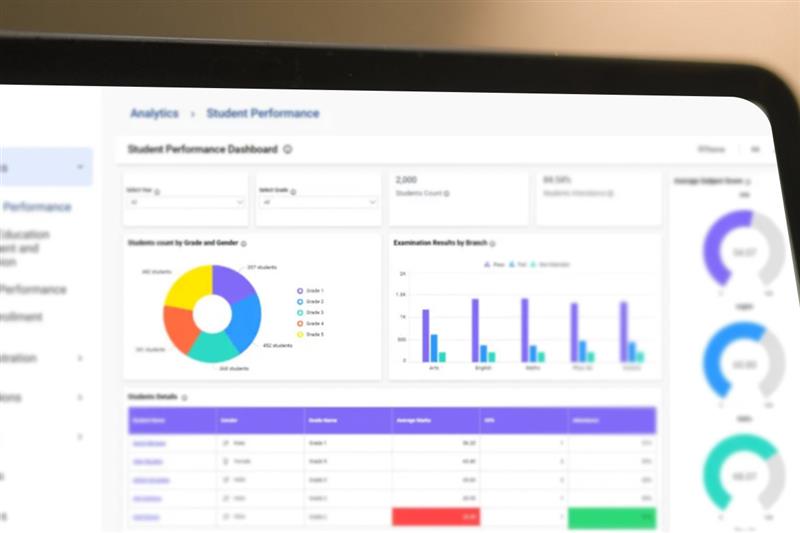
Improved student data flow between admissions, academics and support teams
In a typical university, admissions, academics, student services and alumni relations all operate with their own workflows. When the LMS and CRM, and often, the application portal are disconnected, data must be transferred manually, or staff must access multiple systems. By integrating the LMS (where learning activities happen) with the SIS or CRM (where relationships and student lifecycle data reside), universities enable seamless data flow across the lifecycle: from prospect to applicant to enrolled student to graduate. As one article puts it: “Integrating your LMS with your CRM system can streamline business processes, cut costs, and improve customer service.”
Real-time performance tracking and analytics
Universities require real-time visibility into Student learning engagement, academic performance, and support needs. When the LMS is integrated with the CRM and SIS, it becomes possible to combine learning data (course activity, grades, submissions) with relationship and lifecycle data (admissions funnel, application stage, retention risk). Such integration enables dashboards that reflect “which students are at risk” or “which prospects convert and engage well” rather than after-the-fact reporting. The value of integrated platforms, data, analytics, and insights is recognised broadly: “The data-empowered institution is the No. 1 issue on the 2025 EDUCAUSE Top 10 list of technologies and trends in the industry.”
Centralised communication for better student engagement
Whether an applicant, current student or alumnus, each individual expects seamless, consistent communication. If your CRM knows an applicant has been admitted and enrolled, the LMS should reflect it; then communications (via CRM) should align with their LMS activity. A disconnected environment can lead to redundant emails, missed outreach, or conflicting messages. Integrating LMS with CRM ensures everyone, admissions, academic advisors, and student services, acts on the same data, enabling personalised communication, timely intervention and better engagement.
Steps to Successfully Integrate LMS with CRM Systems
Audit your current systems for compatibility
Before you begin, map your current technology stack and identify where the points of integration should occur. Which CRM are you using? What LMS? Do you have an Apply Portal? What workflows currently exist between these systems? Which data flows are manual? This audit helps you identify data models, system boundaries, integration gaps and potential friction points. It also clarifies whether your infrastructure supports APIs, standard connectors or will require custom work.
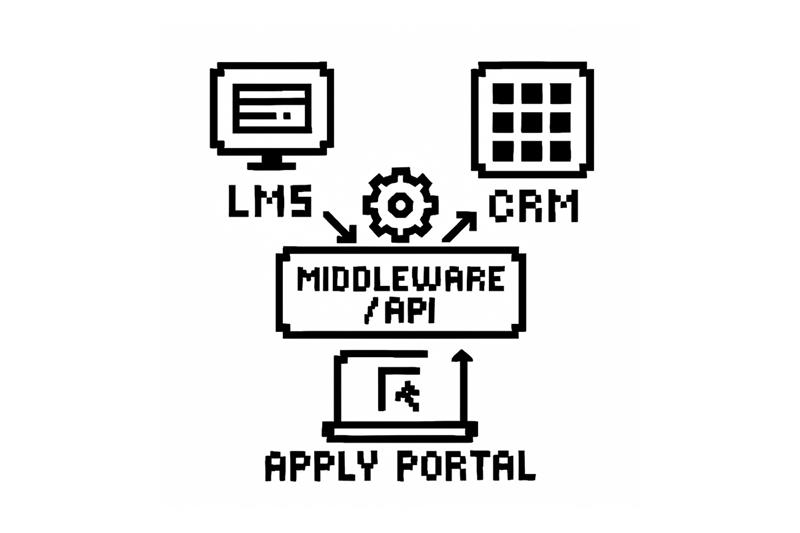
Use middleware or APIs for a smooth connection
Once you know what you have and what you need, plan the integration architecture. For many institutions, using middleware or an integration platform (iPaaS) is effective because it decouples systems, enables standard connectors, handles mapping and ensures future flexibility. For example, connecting your LMS via its API to the CRM allows student records, enrolments, course completions and performance to sync. In some cases, out-of-the-box connectors exist. As one source notes: “Many modern LMS platforms come with out-of-the-box integrations … If a pre-built integration isn’t available … you’ll likely need a custom integration … which is more complicated.”
Provide staff training for consistent usage
Integration is not only about technology, it is about people and processes. Staff need training to understand how the unified systems work, how data moves across platforms, and how their workflows should adapt. Without consistent usage and governance, even a highly integrated technical stack will underperform. Change management is important: for example, setting roles and responsibilities, establishing data-entry standards, and appointing “champions” in each department. As noted in broader CRM/ERP integration work: “Change management … is essential.”
Benefits of Unified Platforms in Higher Education

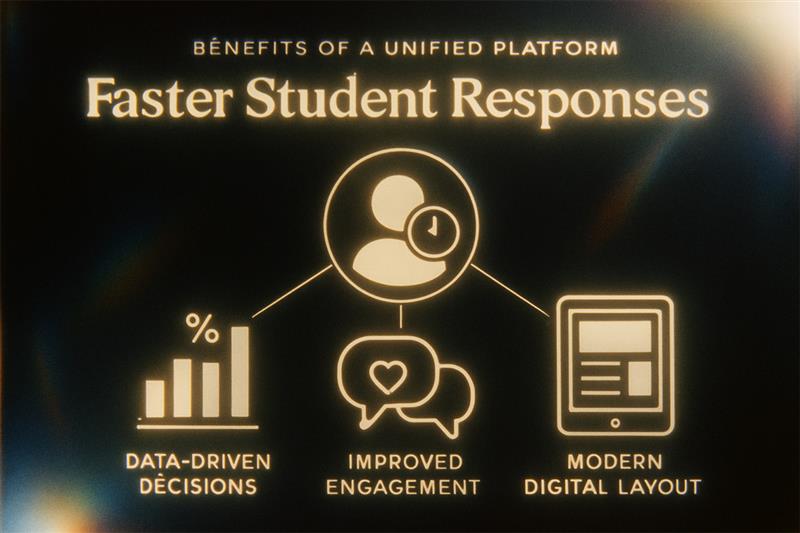
Better decision-making through data insights
When admissions, academic, support and alumni-relations systems are integrated, leadership gains visibility into end-to-end student journeys. They can ask questions such as: at what stage do applicants disengage? Which courses correlate with higher retention? Which support interventions work best? These are only possible when data lives in connected platforms. For universities committed to continuous improvement, this is a game-changer.
Reduced admin workload and faster student response times
Manual data entry, reconciliation of records between systems, and chasing information across platforms consume significant staff time. A unified platform means student information entered in one place flows automatically to others. This reduces administrative burden, speeds responses to students (for example, confirming enrolment, recognising prior learning, scheduling support), and reduces error. In practical terms, less time wasted on admin means more time for student-facing work and strategic initiatives.
Enhanced overall student experience
When all is said and done, what matters the most is the student’s experience. A connected system means an applicant registers once; a student accesses their learning, applications, support and communications in a seamless way. They don’t have to wait for data to move between departments. They don’t face inconsistent messaging. They have one unified journey. That experience enhances satisfaction, improves outcomes, and strengthens institutional reputation.
Tools That Simplify LMS Integration
Vigilearn’s EdiifyLMS and suite of products
At Vigilearn, our LMS solution, EdiifyLMS, is built to integrate within a broader platform architecture. Our suite includes not only EdiifyLMS, but also a student application platform, Apply Portal, a Student Information System, Enroli SIS, and a cloud-based collaborative video conferencing platform, Studio. This approach means that integration between LMS, CRM (or Apply Portal), and SIS is built in from design. Institutions working with us can exploit pre-configured data flows, API connectors, role-based access, and dashboards across the student lifecycle.
Other tools: Moodle, Salesforce Education Cloud, HubSpot Education CRM
- Moodle: A widely used open-source LMS with large community support. It offers integration capabilities, and its documentation includes guidance on integration scenarios.
- Salesforce Education Cloud: A purpose-built CRM/EDU platform offering unified constituent management, data foundation, and lifecycle-oriented features for higher education. It supports recruitment, admissions, academic operations and student success.
- HubSpot CRM (though not strictly education-specific) can be customised for educational institutions and offers integration with LMS via API/middleware.
When evaluating tools, institutions should compare: ability to integrate (APIs/middleware/connectors), data model flexibility, analytics capabilities, change-management support, and vendor roadmap.
The case for LMS integration for universities is compelling. As higher education institutions confront shifting demands, the ability to operate efficiently and provide seamless student experiences becomes a strategic differentiator. Integrating your LMS with CRM systems and application portals is a transformation of workflow, communication, data, and institutional agility.
At Vigilearn Technologies, we support institutions in this transformation. Our platform-centric approach ensures that institutions do not manage a patchwork of disconnected applications but a unified ecosystem where student data flows across admissions, learning, support and alumni relations.
If you are ready to make the shift from disconnected systems to connected platforms, now is the time. The institutions that succeed will be those that integrate multiple platforms into a cohesive, student-centred digital architecture.
