


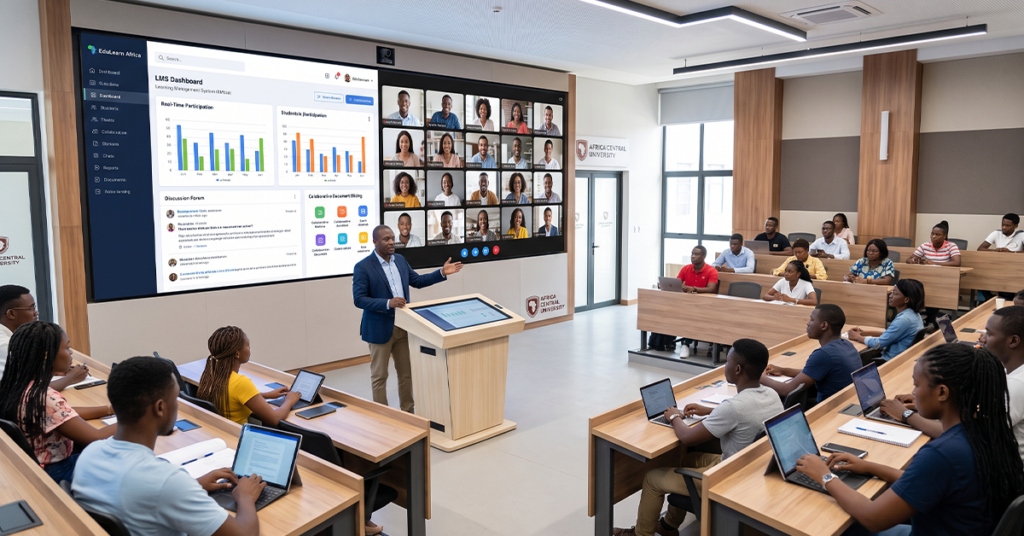
Many institutions invest in learning platforms expecting them to transform teaching overnight. But years later, they are still grappling with low student engagement, inactive discussion forums, missed course announcements and underutilised learning resources. The reality is that technology alone cannot create meaningful learning experiences.
That is why LMS and eLearning Solutions have evolved beyond simply hosting course materials. In 2026, the most effective platforms are designed to support engaging, learner-centred experiences that match the speed, simplicity and convenience students expect from modern digital tools. Institutions that intentionally design their digital learning environments, rather than simply deploying software, consistently achieve stronger participation, better learning outcomes and greater teaching efficiency. This article explores what makes LMS and eLearning Solutions effective and how a connected platform like Vigilearn helps institutions deliver modern, impactful education.
Read More: The Digital Campus Is Not the Future. It’s What Your Students Are Already Expecting Today
What Are LMS and eLearning Solutions?

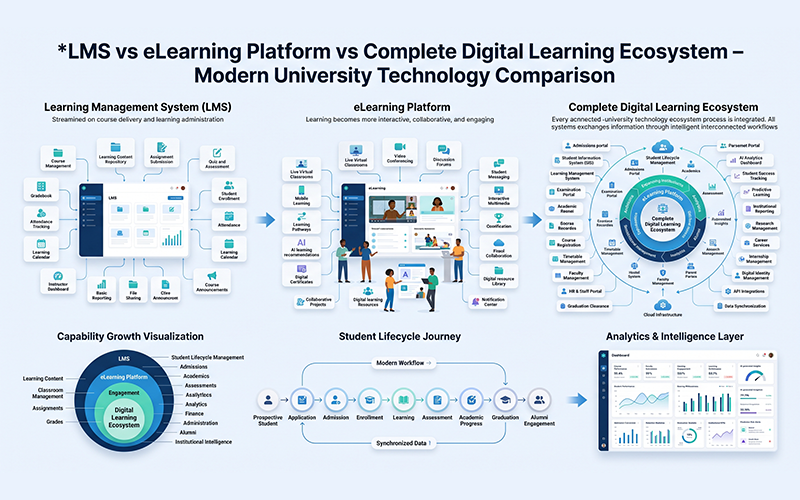
A learning management system (LMS) is the software that hosts, organises and tracks a course: content, assignments, grades and communication in one place. An eLearning platform is broader still; it covers the tools, content and delivery methods used to teach and assess learners digitally, whether inside an LMS or alongside it. Taken together, LMS and eLearning Solutions describe the combined infrastructure and content strategy that enables an institution to teach, assess, and support students online, rather than a single piece of software doing all the work.
The confusion between these terms is common, and understandable. Many universities buy an LMS expecting it to behave like a complete digital learning ecosystem: something that also handles live classes, discussion, mobile access and analytics on its own. In practice, a strong learning management system is the foundation. Still, it needs to be paired with the right content design, faculty support and connected tools before it becomes a genuine online learning platform rather than a filing cabinet for lecture slides.
Why Traditional Learning Models Are No Longer Enough
Higher education has grown far more diverse in how, when and from where students want to learn. Global enrolment has more than doubled over the past two decades, from roughly 100 million students in 2000 to 269 million in 2024, according to UNESCO. That growth has not produced a single, uniform kind of student. Universities now teach on-campus undergraduates alongside remote learners, working professionals studying part-time, and international students juggling time zones, often within the same course.
Several groups make flexible delivery non-negotiable rather than optional:
- Hybrid classroom students who attend some sessions in person and expect the rest to be available online without a drop in quality.
- Remote and distance learners, a growing share of the student population, for whom the digital experience is the entire course experience.
- Working professionals studying around jobs and family commitments, who need asynchronous access to lectures and materials.
- International learners managing coursework across time zones, who rely on recorded content and clear, async communication.
A single, rigid delivery model no longer serves this mix. Institutions need a university LMS platform flexible enough to support blended, fully online and traditional cohorts at once, without maintaining three separate systems to do it.
The Features That Actually Improve Learning
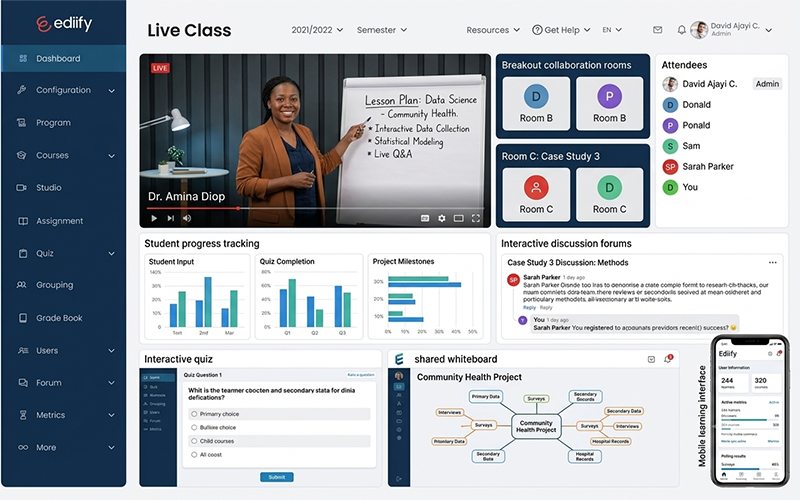
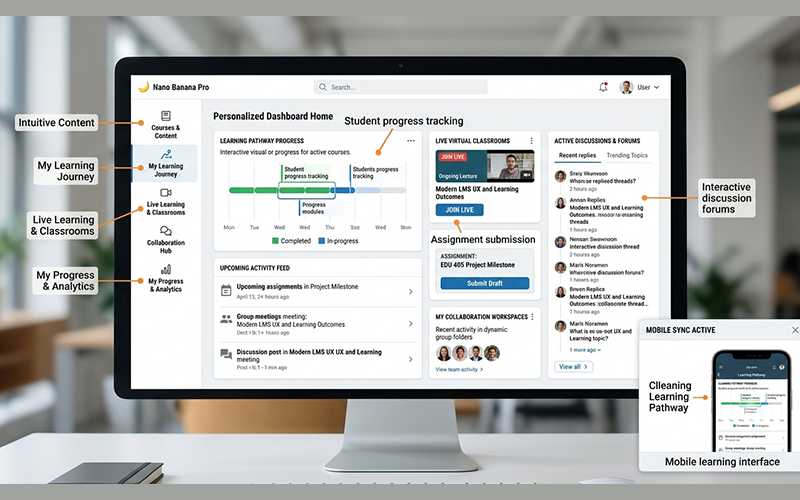
It is easy to list LMS features. It is more useful to ask what each one is actually meant to fix. Course management keeps materials, deadlines and communication organised in one place, replacing the scattered emails and shared folders that leave students guessing what is due and when. Content delivery, done well, presents lectures, readings and multimedia in a sequence that matches how a course is actually taught, not just a dump of files in date order.
Assignments and assessments matter just as much for the feedback they generate as for the grade they produce; a platform that returns marks with no comment teaches a student very little. Live virtual classes extend real teaching to students who cannot be in the room, provided the session is designed for a screen and not simply a webcam pointed at a whiteboard. Discussion forums, when moderated and prompted well, recreate some of the peer exchange that hallway conversations once provided. Mobile learning meets students where they already are, particularly important in markets where a phone, not a laptop, is the primary device. Learning analytics, finally, gives faculty and administrators visibility into who is falling behind before a missed exam makes it obvious.
None of these features improves learning on its own. Each earns its place only when it is used the way it was designed to be used, which is precisely where most digital learning solutions succeed or fail.
Why Student Adoption Matters More Than Feature Lists
An EDUCAUSE Review analysis of faculty and student LMS use found that while adoption of the platform itself is close to universal, with the large majority of faculty and students using an LMS regularly, use of its more advanced features lags well behind: fewer than half of surveyed faculty reported using their LMS to promote interaction beyond the classroom. The pattern holds a decade on: institutions rarely struggle to get people to log in. They struggle to get people to use the system for anything beyond storing files.
Read More: The LMS Buying Decision: What Higher Education Leaders Need to Know Before They Sign
Adoption, not feature count, is what separates a working eLearning software deployment from an expensive one that sits half used. A handful of conditions tend to decide which way it goes:
- A simple interface that does not require training to find a syllabus or submit an assignment.
- Mobile accessibility that works as well on a mid-range phone as on a university lab computer.
- Low-bandwidth performance, essential in regions where connectivity is inconsistent.
- Genuine faculty buy-in, built through support and training rather than a mandate handed down before term starts.
- Easy content creation tools, so lecturers can build a course without needing a technical background.
Get these right, and the platform disappears into the background of good teaching. Get them wrong, and even the most feature-rich system becomes something staff tolerate rather than use.
Building One Connected Learning Ecosystem
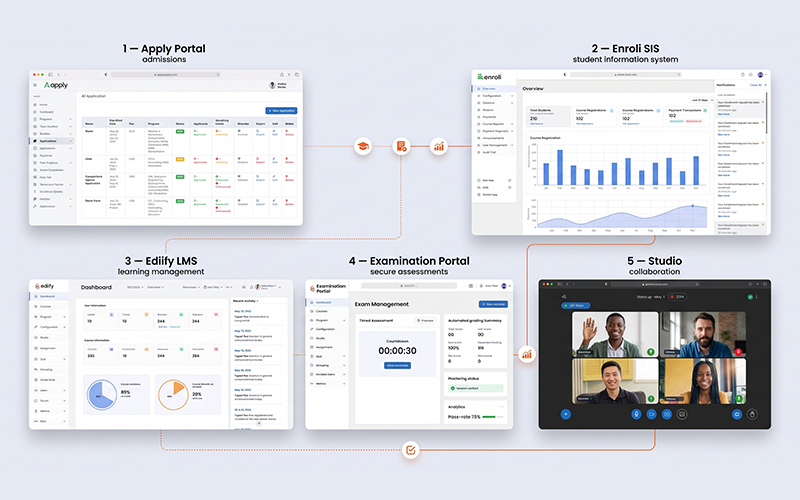
The strongest argument for treating LMS selection as an institutional strategy, rather than a software purchase, is what happens when the learning platform is not connected to everything around it. A student applies through one system, enrols through another, learns through a third, and sits exams through a fourth, each holding its own version of the student record. Every disconnect between them becomes a point of friction, a re-entered form, or a lost piece of academic history.
Vigilearn’s Ediify LMS is built to sit inside a connected ecosystem rather than stand apart from one, linking directly with Apply for admissions, Enroli SIS for enrolment and academic records, the Examination Portal for assessment, and Studio for live collaboration and virtual sessions. A student’s identity, course registrations and progress travel with them from application through to graduation, rather than being re-entered at every stage. That continuity is what turns a virtual learning platform into genuine institutional infrastructure.
Measuring Success Beyond Course Completion
Course completion rates are the easiest number to report and the least complete picture of success. A fuller view of institutional performance looks at student engagement patterns across a term, not just at its end; faculty participation, since a course with an absent instructor rarely engages students regardless of platform; assessment performance broken down by topic, which shows where teaching is landing and where it is not; and retention, arguably the most consequential metric of all, since a disengaged student who quietly drops out costs far more than one who finishes a course with a mediocre grade.
Learning analytics exist to make these patterns visible early enough to act on, feeding into a cycle of continuous improvement rather than an end-of-year report nobody revisits. Institutions serious about blended learning solutions treat these metrics as an ongoing conversation between teaching teams and the platform data, not a compliance exercise completed once a semester.
Read More: The University That Runs Itself: What Autonomous Campus Management Actually Looks Like
How Vigilearn Delivers Modern LMS and eLearning Solutions
Vigilearn’s approach to LMS and eLearning Solutions starts from outcomes rather than a feature checklist. Ediify LMS is designed to support better teaching, through content tools that make course design straightforward rather than technical; improved collaboration, through direct integration with Studio for live sessions and group work; and scalable delivery, so an institution can grow from a single faculty pilot to university-wide deployment without re-platforming.
Analytics run throughout the suite rather than sitting in a separate reporting tool, giving programme leaders a live view of engagement and performance instead of a term-end summary. Because Ediify LMS shares student data with Apply, Enroli SIS and the Examination Portal, the result is a single, coherent student experience from first application to final transcript, which is ultimately the measure that matters more than any individual feature.
Digital learning is not about putting classrooms online. It is about creating connected learning experiences that improve teaching, engagement and student success. Book a Vigilearn demo to see how Ediify LMS helps universities deliver scalable, engaging and data-driven education. Explore more insights on the Vigilearn Blog.
Frequently Asked Questions
What are LMS and eLearning Solutions? LMS and eLearning Solutions describe the combined software and content infrastructure universities use to deliver, manage and assess learning online. The LMS hosts courses and tracks progress, while eLearning solutions cover the broader tools and design that make that learning effective.
What is the difference between an LMS and an eLearning platform? An LMS is the system that organises courses, grades and communication. An eLearning platform is broader, covering the content, delivery methods and tools used to teach digitally, whether inside the LMS or through connected applications like virtual classrooms.
Which LMS is best for universities? The best LMS depends less on features than on adoption, integration and analytics. A platform that connects with admissions, student records and examination systems, and that faculty and students actually use daily, will outperform a feature-rich system nobody adopts.
Can an LMS support hybrid learning? Yes. A well-designed LMS supports on-campus, remote and hybrid students within the same course, offering recorded lectures, live virtual sessions and asynchronous discussion so no cohort is treated as an afterthought.
Why do universities need learning analytics? Learning analytics surface patterns in engagement and performance early enough for faculty to act, identifying students at risk of disengaging before a missed assessment makes the problem obvious, and informing ongoing improvements to course design.
Can an LMS integrate with SIS and examination systems? Yes. A connected LMS shares student identity and records with the student information system and examination platform, so enrolment, coursework and assessment data flow together rather than existing as separate, disconnected records.