
If your organisation already runs a learning management system, the LMS vs LXP question can feel unnecessary. Why add another platform when the one you have already delivers courses, tracks completions and keeps compliance officers happy?
The honest answer is that an LMS and an LXP were built to solve different problems, and understanding that difference matters more than picking a winner. One gives administrators control over what people must learn. The other gives learners a reason to want to learn more than the minimum. Most organisations, from corporate L&D teams to university programme leaders and government training departments, eventually need something of both.
Read More: Learning Management Systems Explained and How You Can Pick the Best Fit (2026 Edition)
LMS vs LXP: The Short Answer
A learning management system primarily focuses on managing, delivering, tracking and administering structured learning: course assignment, assessments, certifications and compliance records. A learning experience platform places greater emphasis on learner-driven discovery, personalisation, content recommendations and engagement, closer to how a streaming service surfaces what you might want to watch next.
Neither is universally better. The categories increasingly overlap as vendors add personalisation to LMS platforms and administrative rigour to LXPs, but the underlying design philosophy, administration first versus experience first, still shapes how each platform behaves.
What Is an LMS?
A learning management system is software for creating, assigning, delivering and tracking structured courses. It typically handles enrolment, assessments, certifications, compliance tracking, reporting and administration, and it works best when learning needs to follow a defined path: onboarding, safety training, regulatory certification, academic modules with fixed syllabi. Administrators, not learners, usually decide what gets assigned and when. This top-down structure is precisely why LMS platforms remain the backbone of mandatory and compliance-heavy training across corporate, higher education and government settings.
What Is an LXP?
A learning experience platform is a learner-centric digital learning platform built around content discovery rather than content assignment. Instead of pushing predetermined courses, an LXP surfaces recommendations based on a learner’s role, interests, skills and previous activity, often drawing on internal course libraries, external content and even user-generated material. Social and peer learning, skills-oriented pathways and search-driven discovery are common features. The Wikipedia overview of learning experience platforms notes that an LXP aims to turn learners from passive recipients of content into active participants in their own development, which is a fair summary of the shift an LXP represents.
LMS vs LXP: The Core Differences
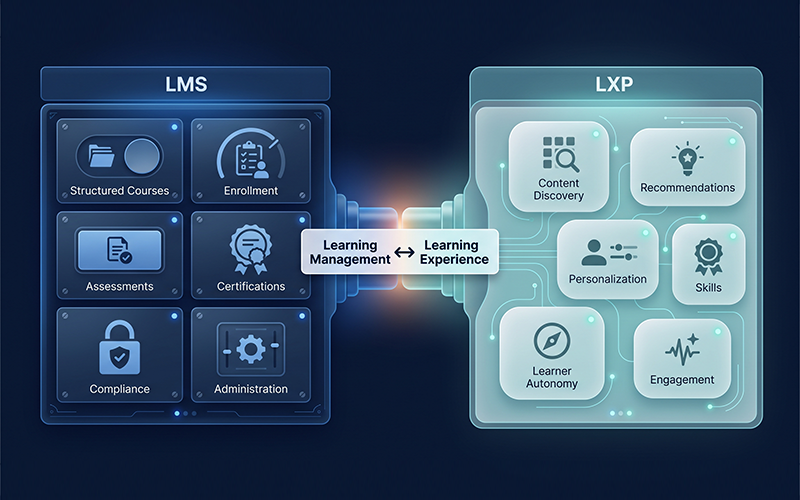
Capabilities vary significantly between vendors, but the general pattern holds across most platforms on the market:
| Capability | LMS | LXP |
| Primary focus | Learning administration | Learning experience |
| Content | Structured courses | Broader content discovery |
| Personalisation | Often limited or rule-based | Typically a core capability |
| Learner control | Structured, assign | More learner-driven |
| Recommendations | May be limited | Core features |
| Compliance | Strong | Not always the primary focus |
| Assessment | Strong | Varies by vendor |
| Engagement | Increasingly important | Central |
| Skills discovery | Growing capability | Often central |
Read More: LMS and eLearning Solutions: What Modern Universities Need to Deliver Better Learning
Administration vs Experience
Think of an LMS as the operational backbone of an organisation’s training function and an LXP as the discovery and engagement layer that sits closer to the learner. Both perspectives matter because they answer different questions. The LMS answers “has this person completed what they are required to complete?” The LXP answers “what does this person actually want or need to learn next?” Modern platforms increasingly blur that distinction, but the two questions rarely disappear entirely, which is why understanding both a learning management system and an LXP platform helps buyers avoid choosing on marketing language alone.
Personalisation: Where LXPs Change the Learning Experience
Personalised learning is the clearest differentiator in most LMS vs LXP comparisons. An LXP typically builds recommendations from several signals at once: stated interests, inferred skills, role and department context, prior learning activity and stated career goals. Done well, a personalised learning platform reduces the content overload that plagues large course catalogues, where employees abandon a search after scrolling past dozens of irrelevant modules. Rather than browsing everything, learners see what is actually relevant to where they sit and where they are heading.
How AI Is Changing LMS and LXP Platforms
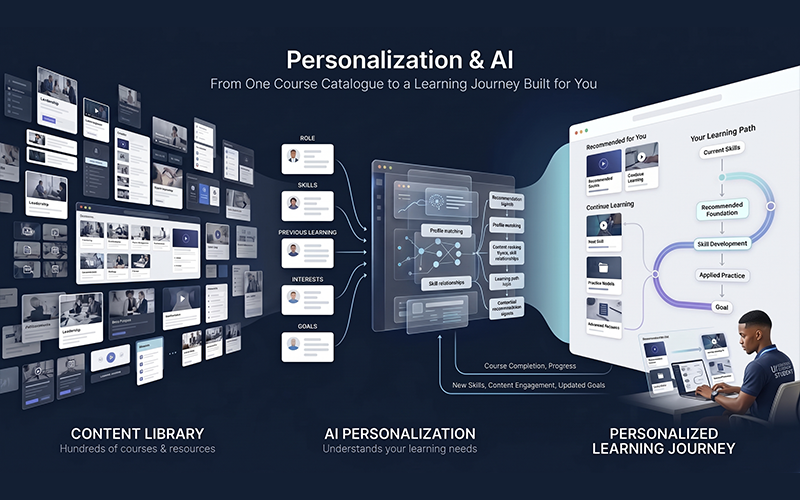
Artificial intelligence has become the connective tissue between both categories. Common applications include AI-powered content recommendations, adaptive learning paths that adjust based on performance, automated skills inference from activity data, smarter search and, increasingly, conversational learning assistants that help people find the right module without browsing a catalogue at all. The important caveat is that AI should improve relevance rather than exist as a bolt-on feature. A recommendation engine that surfaces irrelevant content erodes trust in a platform faster than having no recommendations at all.
Skills-Based Learning and Personalised Learning Platforms
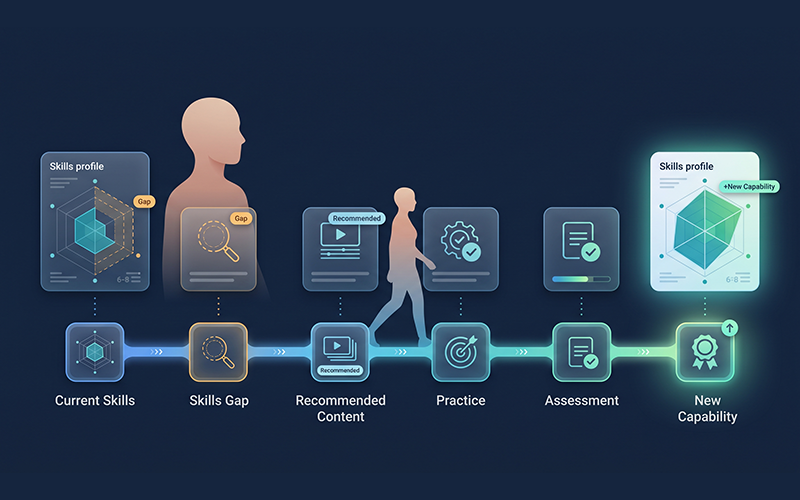
The shift from course completion to skills development is reshaping how organisations think about training altogether, and it is one of the main reasons teams start researching LMS alternatives in the first place. The World Economic Forum’s Future of Jobs Report 2025 found that employers expect 39% of workers’ core skills to change by 2030, and that 59 in every 100 workers will need reskilling or upskilling within that period. Skills-based learning software responds to this by mapping individual skill gaps against role requirements and recommending pathways to close them, rather than simply tracking which courses someone finished. Good skills-based learning software treats a completed course as a starting point for measuring capability, not the end goal itself. This is exactly where personalisation earns its keep: a learner with a defined skill gap benefits far more from a targeted recommendation than from a static catalogue.
Can an LXP Replace an LMS?
Not automatically, and organisations should resist assuming it can. Compliance-heavy environments such as healthcare, finance, aviation and public sector training still need the assignment tracking, audit trails and certification management an LMS provides. Some modern platforms now combine both models, and integrations between a dedicated LXP and an existing LMS are common where a full replacement is not realistic. Teams that go looking for LMS alternatives purely because their current system feels dated often find that what they actually need is an LXP layered on top, not a wholesale system replacement. The decision should rest on actual learning and business requirements, not on which category feels more current.
Can You Use an LMS and LXP Together?
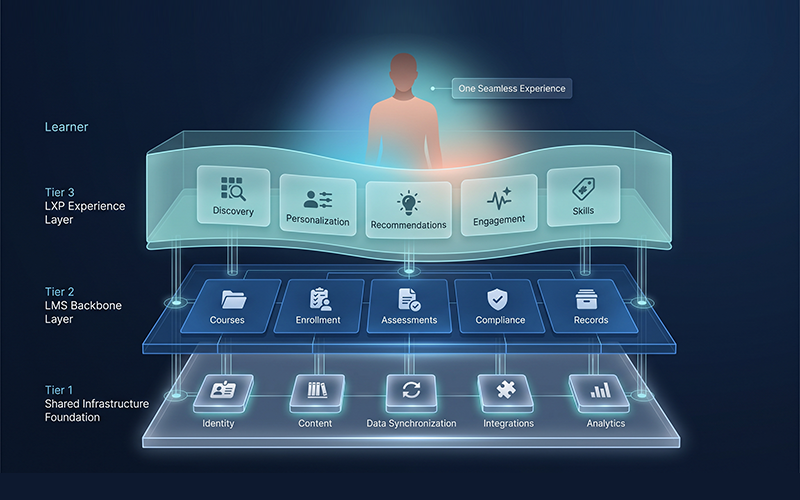
Yes, and for many organisations this is the more practical architecture. The LMS remains the system of record: enrolment, completions, certifications and compliance reporting. The LXP becomes the learner-facing experience layer: discovery, recommendations, social learning and engagement. Making this work well depends on solid integrations, including identity management, content aggregation and data synchronisation, so that activity in the LXP still feeds back into the LMS for reporting. A combined ecosystem tends to make sense once an organisation’s compliance needs and its appetite for learner-driven development both become significant.
What to Look for in a Modern Learning Platform
Whichever direction you lean, evaluate any digital learning platform against a consistent checklist:
- Personalisation and AI capabilities
- Content discovery and search
- Analytics and reporting depth
- Skills mapping and management
- Integrations with existing HR and content systems
- Mobile experience and accessibility
- Administration, security and scalability
Read More: School Management Software Cost: A Complete Pricing Guide
Where Ediify Fits Into the Evolution of Digital Learning
Ediify LMS, part of the Vigilearn suite, is built around the idea that a structured employee learning platform does not have to feel static. Live classes, forums for peer discussion and social interaction, and big data analytics that surface patterns in how people actually learn are built into its core experience rather than bolted on afterwards. That combination of solid administration with genuine engagement reflects the broader direction the market is moving in: away from course catalogues that sit unused, and towards learning environments people return to because they find something worth returning for. Organisations exploring how Vigilearn’s platforms approach digital learning can see how this thinking plays out across the wider product suite.
LMS vs LXP: Which Approach Is Right for You?
A simple framework helps cut through vendor marketing:
Choose LMS-oriented capabilities when you need:
- Structured courses and mandatory training
- Compliance tracking and certifications
- Formal assessments
- Central administration and audit trails
Prioritise LXP-style capabilities when you need:
- Personalisation and content discovery
- Learner autonomy and self-directed development
- Engagement and social learning
- Skills-based recommendations
Many organisations will ultimately need both sets of capabilities, whether through one converged platform or two integrated systems.
The Future: Why LMS and LXP Are Converging
The LMS vs LXP debate is gradually becoming less relevant as a strict either-or choice. LMS platforms are adding personalisation and recommendation engines. LXPs are adding stronger administration, reporting and compliance features. AI is becoming a layer across both rather than a differentiator for either, and skills are emerging as the common currency that connects assignment, discovery and career development. The more useful question for buyers is no longer “LMS or LXP” but “does this platform actually improve learning outcomes for the people using it.”
The LMS vs LXP comparison is less about choosing a winner and more about understanding what each category was built to solve. An LMS gives you administrative control and compliance confidence. An LXP gives learners a reason to engage beyond what is mandatory. Most organisations, particularly those managing both regulatory obligations and genuine skills development, will find they need elements of both, whether that means running an LXP platform alongside an existing LMS or choosing a converged employee learning platform that has grown to include both sets of capabilities. If you are evaluating your organisation’s learning technology stack, it is worth exploring how Ediify LMS combines structured administration with the engagement features that keep learners coming back.
Read More: Affordable, Scalable LMS Solutions for Schools and Corporations in Africa
Frequently Asked Question
What is the difference between an LMS and an LXP? An LMS focuses on managing, assigning and tracking structured, often mandatory learning. An LXP focuses on learner-driven discovery, personalisation and engagement.
Is an LXP better than an LMS? Neither is universally better. The right choice depends on whether your priority is compliance and structured administration or personalisation and engagement, and many organisations need both.
Can an LXP replace an LMS? Not in most compliance-heavy environments. Organisations with mandatory training, certification and audit requirements typically still need core LMS functionality.
Can an LMS and LXP work together? Yes. A common architecture uses the LMS as the system of record for compliance and completions, with the LXP acting as the learner-facing discovery and engagement layer.
What is a learning experience platform? An LXP is a digital learning platform that prioritises personalised content discovery, recommendations and learner-driven, self-directed development over administrator-assigned courses.
How does AI personalise learning? AI analyses signals such as role, prior activity, stated interests and skill gaps to recommend relevant content, adapt learning paths and improve search, ideally making learning more relevant rather than simply adding a feature.
What is skills-based learning software? Software that maps individual or team skill gaps against role or career requirements and recommends learning pathways to close them, rather than tracking course completion alone.
How do I choose between an LMS and LXP? Start with your actual requirements: compliance and structured training point towards LMS capabilities, while personalisation, discovery and engagement point towards LXP capabilities. Most organisations end up needing a combination of both.
