Universities are under more pressure than ever to operate efficiently, deliver quality learning, and make sense of mountains of institutional data. In the middle of that pressure sits a decision that confuses many higher education leaders: LMS vs SIS vs ERP, and what exactly each system is supposed to do. These three acronyms are often used interchangeably, sometimes bundled together, and frequently misunderstood, which leads institutions to purchase the wrong tools, run disconnected systems, and wonder why nothing quite works the way it should.
The confusion is understandable. All three platforms touch student data in some way. And all three promise to improve how your institution runs. But choosing the wrong one or implementing it in isolation when you need the others can create costly inefficiencies that take years to untangle. This guide cuts through the noise. Whether you are a vice-chancellor evaluating your technology roadmap, a registrar frustrated by data silos, or an IT director fielding yet another request for “a system that does everything,” this breakdown will help you make the right call.
Read more: LMS vs CRM for Universities: What Each System Actually Does in 2026
LMS vs SIS vs ERP Explained: Why the Confusion Exists
The overlap between these systems is partly what causes so much confusion. A learning management system, a student information system, and an enterprise resource planning system all sit within the broader universe of higher education technology, and they all hold data about students. But they serve fundamentally different purposes, and conflating them leads to significant gaps in how an institution operates.
Think of it this way: the LMS is your classroom, the SIS is your filing cabinet, and the ERP is your back-office engine. Each one is essential. None is a substitute for the others. EDUCAUSE, a leading voice in higher education technology, notes that ERP systems in particular are often “misaligned, overly customised, and costly” precisely because institutions implement them without a clear understanding of how they relate to adjacent systems. Getting this right starts with understanding what each system actually does.
What Is a Learning Management System (LMS)?
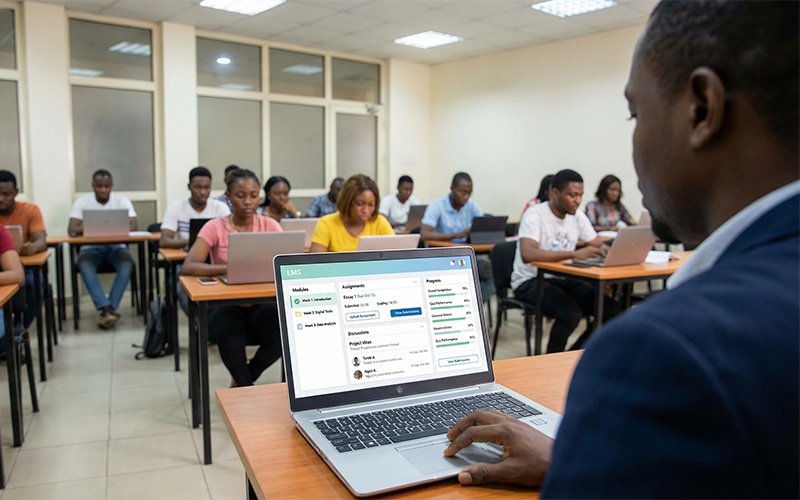
A learning management system is the digital environment in which teaching and learning takes place. It is the platform lecturers use to deliver course content, set assignments, and assess student performance. It is where students go to watch recorded lectures, submit coursework, participate in discussion forums, and check their grades.
Core functions of an LMS include:
- Course creation and content delivery
- Assignment submission and grading workflows
- Student engagement tools such as discussion boards and quizzes
- Progress tracking and learning analytics
- Online examination and assessment management
The LMS is entirely focused on the academic experience. It does not manage admissions, payroll, or student records in any administrative sense. Its users are primarily faculty and students. According to Grand View Research, the global LMS market is projected to grow from $28.58 billion in 2025 to $70.83 billion by 2030, underscoring just how central these platforms have become to modern higher education. Vigilearn’s Ediify LMS is built specifically for this purpose, giving institutions a dedicated, scalable environment for digital course delivery.
What Is a Student Information System (SIS)?
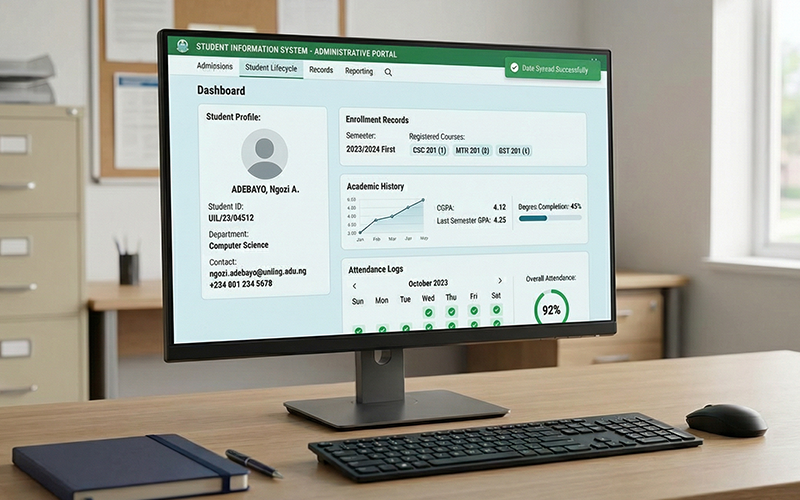
A student information system manages the administrative data that follows a student through their entire academic journey. Where the LMS handles learning, the SIS handles records. It is the single source of truth for who your students are, what they are enrolled in, what grades they have earned, and where they stand in their academic progression.
Key functions of a student information system include:
- Student registration and enrolment management
- Academic records and transcript management
- Attendance tracking and reporting
- Academic history and degree audit
- Communication between students and administrative staff
The SIS is used primarily by administrative staff, registrars, and academic advisers, though students often access it to view their own records. According to market data, the global SIS market was valued at approximately $13.2 billion in 2024 and is projected to reach $22.3 billion by 2030. This growth reflects the increasing demand for robust student data management across institutions of every size. Vigilearn’s Enroli SIS is designed to centralise student lifecycle data and integrate smoothly with academic platforms.
Read more: Student Data Management System for Modern Universities
What Is a University ERP System?
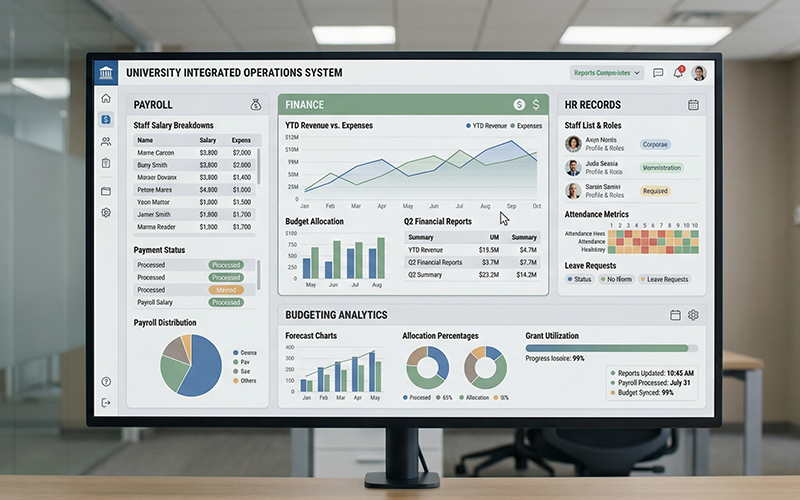
A university ERP system handles the institution’s back-office operations. Enterprise resource planning was originally developed for the corporate world to integrate functions such as finance, HR, and supply chain into a single platform. In higher education, the same principle applies: the ERP brings together the administrative machinery that keeps an institution running.
Functions covered by a university ERP system typically include:
- Finance and accounting: budgeting, procurement, accounts payable
- Human resources and payroll management
- Facilities and asset management
- Institutional reporting and compliance
- Resource planning across departments
The primary users of an ERP are finance teams, HR departments, and senior administrators. The ERP rarely touches the learning experience directly, but it underpins everything that makes an institution financially and operationally viable. EDUCAUSE data shows that 44% of reported finance ERP market share in higher education is held by Ellucian products, with Oracle following at 21%, indicating how specialised and entrenched these systems have become.
LMS vs SIS vs ERP: Key Differences at a Glance
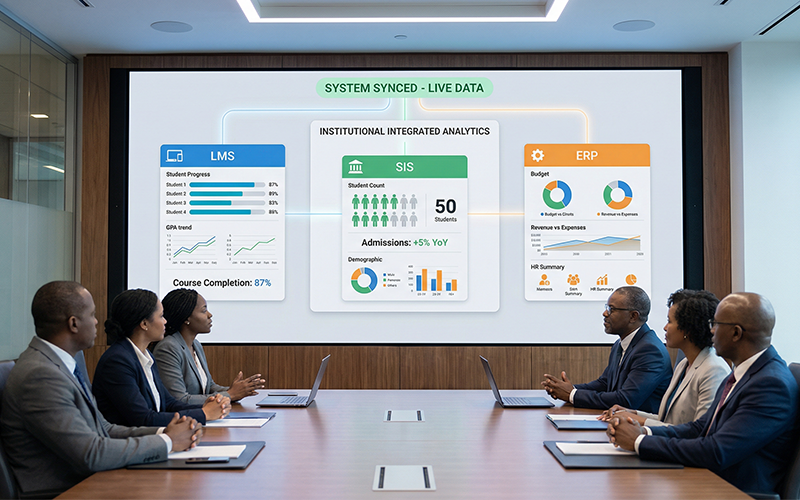
Understanding how these systems differ becomes much clearer when you compare them side by side:
| LMS | SIS | ERP | |
| Primary Purpose | Deliver and manage learning | Manage student records and enrolment | Run institutional operations |
| Key Users | Faculty and students | Registrars, advisers, admin staff | Finance, HR, senior leadership |
| Data managed | Course content, grades, engagement | Academic history, enrolment, transcripts | Payroll, budgets, HR records |
| System Scope | Academic experience | Student lifecycle | Back-office operations |
The distinction between the learning management system and SIS is particularly important for institutions that sometimes conflate the two, as both hold grade-related data. The LMS records grades in real time as part of the learning process; the SIS holds those grades as part of the official academic record. They serve different masters and should ideally be integrated so that data flows between them automatically.
When Does a University Need Each System?
The short answer is that most universities need all three. But the priority and sequencing depend on institutional maturity and current pain points.
You need an LMS if: your institution delivers courses online or in a blended format, you want to track student engagement and learning outcomes, or your faculty needs a structured environment for assignments and assessment.
You need an SIS if: you are managing student enrolments, transcripts, and academic records at scale, or your administrative staff are drowning in manual record-keeping and compliance requirements.
You need a university ERP system if: your finance and HR operations are fragmented, you lack visibility into institutional spending, or you are trying to manage payroll, procurement, and reporting across multiple departments without a unified system.
Most growing institutions reach a point where all three are necessary, and the real question becomes how they talk to each other.
The Problem with Disconnected Systems
Many universities find themselves with an LMS, an SIS, and some form of financial software that never quite speak to one another. The consequences are significant and well-documented. A 2024 study cited in LMS integration research found that 67% of institutions cite system integration as their top technology challenge, with LMS-ERP integration as the most commonly cited gap.
When systems are disconnected, specific problems emerge:
- Students enrolled in the SIS may not appear correctly on LMS course rosters
- Attendance data captured in the LMS does not reflect in institutional records
- Students dropped for non-payment in the ERP may retain LMS access
- Institutional analytics cannot connect learning engagement data with academic outcomes
As EDUCAUSE notes, ERP implementations in particular depend on effective change management and stakeholder engagement. Without that, even a well-designed system produces poor outcomes. The technology is only part of the solution; the integration strategy is equally critical.
How Integrated Platforms Improve University Operations
The move towards integrated systems is not simply a technology trend. It is a strategic imperative. When an LMS, a SIS, and an ERP are connected, universities gain something far more powerful than three separate tools. They gain a unified view of institutional performance.
The benefits are tangible:
- Centralised data means administrators no longer maintain separate spreadsheets or reconcile conflicting records
- Better decision-making becomes possible when finance, HR, and academic data are visible in one place
- Workflows improve because information flows automatically between systems rather than being re-entered manually
- The student and faculty experience becomes seamless, with single sign-on, consistent data, and fewer administrative bottlenecks
Gartner and EDUCAUSE both advocate what is often called a “best-of-breed, connected” strategy: using specialised systems for each function while ensuring they are integrated through modern APIs and middleware rather than forcing one monolithic platform to do everything. This approach gives institutions flexibility without sacrificing coherence.
How Vigilearn Fits Into the University Technology Stack
Vigilearn is purpose-built for higher education institutions navigating exactly this challenge. Rather than offering a generic platform, Vigilearn provides dedicated academic tools that are designed to integrate into a broader institutional technology stack.
The Ediify LMS delivers a structured, scalable environment for online and blended learning, complete with course management, assessments, and engagement analytics. The Enroli SIS handles the student information layer, managing enrolment data, academic records, and the administrative processes that surround the student lifecycle. The Examination Portal adds a dedicated layer for secure, large-scale assessments, and Apply streamlines the admissions process from application to enrolment.
Together, these products cover the academic operations layer of a university’s technology stack, from a student’s first application to their final transcript. They are designed to integrate with existing infrastructure, ensuring that institutions do not have to choose between specialised academic tools and institutional coherence.
For universities looking to scale their digital learning capabilities without fragmenting their data, Vigilearn offers a coherent, connected path forward. Explore the full product suite or read more on the Vigilearn blog.