
An online application portal is quietly becoming the backbone of how universities, businesses and government agencies collect and manage applications at scale. For decades, the default was paper forms, email attachments and spreadsheets stitched together by whichever staff member had the patience for it. That approach worked when volumes were modest. It buckles the moment an admissions office, a recruitment team or a government programme must process thousands of submissions within a tight window.
The strain is not just about volume. It is about accountability. When applications arrive through five different channels, no one can say with certainty how many are outstanding, which documents are missing, or who last reviewed a file. A properly designed system solves this by giving every applicant one place to apply and every administrator one system to manage the entire pipeline, whether that pipeline serves a university admissions cycle, a corporate recruitment drive, or a state scholarship scheme.
Read More: Biometric Attendance Systems: How Schools and Universities Track Attendance Accurately
What Is an Online Application Portal?
It is a centralised digital application system that lets organisations collect, review and manage applications from start to finish, replacing manual, paper-based or email-driven processes. For the applicant, it typically means creating an account, filling in a structured digital form, uploading supporting documents, submitting the application and then tracking its status without needing to phone or email anyone. Notifications arrive automatically at each stage, so applicants are never left guessing.
On the administrative side, it functions as application management software and, just as importantly, an applicant management system: staff can review submissions against set criteria, verify documents, update statuses, shortlist candidates, and generate reports, all from a single dashboard rather than a scattered mix of inboxes and folders. This is precisely why the same underlying infrastructure works equally well for a university admissions office, an HR team screening job applicants, and a government agency processing scholarship or grant applications.
How an Online Application Portal Works
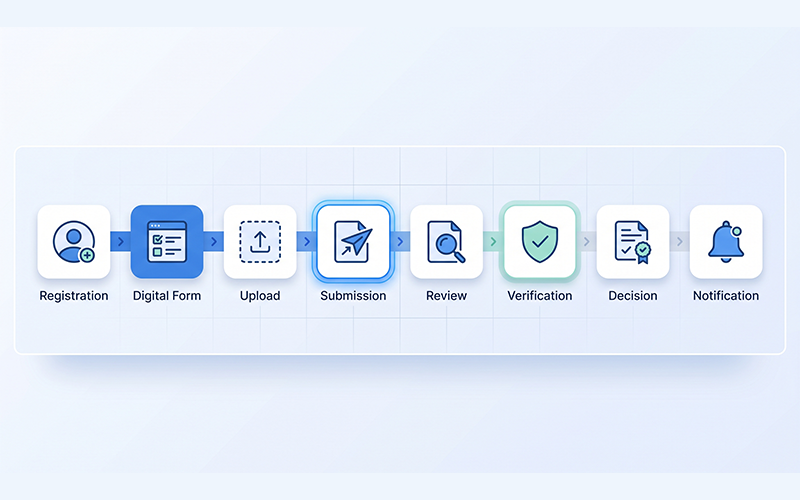
Most portals follow a broadly similar workflow, even though each organisation configures it around its own rules and stages:
- Applicant registration: the individual creates a profile.
- Digital form completion: structured fields replace ambiguous paper forms.
- Document upload: certificates, identification and supporting files are attached directly.
- Application submission: a single click sends the completed file for review.
- Review and verification: staff check eligibility and authenticate documents.
- Decision: applications are approved, rejected or shortlisted.
- Applicant notification: outcomes are communicated automatically.
A university might add an interview stage; a civil service commission might insert a screening test; a business might add a reference check. The workflow logic bends to the organisation, not the other way round.
Why Institutions Need Application Management Software
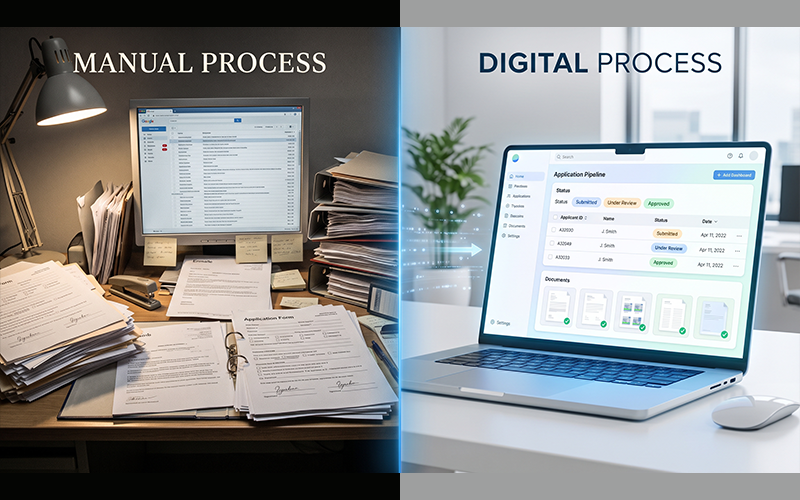
Universities, schools and training institutions are usually the first to feel the pressure of manual intake, particularly during peak admissions periods. Application management software addresses this directly by centralising every submission, cutting down on physical paperwork, and giving admissions staff a shared view of where each file stands.
The practical gains compound quickly:
- Faster processing, because reviewers work from one system rather than reconciling spreadsheets.
- Better applicant communication, through automated status updates rather than manual follow-up emails.
- Reliable document management, with transcripts and certificates stored against the correct applicant record.
- Genuine application tracking, so nothing quietly falls through the cracks.
- Staff collaboration, since multiple reviewers can work on the same pipeline without duplicating effort.
- Cleaner reporting, useful when institutions need to justify admissions numbers to boards or accreditation bodies.
Read More: School Management Software Cost: A Complete Pricing Guide
An admission management system built on this foundation also feeds naturally into onboarding, since verified applicant data does not need to be re-entered once a candidate is admitted. In effect, institutions get an applicant management system and an onboarding tool in one place, rather than two disconnected systems. The same logic extends outward to related operations, such as school management software and fee collection software, which work best when applicant data does not need to be re-entered at every stage. UNESCO has noted that digital innovation can expand access to educational opportunities for learners who would otherwise be excluded, which is as true of the application stage as it is of learning itself.
How Government Agencies Can Use a Government Application Portal
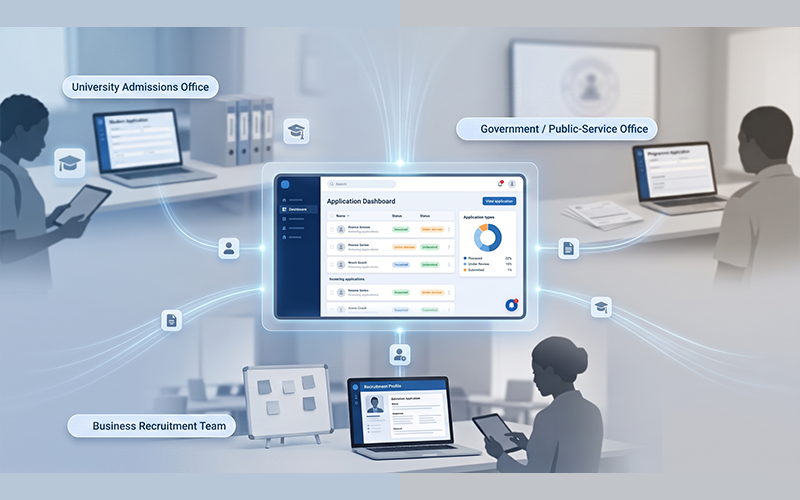
Government agencies handle some of the largest and most consequential application volumes of any sector, from scholarship schemes to civil service recruitment. Nigeria’s Joint Admissions and Matriculation Board, for instance, registered over 2.2 million candidates for the 2026 Unified Tertiary Matriculation Examination, illustrating just how significant digital intake infrastructure has become for managing national-scale demand.
A government application portal can plausibly support several public-sector functions, including:
- State scholarship applications
- Public programme and grant applications
- Civil service recruitment and public-sector intake
- Education initiative applications
The value is standardisation. Instead of each department improvising its own paper-based process, a shared digital application system creates one consistent applicant experience and one consistent audit trail, which matters enormously for public accountability. The World Bank’s GovTech programme frames this kind of reform around citizen-centric services, universal accessibility and digital transformation, three principles that apply just as well to an application intake process as to any other government service. This is an area of clear potential rather than a claim about any specific deployment; every agency’s requirements and existing infrastructure differ, and Nigeria’s National Information Technology Development Agency has been developing a Government Digital Service framework precisely to guide this kind of standardisation across ministries, departments and agencies.
Because applications inevitably involve personal data, government agencies adopting online application management also need to build in compliance with the Nigeria Data Protection Act, which governs how personal data collected from citizens must be secured and processed. Done well, online application management becomes as much a governance function as an administrative one.
From Application Submission to Decision: Automating the Workflow
Application workflow automation is what separates a genuinely useful digital application system from one that has simply moved paperwork onto a screen. Automated acknowledgements confirm receipt the moment an applicant submits. Application routing sends each file to the correct reviewer or department without manual sorting. Document collection happens upfront, rather than through a frustrating back-and-forth of missing attachments.
From there, status updates keep applicants informed, reviewer assignment distributes workload evenly, and shortlisting tools help staff narrow large pools down to a manageable set of candidates. Notifications and reporting close the loop, giving administrators a clear picture of throughput and bottlenecks. None of this eliminates human judgement from the review process; it simply removes the repetitive administrative work that keeps staff from focusing on it.
What Features Should an Online Application Portal Include?
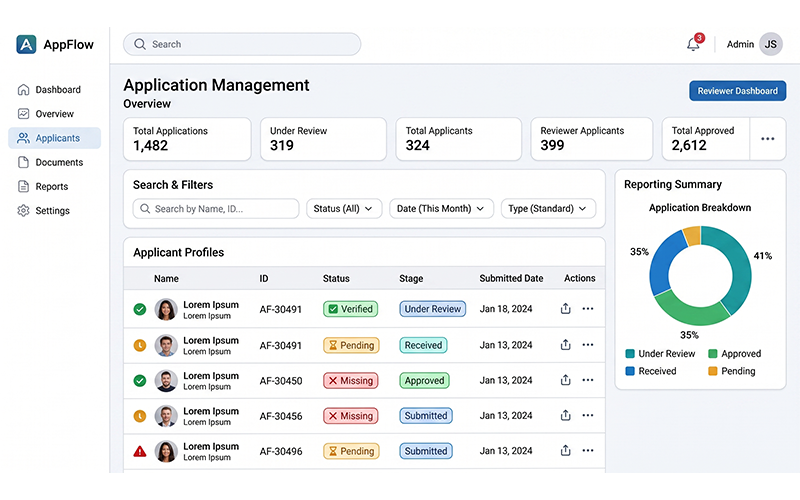
Whether the buyer is a school, a business or a government agency, a genuinely useful application portal should include:
- Online registration and applicant accounts
- A flexible form builder
- Secure document upload
- Real-time application tracking
- An applicant-facing dashboard
- Automated notifications
- Configurable review workflows
- Role-based user permissions
- Centralised data management
- Reporting and analytics
- Search and filtering across applicant records
- Mobile accessibility
- Data security safeguards
Missing even one or two of these tends to reintroduce the manual bottlenecks the system was meant to remove.
Read More: Examination Portal: Why Universities Need Digital Assessment Systems in 2026
Online Application Portal vs Manual Application Process
The contrast between manual intake and a digital application system is stark once laid out side by side:
- Paper forms become digital forms.
- Email attachments become centralised document uploads.
- Spreadsheet tracking becomes an application dashboard.
- Manual status updates become automated notifications.
- Fragmented records become centralised records.
- Difficult, ad hoc reporting becomes structured digital reporting.
It is worth being honest here: digitalisation only creates value when the underlying workflow is properly designed. A poorly configured portal that simply replicates a confusing paper process on screen will frustrate applicants just as much as the paperwork it replaced.
How Apply Supports Digital Application Management
Apply Portal, part of the Vigilearn suite, is built around this same three-way positioning: academic institutions, businesses and government agencies. It functions as both a digital gateway for applicants and an applicant management system for administrators, with user management interfaces designed for both sides of the process.
Apply currently supports payment integration through fintech platforms for application fees, user screening so administrators can assess applicant profiles against defined parameters, and analytics that help institutions and organisations draw insight from their application data for planning purposes. Institutions using Enroli SIS alongside Apply can carry verified applicant data straight into student records, avoiding duplicate data entry at the onboarding stage.
Choosing the Right Application Processing Software
Organisations evaluating application processing software should weigh a consistent set of criteria:
- Ease of use for both applicants and reviewers
- Workflow flexibility to match internal processes
- Capacity for high application volumes
- Solid document management
- Reporting depth
- Data security and access controls
- Granular user permissions
- Integration capability with existing systems
- Mobile experience
- Scalability as volumes grow
- Responsive support
Rushing this evaluation is a common mistake. A portal built for a few hundred applications a year may struggle at ten times that volume, especially without application workflow automation built in from the start.
The Future of Digital Applications
Several developments are shaping where digital application portals are headed, even if adoption varies significantly by country and sector. Digital identity verification is increasingly discussed as a way to authenticate applicants without physical documents. Automated document verification and AI-assisted application review are being explored to speed up screening for high-volume programmes. Digital credentials, real-time application tracking, and eventually cross-agency application systems that let citizens reuse verified data across multiple government services all represent plausible next steps rather than universally available capabilities today. Organisations considering these features should treat them as part of a longer roadmap, distinct from what any specific system currently offers.
Whether the applicant pool is prospective students, job candidates or citizens applying for a government scheme, the challenge is the same: collecting, reviewing and managing large volumes of applications without losing track of any single file. An online application portal solves this by replacing scattered paper and email-based processes with one centralised, auditable system that works for education, business and government alike. Institutions and agencies still relying on spreadsheets and inboxes are, in effect, choosing to absorb avoidable delays and administrative risk, while those that move first gain a communication advantage with applicants and a data advantage with their own leadership. If your institution, business or agency is ready to explore what a properly configured system could look like for your workflow, Vigilearn offers Apply as a starting point; you are welcome to request a free trial or get in touch to discuss your requirements.
Read More: How to Choose an LMS: A Practical Evaluation Checklist for Institutions
Frequently Asked Questions
What is an online application portal? A centralised digital system that lets applicants submit and track applications online, while giving administrators one place to review, verify and process them.
What is application management software? Software that helps organisations manage the full application lifecycle, from intake and document verification through to decisions and reporting.
How does an application portal work? Applicants register, complete a digital form, upload documents and submit; staff then review, verify and communicate decisions, often with automated notifications at each stage.
What can government agencies use application portals for? Potential uses include scholarship schemes, grant applications, civil service recruitment and public-sector programme intake, standardising what is often a fragmented, paper-based process.
What is the difference between an application portal and an admission management system? An admission management system is typically education-specific, whereas an application portal is broader and can serve education, business and government use cases on shared infrastructure.
How can online applications reduce processing time? By removing manual document handling, automating routing and notifications, and giving reviewers a single dashboard instead of scattered spreadsheets and inboxes.
What features should an application portal have? At minimum: registration, a form builder, document upload, tracking, notifications, review workflows, permissions, reporting and mobile accessibility.
Is a government application portal suitable for public-sector use? Yes, in principle. Government agencies handle high application volumes and benefit from standardisation, though each agency’s requirements and existing digital infrastructure will shape how a portal is deployed, as guided by frameworks such as NITDA’s Government Digital Service framework.
