
Somewhere in your admissions office, there is a form being printed right now that should not exist.
It might be a supplementary document request, a referee submission sheet, or a course registration slip. Wherever it sits, it represents something that paperless university administration has already solved for institutions that made the decision to move. Paper in a university is not a legacy issue to be managed; it is a choice every institution makes, consciously or not, every time it fails to replace a manual step with a digital one. The question worth asking directly: when did your institution last audit how many paper-based steps still exist in a student’s journey from application to graduation? For most universities, the answer is never, and the implications are already embedded in their operating costs, their error rates, and their student satisfaction scores.
Read More: The Digital Campus Is Not the Future. It’s What Your Students Are Already Expecting Today
The Hidden Cost of Every Paper Form
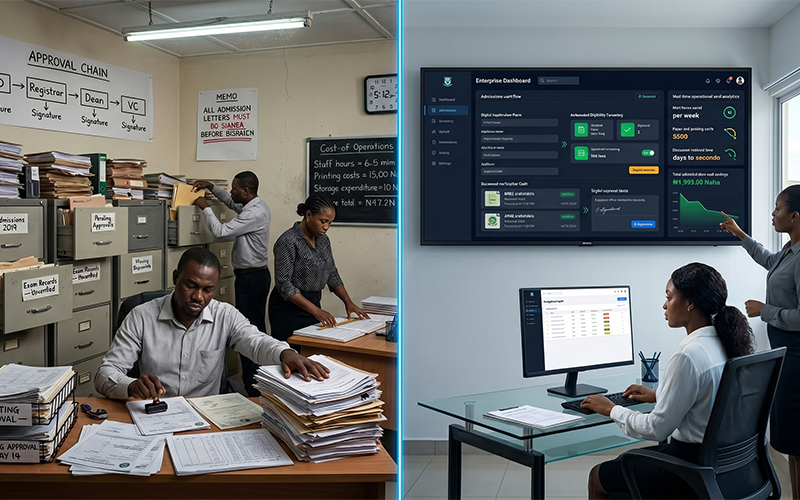
The financial case for paperless university administration is not built on the cost of paper and ink. Those are negligible in isolation. The real cost is the labour that paper demands.
Consider a single paper-based step in your admissions process. A form is distributed, either physically or as a PDF. A student completes it, often incorrectly or incompletely. A staff member reviews it, identifies the error, and contacts the student. The student corrects and resubmits. The form is manually keyed into your student system. The entry is checked against the original. The form is filed. Weeks later, when that record is needed for a compliance audit, someone physically retrieves it. Every one of those steps carries a labour cost, a delay cost, and an error risk that compounds across thousands of students every academic year.
Research published in 2025 found that, in the U.S alone, manual data entry costs organisations an average of $28,500 per employee annually, with 56% of employees experiencing burnout from repetitive administrative tasks. The education sector is consistently flagged in this data. Separately, human data entry achieves only 96 to 99% accuracy under best conditions, meaning that even careful staff introduce between 100 and 400 errors per 10,000 entries. At the institutional scale, those errors generate correction cycles, dispute processes, and compliance risks that cost far more than the entry errors themselves.
Paper is not free. It is a tax on every stakeholder who touches it: the student who completes it, the staff member who processes it, the registrar who files it, and the administrator who retrieves it.
Where Paper Still Hides in Institutions That Consider Themselves Digital
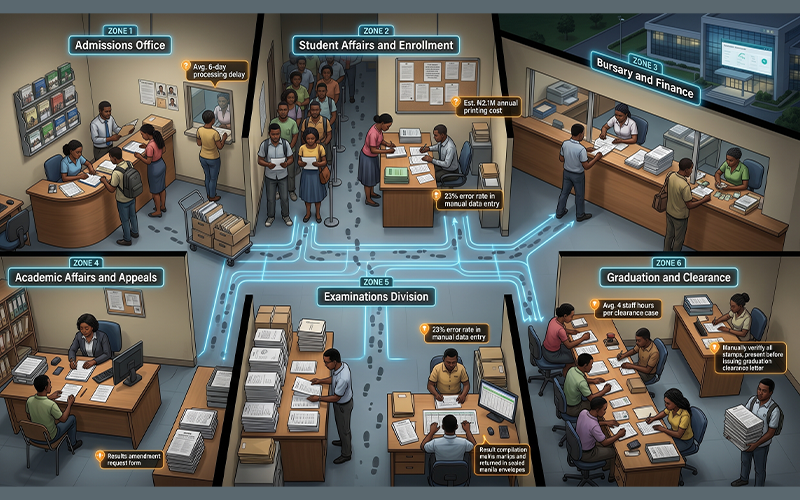
Here is an uncomfortable truth that many university leaders do not fully reckon with: most institutions have digitised their front-facing student experience while leaving paper-based back-office processes entirely intact. They have a portal and a spreadsheet. A digital form and a physical file. This hybrid creates a situation where the institution carries the operational costs of both a paper system and a digital one without capturing the full benefit of either.
Paper persists in predictable locations across almost every university that has not committed to eliminating it:
- Admissions: supplementary document submission, referee forms, identity verification photocopies, and conditional offer acceptance slips.
- Enrolment: course selection forms, accommodation requests, and student ID collection sheets.
- Finance: fee payment receipts, bursary application forms, refund request paperwork, and instalment arrangement letters.
- Academic administration: assignment cover sheets, special circumstances forms, academic appeal letters, and attendance registers.
- Examinations: exam entry forms, invigilator sign-off sheets, and result dispute paperwork.
- Graduation: gown collection forms, clearance certificates, and alumni registration sheets.
The irony is stark: universities invest heavily in research infrastructure and digital learning platforms, yet many still run their admissions operations on spreadsheets, email chains, and paper-based approval workflows. The 2024 Gartner CIO and Technology Executive Survey found that 83% of higher education CIOs ranked student experience as their highest priority for digital investment, yet back-office processes that directly shape that experience remain largely unchanged. That gap is where paper hides.
The Student Experience Argument: What Paper Communicates Without Saying a Word
The operational case for paperless university administration is compelling on its own. But the student experience argument is what makes this a strategic priority rather than simply an efficiency project.
EDUCAUSE research identifies “smoothing the student journey” as one of the sector’s top 10 institutional priorities, with universities investing in seamless digital experiences from admission to graduation. Against that backdrop, paper is not neutral. It actively communicates something to every student who encounters it. It signals operational immaturity. It creates friction at exactly the moments when a prospective student is forming their first and most durable impressions of the institution.
EDUCAUSE research notes that the majority of currently enrolled students are digital natives accustomed to seamless app-based experiences, who encounter university systems that often predate their births, with poor mobile support and confusing, overlapping processes. For a generation of students whose banking, healthcare, and government interactions are entirely digital, a paper form is not an inconvenience. It is a disqualifying signal about whether this institution understands the world they live in.
Jisc’s digital experience insights survey, which gathered responses from 15,398 students across 30 UK universities in 2024 and 2025, consistently shows that students rate their digital environments well above average when those environments are coherent and integrated. The institutions scoring poorly are almost always those with hybrid systems, where a digital front end conceals a paper-dependent back office.
What Paperless Actually Requires: Beyond the Portal
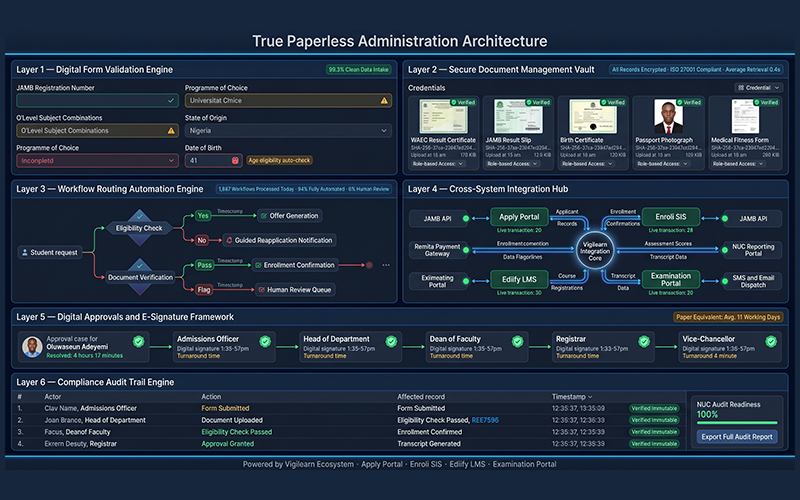
Eliminating paper is not the same as scanning paper. That distinction matters more than most institutions initially appreciate, and it is where genuine transformation departs from cosmetic digitisation.
Scanning a paper form and storing it as a PDF is a filing decision. It removes the physical object but preserves the underlying problem: a process that still requires someone to complete, collect, and process something outside the digital workflow. True paperless university administration requires something more fundamental.
It requires digital capture with validation, meaning forms that enforce completeness at the point of submission rather than during manual review. It requires a document management infrastructure where submissions are securely stored, retrievable, and shareable without email attachments. It requires workflow routing so that approval chains operate digitally, replacing the physical movement of a file between departments. It requires system integration so that data submitted in one system is automatically available in connected systems, eliminating re-entry. And it requires a complete audit trail: every action logged, timestamped, and traceable for compliance and accreditation.
Going paperless is not a technology upgrade. It is a process redesign that removes paper from the workflow before it has the opportunity to enter.
How Apply Portal and Enroli SIS Eliminate Paper Across the Student Journey
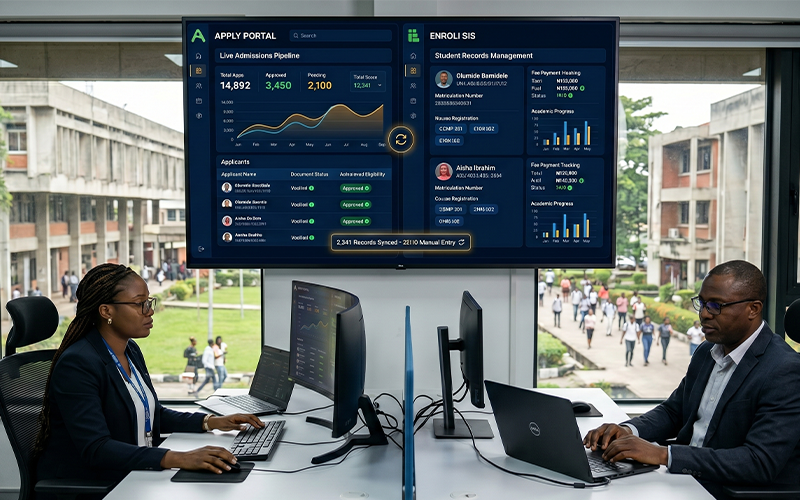
Vigilearn’s Apply Portal approaches admissions as a fully digital workflow from the first moment of contact. Applications, supporting documents, referee submissions, and identity materials are captured entirely within the portal. Guided submission logic means that incomplete or incorrectly formatted submissions are flagged before they reach a reviewer, eliminating the correction cycles that consume staff time in paper-based processes. Automated communications replace paper-based correspondence, and internal workflow routing replaces the physical movement of application files between staff members and departments.
Enroli SIS then functions as the single verified record of every student across their entire institutional journey. Fee status, academic progress, enrolment history, document records, and compliance information are all held in one system, accessible to any authorised staff member without a filing room, a physical archive, or a manual retrieval process.
The integration between the two systems is where the largest paper gap in most institutions is finally closed. When a student is accepted through Apply Portal, their enrolment record in Enroli SIS is created automatically. No manual data transfer, no re-entry, no gap between admissions and registration where information gets lost, delayed, or entered incorrectly.
Vigilearn does not digitise your existing paper process. It replaces it with a better process that never involved paper in the first place. That distinction is the difference between a partial solution and a genuine one.
Read More: Admissions Automation: How Smart Universities Are Cutting Processing Time by 70%
The Institutions That Have Made the Transition: What Changed
The outcomes documented across institutions that have committed to eliminating manual administration follow consistent patterns. King’s University College transitioned from a paper-based admissions system to a digital document management platform with automated workflows, which reduced document loss, improved cross-department collaboration, and accelerated admissions decisions. The University of Pécs adopted automated application management for international admissions and tripled enrolment within five years, with automation reducing administrative workload and allowing staff to focus on personalised student support.
The consistent outcomes across these transitions include faster admissions processing, lower error rates in student records, improved compliance readiness through digital audit trails, and higher student satisfaction with the application and enrolment experience. Staff capacity shifts from processing and filing toward genuine student engagement. Leadership gains access to accurate, real-time institutional data rather than reports compiled by hand from fragmented sources.
These are not theoretical benefits. They are the documented consequence of one decision: to stop treating paper as inevitable in university administration.
Frequently Asked Questions
How do universities go paperless? By replacing paper-based processes with integrated digital systems that capture, validate, route, and store information without any step requiring a physical document. This involves redesigning processes, not simply scanning existing paper forms.
What are the benefits of paperless admissions? Faster processing, lower error rates, reduced staff time on manual data entry, improved applicant experience, and complete audit trails for compliance and accreditation.
Which university processes still use paper unnecessarily? Admissions document submission, course registration, bursary applications, special circumstances forms, examination entry, and graduation clearance are among the most common locations where paper persists in institutions that consider themselves digital.
How does a digital admissions portal eliminate paper? By capturing applications and supporting documents entirely online, enforcing completeness at submission, automating communications, and routing approvals digitally. Apply Portal handles all of this within a single workflow.
What is the cost of manual data entry in university administration? Beyond direct labour costs, manual entry introduces error rates that generate correction cycles, compliance risks, and audit vulnerabilities. Research indicates poor data quality costs organisations millions annually, with education consistently among the affected sectors.
Can a university operate without any paper-based processes? Yes. With the right integrated platform, every administrative stage from initial inquiry to graduation can be managed entirely within digital systems. The barrier is not technical; it is the willingness to redesign processes rather than digitise them.
See how Vigilearn Apply Portal and Enroli SIS eliminate paper from admissions to graduation. Request a paperless campus walkthrough and discover what your institution looks like when the last form is finally gone. Book a consultation with the Vigilearn team today.