
There is a particular kind of institutional crisis that does not announce itself loudly. It creeps in gradually, disguised as growing pains: admissions taking twice as long as they used to, staff copying data between systems that were never meant to communicate, and academic reports that take days to generate and still come out wrong. By the time a university leadership team recognises what is happening, the underlying problem has often been embedded for years. The system the institution chose when it had 400 students was simply never built to handle 4,000.
Africa’s higher education sector is in the middle of a demographic surge with no signs of slowing down. UNESCO estimates that the number of young Africans completing secondary or tertiary education will double from 103 million to 240 million between 2020 and 2040. Kenya’s university enrolment grew 152% in just 12 years, crossing 606,000 students by 2024. Nigeria now has over 300 universities, the majority of them private institutions, added in the last decade. For any institution operating in this environment, scalable university management software in Africa is not a long-term wish list item. It is an operational necessity that determines whether growth becomes an asset or a liability.
Read more: Student Lifecycle Management in Higher Education
Why Scalability Matters More Than Features When Choosing University Software
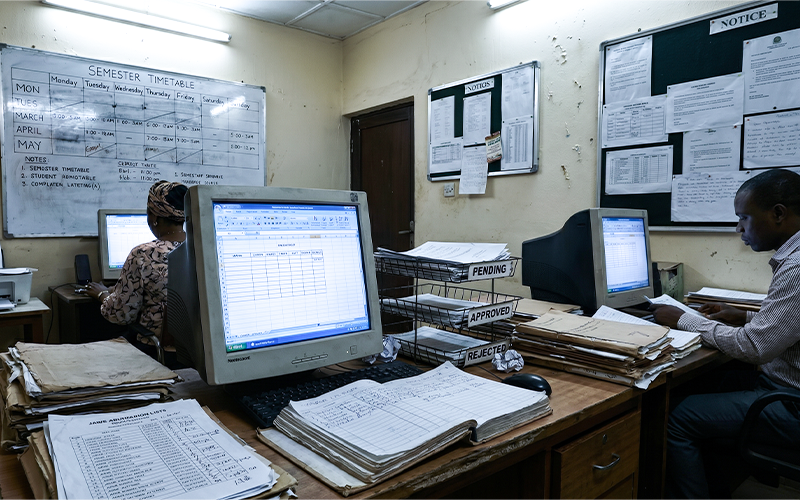
A feature-rich platform can be genuinely impressive during a product demonstration. It can show you beautiful dashboards, clean enrolment workflows, and elegant grade reports. What a demo cannot show you is how the system performs when 3,000 students attempt to register for courses simultaneously at the start of a semester, or when your IT team is trying to generate a report across five faculties and six campuses at once.
Scalability is not about what a system can do on day one. It is about what it can sustain over time, under real institutional pressure, as complexity multiplies. Institutions that choose software based purely on current needs often find themselves facing a forced migration two or three years later, precisely when growth is accelerating, and stability matters most. Migration at that stage is not just expensive; it is disruptive to students, faculty, and administrative staff in ways that damage institutional credibility.
The right question to ask when evaluating any platform is not “Does this work for what we are now?” It is “Will this still work when we are three times this size, running multiple programmes, and managing a distributed team?”
The 3 Phases of Institutional Growth and What Each Demands From Technology

Technology requirements change as institutions grow, and they change in ways that are predictable. Understanding the three phases helps institutions make smarter procurement decisions from the start.
Phase 1: 100–500 Students. Early-stage institutions need software that is fast to set up, affordable, and light on administrative overhead. The priority is getting core operations running without requiring a dedicated IT team. Key needs at this stage include easy onboarding, basic admissions tracking, course management, and simple reporting.
Phase 2: 500–5,000 Students. At this stage, manual processes that worked at a smaller scale begin breaking down. Admissions volumes require workflow automation. Finance and student records need to integrate reliably. Reporting demands increase as leadership needs cleaner data to make decisions. Institutions at this phase need automation, CRM-level integrations, and reliable workflows that do not depend on individual staff members remembering the right steps.
Phase 3: 5,000–50,000+ Students. Enterprise-level demands become unavoidable. Multi-campus management, department-level access controls, advanced analytics, high-volume examination processing, and concurrent system usage by thousands of users simultaneously all require infrastructure that was designed for this from the start, not retrofitted to handle it. This is the phase where institutions running under-engineered systems begin to experience visible failure.
What “Scalable” Actually Means in Practice

Scalability is widely misunderstood as simply meaning “can handle more users.” That is one dimension of it. The fuller definition is considerably more demanding.
A truly scalable university management platform maintains consistent performance as user numbers grow. It keeps administrative complexity from multiplying in proportion to enrolment. It delivers reliable reporting even when data volumes are large. It integrates with other systems without those integrations becoming brittle. And it preserves data integrity across the entire institution, regardless of how many departments or campuses are involved.
In practice, this means a scalable system can handle:
- Thousands of simultaneous enrolments during peak registration periods without slowdowns.
- Concurrent examinations across multiple faculties without system conflicts.
- Admissions processing at volume while maintaining accurate, real-time student records.
- Reporting across departments that reflects live data, not last night’s export.
An institution running scalable university management software in Africa does not need to warn students to “try again later” during registration week. That single detail captures the practical difference between a system that merely works and one built to scale.
Why Some University Systems Break During Growth
Growth does not create problems in well-designed systems. It reveals problems that were already there. The most common failure patterns follow a recognisable sequence.
Outdated infrastructure: On-premise systems reach hardware limits before administrators realise it is happening. Processing slows, queues build, and the IT team spends its time managing load rather than supporting institutional needs.
Disconnected systems: When the admissions portal, the student information system, the LMS, and the finance system do not communicate reliably, staff fill the gaps manually. Manual processes are slow, error-prone, and do not scale.
Poor database design: Systems built for small volumes often use database architectures that perform adequately at low scale but degrade badly as record counts grow. This is an infrastructure problem that cannot be solved by adding staff.
Weak integrations: Third-party integrations bolted onto legacy systems become unreliable under load, leading to data inconsistencies that undermine institutional reporting and decision-making.
The pattern is consistent: institutions outgrow weak systems quickly, and the warning signs are usually visible well before the crisis point. The challenge is that switching systems mid-growth is far more difficult than starting with a scalable foundation.
How Vigilearn Is Built to Scale
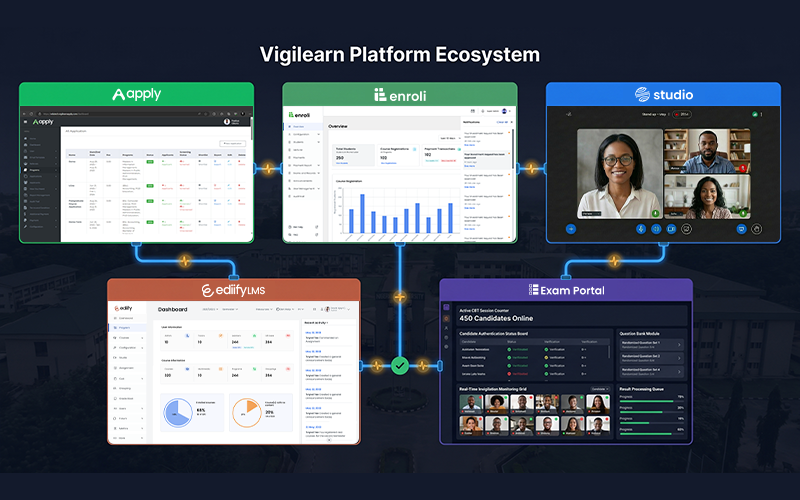
Vigilearn was designed as scalable university management software in Africa from the ground up, not adapted for it after the fact. The architecture reflects this in several ways.
The platform runs on cloud infrastructure, which means capacity scales dynamically with institutional demand rather than being constrained by on-premise hardware. A centralised, multi-tenant architecture ensures that each institution’s data is secure and independent while benefiting from shared infrastructure reliability. API flexibility allows the platform to integrate with existing institutional systems without the brittle connectors that plague legacy platforms.
The Vigilearn ecosystem is modular and fully integrated:
- Apply Portal: Manages online admissions from application through to acceptance, handling high-volume cycles without bottlenecks.
- Enroli SIS: The student information system, maintaining accurate records across the full student lifecycle.
- Ediify LMS: Delivers and manages academic content, accessible from any device.
- Examination Portal: Handles assessment at scale, including concurrent examinations across departments.
- Studio: Enables institutions to create and publish digital course content without specialist technical knowledge.
Each product works independently and as part of the integrated whole. Institutions can begin with the modules they need and expand as they grow, without rebuilding or migrating data. This is what enterprise-grade scalability looks like in practice: institutions do not face a rebuild every few years because the platform was built for where they are going, not only where they started.
What Growth-Stage Institutions Experience With the Right Platform
The operational difference between a scalable platform and an under-engineered one becomes most visible at key institutional stress points.
Institutions that implement scalable university management software in Africa typically report improvements across several areas:
- Admissions processing: Applications that previously required manual review, data entry, and follow-up emails get processed through automated workflows. What took weeks compresses to days.
- Enrolment capacity: The system handles concurrent registration without degradation, eliminating the queues and errors that frustrate students and overwhelm administrative staff.
- Reporting visibility: Leadership gains real-time access to enrolment figures, academic performance data, and operational metrics, rather than waiting for manually compiled reports.
- Administrative workload: Staff shift from managing system limitations to managing institutional strategy. The repetitive, error-prone tasks that consumed disproportionate hours move into automated workflows.
The before-and-after is not primarily about technology. It is about what administrators and leaders can focus on when infrastructure stops being a constraint.
Vigilearn: Built for Every Stage of Institutional Growth
The most important decision a growing institution can make is to avoid building on a platform it will outgrow. The cost of migrating systems mid-growth, in time, disruption, and data risk, almost always exceeds the cost of choosing a scalable foundation at the start.
Vigilearn supports institutions from the new private university processing its first cohort to the established multi-campus institution managing tens of thousands of students. The platform is cloud-native, growth-ready, and enterprise-capable without demanding enterprise-level complexity before it is needed.
For more on how African institutions are modernising their operations, visit the Vigilearn blog.
FAQ
What is scalable university management software? It is a platform that maintains reliable performance, operational consistency, and data integrity as an institution grows, handling increasing users, data volumes, and complexity without requiring system replacement.
Why does scalability matter in higher education technology? Because enrolment growth, new programmes, and additional campuses all increase system demands rapidly. Platforms that cannot scale force disruptive and costly migrations at exactly the wrong moment.
Can one platform support both small and large universities? Yes, if it was designed with a scalable architecture. Cloud-native, modular platforms like Vigilearn support institutions from early stage through to enterprise scale on the same infrastructure.
How do universities avoid outgrowing their systems? By choosing platforms built on scalable cloud infrastructure with modular expansion capabilities from the start, rather than adopting the most affordable option at launch and migrating when it fails.
Ready to Build on the Right Foundation?
Whether your institution manages 500 students or 50,000, Vigilearn is built to scale with you. Book a demo and explore what your next stage of growth could look like with the right infrastructure behind it.