In many universities today, the student journey looks seamless on brochures and websites. A prospect discovers the school, applies, gets admitted, learns, graduates, and becomes an alumnus. Simple. Linear. Almost elegant.
Behind the scenes, however, administrators know the truth. That journey is often held together by spreadsheets, emails, manual approvals, and systems that barely speak to each other. Admissions works in one tool. Academic teams manage learning in another. Finance runs a separate system. Certification and records sit somewhere else entirely. Each handoff introduces friction, delays, and confusion, not just for staff, but for students who increasingly expect clarity, speed, and consistency.
As competition for students intensifies and digital-first learners become the norm, this fragmentation is no longer just an operational inconvenience. It actively damages student experience, increases drop-off, and limits institutional growth. That is why universities are rethinking how the entire student lifecycle is managed, not as isolated stages, but as a single, connected system.
Read more: Automating Student Records and Transcripts in 2026
In 2026 and beyond, leading institutions will not be defined by how many tools they use, but by how well those tools work together. End-to-end student automation is fast becoming the foundational infrastructure.
Why Fragmented Systems Kill Student Experience

Most universities did not set out to build fragmented systems. The problem emerged gradually. A CRM was added to manage leads. An application portal followed. A learning management system handled teaching. A separate system issued certificates. Each solution solved a real problem at the time.
The challenge is that these systems were rarely designed to function as a unified whole.
When platforms do not share data seamlessly, the student feels the gaps immediately. A prospect submits an inquiry and waits days for a response because admissions must manually export and forward details. An applicant uploads documents, only to be asked for the same files again after admission. A newly enrolled student receives conflicting emails from different departments because records are not synchronized.
These are not minor annoyances. They shape perception.
According to research highlighted by McKinsey Digital Education, students increasingly evaluate institutions not just on academic quality, but on digital experience and responsiveness. Delays, repeated requests, and unclear communication erode trust long before learning even begins.
Fragmentation also affects internal teams. Administrators spend valuable time reconciling data instead of supporting students. Decision-making becomes slower because leadership lacks a single, reliable view of the student lifecycle. Errors multiply when information is manually re-entered across systems.
In short, disconnected tools create disconnected experiences. And in a competitive education landscape, that cost is too high.
Understanding the Full Student Automation Flow
A true education workflow automation strategy connects every major stage of the student lifecycle into one continuous process. Rather than treating admissions, learning, and graduation as separate silos, automation allows data, actions, and decisions to flow naturally from one stage to the next.
Let us break down what this looks like in practice.
1. Lead Capture and Nurturing
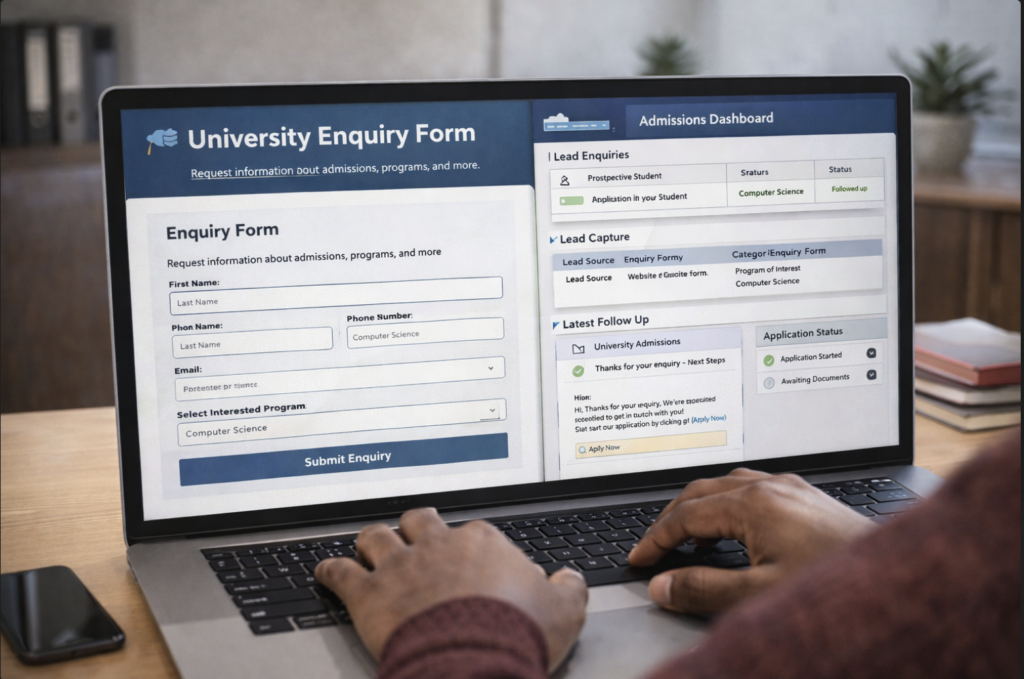
The student journey begins long before an application is submitted. Prospective students interact with websites, social media, webinars, and enquiry forms. In a fragmented setup, these leads often live in inboxes or spreadsheets.
With a student automation system, leads are captured automatically, categorized, and nurtured through structured communication. Follow-up emails, reminders, and updates are triggered based on student behaviour, not manual intervention. This mirrors the approach used in enterprise platforms such as Salesforce Education Cloud, but tailored to academic workflows.
The result is faster response times and a more professional first impression.
Read more: The Hidden ROI of Student Journey Automation
2. Application Management
Once a prospect is ready to apply, automation ensures continuity. Their existing data flows directly into the application portal. Required documents, application status, and communication are centralized.
Instead of admissions officers chasing files or updating applicants manually, the system tracks progress automatically. Students know exactly where they stand. Administrators see bottlenecks clearly and resolve them faster.
This is where lifecycle automation begins to show its real value. Every action builds on the last.
3. Enrollment and Onboarding
After acceptance, the enrollment phase is critical. Delays or confusion here often lead to drop-off, especially for international or distance learners.
An automated system triggers enrollment workflows immediately after admission. Payment confirmations, course registration, student ID creation, and access credentials are generated without manual intervention. Welcome emails and onboarding resources are sent at the right time, not days later.
This creates momentum. Students feel guided, not lost.
4. Learning and Academic Engagement

The learning phase is where automation must support, not replace, human interaction. A connected LMS ensures that enrolled students automatically gain access to the right courses, schedules, and resources.
Attendance tracking, assessment submissions, feedback, and progress monitoring happen in one environment. Academic staff see real-time data. Students receive timely notifications and support.
Platforms such as EdiifyLMS have shaped expectations around ease of use and accessibility. Universities that fail to meet these standards risk disengagement, regardless of content quality.
5. Certification and Graduation
Graduation is often treated as an administrative afterthought, yet it is one of the most emotionally significant moments in a student’s journey.
With automation, eligibility checks, academic records, and certification are handled systematically. Digital certificates can be generated securely, verified easily, and issued without delay. Alumni records are updated automatically, closing the lifecycle loop cleanly.
At this point, the student journey does not just end. It transitions into lifelong engagement.
How Automation Reduces Student Drop-Off

Drop-off rarely happens because students suddenly lose interest, more often, it is the result of accumulated friction.
Decision delays are one of the biggest contributors. When students wait too long for responses, approvals, or clarity, uncertainty grows. They explore alternatives. Momentum fades.
Automation addresses this problem directly.
By reducing manual dependencies, institutions shorten response times across every stage. Applications are acknowledged instantly. Status updates are clear. Enrollment steps are visible. Learning access is immediate.
Research summarized by Gartner’s education technology insights consistently shows that transparency and speed significantly improve retention and completion rates. When students understand what is happening and what comes next, they are far more likely to stay engaged.
Automation also reduces internal errors. Missing records, incorrect course assignments, or delayed certifications are common reasons students disengage or escalate complaints. A connected system minimizes these risks by design.
Ultimately, automation protects trust. And trust is what keeps students committed through to graduation.
How Vigilearn Powers Full Lifecycle Automation
Vigilearn approaches student automation not as a collection of tools, but as an integrated ecosystem designed specifically for educational institutions. At the centre of this ecosystem is a connected flow between admissions, learning, communication, and certification.
Apply Portal: Structured Admissions Without Chaos
The Apply Portal handles the front end of the student lifecycle. It centralizes applications, documents, and communication, ensuring that every applicant’s data is captured accurately and consistently.
Because it is built to integrate with other Vigilearn products, information does not stop at admission. It moves forward.
EdiifyLMS: Learning That Connects to the Bigger Picture
EdiifyLMS manages teaching, learning, and assessment within the same lifecycle framework. Enrollment data flows directly into course access. Progress tracking and assessment outcomes feed into academic records automatically.
This eliminates the traditional gap between admissions and academics, one of the most common failure points in digital student journeys.
Studio and Communication Continuity
With Studio, institutions extend learning and engagement beyond static content. Live classes, collaboration, and virtual events become part of the same system, not a disconnected add-on.
Communication remains consistent because student data is unified.
What Universities Gain from Full Automation
When student lifecycle automation is implemented properly, the benefits extend far beyond operational efficiency.
Speed
Processes that once took days or weeks happen in minutes. Faster admissions, quicker onboarding, and timely certification improve both student satisfaction and institutional reputation.
Accuracy
Automation reduces human error. Records are consistent, data is reliable, and compliance becomes easier to manage. This is particularly important for accreditation and reporting.
Visibility
Leadership gains a clear, real-time view of the entire student journey. From lead conversion to graduation rates, decisions are informed by accurate data, not assumptions.
Perhaps most importantly, teams regain time. Time to support students. Time to improve programmes. Time to focus on what education is meant to do.
By investing in a unified student automation system, institutions create clarity for students, confidence for staff, and capacity for growth.
Vigilearn is built for this reality. Not as a patchwork of tools, but as a foundation for modern education.