
There is a particular kind of operational chaos that higher education institutions know well, even if they rarely name it directly. An admissions officer searches for three different folders for a student’s enrolment form. A finance team cannot confirm whether a fee has been settled because the payment spreadsheet was last updated a fortnight ago. A registrar compiling a graduation list manually cross-checks records from four separate sources. For many universities across Africa and beyond, this is a normal Tuesday.
Much of what passes for student records management at growing institutions is a patchwork of spreadsheets, shared drives, and institutional memory. It works until it doesn’t. When it stops, the consequences range from frustrated students and delayed transcripts to accreditation risks and reputational damage that takes years to repair. A well-implemented student information system for universities makes every one of these problems solvable.
Read More: LMS vs SIS vs ERP: What System Does Your University Need
What Is a Student Information System?
A Student Information System (SIS) is the central platform that manages the complete student lifecycle: from the moment a student applies through to graduation and alumni management. It is the single authoritative source for all student-related administrative data within an institution.
A robust SIS handles:
- Student registration and enrolment: capturing and processing applications, managing intake, and maintaining enrolment records
- Academic records management: grades, transcripts, course history, and academic progression tracking
- Fee and payment tracking: tuition invoicing, payment confirmation, outstanding balance monitoring
- Attendance management: recording and analysing student participation across courses
- Compliance and accreditation reporting: generating audit-ready reports for regulatory bodies
- Graduation management: managing clearance workflows and certificate processing
- Alumni records: maintaining long-term data beyond the point of graduation
One important distinction: an SIS is not the same as a Learning Management System (LMS). An LMS, such as Vigilearn’s Ediify, manages teaching and learning delivery, course content, assignments, assessments, and academic engagement. An SIS manages student records and administrative operations. They serve different functions, and institutions that conflate the two often find significant gaps in both areas.
What Universities Without a Proper SIS Actually Experience

Industry research confirms that errors from manual data entry across multiple platforms, and the burden of correcting inconsistent records, consume time and resources institutions cannot afford to waste.
For universities still relying on disconnected systems, the day-to-day reality looks something like this:
Manual enrolment processing. Every new intake trigger weeks of back-and-forth between admissions, finance, and academic departments. Forms are printed, signed, scanned, and filed in folders that nobody can find six months later.
Spreadsheet dependency. Spreadsheets are not an administrative strategy; they are a liability. A single formula error, an accidental overwrite, or a corrupted file can wipe out months of data. As Vigilearn’s analysis of university data management notes, institutions that rely on isolated files “drown in spreadsheets, miss trends, overlook early signs of problems, and react too late.”
Lost or duplicated records. Higher education data research highlights duplicate records, inconsistent formats, and incomplete information as chronic problems that hinder decision-making and operational efficiency.
Accreditation chaos. Regulatory bodies require structured, accurate data. When records are fragmented, compiling a compliance report becomes a crisis rather than a routine process, putting institutional standing at risk.
Poor leadership visibility. When enrolment figures, fee collection rates, and academic performance sit in disconnected systems, institutional strategy defaults to guesswork. Students waiting days for a transcript or weeks for enrolment confirmation do not stay quiet. Administrative inefficiency is a direct competitive disadvantage.
The numbers reflect the urgency. Industry analysts project the student management system market will grow from $15.33 billion in 2024 to over $32 billion by 2029, a 15.9% compound annual growth rate.
Read More: Student Data Management System for Modern Universities
The 7 Core Functions of an Institutional-Grade SIS
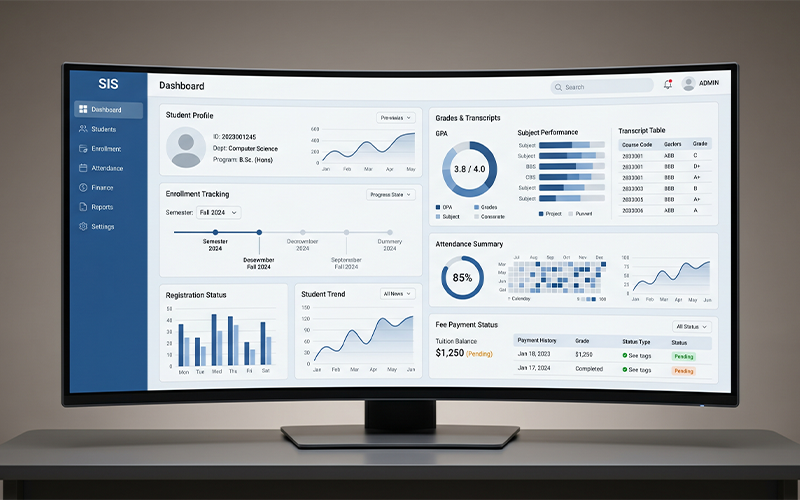
Not all SIS platforms are equal. An institutional-grade system does considerably more than digitise a filing cabinet. Here is what it actually needs to do:
1. Student Registration and Enrolment This is the foundation. A proper SIS captures applications through an integrated portal, processes enrolment decisions, assigns student IDs, and builds a clean intake record from day one. Institutions using Vigilearn’s Apply Portal integration experience this as a seamless flow from application to active student status, without manual handoffs.
2. Academic Records Management Every grade, every module, every academic progression decision needs to be recorded, verified, and retrievable. A good SIS maintains a complete academic history for each student, generates official transcripts on demand, and tracks progression against programme requirements, making graduation clearance manageable rather than chaotic.
3. Financial Management Fee tracking is where manual systems create the most visible pain. An SIS generates tuition invoices automatically, records payments against student accounts, flags outstanding balances, and gives finance teams real-time visibility into collection rates.
4. Attendance Management Attendance data matters for academic intervention and compliance reporting. A well-configured SIS captures this consistently across departments, enabling early identification of at-risk students before problems escalate.
5. Accreditation and Compliance Reporting EDUCAUSE research confirms that institutions are increasingly prioritising systems that support regulatory compliance. An SIS generates structured reports that map directly to regulatory requirements, reducing audit preparation from weeks to hours.
6. Graduation Management Graduation clearance involves finance, academics, library, and the registrar simultaneously. An SIS manages this as a structured workflow, with clear sign-offs at each stage, ensuring graduation lists are accurate before ceremonies.
7. Alumni Tracking The student relationship does not end at graduation. Alumni data supports fundraising, career placement tracking, and accreditation evidence. A university that loses track of its graduates immediately after convocation is leaving long-term value unrealised.
SIS vs LMS vs ERP: Understanding the Difference
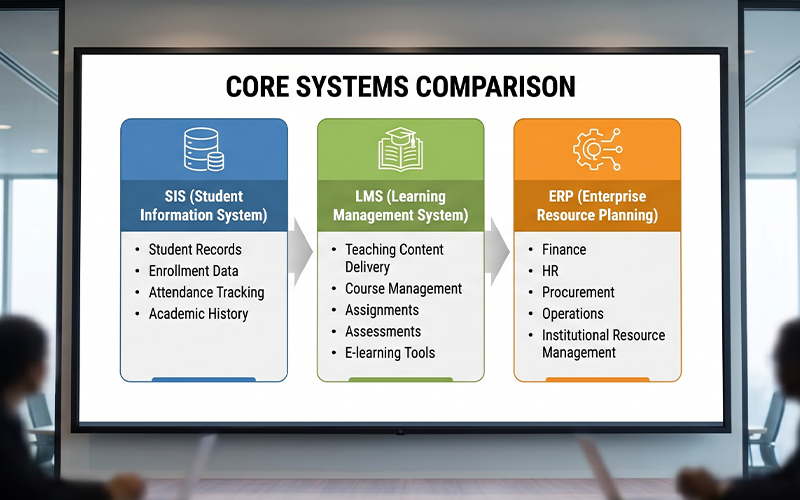
These three categories of software are frequently confused, and that confusion leads to institutions either over-investing in one area or leaving critical gaps in another.
An SIS manages student records and administrative operations across the full student lifecycle. An LMS manages teaching and learning delivery, covering course content, assessments, and academic engagement. An ERP manages wider institutional business processes: human resources, procurement, and institutional finance.
Most universities need all three working in coordination. An SIS feeds enrolment data into an LMS so students are automatically added to correct courses. An ERP handles staff payroll while the SIS handles student fees. These systems are complementary. Vigilearn’s product suite is designed with this integration in mind, connecting Enroli SIS directly with Ediify LMS to create a unified institutional environment.
Enroli SIS: Built for Modern Universities
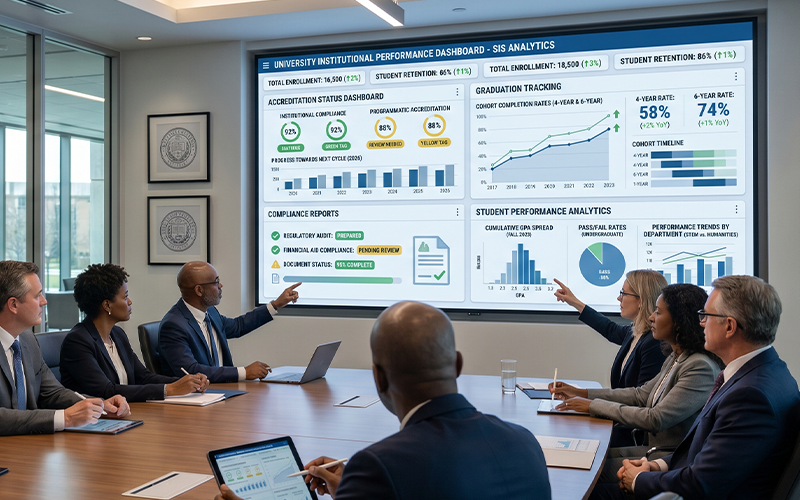
Enroli SIS by Vigilearn is built specifically for the operational realities of growing universities. It is not a repurposed school management tool. It is an institutional-grade platform that manages the complete student lifecycle with the integrations and reporting capabilities university leadership actually needs.
Key operational outcomes include:
- A single, accurate source of student data across all departments
- Automated enrolment workflows connected to the Apply Portal, eliminating manual data entry
- Real-time fee tracking and financial reporting for finance teams
- Direct integration with Ediify LMS, keeping academic and administrative data aligned
- Compliance-ready reporting that turns accreditation preparation into a process, not a panic
- Scalable architecture designed to grow alongside an institution’s student population
The goal is not to give administrators more software to manage. It is to give institutions the infrastructure to manage growth with confidence.
Read More: Student Lifecycle Management in Higher Education
Implementation: What Onboarding Actually Looks Like
The biggest barrier to adopting institutional software is fear of disruption: that migrating years of student data will go wrong, that staff will resist, or that operations will stall mid-transition. These concerns are legitimate and manageable.
A structured Enroli onboarding includes a scoping phase to map existing data and workflows, data migration support, staff training before go-live, and a staged launch to keep operations running. Post-launch support ensures expert guidance during the critical first weeks.
The transition is not as disruptive as institutions fear. What truly disrupts a university is not switching to an SIS. It is continuing to operate without one.
Frequently Asked Questions
- What is a Student Information System in a university? An SIS is a platform that manages student data from admission to graduation, covering enrolment, academic records, fees, attendance, and compliance reporting.
- What is the difference between SIS and LMS? An SIS handles student records and administration. An LMS manages teaching, learning delivery, and academic engagement. Both are necessary and serve distinct functions.
- Why do universities need a Student Information System? To reduce manual work, improve data accuracy, manage compliance requirements, and run efficient student administration at scale.
- Can a university use spreadsheets instead of an SIS? Spreadsheets work temporarily, but they create compounding risks: data loss, reporting errors, poor visibility, and operational delays that worsen as enrolment grows.
Ready to See Enroli SIS in Action?
If your institution is managing student records across spreadsheets, disconnected files, or outdated systems, the operational risks are already real, even if they haven’t yet surfaced as a crisis.
Book a demo of Enroli SIS by Vigilearn and see how universities are moving from manual records chaos to scalable, confident student management. Explore the full Vigilearn product suite or visit the Vigilearn blog for more insights on managing and growing modern educational institutions.