
Every SaaS company in the world knows that if a user does not find value in the first 48 hours, they are gone. Universities have not figured this out yet.
This is not a casual comparison. Consumer technology companies invest extraordinary resources in onboarding because decades of data have confirmed the same conclusion: the first interaction determines everything that follows. Research across SaaS products consistently shows that users who do not engage within the first three days have roughly a 90% chance of churning. The entire discipline of product design has been reshaped around this insight. And yet student onboarding in higher education operates on almost the opposite assumption: that students who have been accepted and have paid fees will naturally find their footing. The first week of university is when a student decides whether they belong, whether they made the right choice, and whether they are going to stay. Most institutions invest almost nothing in making that week work.
Read More: Student Data Management System for Modern Universities
What First-Year Dropout Data Actually Shows
The data on first-year attrition in higher education is consistent, well-documented, and directly linked to what happens in the first few weeks of enrolment.
According to the National Centre for Education Statistics, approximately 23% of all college dropouts are first-year students. Between the 2022 and 2023 academic years, 22.3% of first-time, full-time freshmen dropped out. These are not students who struggled academically for years before eventually leaving. The majority of first-year dropout decisions are formed in the opening weeks of the programme, when students are navigating unfamiliar systems, uncertain about their fit, and making assessments of the institution that will prove difficult to reverse.
The research on why this happens points consistently away from academic difficulty as the primary cause. Research published in peer-reviewed literature from 2020 to 2024 identifies institutional aspects, including the quality of support services, early integration, and academic environment, as critical determinants of whether students persist through their first year. The students most at risk are those who feel disoriented, unsupported, or disconnected before academic difficulty has even begun.
According to the Salesforce Connected Student Report, students with a positive onboarding experience are 35 times more likely to report a great overall university experience, with a 73% correlation between onboarding quality and institutional satisfaction. This is not a peripheral finding. It positions student onboarding in higher education as the single moment with the highest leverage on long-term retention.
What Happens in a Typical New Student’s First 48 Hours
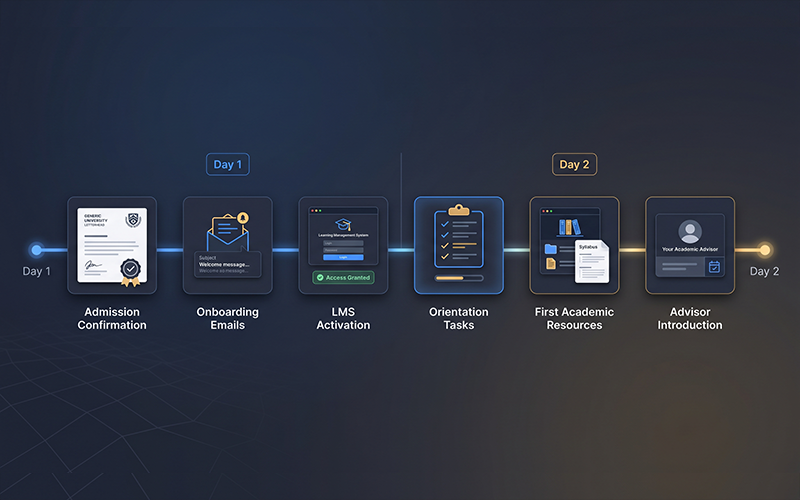
Walk through what most new students actually experience, and the contrast with what evidence says they need becomes stark.
An acceptance letter or email arrives, often carrying minimal guidance on what to do next. The student must navigate several disconnected systems to complete enrolment steps. LMS access is eventually granted, but no structured orientation to the platform is provided. The first institutional communication they receive is administrative in nature rather than welcoming. Nobody has told them who to contact if they are uncertain. Within 48 hours of formally becoming a student, they have encountered institutional friction at almost every turn.
Compare this to the SaaS onboarding standard: a guided first session that delivers immediate value, a clear next step at every point, and an automated check-in if the user does not return. Companies with structured onboarding see up to 50% higher retention in the first 90 days. The entire design logic is oriented around ensuring the new user experiences something meaningful before they leave their first session.
The question worth asking directly: which of those principles does your institution currently apply to a new student’s first 48 hours?
The SaaS Onboarding Framework Applied to Higher Education
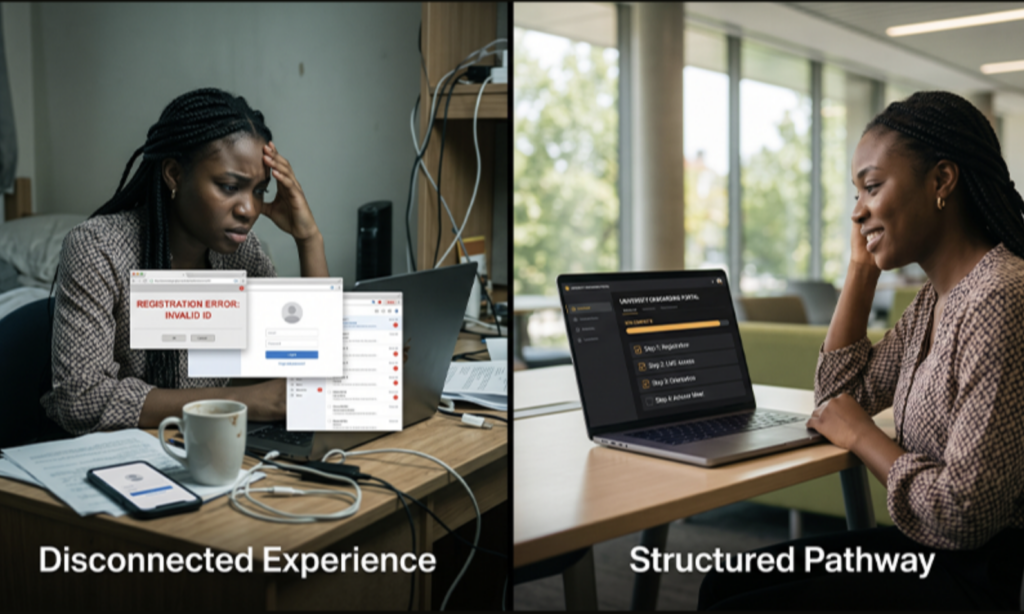
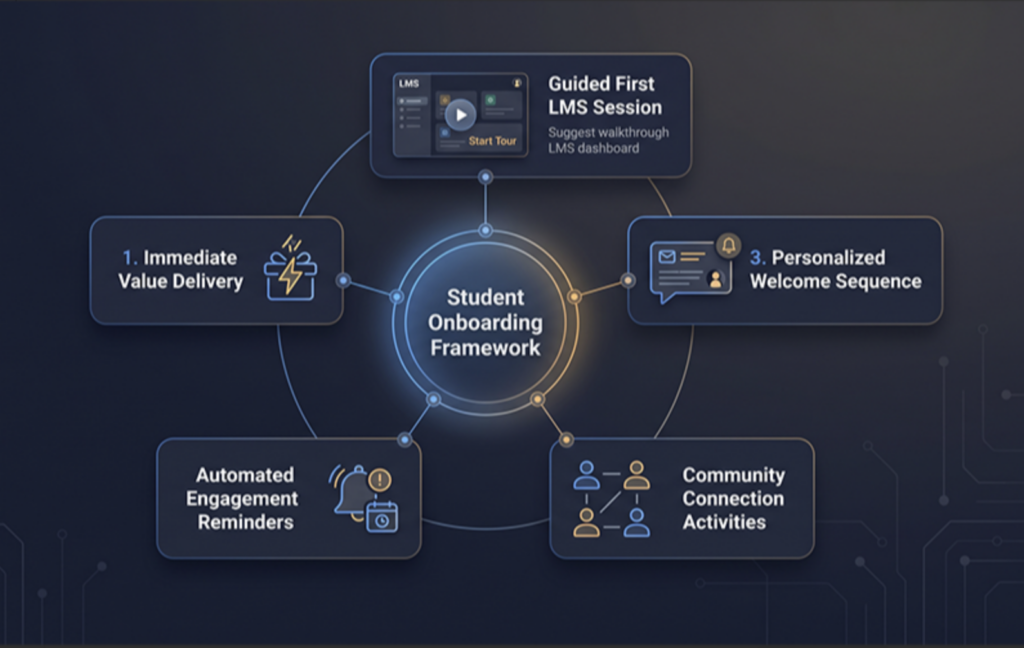
The principles that consumer technology has validated over two decades apply directly to student onboarding in higher education. They require no translation, only application.
Immediate value delivery. Within 24 hours of acceptance, the student should access something meaningful: a faculty welcome, their course outline, or their first piece of relevant content. The first interaction should confirm that the decision to enrol was the right one.
A guided first session. The first time a student logs into the LMS should not present a blank dashboard. It should walk them through where things are and what to do first. Interactive guidance consistently outperforms static tutorials, with structured onboarding flows producing significantly higher activation and retention.
A clear next step at every point. Every communication and every platform screen should invite one clear action. The student who does not know what to do next is the student who stops.
A re-engagement trigger. If a student does not log in within 48 hours of access being granted, an automated check-in should be sent. If they do not respond within 72 hours, a member of staff should make human contact. The cost of that intervention is negligible compared to the revenue cost of the dropout it prevents.
Community connection. Isolation is the leading cause of first-year dropout. Research confirms that students who feel a sense of belonging early in their university experience are significantly more likely to persist, perform academically, and report positive well-being. Onboarding should include a structured step that connects every new student to at least one peer or group before the first class.
Read More: Student Engagement Tools for Virtual Classrooms
The Financial Case for Onboarding Investment
The argument for investing in student onboarding in higher education is not primarily pastoral. It is financial.
Every first-year dropout represents a full year of lost tuition revenue. The marketing and admissions cost to acquire that student, the time invested in processing their application, the platform access provisioned for them: all of it is sunk. Four-year institutions lose an average of $21,000 per dropout in tuition and fees. The infrastructure investment required to improve onboarding is a fraction of the revenue cost of a single percentage point improvement in retention.
The arithmetic is not complicated. An institution with 2,000 new students and a 15% first-year dropout rate loses 300 students in the first year alone. A 2% improvement in retention through structured onboarding retains 40 additional students. At a conservative $1,500 average annual fee, that is $60,000 in recovered revenue from a single cohort improvement. At realistic fee levels in most African and international markets, the number is considerably higher. And it compounds: those retained students generate second-year, third-year, and fourth-year revenue that the dropout does not.
Universities that treat retention as a financial metric rather than only an academic welfare concern are the ones investing in the infrastructure that makes it possible.
How Apply Portal and Ediify LMS Automate the First 48 Hours
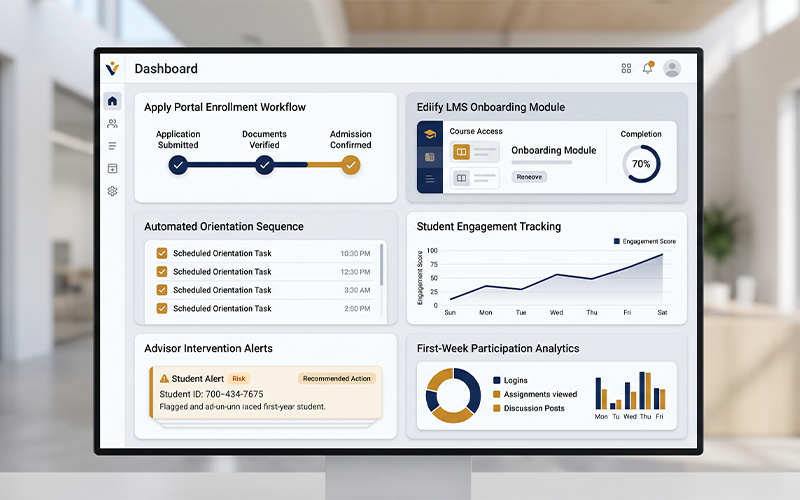
Vigilearn’s Apply Portal treats the acceptance step as the beginning of onboarding, not its end. The post-acceptance workflow includes structured communication that delivers clear next steps the moment an offer is accepted, not a generic confirmation email followed by silence. Students know what to do, in what order, and where to go.
The automated welcome sequence is configurable to send welcome content, platform orientation, and community connection prompts within the first 24 hours of LMS access. Every message has a clear purpose and a clear next action.
Ediify LMS guides new students through a structured orientation module before they encounter course content. The first session establishes platform confidence and environmental familiarity before academic demands begin. A student who understands their learning environment before their first assignment has a fundamentally different starting position from one who is still trying to navigate the platform when coursework arrives.
Re-engagement triggers flag students who have not engaged within defined windows. When a student goes quiet, the system notifies the relevant staff member immediately: not after a missed assignment, not after a grade drops, but within the window where a single conversation can change the outcome.
Vigilearn treats the first 48 hours as the most important infrastructure investment in the student lifecycle. Because the data shows that it is.
Frequently Asked Questions
Why is student onboarding important in higher education? Because first-year retention is most vulnerable to the quality of the initial experience. Students who feel disoriented, unsupported, or disconnected in their first week are significantly more likely to drop out, regardless of their academic capability.
What should happen in the first 48 hours after a student enrols? Immediate, structured communication with clear next steps; guided access to the LMS; a welcome from faculty; and at least one mechanism for connecting with peers. Every step should deliver value and reduce uncertainty.
How does poor onboarding contribute to first-year dropout? By creating friction, confusion, and isolation at exactly the moment when a student is deciding whether they belong. Dropout is rarely triggered by academic difficulty in the first weeks; it is almost always an experience and belonging failure first.
What does effective digital student onboarding look like? A guided first session on the platform, automated communication triggered by student behaviour rather than the calendar, community connection built into the process, and re-engagement alerts for students who go quiet within the first 48 to 72 hours.
How can universities use technology to improve the new student experience? By replacing generic confirmation emails with structured welcome sequences, introducing LMS orientation modules, automating re-engagement triggers, and integrating community connection steps into the post-acceptance workflow.
What is the financial return on improving student onboarding? Retaining an additional 2% of first-year students at a 2,000-student institution recovers a minimum of $60,000 in a single year at modest fee levels. At realistic higher education fees, and accounting for multi-year revenue, the return on onboarding investment is substantial.
The Infrastructure Decision Behind the First 48 Hours
The first 48 hours determine whether a student stays. Your onboarding infrastructure determines what those 48 hours feel like.
See how Vigilearn automates student onboarding in higher education from acceptance letter to first class. Request a walkthrough and discover what a structured first experience does for first-year retention.