
Universities are changing fast. Student populations are growing. Degree programs are expanding. Administrative workload is increasing, from admissions, fee management, exam scheduling, to record-keeping and more. As institutions scale, the old ways of handling admin tasks, spreadsheets, email threads, and paper forms start to crack. What once worked fine for a few hundred students becomes chaotic when there are thousands. Delays, errors, mismatched data, and silos across departments emerge.
By 2026, many institutions will no longer tolerate those inefficiencies. They need systems built to handle complexity, size, and speed. A central admin portal, a unified, digital, web-based dashboard for everything, stops processes from breaking under scale. It not only keeps things organised but also unlocks new levels of efficiency, transparency, and reliability.
Read more: How Student Journey Automation Improved University Operations in 2025
Why Manual Admin Work Breaks at Scale
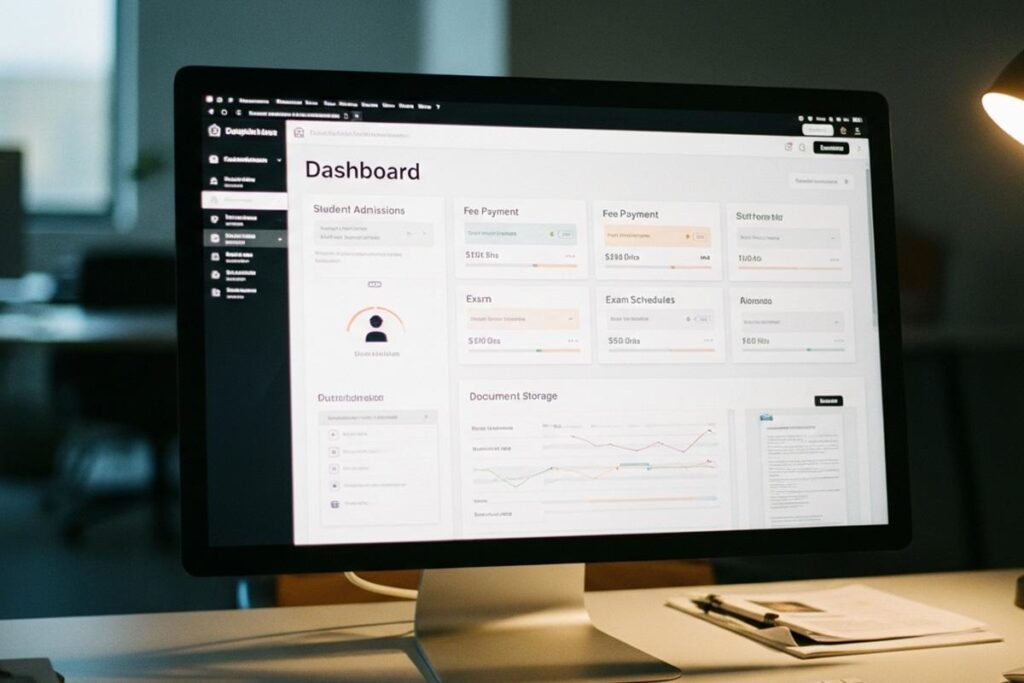
For small institutions, manually tracking admissions, payments, records, and exams may remain tolerable. A few spreadsheets here, some email approvals there, it works. But as student numbers grow, such an approach becomes fragile.
First, spreadsheets fail under high student volume. They get unwieldy. Multiple staff members update the same file, often leading to conflicts, overwrites, or duplicate entries. It becomes hard to know which version is current. Something as simple as a missing fee payment or a wrong exam date can cascade into bigger problems.
Second, manual workflows that depend on email and human coordination quickly replace structured, reliable processes. Emails go unread or get lost. Approval delays block application progress or fee confirmations. Without a clear workflow engine, tasks get stuck in inboxes. Students may apply, then wait days or weeks before receiving confirmation. Staff often chase each other repeatedly.
Third, data mismatches become common, disrupting reporting accuracy. When different departments (admissions, finance, academics) each maintain their own records, it’s almost inevitable that information diverges. The institution’s reports of enrollment numbers, tuition revenue, and academic results become unreliable or require time-consuming reconciliation. In the long run, this inefficiency: lost time, bad data, frustrated students and staff, hampers growth and institutional credibility.
As one recent analysis argues, universities stuck in paperwork-heavy systems “risk falling behind peers who have adopted digital tools.”
What an Admin Portal Manages
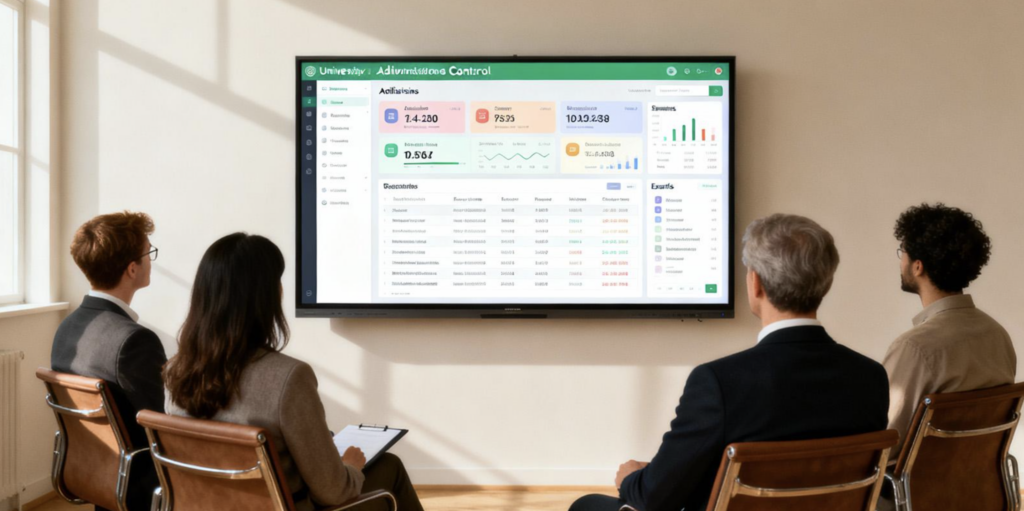
A robust university admin portal is more than a database. At a minimum, it should manage:
- Admissions processing and verification. Application submission, screening, acceptance, rejections, waitlists, all handled online in structured workflows.
- Fee payments and financial tracking. From fee invoices to payment confirmations, fee status dashboards, reminders, and financial reporting.
- Exam scheduling and result publishing. Automatic timetable generation, room allocation, conflict detection, grade recording, and final result publication.
- Student records and document storage. Personal data, transcripts, certifications, attendance logs, and disciplinary records, securely stored, easily retrievable.
- Staff workload and system access logs. Who did what, when, approvals, data modifications, access to sensitive records, and working across units.
In effect, the portal becomes the beating heart of a university’s operations, handling the full student lifecycle from admission to graduation, and supporting staff activity across roles.
How Central Dashboards Reduce Delays

Switching from fragmented tools to a central admin dashboard brings concrete improvements:
- Single screen for pending actions. Instead of hunting through emails or spreadsheets to see what needs attention, administrators get a unified view, pending admissions, unpaid fees, upcoming exams, and unverified documents. This reduces bottlenecks and speeds up throughput.
- Automatic alerts and reminders. The system can notify staff or students when an action is required: a fee payment is due, an admission needs verification, or an exam result needs approval. Automation ensures nothing slips through the cracks.
- Workflow visibility across teams. When everyone, admissions, finance, academics, and registry, uses the same system, it’s easier to see where a request is stuck, who needs to do what, and which tasks are awaiting completion. Inter-team confusion is reduced.
- Real-time status tracking. Students, staff, and leadership can see the real status of tasks: applications processed, fees cleared, and results published. No more follow-up calls or emails to check status. This transparency improves communication and accountability.
How Vigilearn’s Platforms Handle Multi-Campus Operations
Vigilearn is built for universities that operate across multiple campuses or study centres. Each product in the suite works together to provide a unified, scalable admin engine.
EdiifyLMS, Enroli SIS, the Apply Portal, Exam Portal, and Studio all sync into one ecosystem. This means every campus runs on the same data source, the same workflows, and the same reporting structure.
A single master dashboard gives leadership visibility across all campuses. Admissions load is automatically balanced through the Apply Portal. Course delivery and learning activities stay uniform through EdiifyLMS. Student records, payments, and program data remain consistent across locations through Enroli SIS. Exams and assessments run centrally via the Exam Portal, while Studio supports remote classes, virtual meetings, and inter-campus collaboration.
Finance data stays synchronised without manual uploads. Campus-level reports generate instantly. And because everything is integrated, universities avoid the chaos of duplicated systems and mismatched records.
In short, Vigilearn helps multi-campus institutions operate as one connected university, not scattered units.
Security and Role Access Inside Admin Panels
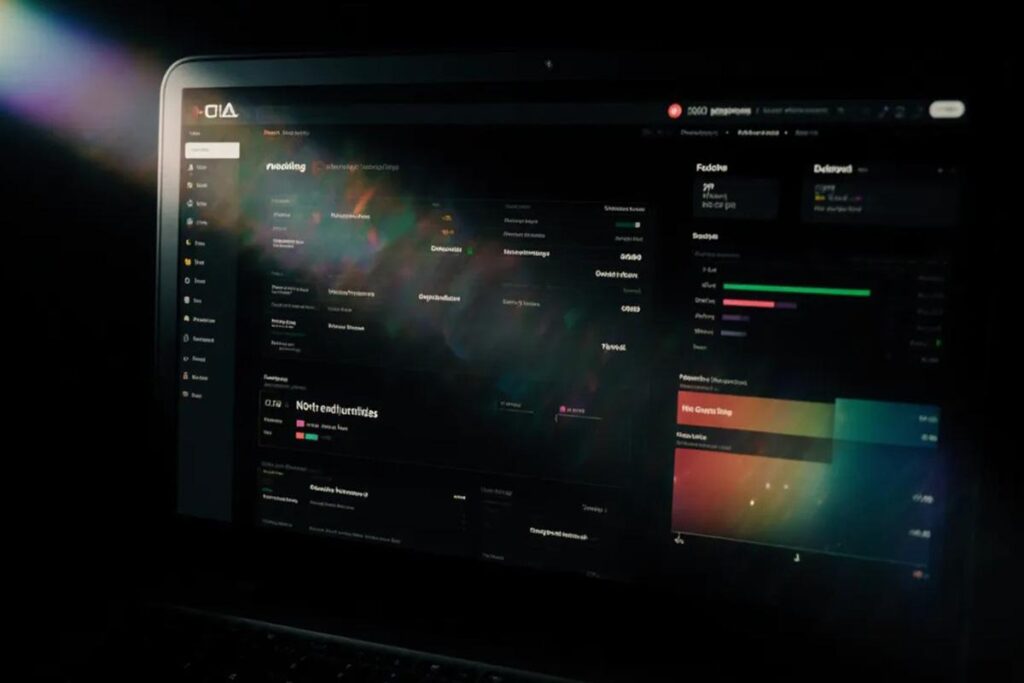
One of the biggest challenges in a central admin portal is ensuring that sensitive data remains secure, while still accessible to those who need it. Vigilearn addresses this through a robust role-based access model and audit controls:
- Role-based access controls (RBAC). Users are assigned roles (e.g., admissions officer, finance staff, counsellor, registrar, dean). Each role has clearly defined permissions. For example, only finance staff can view or manage fee payment data. Counsellors can access only the student records assigned to them.
- Restricted access to sensitive data. Financial records, student personal data, and disciplinary information all remain visible only to authorised roles. Unauthorised users simply do not see those sections of the portal.
- Audit logs for every system action. Every action, payment recorded, exam result published, and record updated, is logged. The log shows who did what and when. This provides accountability, helps with compliance, and supports investigations in case of disputes.
- Prevention of unauthorised data exposure. By combining RBAC with secure authentication, encrypted storage, and secure data transmission, the system ensures that sensitive information does not leak outside authorised channels.
This level of security is essential in 2026, when data privacy expectations and regulatory requirements are high. A portal without proper access controls or auditability can be more dangerous than helpful.
Why 2026 Is a Critical Moment for Universities to Adopt Central Admin Portals
There are several trends converging around 2026 that make a central admin portal not only beneficial but necessary.
- Growing student populations and institutional expansion. Many universities, especially in fast-growing regions, are expanding campuses, adding programs, and enrolling more students than ever before. Manual tools simply cannot keep up.
- Demand for faster turnaround and transparency. Students and parents expect quick responses: admission decisions, fee confirmations, and exam results. A portal with real-time status and automated workflows supports those expectations.
- Need for data-driven decision making. Institutional leaders want to track performance: enrollment trends, financial health, and academic outcomes. They need accurate, up-to-date data. A unified dashboard delivers that.
- Cost pressures and resource optimisation. Cloud-based management systems reduce the need for paper, printing, physical storage, and manual labour. As institutions tighten budgets, the savings from automation become attractive.
- Regulatory and security demands. With data privacy laws spreading, universities must ensure that student and staff data are handled securely. A well-designed portal with role-based access and audit logs helps meet compliance requirements.
Given these pressures, 2026 may represent a tipping point: universities that still rely on manual admin processes risk falling far behind their digitally transformed peers.
For any university that wants to stay competitive, efficient, and student-centred in 2026 and beyond, building a central admin portal is not just a technical upgrade. It is core infrastructure.
If you’d like to see how Vigilearn’s portal modules align with your institution’s needs, from admissions to finance to reporting, check out our Homepage, explore Vigilearn Studio, or learn more via our Apply Portal.
