
Across Africa, universities are facing a new reality. Competition for students is increasing, learner expectations are changing, and institutional growth is no longer driven by reputation alone. Today’s students expect fast applications, seamless communication, mobile accessibility, and digital-first experiences from the moment they discover a university to the day they graduate.
This is why university enrolment technology in Africa has become more than an operational conversation. It is now a growth conversation. Institutions that once treated technology as a back-office IT function are beginning to realise that enrolment outcomes are directly tied to the quality of their digital systems. A slow admissions process, fragmented communication, or poor online application experience can quietly reduce conversion rates long before a student reaches the classroom.
According to EDUCAUSE, digital transformation in higher education involves coordinated changes across culture, operations, and technology to improve institutional performance and student experience. In practical terms, universities are discovering that technology is no longer supporting enrolment growth from the sidelines. It is actively shaping it.
Read More: Hybrid Learning in Universities: Managing Flexible Education Models
Why Technology Is Now an Enrolment Variable, Not an IT Variable
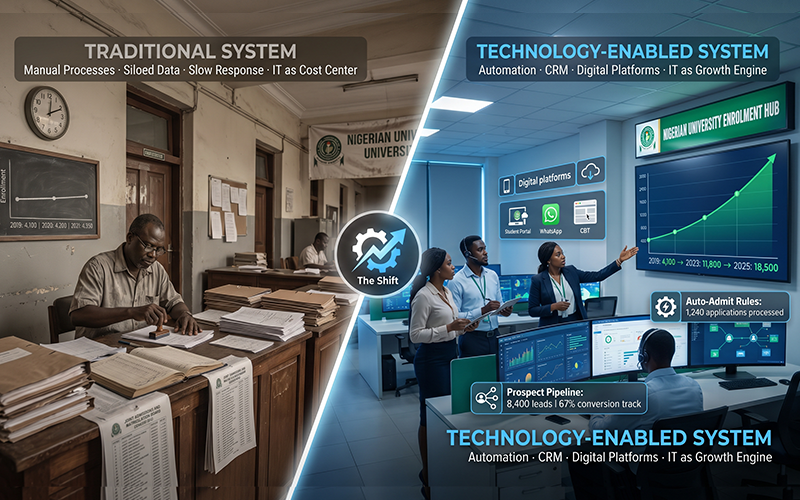
For years, many universities viewed technology primarily as infrastructure. The focus was on maintaining servers, digitising records, or supporting internal administration. Enrolment growth was handled separately by marketing teams and admissions departments.
That separation no longer works.
Modern students interact with universities the same way they interact with banks, airlines, and digital services. They expect speed, convenience, transparency, and personalised engagement. Institutions that fail to provide this experience lose applicants during the enrolment journey.
This shift explains why university enrolment technology Africa is becoming central to institutional strategy. Universities that align technology with recruitment and admissions goals tend to scale faster because their systems reduce friction throughout the student journey.
By contrast, institutions operating disconnected systems often face:
- Incomplete applications
- Delayed admissions decisions
- Lost applicant data
- Poor follow-up communication
- Low student retention after enrolment
Technology now influences whether prospective students complete applications, accept offers, remain engaged, and recommend the institution to others.
The question universities must ask is simple: are your systems helping enrolment growth or quietly slowing it down?
The 3 Enrolment Levers Technology Directly Impacts
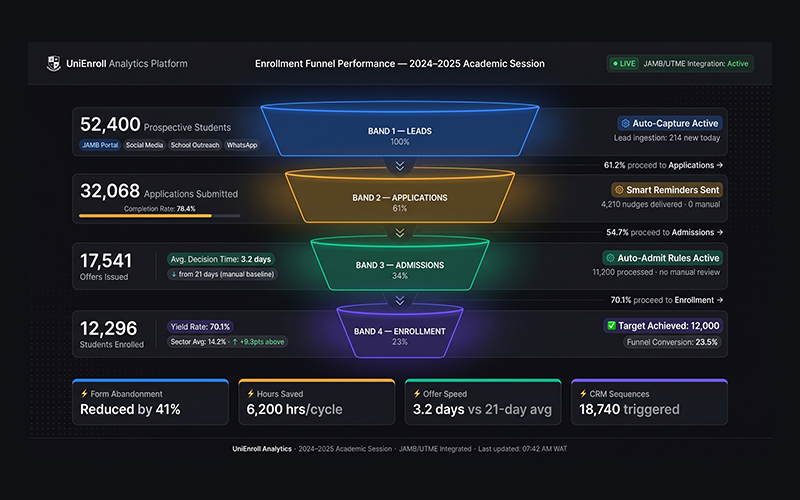
1. Application Completion Rate
One of the biggest enrolment problems universities face is application abandonment. Students begin applications but fail to finish them because the process is too long, confusing, or inaccessible on mobile devices.
A modern university’s digital enrolment system improves completion rates by simplifying the process. This includes:
- Mobile-friendly applications
- Automated document uploads
- Real-time progress tracking
- Instant confirmations
- Integrated payment systems
When students experience fewer barriers, submission rates improve naturally.
Many universities underestimate how much friction affects enrolment. Even reducing unnecessary steps in an application form can significantly increase completed applications.
2. Admissions Processing Speed
Speed matters in admissions.
When universities take weeks to process applications manually, students often accept offers elsewhere. Institutions using technology-driven admissions workflows gain a major advantage because they respond faster and maintain engagement throughout the decision process.
Automation helps institutions:
- Route applications instantly
- Verify documents faster
- Track admissions status centrally
- Send automated communication updates
- Reduce administrative bottlenecks
This creates a first-mover advantage. The university that responds quickly often wins the student.
According to EDUCAUSE Review, digital transformation enables institutions to improve learner experiences and operational efficiency through integrated systems and workflows.
3. Student Experience After Enrolment
Enrolment growth does not end when a student accepts admission. Retention matters equally.
Students who experience poor onboarding, fragmented learning systems, or communication gaps are less likely to remain engaged. They are also less likely to recommend the institution to others.
This is where Learning Management Systems, student portals, and communication tools become important for EdTech enrolment growth Africa.
Strong post-enrolment systems improve:
- Student onboarding
- Course access
- Communication with lecturers
- Academic visibility
- Student satisfaction
- Retention and referrals
A student who enjoys a seamless academic experience becomes part of the university’s marketing ecosystem.
Case Evidence: Institutions That Made the Technology Shift
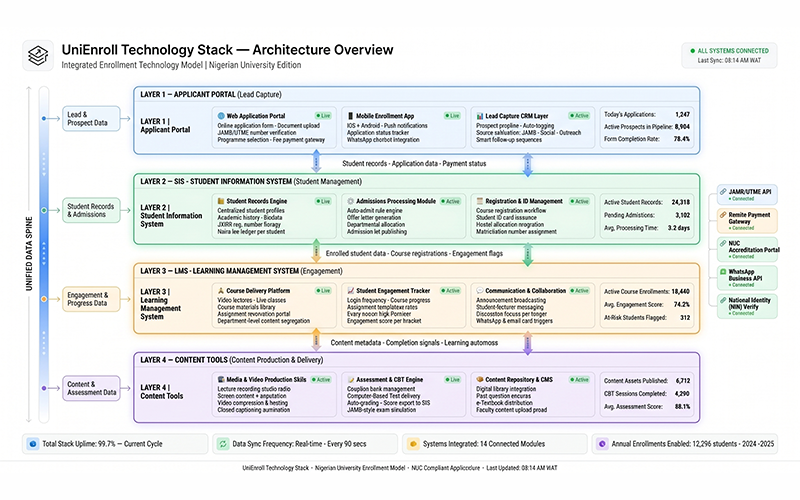
Across Africa, institutions adopting integrated digital systems are already seeing measurable results.
A private university in East Africa, for example, reduced its admissions processing timeline from several weeks to less than five working days after digitising its admissions workflow. The institution also recorded a noticeable increase in completed applications because prospective students could apply fully online.
Another institution in West Africa implemented a centralised student information system alongside a modern LMS. Within one academic cycle, the university improved communication consistency, reduced manual registration errors, and increased student retention rates.
These outcomes are not accidental.
The relationship between technology and enrolment growth follows a clear pattern:
Better systems → smoother applicant experience → higher conversion → improved student satisfaction → stronger institutional reputation.
This is why technology-driven enrollment university strategies are becoming essential for universities seeking sustainable growth.
Read More: How Universities Can Manage High Application Volume
The Complete Enrolment Technology Stack
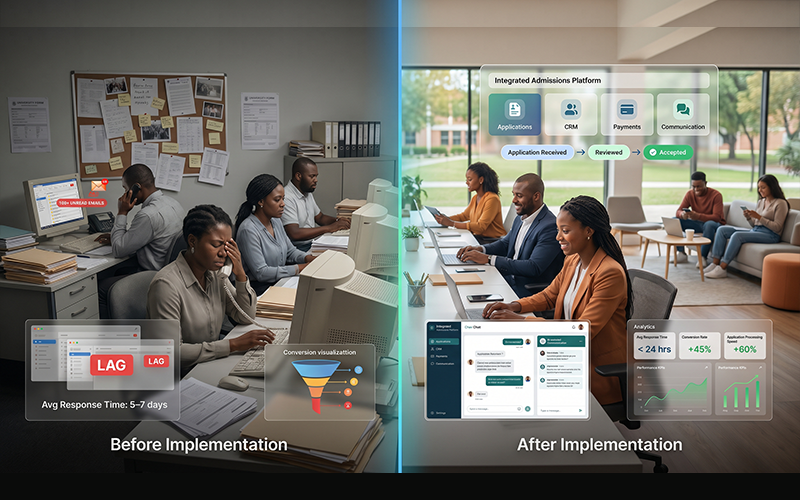
Enrolment growth is rarely the result of a single tool. It usually comes from connected systems working together across the student lifecycle.
A modern enrolment stack typically includes:
Application Portal: This is the first touchpoint for prospective students. It manages inquiries, applications, uploads, payments, and applicant communication.
Student Information System (SIS): The SIS centralises student records, admissions data, academic progress, and administrative operations.
Learning Management System (LMS): An LMS supports digital learning delivery, assignment management, assessments, and student engagement after enrollment.
Communication and Content Tools
These tools support announcements, onboarding, virtual learning, and student engagement across departments.
The most effective institutions understand that enrollment is a connected system, not a one-time campaign.
Disconnected platforms create friction. Connected systems improve visibility, efficiency, and student experience.
This is one reason many institutions are investing in integrated platforms rather than isolated tools. According to EDUCAUSE Digital Transformation Resources, successful digital transformation depends heavily on coordinated systems rather than isolated technology adoption.
What Implementation Looks Like: Timeline and Milestones
One major concern universities have about adopting new systems is implementation complexity. Many assume digital transformation will disrupt operations for months.
In reality, phased implementation significantly reduces disruption.
A typical rollout may look like this:
Week 1–2: Audit and Planning
- Review existing processes
- Identify bottlenecks
- Define enrollment goals
- Map student journey workflows
Week 3–5: System Setup
- Configure application portals
- Set up workflows
- Integrate departments
- Establish reporting structures
Week 6–8: Data Migration and Training
- Move existing records securely
- Train admissions and academic teams
- Test workflows
Week 9–12: Go Live and Optimisation
- Launch systems gradually
- Monitor performance
- Improve user experience
- Resolve operational gaps
The key is phased rollout rather than sudden institutional change.
Why Some Universities Still Fail After Adopting Technology
Technology alone does not guarantee growth.
Some universities invest heavily in software yet continue struggling with enrollment because implementation lacks strategy and institutional alignment.
Common reasons include:
- Poor staff adoption
- Lack of leadership buy-in
- Disconnected workflows
- Choosing tools that do not integrate
- Minimal training
- Treating technology as infrastructure instead of strategy
According to recent higher education digital transformation research, implementation challenges remain one of the biggest obstacles institutions face during technology adoption.
Successful institutions approach digital transformation as an institutional growth initiative rather than simply an IT upgrade.
How Vigilearn Supports Enrollment Growth
Vigilearn helps institutions connect the full enrollment and learning journey through integrated education technology solutions.
Rather than operating fragmented systems, universities can manage applications, admissions, student information, examinations, and digital learning within a connected ecosystem.
Through solutions available on the Vigilearn Products Page, institutions can:
- Simplify student applications
- Reduce admissions delays
- Improve communication workflows
- Deliver seamless digital learning
- Support scalable institutional growth
This approach positions technology as a growth system, not just software.
Institutions exploring broader higher education technology insights can also access resources on the Vigilearn Blog.
Frequently Asked Questions
How does technology increase university enrollment?
Technology improves enrollment by simplifying applications, speeding admissions processing, improving communication, and enhancing student experience throughout the enrollment journey.
What systems improve student conversion?
Application portals, Student Information Systems, Learning Management Systems, and automated communication tools all improve conversion when integrated properly.
What is an enrollment technology stack?
An enrollment technology stack refers to the connected systems universities use to manage recruitment, admissions, student data, learning delivery, and engagement.
How long does implementation take?
Most institutions can begin phased implementation within 8 to 12 weeks, depending on system complexity and institutional readiness.