
Think back to the last online class or training session you attended. How long before your attention drifted to another tab, your phone, or the quiet hum of your surroundings? Probably not long. Now imagine being a student on the other side of that screen, with fewer professional obligations keeping you tethered to the lesson, less context for why any of this matters, and no teacher physically present to notice the glazed-over look in your eyes.
Virtual classroom engagement is one of the defining challenges of modern education. Schools and training institutions across Africa and beyond have invested heavily in digital infrastructure, yet many still struggle to convert that investment into meaningful learning experiences. Students log in but do not truly show up. They are present in name but absent in mind. This is not simply a student motivation problem. It is a design problem, a teaching problem, and, at its root, a human connection problem.
Read more: Student Engagement Tools for Virtual Classrooms
The good news is that engagement in virtual learning is not a fixed variable. It can be shaped, measured, and consistently improved, provided educators and administrators approach it with the right strategies, the right tools, and a genuine understanding of what disengages learners in the first place.
Why Virtual Classroom Engagement Is Often Low

To solve a problem, you must first understand what causes it. Several interconnected factors conspire to make online classroom engagement genuinely difficult.
The absence of physical presence: In a traditional classroom, an instructor can read the room in seconds. A slouched posture, a puzzled expression, a student whispering to a neighbour: all of these are real-time signals that prompt a teacher to adjust. Online, those signals vanish. Students in virtual classrooms can fly under the radar more easily due to the lack of a physical setting and less oversight from instructors, leading to feelings of isolation and a lack of support. When students feel invisible, disengagement follows naturally.
Passive formats dominate: Far too many virtual classes replicate the traditional lecture format with minimal adaptation. Recordings run for an hour. There is no built-in prompt to respond, reflect, or participate. Research consistently shows this is counterproductive: a large-scale study based on 6.9 million video-watching sessions found that student engagement with online course videos had a median engagement time of just 6 minutes, regardless of the video’s overall length. Lengthy lectures, even excellent ones, are simply not suited to how people learn online.
Technology itself creates distraction: The very device students use to access their virtual class also hosts social media, messaging apps, and entertainment platforms. Research shows that when technology is used solely to transmit information for students to read and memorise, students disengage and opt out of the task. The medium is both the gateway and the obstacle.
Finally, digital platforms create added communication barriers by making it hard to know when to speak and how to read subtle but important elements of discourse, like body language and facial expressions. This limits spontaneous interaction, which is often the heartbeat of a good lesson.
Read more: Student Data Management System for Modern Universities
Strategies to Improve Online Classroom Engagement

Improving virtual classroom engagement begins not with technology but with intent. The most effective instructors approach their online sessions the same way a good host approaches a gathering: they plan for participation, not just presentation.
- Break the one-way flow.
Rather than delivering an uninterrupted monologue, insert deliberate interaction points every eight to ten minutes. Pose a direct question, invite a show of hands via the reaction tools, or pause for a quick written response in the chat. These small interruptions reset attention and remind students that this is a two-way exchange.
- Use breakout rooms for collaboration.
Small group discussions are one of the most underused engagement tools in virtual learning. Placing four or five students in a focused task for ten minutes, then bringing their insights back to the full group, generates both participation and peer accountability. Breakout rooms, chat features, emojis, and virtual whiteboards are all features that can increase engagement for students across grade levels when integrated into structured classroom activities.
- Flip the classroom model.
Rather than using synchronous time for content delivery, send short video segments or readings ahead of the session, then dedicate live time to discussion, problem-solving, and application. This approach is supported by strong evidence: short video content can improve student engagement by up to 24.7% in terms of video viewing time and boost final exam scores by 9%, compared to long-form video instruction.
- Practise equitable participation.
Asynchronous discussion formats can be more equitable because they open participation to students with low bandwidth, schedule limitations, or those who feel uncomfortable engaging in front of the full class. A well-designed blend of synchronous and asynchronous activities ensures that no learner is structurally excluded from participating.
Technology Features That Support Interactive Virtual Classes
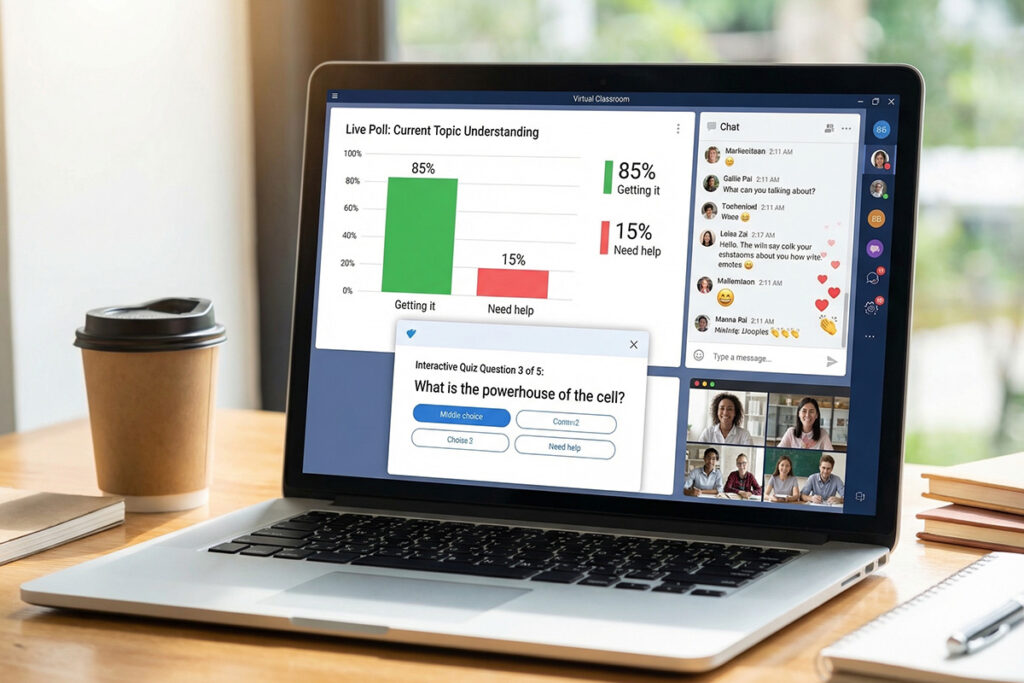
A capable Learning Management System (LMS) can transform passive viewers into active participants, provided instructors know how to use its tools.
Key features that make a measurable difference include:
- Live polling and quick quizzes: Real-time polls give every student a voice simultaneously and provide the instructor with instant insight into comprehension levels.
- Chat and reaction tools: When structured thoughtfully, the chat function becomes a backchannel for ideas, questions, and low-stakes participation. One teacher guided her students in creating norms around using the chat feature, which helped check for understanding and pushed students to engage more deeply with the content.
- Discussion forums: Online forums that require students to post and respond to peers create meaningful back-and-forth dialogue, particularly for reflective learners who need time to formulate their thoughts.
- Interactive whiteboards and collaboration boards: These replicate the dynamic, visual quality of in-person learning and give students a shared creative space to explore concepts together.
The key insight from EDUCAUSE and wider research is this: technology does not create engagement. Pedagogy does. Technology is the channel through which good teaching flows.
The Role of Content Design in Virtual Learning Strategies
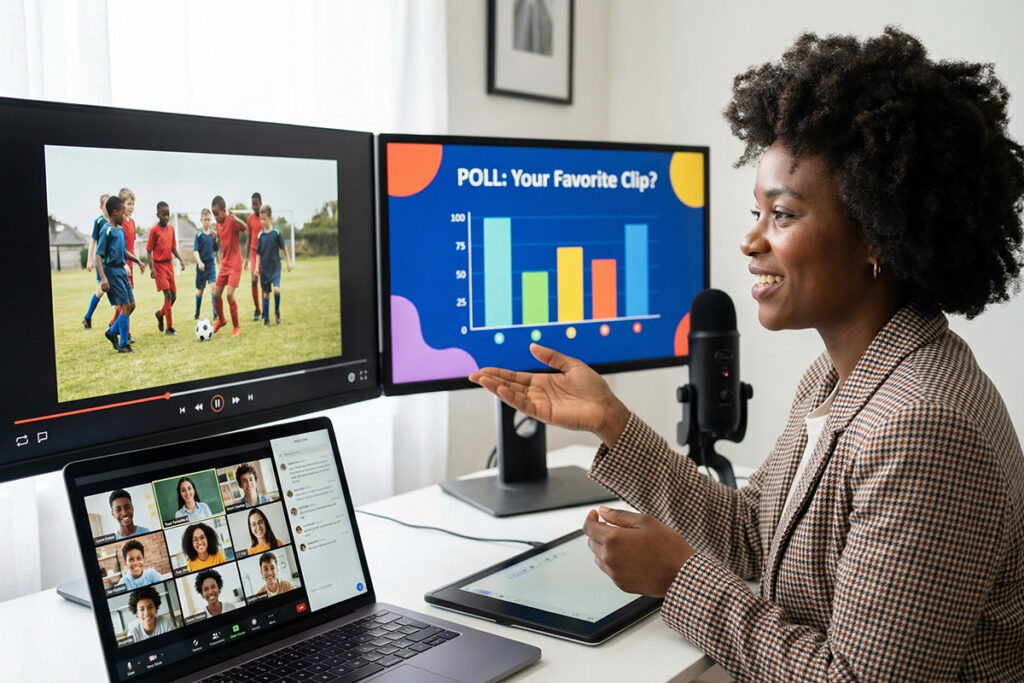
How content is structured matters as much as what it contains. Instructional design, the deliberate craft of organising learning experiences, plays a central role in determining whether virtual learning strategies succeed or fail.
The most important shift is moving away from long-form content. An MIT analysis of more than 6.9 million video sessions found that engagement sharply declines when videos exceed six minutes, with shorter segments consistently producing higher completion rates. This does not mean simplifying content; it means chunking it thoughtfully, building each segment around a single clear learning objective.
Beyond length, the format of content matters too. Multimedia learning materials, those that combine visuals, narration, and interactive elements, consistently outperform text-heavy slides. Visual storytelling, real-world case studies, and scenario-based exercises give abstract ideas a human shape, making them more memorable and more engaging. Interactive assignments that require students to produce something, rather than simply absorb information, deepen both learning and engagement. Technology engages students most effectively when it allows them to construct ideas, collaborate with peers, and create unique work.
Measuring Engagement in Virtual Learning
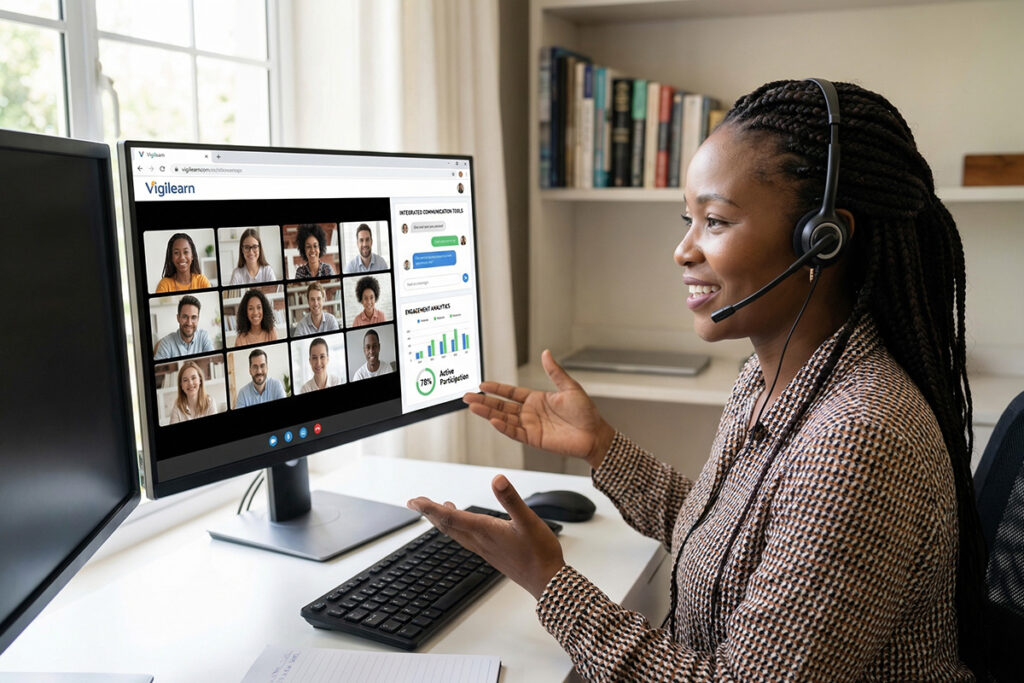
If you cannot measure it, you cannot improve it. Many schools invest in engagement strategies without building in any system to track whether those strategies are working. This is a critical oversight.
Modern LMS platforms offer a range of engagement analytics that go far beyond simple attendance records. Useful metrics to monitor include:
- Activity completion rates: Are students finishing the tasks assigned, or dropping off partway through?
- Time-on-task data: How long are students spending on each module or resource?
- Discussion participation rates: Who is contributing and who has gone silent?
- Quiz and assessment performance: Are scores improving over time, or is there a consistent comprehension gap at particular points in the course?
- Instructor feedback loops: Regular, structured check-ins with students, even brief pulse surveys at the end of a session, provide qualitative data that numbers alone cannot capture.
According to the Online Learning Consortium, high student engagement not only boosts student satisfaction but also ignites a deeper drive to learn, combats feelings of isolation, and improves overall performance in online learning. Tracking these indicators turns engagement from an abstract aspiration into a concrete, improvable outcome.
How Vigilearn’s EdiifyLMS Supports Virtual Classroom Engagement
All of the strategies above require a platform that is genuinely built for engagement, not merely adapted from legacy systems. This is where Vigilearn‘s EdiifyLMS enters the picture.
EdiifyLMS is designed with the realities of modern virtual learning in mind. Its suite of interactive features enables instructors to deploy live polls, quizzes, and discussion forums directly within the learning environment, removing the friction of managing multiple disconnected tools. Integrated communication tools allow learners and instructors to maintain continuous dialogue, both synchronously during live sessions and asynchronously between them.
For administrators and school leaders, EdiifyLMS provides engagement analytics dashboards that translate raw data into actionable insights. Track which content modules are holding attention, identify learners at risk of falling behind, and make evidence-based decisions about where to intervene. The platform creates a seamless virtual learning environment where engagement is not an afterthought but a structural feature of the experience.
For schools looking to explore best practices in educational technology beyond their immediate environment, the Vigilearn blog offers ongoing insights and resources aligned with current thinking in the sector.