
A graduate in Lagos applies for a role in London. The employer asks for proof of her degree. What used to take weeks of letters, stamps and phone calls to a registrar’s office can now, with the right infrastructure, take minutes. This is the promise behind digital credentials for universities: a shift from paper that can be lost, forged or misread, to records that verify themselves.
For institutional leaders, this is not a fringe technology conversation. It touches admissions integrity, graduate employability, international partnerships and the everyday workload of registrars. As more learning happens online, as students move across borders more freely, and as employers grow impatient with slow verification processes, universities that cling to paper-based systems are quietly falling behind.
Read More: AI-Powered LMS: What It Actually Means for Universities in 2026
Why Universities Are Rethinking Academic Records
Several pressures are converging at once. Digital and blended learning have expanded so quickly that a purely paper-based records system can no longer keep pace with how students actually study. International student mobility means transcripts must be understood and trusted by institutions and employers in other countries, often within tight admissions deadlines. Meanwhile, employers are demanding faster answers: nobody wants to wait three weeks for a registrar to confirm a class of degree before extending a job offer.
Layered on top of this is a fraud problem that has grown far beyond forged photocopies. UNESCO’s chief of section for higher education has described the global fake degree industry as a business worth an estimated $22 billion (£17 billion), fuelled by rising demand for higher education and, increasingly, by artificial intelligence tools that make forgeries easier to produce. Separately, investigations into UK degree fraud have found that roughly 8% of degrees submitted for verification could not be confirmed, with candidates most commonly overstating a lower classification as a first.
This is precisely the environment in which digital credentials for universities stop being a nice-to-have and become a strategic necessity. Institutions that can offer reliable academic credential verification protect their own reputation as much as they protect their graduates, and they save employers and admissions teams the frustration of chasing paperwork that may never arrive.
What Are Digital Credentials?
Digital credentials are electronic records of academic achievement that can be verified without contacting the issuing institution directly. They include several formats:
- Digital certificates, confirming completion of a course, programme or qualification
- Digital transcripts, recording modules, grades and academic history
- Digital diplomas, the electronic equivalent of the parchment handed out at graduation
- Digital badges, smaller, skills-based credentials that recognise specific competencies
The defining difference between paper and digital credentials is not simply the format. It is verifiability. A paper certificate asks the reader to trust its appearance: the letterhead, the seal, the signature. A verifiable digital certificate carries embedded, cryptographically secured data that can be checked instantly against the issuing system, usually via a QR code or a secure link. Where 1EdTech’s Open Badges and Comprehensive Learner Record standards apply, that data follows an internationally recognised format, so achievements assert who earned them, who issued them and what evidence supports the claim, all machine-readable and shareable across digital wallets. Nobody has to take the document’s word for it.
Why Traditional Academic Records Are No Longer Enough
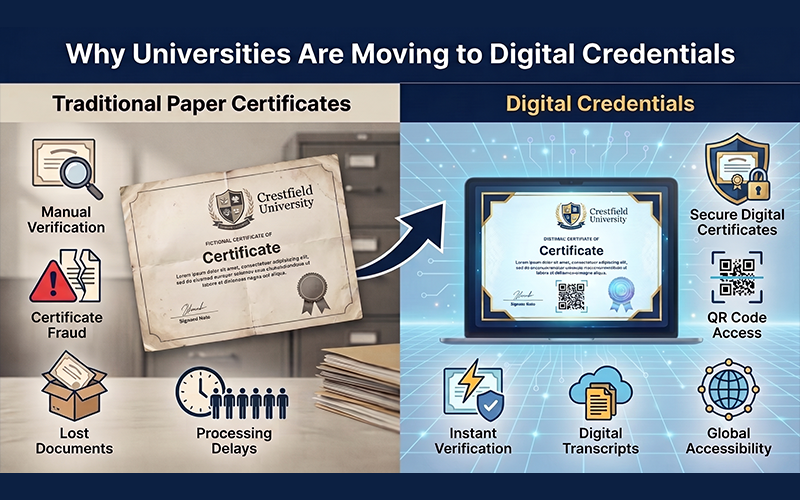
Paper certificates were designed for a world where a graduate’s employer, professional body or next institution was usually within reach of a phone call. That world has changed. A few familiar frustrations illustrate why:
- Manual verification requires registrar staff to search archives, confirm identity and respond to requests one at a time
- Administrative delays of days or weeks are common, even for straightforward requests
- Certificate fraud has become more sophisticated and harder to spot by eye
- Lost or damaged documentation forces graduates to request costly, slow reissues
- The overall graduate experience suffers, particularly for alumni applying for jobs or further study years after leaving
None of this reflects poorly on the staff involved. It reflects a system built for a smaller, slower, more local world than the one universities now operate in.
Read More: Learning Analytics in Higher Education: How Universities Turn Student Data Into Better Outcomes
Benefits of Digital Credentials for Universities
Moving to verifiable digital certificates changes the equation for everyone involved, not just the institution issuing them.
- Instant verification. Employers and admissions officers can confirm authenticity in seconds rather than days.
- Reduced fraud. Tamper-proof certificates are far harder to forge convincingly than a scanned PDF or printed document.
- Improved employer trust. Organisations increasingly expect the kind of instant, transparent credential checks that other digital systems already offer.
- Faster transcript requests. Students and alumni can generate an official digital transcript without waiting on registrar processing time.
- Student self-service. Graduates control access to their own records, sharing them directly with whoever needs to see them.
- Lower administrative workload. Registrar teams spend less time on repetitive verification requests and more time on higher-value work.
- International recognition. UNESCO’s Global Convention on the Recognition of Qualifications, in force since 2023, has pushed institutions worldwide towards efficient digital verification systems, including blockchain-based credentials, to ensure qualifications from different countries can be trusted and compared.
Together, these benefits explain why digital credentials for universities have moved from experimental pilots to core infrastructure decisions at institutions serious about their reputation and their graduates’ outcomes. Even institutions that are not yet ready to explore blockchain academic credentials can capture most of these gains simply by replacing static, paper-based electronic academic records with a properly connected, verifiable system.
How Universities Can Issue Verifiable Digital Certificates
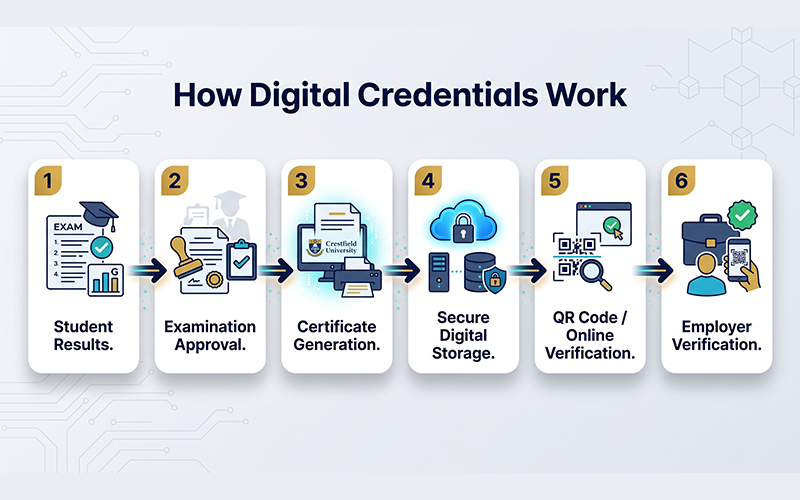
Issuing secure digital certificates is a workflow, not a single tool. It typically involves several connected steps. First, certificate generation, where results and completion data trigger automatic creation of a digital certificate rather than a manually typed document. Second, secure storage, keeping records in a system that protects against unauthorised edits. Third, QR code or link-based verification, allowing any third party to check authenticity without needing login credentials of their own. Fourth, blockchain-ready infrastructure, which some institutions are exploring to give each credential an immutable, independently checkable record, in line with how the World Economic Forum describes trustworthy digital credentials as requiring taxonomy, portability and credibility, with tamper-proof design at the core. Fifth, digital transcript management, so a full academic history, not just a single certificate, is available on demand. Sixth, automated record generation that removes manual data entry, and with it, a common source of error.
Handled well, this workflow turns what used to be a reactive, request-driven process into something proactive: records that are ready the moment they are needed.
The Role of Examination Portal and Enroli SIS
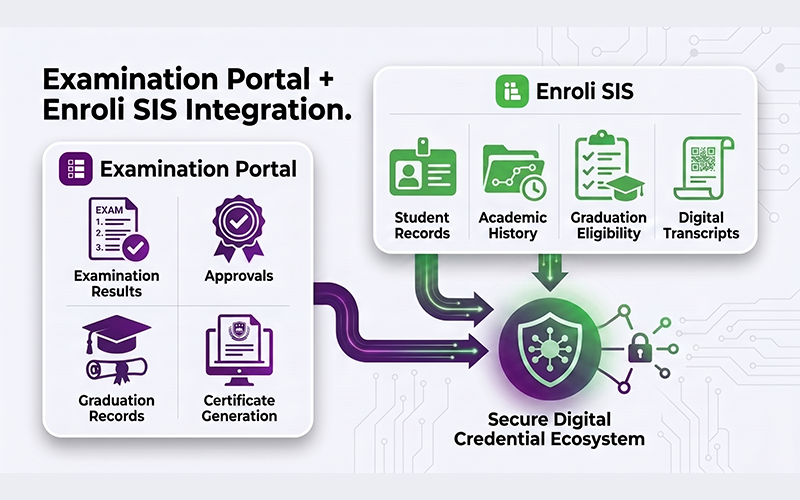
For institutions weighing up how to build this capability rather than bolt it on, the answer usually lies in connecting examinations to student records properly, rather than treating them as separate systems.
Vigilearn’s Examination Portal manages the assessment side of this equation: results processing, approval workflows, graduation eligibility checks and certificate generation itself. It is where academic outcomes are recorded and formally confirmed.
Enroli SIS, Vigilearn’s student information system, holds the wider picture: full student records, academic history, enrolment status and graduation eligibility. When a transcript is requested, it is Enroli SIS that assembles the accurate, complete academic record behind it.
The two systems work together rather than in isolation. Examination Portal confirms that a student has met the requirements for a qualification; Enroli SIS ensures that confirmation sits within an accurate, up-to-date academic history, ready to be issued as a secure digital certificate or digital transcript the moment it is needed. For institutions, this means certificate generation is no longer a manual task performed weeks after results are finalised. It becomes a natural output of results already verified within the system.
The Future of Academic Credential Management
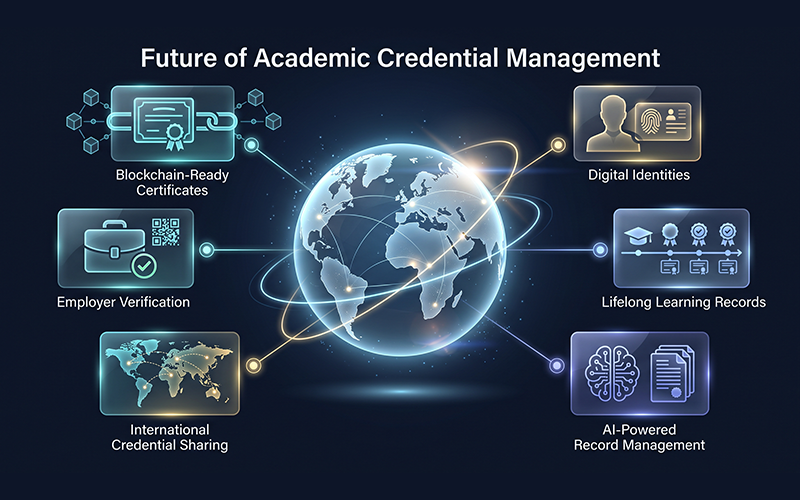
The direction of travel is fairly clear. Blockchain-secured academic credentials are moving from pilot projects to production use in a growing number of institutions, offering immutable proof of who issued a credential and when. Skills passports, championed by organisations including the World Economic Forum, aim to give learners a portable, verifiable record of competencies that travels with them between employers and even between countries. International credential portability is being reinforced by frameworks such as UNESCO’s Global Convention and standards bodies like 1EdTech, whose Open Badges and Comprehensive Learner Record standards are designed to make credentials readable and trustworthy across different systems worldwide.
Digital identity is also converging with credentialing, so a verified academic record becomes one part of a learner’s broader, trusted digital profile. Employer verification is shifting from document requests to real-time API or QR-based checks. And institutions are beginning to explore AI-powered record management to flag anomalies, streamline transcript assembly and reduce the administrative burden that manual verification still places on registrar teams. For university leaders, the practical question is not whether to move towards this model, but how soon their infrastructure can support it credibly.
Modernising Academic Records Starts With the Right Infrastructure
Academic credentials exist to be trusted. When verification is slow, inconsistent or vulnerable to fraud, that trust erodes, quietly costing graduates opportunities and costing institutions reputation. Digital credentials for universities offer a practical way to restore that trust: certificates and transcripts that verify themselves, records that are available the moment a student or employer needs them, and administrative teams freed from repetitive manual checks.
Help your institution modernise academic record management with Vigilearn’s Examination Portal and Enroli SIS. Deliver secure, verifiable digital credentials that simplify administration, strengthen employer trust and improve the graduate experience. Explore more insights on the Vigilearn blog or visit vigilearn.com to see how it works.
Frequently Asked Questions
What are digital credentials? Digital credentials are electronic records, such as certificates, transcripts, diplomas or badges, that confirm an academic achievement and can be verified independently of the issuing institution, usually via a secure link or QR code.
Are digital certificates legally recognised? Yes. Digital certificates issued by accredited institutions carry the same legal standing as their paper equivalents. What changes is not their legitimacy but how easily that legitimacy can be checked.
Can employers verify digital credentials? Employers can typically verify a digital certificate in seconds by scanning a QR code or following a secure verification link, rather than contacting the registrar’s office and waiting for a manual response.
How are digital transcripts different from paper transcripts? A digital transcript is generated directly from a student’s academic records and can be securely shared or independently verified, reducing the delays, reissue costs and forgery risk associated with paper transcripts.
What technology supports digital credentials? Secure digital certificates rely on systems that connect examination results to student records, supported by verification tools such as QR codes, secure links and, increasingly, blockchain-based infrastructure for tamper-proof record keeping.
