
Ask any provost what keeps them up at night in 2026, and artificial intelligence will feature near the top of the list, usually alongside enrolment pressure and shrinking budgets. What is less clear to most leaders is what AI actually looks like once it moves past the headlines and into the software their staff and students use every day. Nowhere is that question more pressing than the learning management system, the platform that already touches every course, every assessment and every student on campus.
That is the gap this article sets out to close. An AI-powered LMS is not a marketing label bolted onto an old platform. It is a genuine shift in what a learning system can do: spotting a struggling student before their grades reflect it, cutting hours from a lecturer’s marking pile, and giving leadership a live picture of institutional health rather than a term-end report. For universities weighing whether to adopt one, understanding the substance behind the term matters more than chasing the buzzword.
Read More: How AI Is Transforming Online Education and Student Support Services
Why Traditional LMS Platforms Are No Longer Enough
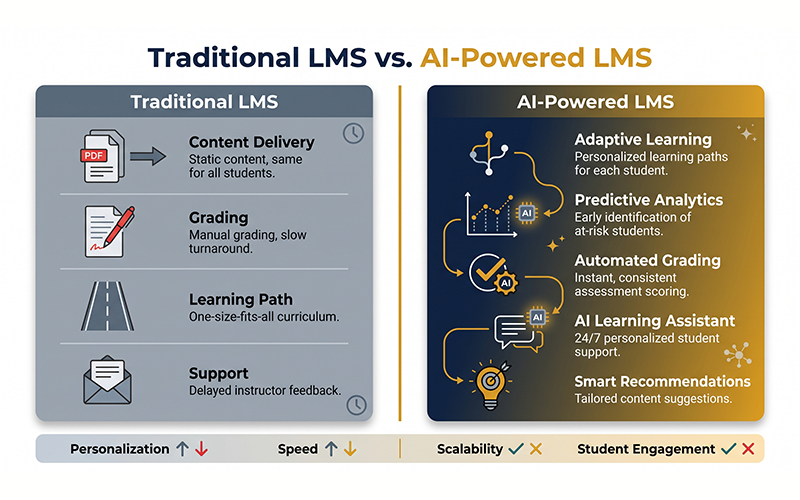
Most universities built their digital infrastructure for a simpler problem: hosting course content and recording grades. That problem has changed shape. Enrolment has grown, often across more campuses and delivery modes, while students now expect the same personalisation from their university that they get from every other digital service in their lives. Meanwhile, faculty workloads have expanded to include marking, moderation, pastoral check-ins and reporting, often within the same static system that was never designed to lighten that load.
The result is data overload without insight. Institutions accumulate attendance logs, assignment scores and login histories, yet a traditional LMS simply displays these figures rather than interpreting them. The 2026 EDUCAUSE Horizon Report: Teaching and Learning Edition names artificial intelligence one of the defining forces reshaping instructional practice this year, precisely because it addresses that gap between data collected and decisions made. This is the pressure point where AI stops being optional and starts becoming infrastructure.
What Is an AI-Powered LMS?
An AI-powered LMS is a learning management system that uses artificial intelligence and machine learning to personalise content, automate administrative tasks, and generate predictive insights about student performance, rather than simply hosting and recording coursework. Where a traditional LMS is a filing cabinet for content and grades, this is an active participant in the teaching and learning process.
The distinction rests on a few core capabilities. Machine learning models analyse patterns across thousands of student interactions to flag risk before it becomes visible in a grade book. Automation handles repetitive administrative work, from attendance logging to routine notifications, freeing staff time for higher-value support. Predictive analytics forecasts outcomes rather than reporting on the past, and personalised learning adjusts pace and content to the individual rather than the average student in the room.
According to Digital Education Council’s 2026 global survey of more than 45,000 students and faculty across 35 countries, AI use is already widespread on campus, yet only a small share of students say it is meaningfully integrated into their courses, a gap an intelligent LMS is designed to close.
The Seven AI Features Universities Should Look For
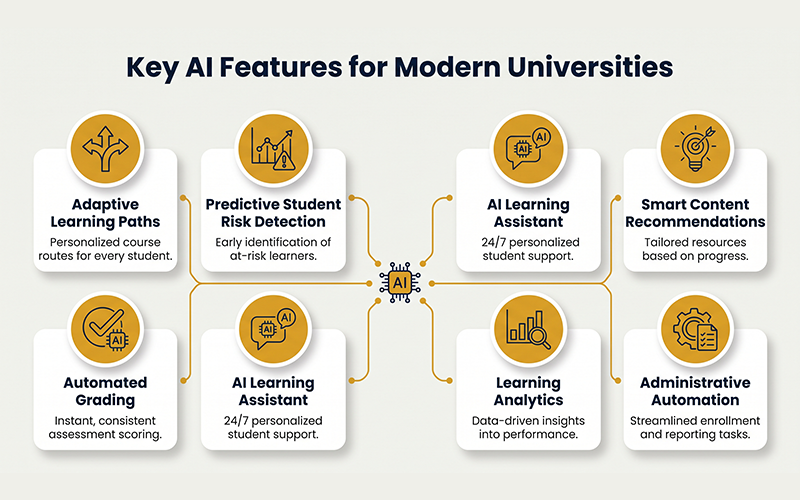
Not every feature marketed as “AI” earns the label. Leaders should look for genuine capability across these seven areas.
- Adaptive learning paths. The system adjusts content sequencing and difficulty to each student’s demonstrated understanding, rather than delivering the same fixed path to everyone in a cohort.
- Predictive student risk detection. Machine learning models combine attendance, engagement and assessment data to flag struggling students, often weeks before a human adviser would notice.
- Automated grading. Objective and semi-objective assessments are marked instantly, and AI-assisted tools can support first-pass feedback on written work, reducing faculty turnaround time.
- AI learning assistants. Always-on tools answer routine student queries about deadlines, course content and administrative processes outside office hours.
- Content recommendations. The system surfaces the specific resource, video or practice exercise most likely to help a student close a particular knowledge gap.
- Learning analytics. Real-time dashboards translate engagement and performance data into a single, actionable view for faculty and administrators.
- Administrative automation. Attendance capture, notifications and routine reporting run in the background, rather than consuming staff time manually.
Microsoft’s own Copilot rollout data illustrates the scale of the gain: at the University of South Carolina, 84 per cent of users, including students, reported saving between one and five hours a week once AI tools were embedded into daily academic workflow.
Read More: Student Enrolment Automation: How Universities Can Increase Applications and Reduce Drop-Offs
How AI Improves Student Success

The case for an AI-powered LMS rests on outcomes, not novelty. Institutions that use predictive analytics well can intervene while a struggling student is still reachable, rather than after a module has already been failed. Personalised content pacing keeps students engaged with material suited to their level, improving both completion rates and satisfaction. Faster feedback loops, particularly around automated grading, mean students learn from mistakes while the material is still fresh rather than weeks later.
Faculty productivity gains matter here too. When routine marking and administrative work is automated, lecturers reclaim time for the high-touch mentoring and course redesign that no algorithm can replace. That combination, personalised support for students and reclaimed capacity for staff, is what tends to move retention and completion figures rather than any single feature in isolation.
Common Misconceptions About AI in Higher Education
Several persistent myths slow adoption, and most dissolve on closer inspection.
- AI replaces teachers. It does not. UNESCO’s Guidance for Generative AI in Education and Research is explicit that AI should serve human capabilities in education, not substitute for them, and every credible platform is built around that same principle of augmentation.
- AI grades everything. In practice, AI handles objective and semi-objective assessment reliably, while nuanced academic judgement, particularly on dissertations and creative work, remains firmly with faculty.
- AI removes academic integrity. The opposite is often true. AI-powered detection and process-based assessment design, an approach the EDUCAUSE Review has highlighted as a growing institutional response, can strengthen integrity rather than undermine it.
- AI is too expensive. Cloud-based AI features are increasingly bundled into existing LMS and Microsoft 365 licensing rather than sold as costly standalone add-ons.
- AI is difficult to implement. Modern platforms support phased rollout, starting with one or two high-value features rather than a full overhaul on day one.
Why AI Works Best When Combined With an Integrated SIS
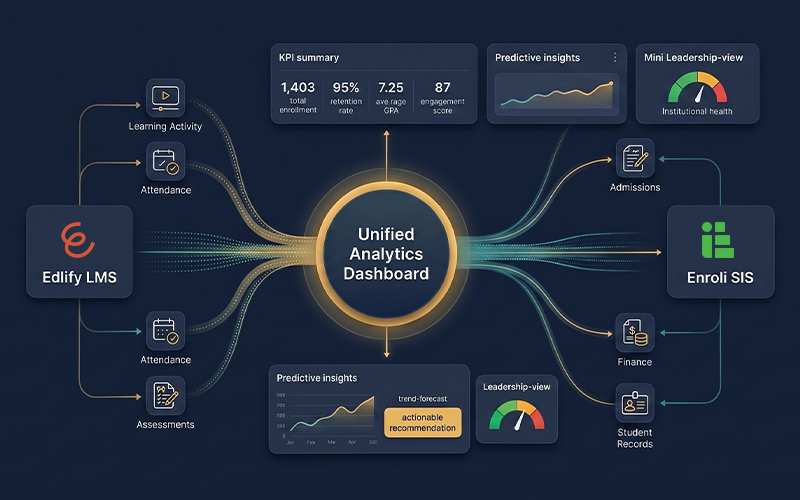
An AI-powered LMS becomes significantly more powerful when it draws on data from a connected student information system, rather than operating on learning behaviour alone. Ediify LMS combined with Enroli SIS creates a 360-degree student profile spanning enrolment status, fee records, attendance and academic performance in a single view, rather than fragments scattered across departments.
That combination changes what predictive intervention looks like in practice. A risk alert grounded only in LMS activity might flag disengagement without knowing a funding delay is the underlying cause. When enrolment and financial context sit alongside learning data, advisers see the full picture and can act accordingly. The same integration supports smarter institution-wide reporting and genuinely personalised communication, since messages reflect a student’s real academic and administrative status rather than a generic template.
The Future of AI-Powered Learning
Generative AI is moving from novelty to infrastructure across higher education, and the learning management system sits at the centre of that shift. Expect voice-based tutors that support revision conversationally, AI-assisted course creation that helps faculty build materials faster, and persistent learning companions that follow a student across modules rather than resetting each term. Competency-based education, where progress is measured by demonstrated skill rather than seat time, becomes far more practical once a system like this tracks mastery continuously. Institutional intelligence, seeing patterns across an entire university rather than one classroom, is the natural end point of these capabilities working together.
An AI-powered LMS is not a single feature or a marketing checkbox. It is a shift in what a university’s core learning platform can notice, automate and predict on behalf of staff and students alike. Institutions that treat this as a strategic decision, rather than a procurement exercise, are best positioned to improve outcomes without adding administrative complexity.
Vigilearn brings this together in practice. By pairing Ediify LMS with Enroli SIS, we help universities move beyond isolated features towards genuinely intelligent, connected digital learning infrastructure, backed by the student success and automation tools that make predictive insight actionable institution-wide.
If your institution is ready to explore what this looks like in practice, schedule an AI Learning Platform Consultation with Vigilearn and discover how Ediify LMS and Enroli SIS can help you deliver intelligent, personalised and future-ready digital learning. You may also find our earlier piece on learning analytics in higher education useful background, or visit vigilearn.com to explore the full platform.
Frequently Asked Questions
What is an AI-powered LMS? A learning management system that uses artificial intelligence to personalise content, automate administrative work and generate predictive insights about student performance and risk.
Can AI improve student learning? Yes, when it supports early intervention, personalised pacing and faster feedback, rather than simply automating existing processes without changing how support is delivered.
Does AI replace lecturers? No. Every credible framework, including UNESCO’s guidance on generative AI in education, positions AI as a support for human judgement and teaching, not a substitute for it.
Is AI safe for higher education? It can be, provided platforms are built with data privacy, transparency and institutional governance in mind, which is why vendor track record matters as much as feature lists.
Which AI features should universities prioritise? Predictive student risk detection and automated grading typically deliver the fastest, most measurable return, with adaptive learning paths following as data maturity grows.
