
A fraudulent degree can be produced online in about 20 minutes. A verifiable one should take about 20 seconds to authenticate. That gap is where billions of dollars of institutional damage accumulate every year. The push towards a global standard for verifiable academic credentials is an urgent, operational response to a problem that has already compromised healthcare systems, civil services, professional licensing bodies, and university admissions offices on every inhabited continent.
The word “fraud” can make this feel like a law enforcement problem. It is not, or not only. It is an infrastructure problem. Paper certificates were designed for a world where fraud was slow, rare, and expensive. That world no longer exists. Today, a convincing counterfeit academic document can be ordered, printed, and delivered within hours. What institutions, governments, and employers need is a credentialing infrastructure that makes fraud structurally impossible. That infrastructure exists. The question is whether your institution has implemented it.
Read More: Beyond Certificates: How Skills Verification Is Redefining Online Learning
The Scale of the Credential Fraud Problem
Credential fraud is a global, multi-billion dollar industry. Researchers and former FBI investigators documenting the ecosystem of academic fraud estimate its total value at over $21 billion when diploma mills, fabricated transcripts, ghost-written dissertations, and falsified professional qualifications are counted together.
The consequences are concrete. In 2023, a US Department of Justice investigation uncovered a scheme in which more than 7,600 fraudulent nursing diplomas were sold to individuals who had never completed clinical training, many of whom went on to obtain professional licences. In India, a single university was implicated in issuing over 43,000 forged degrees across 19 states. In Hong Kong, over 30 postgraduate students at a leading business school were found to have submitted fabricated transcripts.
This is a global problem, not a developing-world one. The UK, United States, Australia, and the EU have all documented significant credential fraud in their own labour markets. According to published research, over 50% of employers globally have encountered job applicants with suspicious academic credentials. Ghost worker scandals involving falsified qualifications have hit civil services from sub-Saharan Africa to Southeast Asia. This is a systemic failure of credential infrastructure.
Why Paper Certificates Cannot Solve a Digital Problem
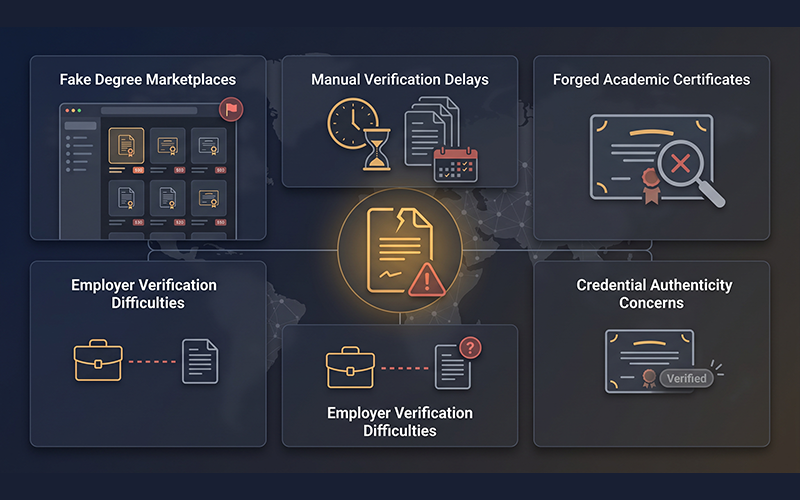
The paper certificate was a reasonable instrument for its time. That time has passed. Its vulnerabilities are structural:
- No real-time verification: a paper certificate cannot be checked without contacting the issuing institution. That process is slow, inconsistently performed, and routinely skipped.
- Easy to forge: consumer printing technology has advanced to the point where a fraudulent certificate is visually indistinguishable from a genuine one without direct institutional confirmation.
- No revocation mechanism: if a qualification is revoked, outstanding paper certificates continue to function as if valid. There is no way to recall them.
- Not scalable: manually verifying credentials at institutional or government scale is operationally unfeasible. Civil services and large employers cannot write letters for every hire.
Responding to a digital-era problem with analogue infrastructure is not caution. It is exposure.
How Verifiable Academic Credentials Work: The Infrastructure Explained
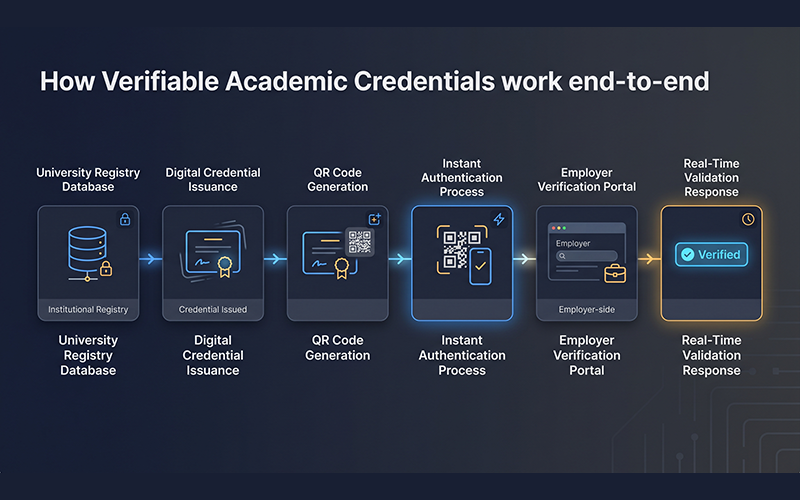
A global standard for verifiable academic credentials is built on one idea: the institution holds the authoritative record, and every certificate issued draws its validity from that live record. The core components:
- Institutional registry: the issuing institution maintains a tamper-proof record of every qualification awarded. This is the source of truth.
- Embedded verification data: each certificate contains a unique identifier, typically a QR code, that links directly to the institutional record.
- Instant verification: any third party can scan the code and receive a real-time confirmation of authenticity in seconds, not days.
- Tamper detection: any modification to the certificate breaks the link to the institutional record. A tampered credential simply will not verify.
- Real-time revocation: if a qualification is revoked, the registry updates immediately. All credentials for that award become unverifiable from that moment.
This is not blockchain in the speculative sense. While blockchain-based credential systems are one valid implementation, the critical principle applies across architectures: the credential derives its authority from a live institutional record, not from the document itself.
Read More: The Digital Campus Is Not the Future. It’s What Your Students Are Already Expecting Today
Where the Global Standard for Verifiable Academic Credentials Is Heading
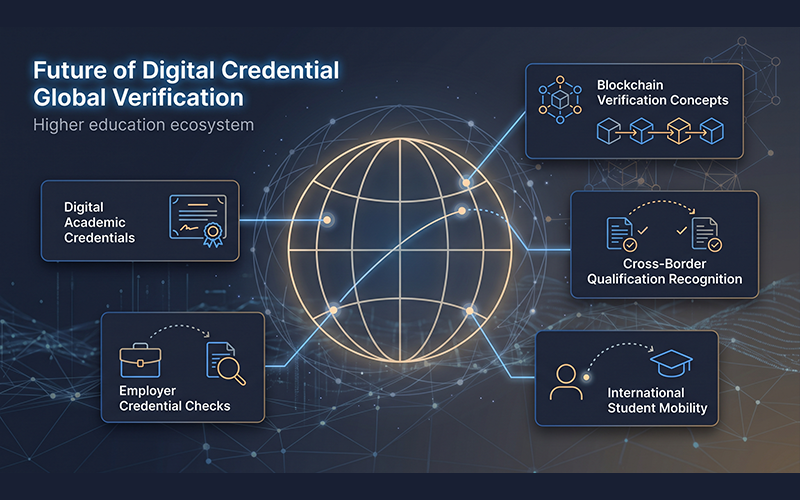
The global shift is already in motion:
- European Digital Credentials for Learning (EDCL): the European Commission has built a continent-wide verifiable credential infrastructure aligned with the W3C Verifiable Credentials Data Model, which member states are progressively mandating for recognised qualifications.
- W3C Verifiable Credentials Data Model v2.0: published as a formal W3C Recommendation in May 2025, this is the emerging global technical standard for digital credential interoperability across institutions and borders.
- Jisc: the UK’s higher education technology body has been advancing digital credentialing frameworks for portable, verifiable graduate records.
- UNESCO and IAU: cross-border qualification recognition frameworks increasingly depend on verifiable credential infrastructure. Without it, mutual recognition remains aspirational.
- World Economic Forum: WEF initiatives on the future of work have identified portable, verifiable credentials as foundational to functional global labour markets.
Verifiable credentials are not an innovation that progressive institutions adopt early. They are an inevitability that every institution will eventually be required to implement. The institutions building this infrastructure now will not be scrambling to comply later.
How Enroli Issues Verifiable Credentials That Cannot Be Faked
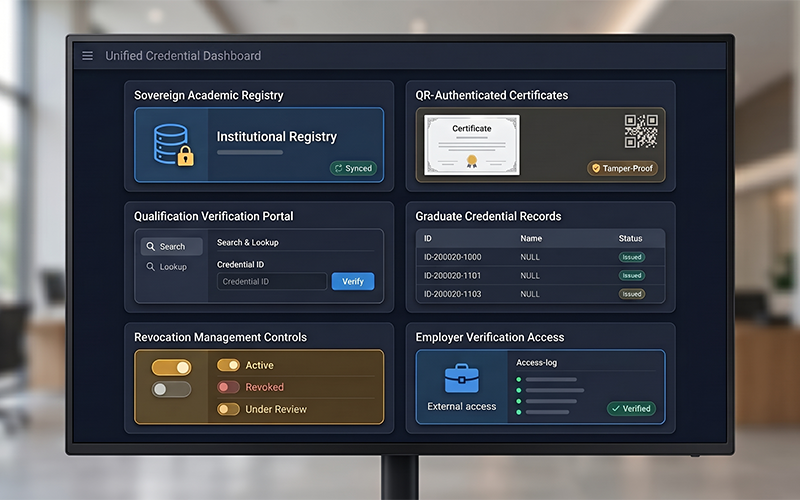
Enroli SIS from Vigilearn is not a certificate printer. It is a sovereign academic registry: a live, tamper-proof record of every enrolled student and every qualification awarded, from which all credential verification draws its authority.
- QR-authenticated certificates: every certificate carries a unique QR code. Scanning it returns a real-time result from the institutional registry in under 20 seconds.
- Tamper detection: any alteration to the certificate document breaks the QR link. A modified credential will not produce a valid verification result.
- Instant revocation: if a qualification is revoked, the Enroli registry updates immediately. All credentials for that award become unverifiable from that moment.
- API access: employers and government bodies can verify credentials at scale through direct API access, enabling bulk checks without individual manual processes.
- Sovereign ownership: the institution owns and controls its registry. The certificate is the output. The registry is the infrastructure.
Learn more about Enroli’s credential infrastructure and explore related topics on the Vigilearn blog.
What Verifiable Credentials Mean for Institutional Reputation
The case for verifiable credentials extends beyond fraud prevention. It is about competitive positioning. Employers who can verify credentials instantly will find it easier to hire graduates from institutions whose qualifications they can trust. Professional licensing bodies requiring digital verification will favour those institutions. International students will increasingly choose programmes whose credentials travel, that are recognisable and verifiable in their home country or target market. Accreditation frameworks developed through bodies like EDUCAUSE are giving growing weight to credential security as part of institutional review.
The inverse is equally important. In a market where a global standard for verifiable academic credentials is fast becoming the baseline expectation, an institution that cannot guarantee the integrity of what it awards is not neutral. It is at risk.
Frequently Asked Questions
What are verifiable academic credentials? Digital qualifications linked to a live institutional registry, authenticable in real time by any third party via QR code or digital verification link, confirming authenticity, current validity, and the awarding institution.
How do universities prevent fake degree certificates? By issuing credentials linked to a live registry, so any attempt to forge or alter the document invalidates the verification. Institutions using Enroli SIS issue QR-authenticated certificates where forgery is structurally defeated: the forged document will not verify.
How does QR code certificate verification work? Each certificate contains a QR code linking to the issuing institution’s registry record for that award. Scanning it returns a real-time result confirming the graduate’s name, qualification, date, and validity. Any alteration breaks the link and returns a failed verification.
What is the global standard for digital credential verification? The W3C Verifiable Credentials Data Model v2.0 (published May 2025) is the leading global technical standard. The EU’s European Digital Credentials for Learning framework is built on it, and government and enterprise credentialing systems worldwide are converging on this architecture.
Can blockchain be used for academic credentials? Yes. Blockchain provides one implementation path within the verifiable credentials infrastructure. The critical design principle, however, is the live linkage between the issued credential and an authoritative institutional record, which applies regardless of the underlying technology.
How do employers verify university degrees quickly? Where institutions issue QR-authenticated credentials, employers can verify a degree in seconds by scanning the certificate. For large-scale verification, API access to institutional registries enables bulk checks. This is the model Enroli is built on.
Your institution’s credentials are either verifiable or they are vulnerable. There is no middle ground.
Read More: From 100 to 10,000 Students: How Vigilearn Scales with Your Institution
See how Enroli issues tamper-proof, instantly verifiable credentials linked to a sovereign academic registry. Request a product demonstration and discover what credential integrity infrastructure looks like in practice.