One of the most consequential purchases a Nigerian bank or fintech will make this year is compliance training software, and the reason has little to do with technology for its own sake. A written AML (Anti-Money Laundering) policy sitting in a shared drive tells a regulator nothing about whether the people handling customer funds actually understood what they were trained to do. Increasingly, that gap between having a policy and proving its effect is where institutions lose the argument during an examination, and it is a gap that spreadsheets and one-off induction sessions were never designed to close.
That distinction has sharpened considerably since the Central Bank of Nigeria issued Circular BSD/DIR/PUB/LAB/019/002 on 10 March 2026, setting baseline standards for automated AML, CFT and CPF systems across banks, mobile money operators, international money transfer operators, payment service providers and other regulated institutions. Under the circular, banks have 18 months to fully deploy automated monitoring systems, other financial institutions have 24 months, and every affected institution was required to submit an implementation roadmap to the CBN’s Compliance Department within 90 days, by 10 June 2026. A Guidance Note issued on 31 March 2026 followed shortly after to clarify how compliance will actually be assessed, reinforcing that examiners will look at the institution as a whole rather than at policy documents in isolation. Automated transaction monitoring only addresses half of what that circular implies. The employees operating those systems, approving exceptions and escalating alerts still need to be trained, tested and tracked, and manual records rarely survive contact with a thorough audit.
Read More: Why Employee Training Software Matters in Nigeria
What Is Compliance Training Software?
Compliance training software is a platform purpose-built to deliver, track and evidence mandatory workplace training, particularly training tied to legal or regulatory obligations. At a functional level, it typically manages course delivery, employee enrolment, training schedules, assessments, completion records, certificates, reporting dashboards and audit logs, all from a single system of record rather than scattered across departmental folders.
This is where it differs meaningfully from a generic corporate LMS. A standard learning management system is built around course catalogues, learner engagement and content variety, which suits general staff development well. A regulatory compliance LMS is built around defensibility instead: it needs to prove, on demand and without reconstruction, who was trained, on what content, when, and with what result. For banks and fintechs, that distinction matters more than most vendors let on, because it only becomes visible at the exact moment an examiner asks for evidence rather than assurances, and by then it is too late to build the missing records.
Why AML Training Matters for Banks and Fintechs
AML compliance training exists to close the gap between what a policy says and what employees actually do when a transaction looks wrong. It helps staff understand financial crime typologies, recognise suspicious activity, follow internal escalation procedures correctly and stay current with regulatory expectations that shift more frequently than most non-compliance staff realise. Nigeria’s removal from the FATF grey list in October 2025 was a genuine and hard-won milestone, but it raised the bar rather than lowering it. Sustained supervision now depends on institutions demonstrating real, ongoing capability rather than a completed action plan filed away and forgotten.
Training requirements are also not uniform across an organisation. A teller, a relationship manager, an onboarding officer and a compliance analyst each carry different exposure to financial crime risk, so effective AML training software needs to assign different content, frequency and depth by role, rather than pushing one generic course to everyone and calling it done. A tiered approach also makes reporting more meaningful, since a dashboard showing ninety per cent completion means little if it cannot show which roles that ninety per cent actually covers. A branch network where frontline tellers are fully trained but relationship managers handling higher value accounts are lagging still carries real exposure, even if the headline completion figure looks reassuring on paper.
What Modern AML Training Should Cover
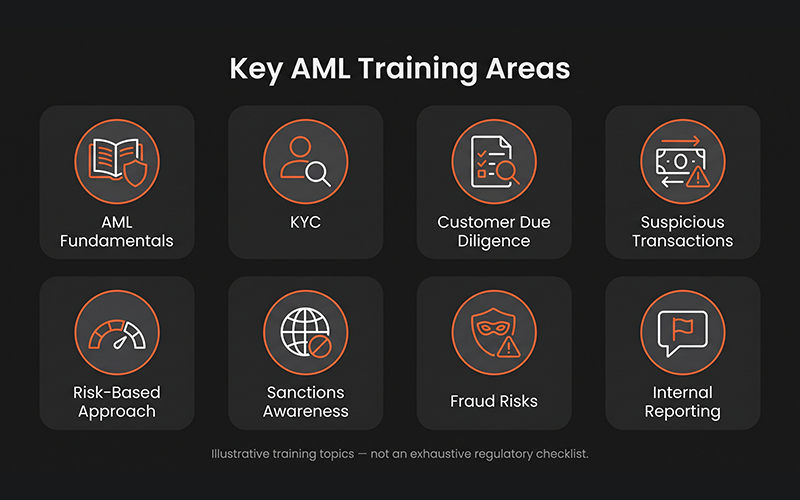
Effective financial compliance training generally spans several interlocking areas rather than a single module:
- AML fundamentals and financial crime typologies relevant to the Nigerian market
- Know Your Customer and customer due diligence procedures
- Suspicious transaction recognition and internal escalation routes
- Risk-based approaches to customer, product and geographic risk
- Sanctions screening awareness
- Fraud risk indicators and red flags
- Record keeping obligations under applicable law
None of this replaces an institution’s own regulatory obligations under the Money Laundering (Prevention and Prohibition) Act or the guidance published by the Nigerian Financial Intelligence Unit; it operationalises those obligations for the people expected to apply them correctly, every working day, often under time pressure.
Read More: Learning Analytics in Higher Education: How Universities Turn Student Data Into Better Outcomes
How Compliance Training Software Automates Employee Training
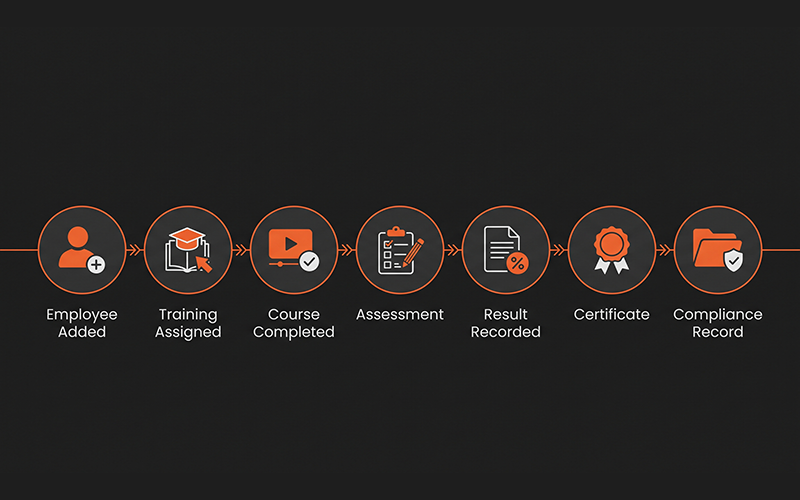
A well built compliance learning management system follows a simple, repeatable workflow: an employee is added to the system, required training is automatically assigned based on their role, the course is completed, an assessment is taken to confirm understanding rather than mere attendance, the result is recorded, a certificate or completion status is issued, and a compliance dashboard updates in real time to reflect the change. Automation removes the manual chasing, spreadsheet updating and email follow-up that quietly consumes a compliance team’s week, particularly at institutions onboarding staff across multiple branches, agent networks or remote teams where a manual process simply cannot keep pace.
Tracking Mandatory and Recurring Compliance Training
Employee compliance training is rarely a one-time event, and treating it as one is where most gaps start. Institutions need ongoing visibility into new employee onboarding training, annual refresher cycles, role-specific modules, certificate expiry dates, automated reminders ahead of deadlines, overdue completions and aggregate completion rates by branch or department. Without a centralised system, compliance teams typically discover these gaps only when someone asks for them, usually during an audit or a regulatory visit, which is the worst possible moment to learn that a branch quietly missed its refresher cycle six months earlier. A single overdue cohort can undermine an otherwise strong compliance record, particularly if that cohort happens to include the staff closest to customer transactions.
Building an Audit-Ready Training Record
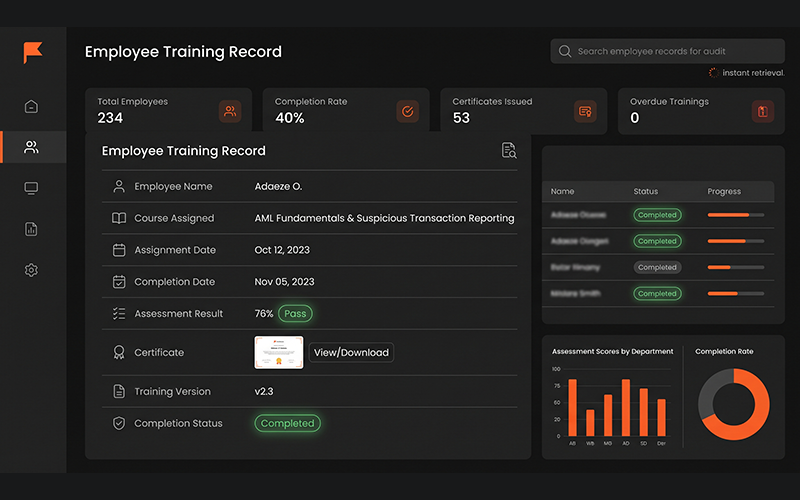
An audit-ready training platform needs to produce a defensible, complete record on request, covering employee identity, the course assigned, the assignment and completion dates, assessment results, the issued certificate, the specific training content version used, the completion status and any related compliance reports. Centralising these records means a compliance officer can retrieve years of evidence within minutes rather than reconstructing a patchy history from email threads, shared drives and departmental spreadsheets, which is often what a manual approach amounts to in practice once an institution has grown past a handful of branches. Examiners generally do not accept promises that records exist somewhere; they expect them produced quickly, in a consistent format, and without gaps that raise further questions about how training was actually managed.
How Ediify Can Support Compliance Training
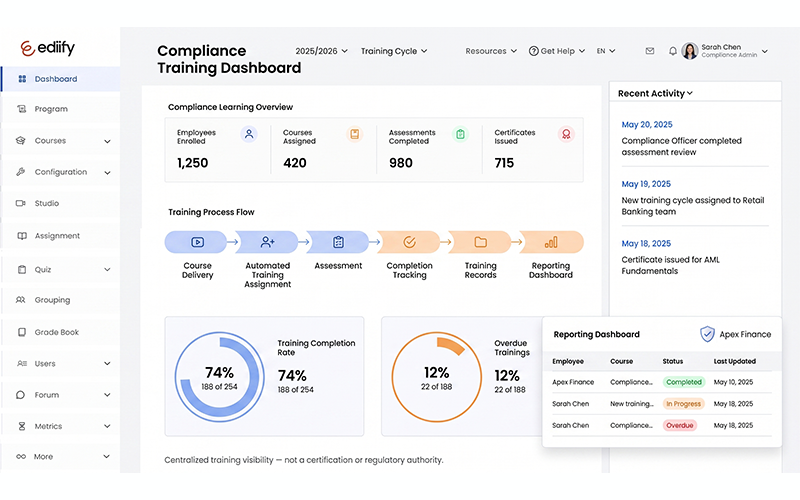
Ediify by Vigilearn is built to support exactly this layer of institutional learning: course delivery, automated role-based assignments, completion tracking, assessments, centralised training records, reporting dashboards and audit visibility, all connected within one platform rather than scattered across disconnected tools that never quite talk to each other. For compliance and risk teams, having assignment, completion and reporting data live in a single dashboard reduces the last-minute scramble that typically precedes a regulatory examination, and gives HR and L&D teams a clearer view of where training gaps sit before they become findings during an examination rather than after one. This should not be read as certification against any specific CBN standard. Ediify supports the training and evidence layer that sits alongside an institution’s own compliance programme, not a substitute for the programme itself.
Choosing Compliance Training Software for a Fintech or Bank
Selecting the right platform usually comes down to whether it can actually operate the way a regulated institution needs it to, not simply whether it can host courses. Many platforms look similar in a demo, so it is worth pressure testing how each one behaves once several hundred employees, multiple branches and a live audit request are involved, rather than judging it purely on interface polish. Before committing, compliance, risk and HR and L&D teams should check for role-based training assignment that reflects real risk exposure, automated enrolment and reminders that reduce manual follow-up, built-in assessment capability that tests understanding rather than attendance, and real-time completion tracking that compliance teams can trust without double-checking. Beyond that, look for:
- Support for recurring and refresher training cycles
- Exportable, audit-ready reporting formats
- Granular user permissions across roles and branches
- Strong data security and access controls
- Integration capability with existing HR and core systems
- Scalability across branches, headcount and geographies
- Mobile access for distributed or field-based teams
The CBN’s March 2026 baseline standards make automated AML systems mandatory, but automation only works when the people running it understand their responsibilities, and institutions can prove that understanding whenever it is questioned. A centralised, audit-ready platform turns AML training software from a compliance checkbox into something closer to an early warning system, one that shows not just who completed a course, but who is genuinely equipped to spot the next suspicious transaction before it becomes a reportable incident. If your institution is still tracking CBN compliance training in spreadsheets and email chains, now is the moment to change that, well before an examiner asks first.
Explore how Ediify supports your institution’s training and audit readiness on the Vigilearn platform, or get in touch with the Vigilearn team to talk through your compliance training needs. Our articles on AI-powered learning management systems and learning analytics may also be useful as you evaluate your options.
Read More: AI-Powered LMS: What It Actually Means for Universities in 2026
Frequently Asked Questions
What is compliance training software? It is a platform that delivers, tracks and evidences mandatory workplace training, including enrolment, assessments, completion records and audit logs, so institutions can prove employees were trained rather than simply asserting it.
What should AML training include? AML fundamentals, KYC and customer due diligence, suspicious transaction recognition, risk-based approaches, sanctions awareness, fraud risk and record keeping, tailored by employee role.
How often should AML training be completed? Most institutions run onboarding training for new staff plus annual refreshers, with additional role-specific or ad hoc training whenever regulations or risk profiles change.
How can banks track employee compliance training? A regulatory compliance LMS assigns training automatically, monitors completion in real time, flags overdue staff and reports aggregate completion rates through a dashboard.
What records should be retained for compliance training? Employee identity, course assigned, assignment and completion dates, assessment results, certificates, training content version and completion status.
What is an audit-ready training platform? A system that can produce complete, verifiable training evidence on request, without manual reconstruction from spreadsheets or email records.
Can an LMS manage AML training? A generic LMS can deliver courses, but AML training specifically needs role-based assignment, assessments and audit-grade reporting, which is why a compliance-focused platform outperforms a basic LMS for regulated institutions.
