
A video API is one of the few pieces of infrastructure a modern fintech can add to its product without needing to build, host or maintain the underlying communication layer itself. Over the past several years, fintech infrastructure has become genuinely modular: a product team can integrate payments, banking rails, identity verification, KYC, notifications and analytics from specialist providers, assembling a financial product from parts rather than building each layer in-house. Communication, oddly, has often been left out of that assembly line, treated as an afterthought bolted onto customer support rather than engineered into the product itself.
That gap shows up in ordinary, everyday moments. A customer struggling with a loan application gets redirected to a phone call. A wealth advisory conversation happens over a third-party video tool with no connection to the account it concerns. A KYC agent verifies a new customer through a screen-share link sent by email, well outside the app the customer just downloaded. Each of these is a point where a fintech could have kept the customer inside its own product experience, and each is a point where embedded video, delivered through a proper video API, quietly closes the gap.
Read More: AI-Powered LMS: What It Actually Means for Universities in 2026
What Is a Video API?
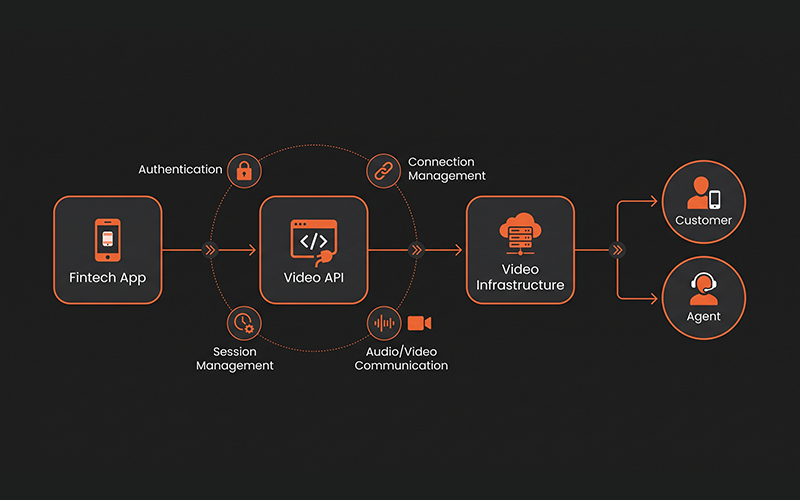
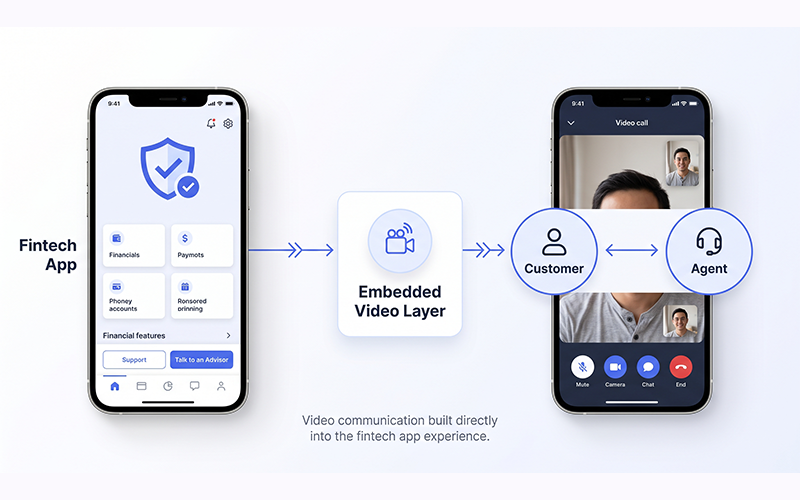
A video API is a service that lets a developer add real-time video and audio functionality to an application by making calls to a backend service, rather than building the underlying video infrastructure from scratch. The basic relationship looks like this: an application calls the API, which in turn manages the video infrastructure, which then serves the end users on both sides of the call.
What the API abstracts away is substantial. Establishing a video session, authenticating the participants, handling the network connection between them, streaming audio and video reliably, and managing the session from start to finish are all handled behind the API rather than built by the product team. For a product leader, that abstraction is the entire point: video becomes a feature you configure and call, not a distributed systems problem you own. For a developer, it means WebRTC, the open standard underpinning most real-time video on the web, sits behind a manageable interface rather than being implemented and maintained directly.
Video API vs Video SDK: What’s the Difference?
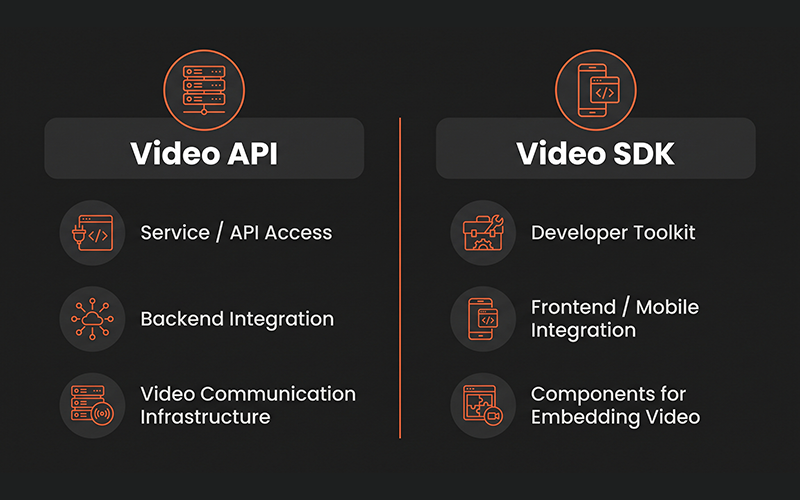
The two terms get used loosely, and providers often package the two together, but they solve different problems.
- Video API: backend or service-level access to video functionality, typically handling the communication infrastructure such as session creation, connection management and streaming, and used through API calls from your own systems.
- Video SDK for developers: a frontend or mobile toolkit, providing ready-made components, interface elements and libraries that get embedded directly into a web or mobile application.
In practice, a video API often exposes the underlying capability, while a video SDK gives developers the building blocks to embed that capability into an actual user interface quickly. A team evaluating providers should expect to use both together rather than choosing one over the other.
Why Fintechs Might Need Embedded Video
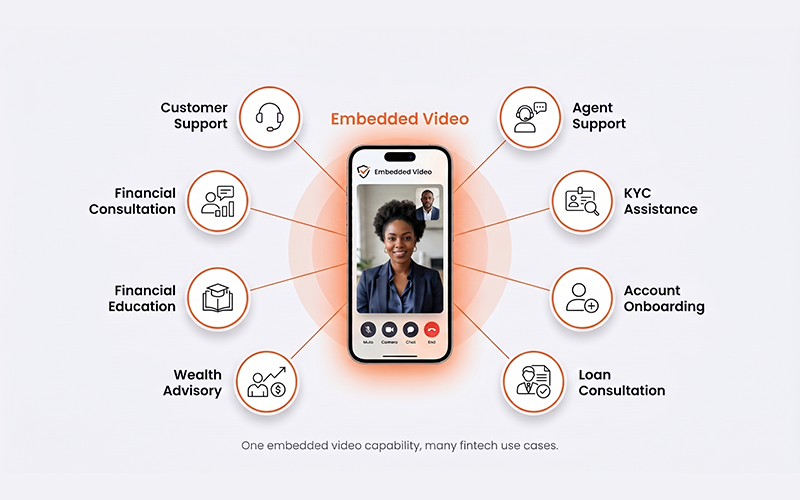
Financial services have several natural use cases for in-app video communication, including remote financial consultations, customer support that goes beyond scripted chat, KYC assistance during onboarding, account opening walkthroughs, loan consultations, wealth management sessions, insurance advisory conversations, agent support and financial education. What connects all of these is that they involve a level of trust and explanation that text alone often cannot carry, particularly for first-time users of a financial product.
The strategic argument for embedding video rather than redirecting to a separate platform is straightforward: every time a customer leaves the app to join a call elsewhere, the fintech loses context, control and, often, the customer’s attention. A borrower who has to open a separate video tool to speak with a loan officer has already taken one more step away from completing the loan. Keeping that conversation inside the existing application, tied to the same account and session, keeps the product experience coherent from first login to final approval.
Read More: Learning Analytics in Higher Education: How Universities Turn Student Data Into Better Outcomes
The African Connectivity Challenge
Any conversation about embedded video for African fintechs has to start from how people actually connect. Mobile is the primary way most people in the region access digital services, and network quality, data costs and device capability vary considerably across and within markets. According to GSMA Intelligence’s Mobile Economy Africa 2026 report, mobile broadband networks now cover the large majority of Africa’s population, yet roughly 63% of Africans live within that coverage without actually using mobile internet, a gap GSMA attributes primarily to affordability and device access rather than network absence. Fixed broadband, by contrast, remains marginal across much of the continent, with Opensignal noting that only a small fraction of African households had a fixed connection as of 2022, leaving mobile networks as the primary route to digital services for most users.
None of this means networks across the continent are uniformly poor; conditions vary enormously by country and even by neighbourhood. It does mean that a video product engineered primarily for high-speed, fixed-line environments elsewhere is not automatically going to perform well for a customer on a variable mobile connection, and fintechs building for these markets need to plan for that variability rather than assume it away.
What Makes a Low-Bandwidth Video API Different?
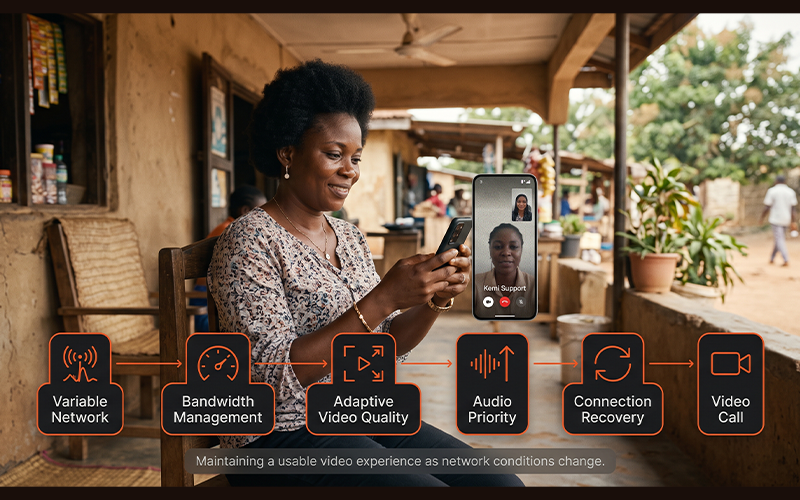
A low-bandwidth video API is designed around the assumption that network conditions will fluctuate, rather than treating a stable, high-speed connection as the default. In practice, that generally means:
- Adaptive bitrate, adjusting video quality automatically as available bandwidth changes
- Active bandwidth management across the session rather than a fixed quality setting
- Audio prioritisation, keeping the conversation intelligible even when video degrades
- Connection recovery that handles brief drops without ending the session entirely
- Attention to latency, since delayed audio is often more disruptive to a conversation than lower video resolution
- Awareness of device performance, since not every user is on a high-end smartphone
- Sensitivity to data consumption, given that data costs remain a real barrier for many users
There is an unavoidable trade-off between quality and bandwidth here, and a video API built for these environments should let quality flex downward gracefully rather than dropping the call outright when conditions worsen.
Read More: Why Every Business Needs an LMS for Employee Training
How Fintechs Can Embed Video Into Their Apps
A typical embedded video workflow follows a fairly consistent pattern: a user opens the app, selects the video service they need, whether that is speaking to a support agent or joining a scheduled consultation, authentication confirms their identity, a video session is created, the customer connects with an agent or advisor, the session ends, and the relevant record or status updates automatically. That last step matters more than it might seem. A video session that connects to user accounts, CRM systems, support ticketing, KYC workflows and notification systems turns a single call into a documented, traceable part of the customer journey, rather than an isolated conversation that leaves no trace in the product itself.
What Developers Should Look for in a Video API
Choosing a provider on feature count alone tends to produce disappointing results once real usage begins. A more useful technical evaluation checklist covers:
- Clear, complete API documentation
- Availability of a companion video SDK for web and mobile
- Confirmed support across web, iOS and Android
- Demonstrated scalability under concurrent sessions
- Documented latency performance
- Genuine bandwidth controls, not just marketing language
- Security practices and encryption standards
- Robust authentication for session access
- Recording capability, where relevant to compliance needs
- Usable analytics and reporting
- Webhooks for integrating events into existing systems
- Track record of reliability
- A pricing model that scales sensibly with usage
StudioApp and the Embedded Video Opportunity
StudioApp, from the team behind Vigilearn, approaches embedded video communication with the low-bandwidth reality described above squarely in view, rather than treating it as an edge case. Rather than assuming every user has a fast, stable connection, StudioApp is built to keep sessions, consultations and conversations usable even when network conditions are not ideal, which matters directly for a fintech trying to keep a KYC call or advisory session running smoothly for a customer on a constrained connection. The broader point for fintech teams is a simple one: you should not need to build an entire video infrastructure layer yourselves just to have a working conversation with a customer inside your own product. You can find current pricing and capability details on StudioApp’s website.
Where Video Infrastructure Could Go Next
Looking ahead, several directions are worth watching, while remaining clearly distinct from what is available today. AI-assisted customer service could route customers to video only when a conversation genuinely needs it. Video KYC could become more standardised as regulators grow more comfortable with remote verification. Remote advisory, financial education delivered through short embedded sessions, and stronger tooling for distributed agent networks all sit on a plausible near-term horizon. None of this is a current product commitment; it is simply where the direction of embedded, real-time communication in financial services appears to be heading.
Video does not have to be a separate application bolted onto the edge of a fintech product. Treated as infrastructure rather than as a standalone conferencing tool, it lets teams add real-time, in-app video communication without taking on the burden of building and operating that infrastructure themselves, and a genuinely low-bandwidth video API extends that capability to the mobile-first, variable-connectivity conditions that define much of the African market. For engineering and product teams weighing whether to build or integrate, the more useful question is rarely whether video adds value; it almost always does. It is whether your team wants to spend the next year maintaining video infrastructure instead of building the financial product itself.
Explore StudioApp’s video capabilities and see how embedded, low-bandwidth communication can fit into your digital product, or book a demo with Vigilearn to talk through your integration needs. You may also find our article on AI-powered learning management systems useful if you are exploring how embedded technology fits into a wider digital product strategy.
Frequently Asked Questions
What is a video API? A service that lets developers add real-time video and audio functionality to an application through API calls, without building the underlying video infrastructure themselves.
What is a video SDK? A developer toolkit, typically for web or mobile, that provides ready-made components for embedding video functionality into an application’s interface.
How do you add video calling to an app? By integrating a video API or SDK that handles session creation, authentication, connection management and streaming, then embedding the resulting components into your existing user interface.
What is a low-bandwidth video API? A video API engineered to adapt to variable network conditions, using techniques such as adaptive bitrate, audio prioritisation and connection recovery to keep sessions usable on slower or unstable connections.
Can fintech apps embed video? Yes. Fintechs can embed video for use cases including customer support, KYC assistance, onboarding, loan consultations, wealth advisory and financial education, keeping the conversation inside their own product rather than redirecting users elsewhere.
What should developers look for in a video API? Documentation quality, SDK availability, platform support, scalability, latency, bandwidth controls, security, authentication, recording, analytics, webhooks, reliability and pricing.
How does video API infrastructure work? An application calls the video API, which manages session creation, authentication and streaming through underlying video infrastructure, connecting users without the application needing to run that infrastructure itself.
Can video APIs support African low-bandwidth users? Yes, provided the API is specifically built for variable network conditions rather than assuming consistent high-speed connectivity, which remains uneven across much of the continent according to GSMA Intelligence.
