
What if the most administratively intensive job at your university was done entirely by your software?
It is not hypothetical. Universities are making deliberate infrastructure decisions that shift entire categories of work, admissions processing, enrolment tracking, fee reconciliation, examination management, and student communications away from human hands and into automated systems. The result is what practitioners are beginning to call an autonomous university management system: a digital architecture that handles the institution’s operational load so completely that the people inside it can focus on what they were actually hired to do.
For African higher education institutions facing growing student populations, widening resource gaps, and mounting pressure to improve outcomes, this is not a conversation about the future. It is a conversation about right now.
Read More: From 100 to 10,000 Students: How Vigilearn Scales with Your Institution
Where Administrative Time Actually Goes in a University

Before you can solve a problem, you have to see it clearly. And the administrative burden in higher education is substantial, often invisible, and almost entirely addressable by technology.
Consider what a typical university week looks like across its departments. Admissions teams are chasing missing documents, manually updating spreadsheet trackers, and sending the same follow-up emails repeatedly. Registrars are reconciling fee payment records against enrolment status, generating reports by hand, and fielding queries that a student portal could answer in seconds. Faculty are logging attendance on paper, redistributing course content through personal email, and manually compiling assignment submissions at the end of every assessment cycle. Leadership, meanwhile, is making strategic decisions based on data that is days or weeks out of date.
Research from the American Council of Trustees and Alumni shows that administrative spending at public universities rose 6.3% between 2016 and 2021, even as instructional spending fell by 4.7% over the same period. The EDUCAUSE 2025 Top 10 research identifies the data-empowered institution as the sector’s number one strategic priority, with integrated systems and workflow automation at its core. The institutions pulling ahead on student outcomes and operational efficiency are not hiring more administrators. They are investing in the right infrastructure.
Every major administrative category inside a university, admissions, student records, learning management, assessment, and communications, is now being automated in whole or in part. The question is not whether this is possible. It is when each institution decides to do it.
Stage One: Automated Admissions, From Inquiry to Enrolled Student
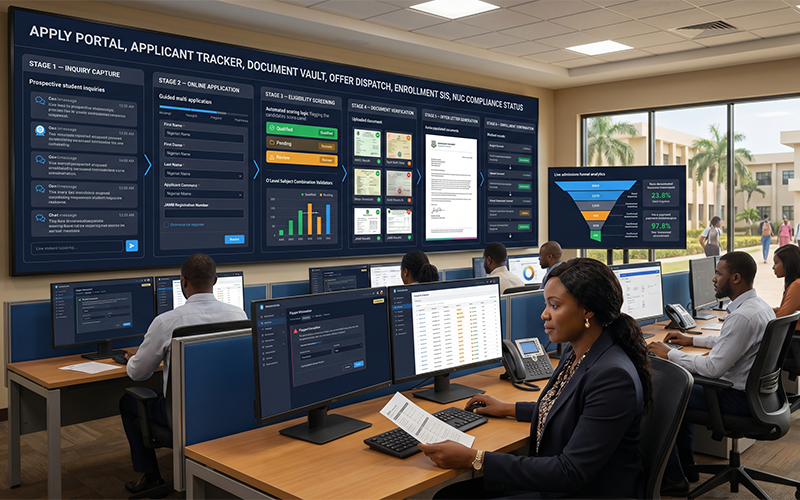
The admissions process is where administrative drag is most visible, and where automation delivers the most immediate relief.
A manual admissions cycle is a series of bottlenecks. An applicant submits an incomplete form. A staff member notices three days later. A follow-up email goes out. The applicant responds a week after that. A reviewer checks eligibility against a printed requirements sheet. An offer letter is drafted, signed, scanned, and emailed. The student confirms acceptance via a different channel. The acceptance is logged into the student record system, manually, by someone who also has seventy other applications to process.
When universities take weeks to process applications manually, students often accept offers elsewhere. This is not an abstract risk. It is a structural disadvantage.
An automated admissions journey looks entirely different. Inquiry capture triggers instant acknowledgement. An online portal guides applicants through document submission with real-time validation. Eligibility screening runs automatically against predefined criteria. Offer letters are generated and dispatched without human drafting. Fee payment is confirmed through integrated payment tracking, and enrolment records are created the moment acceptance is confirmed, without anyone typing a single field.
Vigilearn’s Apply Portal manages the complete application and admissions workflow end to end, giving institutions a single, structured pipeline from first inquiry to enrolled student.
Stage Two: The Living Student Record, Enroli SIS as the Institutional Brain
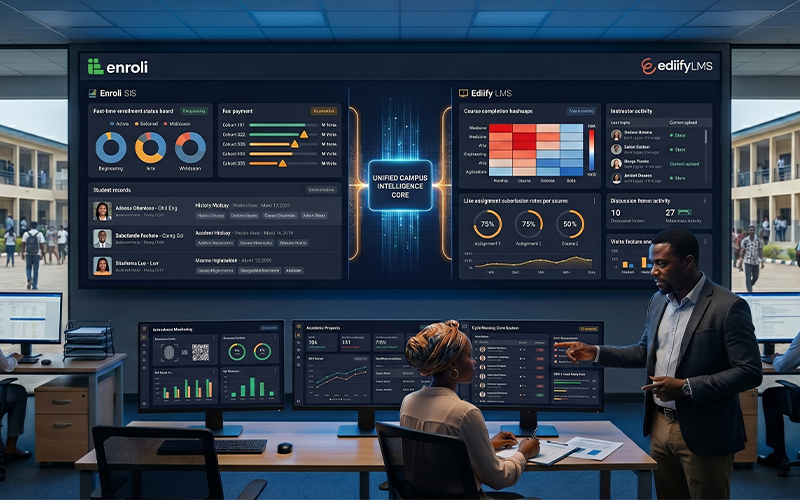
Once a student is enrolled, their relationship with the university generates a continuous stream of data: fees paid, courses registered, grades received, attendance logged, progress tracked. In institutions still relying on fragmented systems or spreadsheets, this data lives in silos. Nobody has the full picture. Decisions are made on incomplete information. Students fall through cracks that exist only because no single system was watching them.
An autonomous university management system resolves this through a Student Information System that functions as the operational centre of the entire institution. Enroli SIS maintains real-time enrolment status across every student, automates fee tracking and payment reminders, updates academic progress records directly from assessment results, feeds attendance data into early warning systems, and verifies graduation eligibility without a manual audit being necessary.
The institutional intelligence this creates is significant. Registrars can see every student’s complete academic and financial status at a glance. Nothing is buried in an email chain. Nothing is waiting for a colleague to update a spreadsheet. When a student’s engagement drops, the system flags it before the situation becomes a dropout. When a student completes their programme requirements, the system knows before the graduation committee meets.
Stage Three: Learning at Scale, Ediify LMS as the Academic Delivery Engine
The learning management system is where automation has the most direct impact on the quality of teaching itself, not just the efficiency of administration behind it.
Ediify LMS automates the mechanical work that consumes faculty time without adding academic value:
- Course content is distributed to enrolled students automatically, without manual file sharing.
- Assignment submissions are collected centrally with automated deadline management.
- Attendance and participation are tracked without paper registers or spreadsheet updates.
- Progress notifications go to students and faculty without anyone manually composing them.
- Analytics flag students at risk of disengagement before they disengage completely.
According to EDUCAUSE, institutions adopting workflow automation report a 30% increase in student satisfaction due to easier access to information and services. When faculty are freed from the logistics of learning management, they can focus on learning design, student interaction, and research. That is the teaching liberation argument for automation: it does not change what universities do; it changes what their people can do within them.
Read More: Why Universities Are Choosing Cloud-Based Platforms Over On-Premise Systems
Stage Four: Secure Assessment, The Examination Portal as Risk Infrastructure
Examinations are the highest-stakes operational moment in any academic institution. They are also, at many universities, the most manual-intensive. Scheduling is done in spreadsheets. Question papers are distributed through channels that are not always secure. Identity verification depends on invigilators following inconsistent protocols. Results are collated manually and transferred into student records by hand, introducing both delay and the risk of error.
Vigilearn’s Examination Portal automates the entire assessment cycle: scheduling and student notification, secure question delivery with randomisation, identity verification at assessment entry, automated submission capture with a full audit trail, and result integration directly into student records the moment assessments are submitted. The system is not simply more efficient than manual examination management. It is structurally more secure and more accountable.
What the Autonomous Campus Actually Frees People to Do
This is the part that matters most for institutional leaders, and the part that tends to get lost in technology conversations. Automation is not a staffing reduction strategy. It is a reallocation of human talent toward higher-value work.
When the administrative burden is handled by an autonomous university management system, something important shifts across every function:
- Admissions teams move from processing applications to converting prospective students, spending time on genuine engagement rather than document chasing.
- Registrars move from data entry to data strategy, using live institutional intelligence to improve retention and outcomes rather than maintaining records.
- Faculty move from administrative teaching management to actual teaching, spending their hours on curriculum, student interaction, and research.
- Leadership moves from operational firefighting to institutional strategy, with clean data and automated workflows providing the visibility needed to make sound decisions.
Automation does not replace university people. It gives them back the work they were hired to do.
How Vigilearn Builds the Autonomous Campus
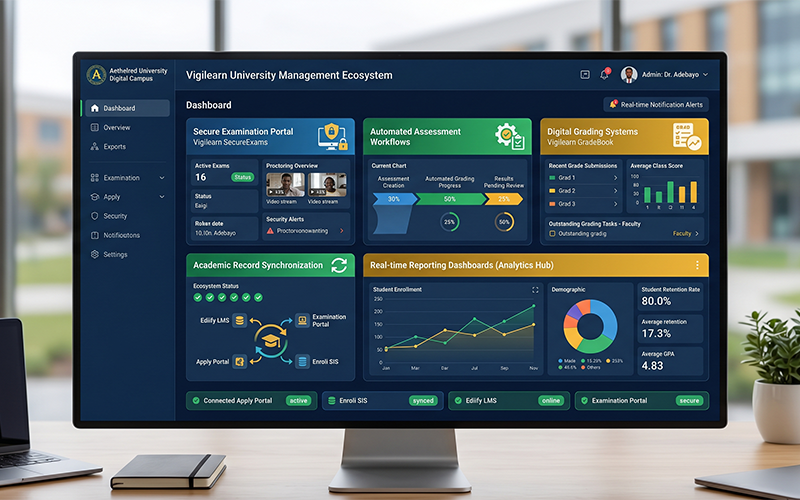
Vigilearn is not a collection of separate products bolted together. It is an integrated platform designed so that each component connects directly to the others, creating a single operational architecture across the entire student lifecycle:
Apply captures application data and feeds enrolment information directly into Enroli, with no manual transfer. Enroli feeds confirmed student status into Ediify, so access to courses is activated automatically on enrolment confirmation. Ediify feeds assessment results and attendance data back into Enroli, keeping the academic record current in real time. The Examination Portal draws from and returns results to Enroli, so grades become part of the student record the moment they are submitted.
The International Association of Universities notes that African institutions are navigating rapid enrolment growth under significant resource pressure. The World Economic Forum consistently identifies digital infrastructure as the foundational enabler of educational transformation in emerging markets. Vigilearn is the only platform on the market that offers a fully integrated autonomous campus architecture built specifically for African higher education institutions.
Explore the full platform or start a free trial to see what your institution looks like when its systems work together.
Read More: The Digital Campus Is Not the Future. It’s What Your Students Are Already Expecting Today
Frequently Asked Questions
What is an autonomous university management system? It is an integrated digital infrastructure that automates the core administrative operations of a university, including admissions, student records, learning management, and assessment, so that the institution can function with minimal manual intervention across its operational processes.
Which university processes can be fully automated? Admissions workflows, enrolment and fee tracking, course content distribution, attendance logging, assignment collection, examination scheduling and delivery, result processing, and graduation eligibility verification can all be substantially or fully automated with the right platform.
How does university workflow automation reduce administrative costs? By replacing manual, repetitive tasks with automated workflows, institutions reduce the staff hours dedicated to processing and tracking, lower error rates that generate costly corrections, and redirect human capacity toward higher-value activities that improve retention and outcomes.
What is the difference between an LMS, SIS, and admissions portal? An LMS (Learning Management System) manages course delivery, assignments, and student engagement. A SIS (Student Information System) maintains the official academic and financial record of every student. An admissions portal manages the application and enrolment pipeline. On the Vigilearn platform, all three connect and exchange data automatically.
How long does it take to implement an integrated university management platform? Implementation timelines vary by institutional size and complexity, but an integrated platform like Vigilearn is designed for structured, phased deployment. Contact the Vigilearn team for a consultation specific to your institution’s configuration.
Can a university run admissions without a manual review process? Automated eligibility screening can handle a significant portion of the review process. Institutions can configure the system to flag edge cases for human review while processing straightforward applications automatically, dramatically reducing the time and staff hours involved.
Your Institution’s Administrative Burden Is an Infrastructure Decision
The question is not whether your university can automate its operations. It is whether you will make the infrastructure decision to do so before your students, faculty, and peer institutions feel the gap.
Your institution’s administrative burden is not a staffing problem. It is an infrastructure decision. See the complete Vigilearn platform in a single demo. We will map every administrative stage of your institution to a system and show you exactly what your campus looks like when it runs itself. Book a consultation today.