
Managing education at a national or state level means making decisions based on a constant flow of information: how many learners are enrolled, where schools are located, how many teachers are available, which facilities need attention, and where resources are most urgently needed. When that information is collected through disconnected systems, paper records, and spreadsheets, getting a reliable picture of what is happening across schools becomes difficult. Data can be incomplete, outdated, or scattered across different offices, making it harder for education authorities to plan effectively.
This is where an education management information system (EMIS) comes in. An EMIS brings together the data generated across schools and education agencies and organizes it into a central system that governments can use for planning, monitoring and decision-making. UNESCO and its partners have supported the development of EMIS in education systems worldwide for decades, with the UNESCO Institute for Statistics describing effective EMIS as central to monitoring progress towards global education goals. Today, however, the role of EMIS extends well beyond keeping track of pupils and school facilities. Governments increasingly rely on these systems to understand how their education systems are performing and to make better decisions about what happens next.
Read More: Online Application Portal: How Institutions and Government Agencies Simplify the Application Process
What Is an Education Management Information System?
At its simplest, an education management information system is a centralised infrastructure for collecting, validating, storing and reporting data about schools, learners, staff and resources, so that education authorities can plan and govern with evidence rather than guesswork. The UNESCO International Institute for Educational Planning defines EMIS as a system of people, technology, methods and processes working together to give education leaders reliable, timely information for decision-making at every level.
Some ministries refer to this same infrastructure as a national education data system, particularly when it draws together census, finance, workforce and assessment data under one architecture rather than treating each as a separate silo. It helps to be clear about what EMIS is not. It is not the same as a school management system, which typically handles the day-to-day running of a single institution: timetables, fee records, gradebooks, parent communication. An EMIS sits above that layer. It draws structured data up from schools, through local or district authorities, into state and national repositories, so that a ministry can see patterns across an entire system rather than the operations of one campus. Information flows upward for planning and oversight, while policy and funding decisions flow back down. A modern ministry of education data platform often connects both layers, but the two remain conceptually distinct, and confusing them is a common reason procurement processes stall.
Why Governments Need Reliable Education Data
Education systems involve staggering numbers. A mid-sized country can have tens of thousands of schools, hundreds of thousands of teachers and millions of pupils spread across widely different geographies. When that scale is managed through paper registers, disconnected spreadsheets and inconsistent local reporting, several problems follow almost immediately.
- Enrolment figures become unreliable, which distorts everything from textbook procurement to school feeding programmes.
- Teacher deployment data goes stale, so some schools are overstaffed while others operate with acute shortages.
- Infrastructure gaps, such as schools without electricity, water or adequate classrooms, stay invisible until a crisis forces attention.
- Budgets get allocated on assumptions rather than evidence, which is difficult to defend to finance ministries and development partners.
Reliable education data management does not eliminate every one of these challenges, but it makes them visible, measurable and therefore solvable. That is the whole point of investing in it. That distinction matters more than it might sound. A government cannot fix what it cannot see.
What Data Does an EMIS Collect?
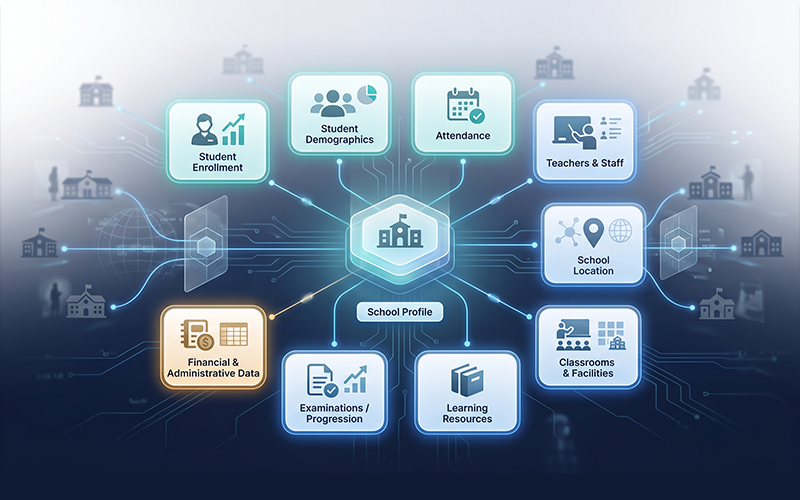
A well-designed education management information system typically gathers information across several interlocking categories:
- Enrolment and demographics, including age, gender and grade level
- Attendance, tracked at term or, increasingly, near real time
- Teachers and staff, covering qualifications, deployment and payroll status
- School locations and ownership, distinguishing public, private, faith-based and community institutions
- Infrastructure, from classroom counts to water, sanitation and electricity access
- Learning resources, such as textbook availability and digital equipment
- Examination and progression data, tracking transitions between grade levels
- Financial and administrative indicators, where the mandate extends that far
Taken together, this is what separates an EMIS from a simple headcount tool. It is not just asking how many pupils exist, but where they are being taught, by whom, in what conditions and with what outcomes.
How a National School Census System Works
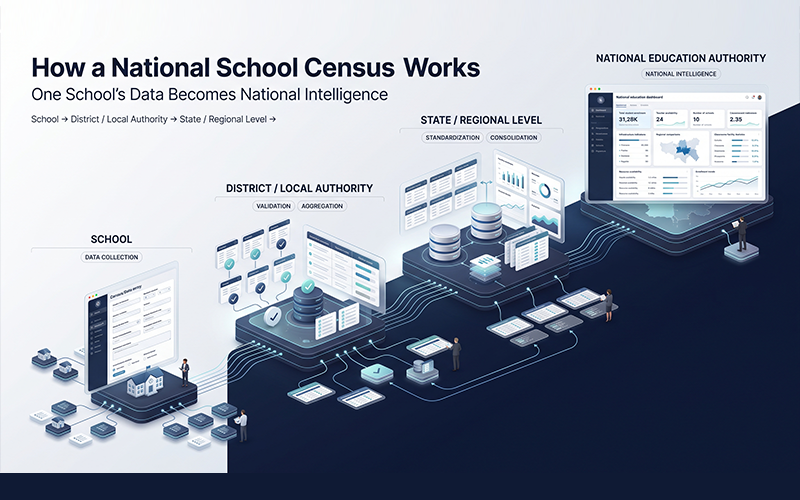
Most national EMIS platforms are built around a school census system, and the design choices here shape everything downstream. A census can be a single annual exercise, where every school submits a full return at a fixed point in the calendar, or a more continuous model, where core indicators are updated throughout the year. The World Bank’s SABER-EMIS framework notes that many systems historically counted only schools, teachers and students, without integrating census, finance, workforce or infrastructure data into one coherent record, which is precisely the fragmentation a modern census workflow is meant to solve.
The mechanics generally follow a consistent pattern: schools submit data, often digitally now rather than on paper; local or district officers review and validate submissions against known benchmarks; anomalies are flagged and returned for correction; and validated data is aggregated upward, from school to local government area, to state, to national level. Standardised forms and shared definitions matter enormously here. If one state counts a “classroom” differently from another, national comparisons collapse before analysis even begins.
Read More: School Management Software Cost: A Complete Pricing Guide
From Data Collection to Government Decision-Making
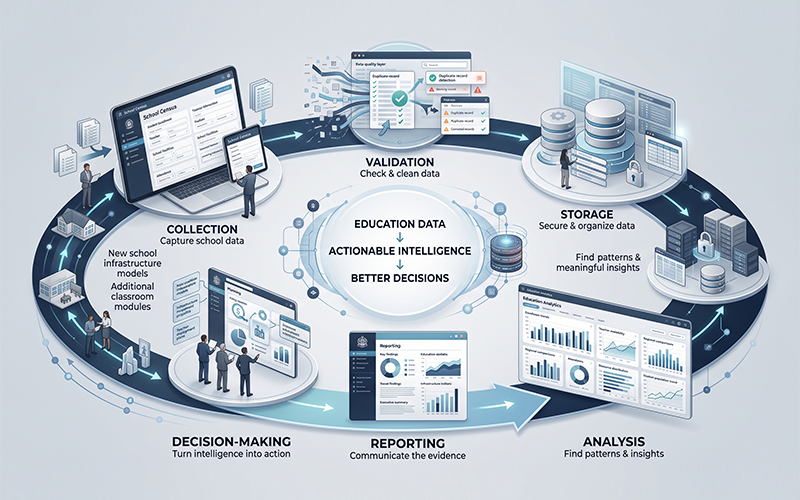
Raw numbers only become useful once they move through a proper lifecycle: collection, validation, storage, analysis, reporting and, finally, decision-making. Skipping or rushing any one of these stages is usually where EMIS software efforts fail. A ministry official reading an unvalidated dashboard is, in effect, making decisions on unverified information, which can be worse than making decisions on no information at all, because it creates false confidence.
How EMIS Supports Education Planning and Budgeting
This is where the strategic value of an education management information system becomes concrete. Ministries use EMIS outputs to identify districts experiencing enrolment growth and plan new school construction accordingly, to allocate teachers where pupil-teacher ratios are highest, to prioritise infrastructure spending in underserved areas, and to monitor progress against national education targets over time. Evidence-based budgeting, rather than historical guesswork, becomes possible only when the underlying data is trustworthy and current.
The Biggest Challenge: Education Data Quality
Every EMIS project eventually confronts the same obstacle: data quality. Duplicate learner records, missing fields, inconsistent formats between regions and manually entered figures that were never cross-checked all erode trust in the system. Outdated records are arguably the most damaging, because they look authoritative while quietly misleading planners.
Addressing this requires validation rules built into the collection process itself, standardised workflows that do not vary by region, and clear accountability for who owns which piece of data. Data governance is not a bureaucratic afterthought; it is what makes the rest of the system worth using.
What a Modern EMIS Software Platform Should Include
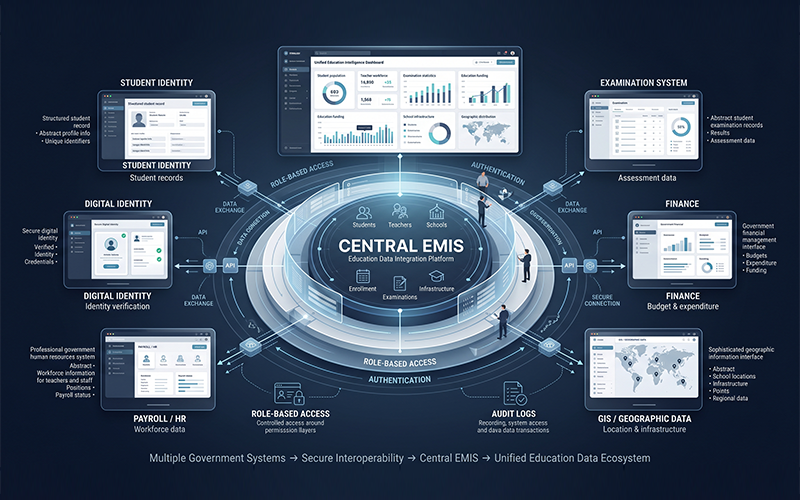
Governments evaluating an education management system or EMIS software procurement should look for a consistent set of capabilities in any school data management solution: a centralised database with role-based access control, digital forms for structured collection, built-in validation logic, school and learner profiles, dashboards and reporting tools, workflow management for approvals, API or integration capabilities, mobile accessibility for field officers, and audit trails that record who changed what and when.
EMIS Dashboards: Turning School Data Into Action
Dashboards are where an education data platform earns its keep. Visualised well, they let decision-makers spot enrolment trends, compare regions, check teacher availability against need, monitor infrastructure gaps and catch anomalies before they become crises. A table of raw figures rarely prompts action; a clear chart showing a district falling behind almost always does.
Integrating EMIS With Other Government Systems
An EMIS should not exist as an isolated database. Interoperability with student identity systems, payroll and HR platforms, examination bodies, finance systems and geographic information systems allows a national education data system to function as part of a wider government architecture rather than a silo. Nigeria’s approach offers a live example: the Federal Ministry of Education has been expanding the National Education Management Information System (NEMIS), which now covers more than 174,000 schools, and linking it to a new Learner Identification Number so pupil records stay consistent across systems.
Data Security, Privacy and Governance
Because any ministry of education data platform holds sensitive information about children, role-based access, strong authentication, audit logging and secure storage are not optional extras. Governance, in the sense of clear ownership and accountability for data, matters as much as the technology stack itself. A system can be technically excellent and still fail if nobody is clearly responsible for what it holds.
Read More: Digital Identity Verification: Why Governments Are Rethinking How They Confirm Who’s Who
How Enroli Can Support Digital Education Data Workflows
Government-scale education data infrastructure does not have to be built entirely from scratch. Enroli SIS, part of the Vigilearn infrastructure, supports structured digital enrolment and application workflows that generate clean, centralised records rather than scattered paper files. For an education authority modernising its digital application processes, that kind of structured intake reduces manual administration at the point where data quality problems usually begin, and feeds more reliable information into the broader education data ecosystem. Enroli is not a substitute for a full national EMIS, but it can be a meaningful building block within one.
The Future of Government Education Data
The direction of travel is clear: more real-time reporting rather than annual snapshots, AI-assisted analysis for anomaly detection, predictive planning for enrolment and staffing, automated validation to reduce manual error, and deeper interoperability across government systems. The shift, fundamentally, is from reporting what already happened to anticipating what an education system will need next.
An education management information system is not a luxury for well-resourced ministries. It is the basic infrastructure that makes planning, budgeting, staffing and accountability possible at national scale. Governments that invest in reliable school data management, disciplined education data management and interoperable, well-governed platforms, whether framed as an education management system or a full EMIS, put themselves in a far stronger position to serve every learner in their care. If your institution is exploring how digital infrastructure can support enrolment and education data workflows at scale, Vigilearn’s Enroli SIS is worth a conversation.
FAQ: Education Management Information Systems
What is an education management information system? It is a centralised system for collecting, validating and reporting data on schools, teachers and learners, used by governments to plan and manage national education systems.
Why is EMIS important for governments? It replaces fragmented, unreliable records with structured data, allowing ministries to plan school construction, teacher deployment and budgets based on evidence.
What information does an EMIS collect? Typically, enrolment, attendance, teacher and staff records, school infrastructure, learning resources and examination or progression data.
What is a school census system? It is the mechanism through which schools submit data, either annually or continuously, which is then validated and aggregated from the school level up to the national level.
How does EMIS support education planning? By showing where enrolment is growing, where teachers are unevenly deployed and where infrastructure investment is most needed.
What is the difference between EMIS and school management software? School management software runs the daily operations of a single institution, while EMIS aggregates data across many institutions for system-wide planning.
What features should modern EMIS software include? Role-based access, digital data collection, validation rules, dashboards, reporting tools, API integrations, mobile accessibility and audit trails.
How does EMIS improve education data quality? Through built-in validation rules, standardised collection workflows and clear accountability for data ownership at every level.
