Hiring someone is not the end of talent management. It is the point at which the organisation begins learning whether that person has the skills, support, motivation and opportunities needed to succeed. The systems used to manage that journey therefore need to do more than move candidates through a recruitment pipeline.
Talent management software brings together processes and workforce information across the employee lifecycle, from attracting and hiring people to onboarding, performance, learning, career development, succession and retention. That broader view matters as skills change quickly. The World Economic Forum’s Future of Jobs Report 2025 estimates that 39% of workers’ core skills will change by 2030, while 63% of employers identify skills gaps as a major barrier to business transformation.
Read More: Beyond Certificates: How Skills Verification Is Redefining Online Learning
What Is Talent Management Software?
Talent management software is a set of digital capabilities that helps organisations attract, assess, develop, deploy and retain people. Depending on the product, it may combine several functions in one platform or connect specialist systems through integrations.
The important distinction is the lifecycle. Recruitment software is primarily concerned with finding and hiring candidates. A talent management platform continues beyond the offer letter, helping organisations understand performance, identify skills gaps, support learning, facilitate internal mobility and prepare successors for critical roles.
A typical lifecycle looks like this:
- Attract and hire
- Onboard
- Develop skills
- Evaluate performance
- Enable career movement
- Plan successors
- Retain and redeploy talent
This is why talent management is increasingly treated as a strategic workforce function rather than an HR administration task. SHRM describes it as aligning recruiting, development and retention, with succession management and workforce planning among priorities for HR leaders.
Talent Management vs Recruitment Software
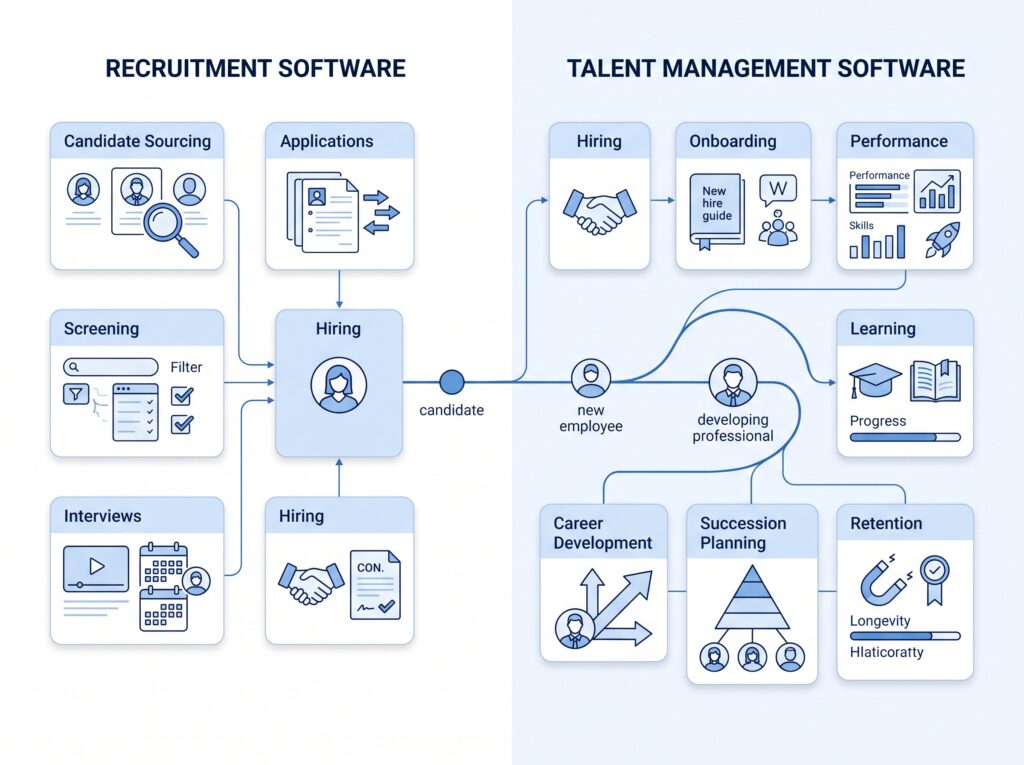
The difference is easiest to understand by asking what happens after a candidate becomes an employee.
Recruitment software, including applicant tracking systems, is built around vacancies, applications, screening, interviews, offers and candidate communication. Its purpose is to help a business make a hiring decision efficiently.
Talent management software has a wider remit. Candidate management may be included, but the system also addresses what happens after hiring: goals, reviews, development, career pathways, succession and workforce visibility.
Read More: Compliance Training Software: What Banks and Fintechs Need to Meet Modern AML Standards
The categories can overlap, and not every product includes every capability. Enterprises may therefore use an ATS alongside an HRIS, learning platform, performance system or talent marketplace. What matters is whether those systems exchange reliable information rather than creating disconnected versions of the same employee record.
What Does Talent Management Software Typically Include?
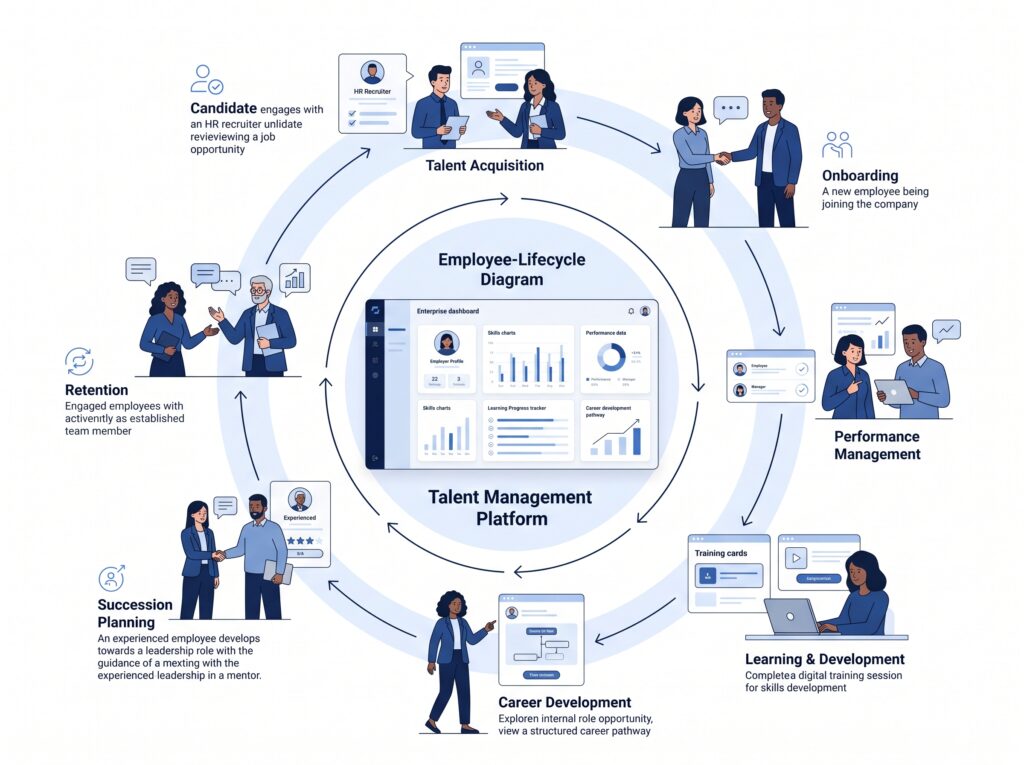
The exact modules vary, but enterprise platforms commonly cover several connected areas.
Talent acquisition
This can include candidate profiles, hiring workflows, skills and experience data, assessments and candidate matching. The strategic advantage comes from moving beyond CV storage towards structured information about what a person can actually do.
Onboarding
Onboarding capabilities can organise documentation, role setup, induction tasks and connections to core HR systems. The aim is to move a new hire from accepted offer to productive employee with less administrative friction.
Performance management
Performance management software can support goals, reviews, feedback and ongoing performance tracking. When performance information is connected to skills and development data, managers can have a more useful conversation about not only what an employee has achieved, but what they need to develop next.
Learning and development
Learning capabilities can connect identified skills gaps with training, learning pathways and development plans. This is increasingly important as organisations try to reskill existing employees rather than relying solely on external hiring.
The WEF reports that 50% of surveyed workers had completed training as part of longer-term learning strategies, up from 41% in its 2023 edition.
For organisations comparing an LMS and LXP, the distinction can help clarify whether they need structured learning administration, broader discovery and personalisation, or both.
Career development and internal mobility
A modern HR talent platform can make career pathways, internal vacancies and relevant skills more visible. Employees can see possible next roles, while managers can identify people whose existing capabilities could transfer to different teams.
Succession planning
Succession planning software helps organisations identify critical roles, build internal talent pools and develop leadership pipelines. Continuity cannot begin when a senior employee announces their departure. It requires earlier visibility of capability, readiness and development needs.
How Talent Management Software Supports Skills-Based Organisations
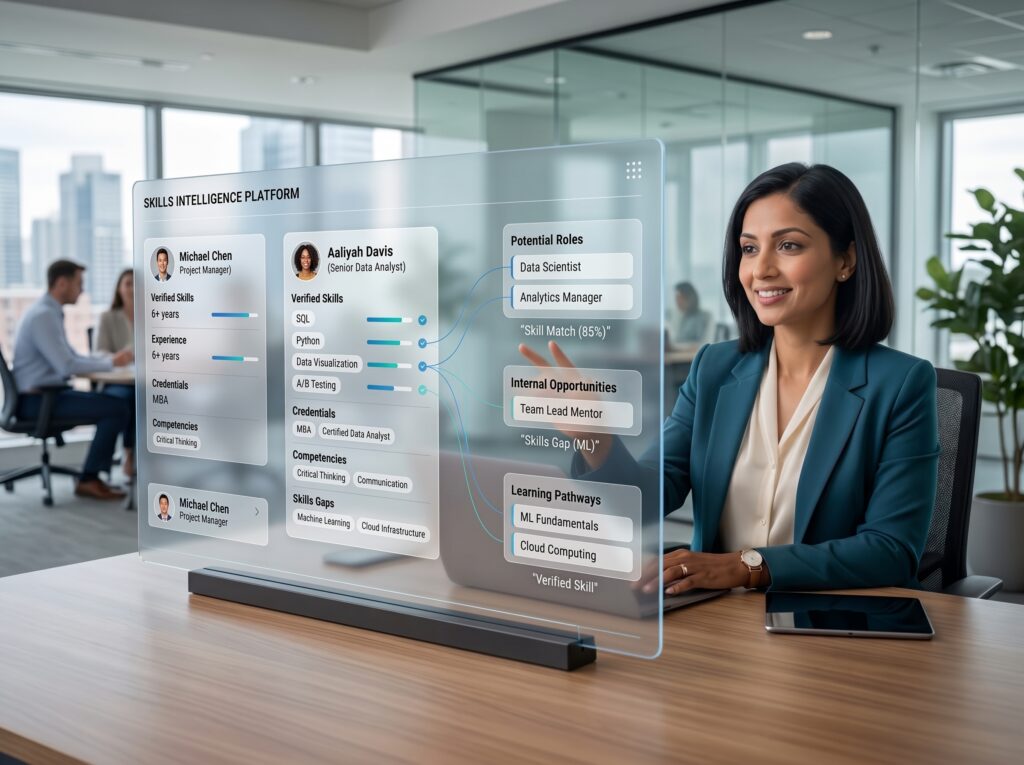
Job titles are useful, but they are an imperfect description of capability. Two people with the same title may have very different technical, behavioural and domain skills. Conversely, someone in one role may possess capabilities that are valuable elsewhere in the organisation.
Skills data creates a more granular workforce picture. It can help organisations map candidate and employee capabilities, identify gaps, match people to roles, recommend learning and support internal mobility.
The case for this approach is becoming stronger as skills change. The WEF expects AI and big data, networks and cybersecurity, and technological literacy to be among the fastest-growing skill areas through 2030.
LinkedIn’s 2025 recruiting research found that 93% of surveyed talent acquisition professionals considered accurate assessment of candidate skills important to improving quality of hire. Its platform data also found that companies conducting the most skills-based searches were 12% more likely to make a quality hire.
But skills data is useful only when it is accurate, current and relevant. A database full of self-reported claims does not automatically create skills intelligence. Verified credentials, assessments and demonstrated competencies can provide additional evidence.
This is where Vigilearn’s skills verification approach can fit into the wider talent ecosystem: not as a replacement for an enterprise HR platform, but as a source of more structured information about what talent can demonstrate.
How Does It Support Employee Retention?
Software does not retain people by itself. It can, however, make the conditions surrounding retention more visible and actionable.
An employee who cannot see a future inside an organisation may eventually look elsewhere. A manager who cannot see available development pathways may struggle to have a meaningful career conversation. An organisation that cannot identify emerging skills gaps may discover too late that critical capabilities are concentrated in a handful of people.
Connected talent data can support:
- Career pathways and internal opportunities
- Learning recommendations linked to skills gaps
- Regular performance and development conversations
- Recognition and visibility of employee capabilities
- Succession planning for critical roles
- Internal mobility before external hiring becomes necessary
The objective is not to assume that every employee wants promotion. It is to give people and managers better information about possible development and movement.
Read More: Why Employee Training Software Matters in Nigeria
The Role of AI in Talent Management
AI can make large talent datasets easier to analyse. Potential applications include extracting skills from CVs and job descriptions, matching candidates to roles, identifying skills gaps, recommending learning, supporting workforce analytics and automating repetitive administrative work.
That does not make every AI recommendation reliable. Talent decisions affect people directly, so organisations need governance around data quality, bias, explainability, privacy and human oversight.
The NIST AI Risk Management Framework provides guidance for incorporating trustworthiness considerations into the design, development, use and evaluation of AI systems. In HR, an AI-generated recommendation should therefore inform a decision, not become an unexamined substitute for human judgement.
Talent Management Software and Enterprise HR Systems
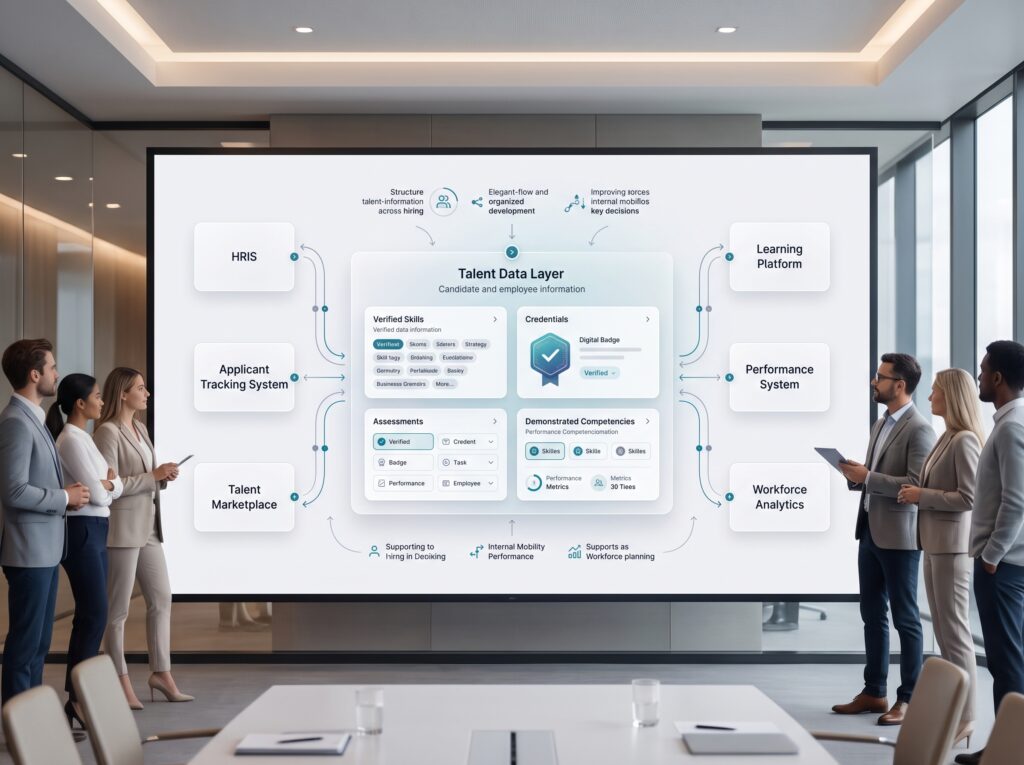
Enterprises rarely operate on one HR application. An HRIS may hold core employee records. An ATS may manage recruitment. Payroll handles compensation. An LMS manages learning. A performance platform tracks goals and reviews. A talent marketplace may support internal opportunities.
The value of an enterprise HR software ecosystem therefore depends partly on how well its components work together. APIs, integrations, data standards, security controls and clear ownership of employee information matter as much as the visible interface.
The goal is not necessarily to replace every system. It is to reduce fragmentation so that workforce decisions are based on a more connected view of people, roles and skills.
What Should Enterprises Look For?
Before selecting a platform, HR and technology leaders should assess capabilities against their workforce strategy rather than buying the longest feature list.
A practical checklist includes:
- Employee lifecycle coverage
- Skills and competency data
- Candidate matching and assessment
- Performance management
- Learning integration
- Career development and internal mobility
- Succession planning
- Workforce analytics and reporting
- AI capabilities and governance
- API and integration support
- Security and privacy
- Scalability and user experience
- Implementation and customisation requirements
The right architecture may be one comprehensive platform or several specialist systems connected properly. The decision should follow the organisation’s processes, workforce complexity and data requirements.
How Verified Talent Data Fits Into the Modern HR Stack
One persistent problem in talent management is the quality of the underlying data. A CV can describe experience, qualifications and skills, but enterprises may still need ways to validate those claims.
Verified credentials, assessment results, badges and demonstrated competencies can add another layer of evidence. Structured information can make matching more meaningful because the system is comparing defined capabilities rather than relying entirely on job titles or free-text descriptions.
For enterprises, this creates an opportunity to treat verified talent information as part of the broader data layer supporting recruitment, development and workforce planning.
Vigilearn’s Hub can complement this ecosystem by helping organisations access verified talent information and matching capabilities without positioning itself as a replacement for a complete HR suite. The value lies in supplying better talent information to the systems and decisions that already sit across the employee lifecycle.
The Future of Talent Management
The direction of travel is towards skills-based organisations, internal talent marketplaces, AI-assisted matching, continuous performance conversations, personalised development and greater interoperability between HR systems.
The underlying shift is more important than any individual technology. Organisations are moving from asking, “How many people do we have in each role?” towards more useful questions: “What capabilities do we have? Where are the gaps? Which skills are changing? Who could move into critical roles? What development would make that possible?”
The WEF’s projection that 39% of core skills will change by 2030 illustrates why this matters. Workforce planning based only on current job structures can struggle when the work itself changes.
Read More: The ROI of Investing in Employee Training Through an LMS
Talent management begins before the first interview and continues long after onboarding. Recruitment, performance, learning, career development, succession and retention are connected workforce decisions, even when different teams or systems own them.
For enterprises, the next step is not necessarily to find one application that does everything. It is to build a connected talent ecosystem in which reliable skills data can move between hiring, development and workforce planning processes.
As skills evolve, better talent decisions will depend increasingly on better information about what people can do, what they could learn, and where those capabilities are needed. Explore Vigilearn to see how verified talent information can contribute to a more skills-focused approach to hiring and workforce development.
Talent Management Software FAQs
- What is talent management software?
It is technology that supports multiple stages of the employee lifecycle, including hiring, onboarding, performance, learning, career development, succession and retention. The scope varies by provider.
- Is talent management software the same as an HRIS?
No. An HRIS generally provides core HR administration and employee records, while talent management focuses more heavily on acquiring, developing, evaluating and retaining talent. The two can overlap and are often integrated.
- How does it support succession planning?
Succession capabilities can identify critical roles, map internal talent pools, assess readiness and connect potential successors with development plans.
- Why is skills data important?
Skills data gives organisations a more detailed view of capability than job titles alone. When the data is accurate and current, it can support hiring, learning, internal mobility and workforce planning.
- Can it integrate with existing HR systems?
Often, yes. Integration capabilities vary, so enterprises should assess APIs, supported systems, data flows, security and implementation requirements before selecting a platform.
