

Blog - Vigilearn Blog - Vigilearn

Vigilearn Blog

Explore insights into our innovations, exciting updates, and the passionate minds shaping the future of learning.

Search

The Latest

Show a global team of employees working from different locations and connecting through one digital learning platform. In the centre, show a laptop/dashboard displaying a training programme with courses, progress, assessments, and employee learning activity. Connect the different employees to the same platform to show how companies can provide consistent training across remote and hybrid teams. remote employee training

Remote Employee Training: How Companies Build Consistent Learning Across Distributed Teams 

Remote employee training rarely fails because the content is wrong. It fails because a new starter in Toronto, a team lead in Manchester and a support analyst in Nairobi receive the same material in three very different ways, then act on three different understandings of the same policy.  The shift is not reversing. Gallup reports that the share of on-site, remote-capable employees who say their team is spread across locations rose from 13% in 2023
Read More »
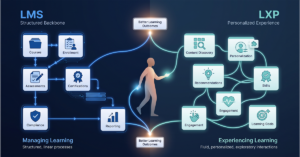
a sophisticated split-screen visual comparing an LMS and an LXP, but avoid making one look outdated or inferior. On the left, show the LMS as the structured learning backbone with: Courses → Enrollment → Assessments → Certifications → Compliance → Reporting On the right, show the LXP as the learner experience layer with: Content Discovery → Personalization → Recommendations → Skills → Engagement → Learning Goals In the centre, show a learner moving between both environments, demonstrating that modern learning ecosystems can use both. The two sides should visually connect toward a shared outcome: better learning and learner outcomes.

LMS vs LXP: What’s the Difference and Which Do You Need? 

If your organisation already runs a learning management system, the LMS vs LXP question can feel unnecessary. Why add another platform when the one you have already delivers courses, tracks completions and keeps compliance officers happy?  The honest answer is that an LMS and an LXP were built to solve different problems, and understanding that difference matters more than picking a winner. One gives administrators control over what people must learn. The other gives learners

Read More »
a wide, premium conceptual illustration showing a large education system feeding into one centralized Education Management Information System (EMIS). Across the bottom, show diverse schools and education institutions from different regions, each generating different types of data — students, teachers, enrollment, attendance, infrastructure, classrooms and resources. These data streams should flow digitally into a large centralized EMIS platform in the centre. On the right, show government education decision-makers viewing a clean dashboard with enrollment trends, teacher availability, school infrastructure and geographic insights. The composition should visually communicate: Schools → Data Collection → Validation → Centralized EMIS → Government Decisions Make the technology infrastructure the hero, rather than focusing on people. Use a sophisticated global government-tech aesthetic with digital networks, dashboards and data layers. No country flags or country-specific visual cues.

Education Management Information System: How Governments Manage School Data 

Managing education at a national or state level means making decisions based on a constant flow of information: how many learners are enrolled, where schools are located, how many teachers are available, which facilities need attention, and where resources are most urgently needed. When that information is collected through disconnected systems, paper records, and spreadsheets, getting a reliable picture of what is happening across schools becomes difficult. Data can be incomplete, outdated, or scattered across
Read More »
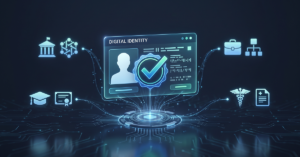
Create a sophisticated digital identity verification scene showing a person's digital identity being securely verified through a central system. The main visual should be a human profile or digital identity card connected to verified records, with a clear verification check symbol. In the background, subtly show government services, education records and workforce databases connected through secure digital infrastructure. Professional government technology aesthetic, clean, trustworthy and modern.

Digital Identity Verification: Why Governments Are Rethinking How They Confirm Who’s Who 

Digital identity verification has quietly become one of the hardest problems in government administration, not because verifying a single person is difficult, but because confirming that thousands of people in a database are real, unique and correctly linked to their records is. A ministry can have sound policy and capable staff, and still lose money and trust because its underlying records are unreliable.  The symptom shows up differently by sector. In payroll, it looks like
Read More »
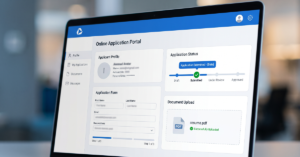
Show a modern digital application portal displayed on a large laptop or desktop screen. The interface should show an applicant profile, application form, document upload section, application status and a clear “Submitted” status. Around the screen, subtly show different types of applicants such as a student, job applicant and programme applicant to communicate that the platform serves education, business and government use cases. Clean corporate technology style, professional blue and white interface, minimal background, no excessive text.

Online Application Portal: How Institutions and Government Agencies Simplify the Application Process 

An online application portal is quietly becoming the backbone of how universities, businesses and government agencies collect and manage applications at scale. For decades, the default was paper forms, email attachments and spreadsheets stitched together by whichever staff member had the patience for it. That approach worked when volumes were modest. It buckles the moment an admissions office, a recruitment team or a government programme must process thousands of submissions within a tight window.  The
Read More »
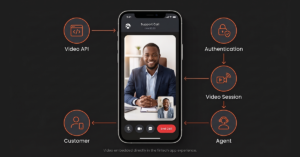
a fintech mobile application with an embedded video call between a customer and a financial advisor or support agent. Around the app, show the underlying infrastructure connecting: Video API → Authentication → Video Session → Customer → Agent The main message should be that video can become part of a fintech application instead of forcing users into a separate video platform.

Video API: The Infrastructure Layer Fintechs Overlook 

A video API is one of the few pieces of infrastructure a modern fintech can add to its product without needing to build, host or maintain the underlying communication layer itself. Over the past several years, fintech infrastructure has become genuinely modular: a product team can integrate payments, banking rails, identity verification, KYC, notifications and analytics from specialist providers, assembling a financial product from parts rather than building each layer in-house. Communication, oddly, has often

Read More »