
GovTech uses technology, data, and digital infrastructure to redesign how governments operate and deliver services, not simply to put old paperwork online. For ministries, agencies, and the businesses that work alongside them, that distinction can mean the difference between a modernisation effort that sticks and one that quietly reverts to manual processes within a few years.
Most of us have filled in a paper form at a government office, only to be told to bring three photocopies to a different building the following week. That frustration is precisely what this movement sets out to remove, not by adding another app to a citizen’s phone, but by rebuilding the systems and workflows behind the counter so that services work as one connected experience rather than a chain of disconnected offices.
Read More: Education Management Information System: How Governments Manage School Data
What Is GovTech?
GovTech covers both the services a citizen sees, such as an online licence application, and the infrastructure behind the scenes that makes that service reliable: shared data standards, cloud platforms, digital identity, automation and analytics. The World Bank describes GovTech as a whole-of-government approach to public sector modernisation, built around three ideas: services that are universally accessible and citizen-centric, coordination across the whole of government rather than agency by agency, and systems that are simple, efficient and transparent.
That last point matters more than it sounds. Digitising a paper form without changing the process behind it usually just creates a slower, more expensive version of the same bureaucracy, one with a login screen bolted on. This is what separates it from earlier digital government services efforts, which often focused on moving a single form online without touching the workflow that produced it. A more useful question for any public sector technology strategy is whether a process needs to exist in its current form at all, or whether shared data and interoperable systems can remove several steps entirely.
Why Are Governments Investing in Digital Transformation?
Citizens increasingly expect government interactions to feel as straightforward as their banking or shopping apps, and that expectation is now a serious source of institutional pressure. Several forces are pushing ministries toward government digital transformation:
- Rising volumes of citizen and administrative data that manual systems cannot process quickly enough
- Pressure to cut processing times and reduce reliance on in-person visits
- The need for better coordination between agencies that currently hold siloed, duplicate records
- Growing demand for transparent, trackable processes that reduce opportunities for corruption
- Ageing legacy systems that are expensive to maintain and increasingly difficult to secure
Read More: Digital Identity Verification: Why Governments Are Rethinking How They Confirm Who’s Who
Crucially, this is an organisational change project as much as a technology one. New software rarely fixes a broken process by itself; more often, it simply exposes the problem that was already there, only faster and in front of more people.
GovTech vs E-Government: What’s the Difference?
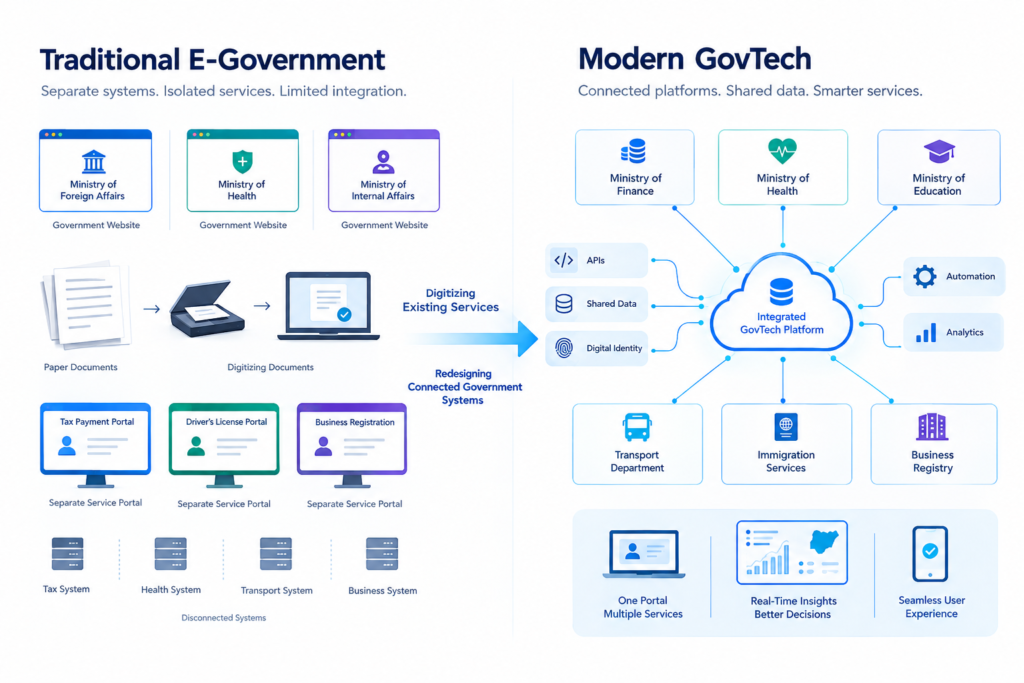
The terms overlap, and definitions vary between institutions, but the practical distinction is one of scope and design philosophy. The OECD’s Digital Government Policy Framework captures this shift well, measuring digital maturity across dimensions such as being digital by design, data-driven and built as a shared platform rather than a collection of separate portals.
| Area | Traditional E-Government | GovTech |
| Focus | Putting services online | Modernising government systems and services |
| Scope | Often a single service | Broader ecosystem |
| Technology | Websites and portals | Platforms, data, APIs, automation, identity, analytics |
| Approach | Digitising existing processes | Redesigning processes around digital capabilities |
| Data | Often siloed | Emphasis on interoperability |
| Users | Citizens and businesses | Citizens, businesses, and government institutions themselves |
What Technologies Are Driving Government Digital Transformation?

A handful of technologies recur across most public sector technology strategies, each solving a distinct government problem rather than simply appearing on a procurement list:
- Cloud computing gives agencies the capacity to scale services without maintaining ageing on-premises servers.
- Digital identity lets a citizen prove who they are once and reuse that verified identity across multiple services.
- APIs and interoperability layers let previously siloed databases- tax, health, and education- exchange the specific data they are authorised to share.
- Workflow automation removes repetitive manual steps, such as document checks, from case processing.
- Data analytics helps ministries spot patterns, from tax fraud to school infrastructure gaps, that manual reporting would miss.
- Cybersecurity technologies protect the sensitive personal and financial data that digital services necessarily centralise.
Read More: Online Application Portal: How Institutions and Government Agencies Simplify the Application Process
Digital identity deserves particular attention, since so much else depends on it working well. The World Bank’s identification initiative estimates that roughly one billion people worldwide still lack any officially recognised proof of identity, which locks them out of banking, healthcare, education and formal employment. Building reliable, verifiable digital identity is therefore not a peripheral feature of e-governance solutions; it is often the precondition for everything else working as intended.
How Public Services Are Changing
The clearest evidence of this shift shows up in everyday interactions: online licence and permit applications that no longer require an in-person queue, digital tax filing and payment systems, social protection payments disbursed directly rather than through intermediaries, and identity verification that confirms eligibility for a service in seconds rather than weeks. The UN E-Government Survey 2024 reports a marked global improvement in digital government development, with the share of the world’s population living in countries lagging on this front falling from 45.0 per cent in 2022 to 22.4 per cent in 2024, even as the survey notes that Africa, least developed countries and small island states still trail the global average. The pattern across these examples of digital government services is consistent: redesigned workflows reduce unnecessary manual steps while making each step easier to trace and audit.
Applying GovTech Principles to Education
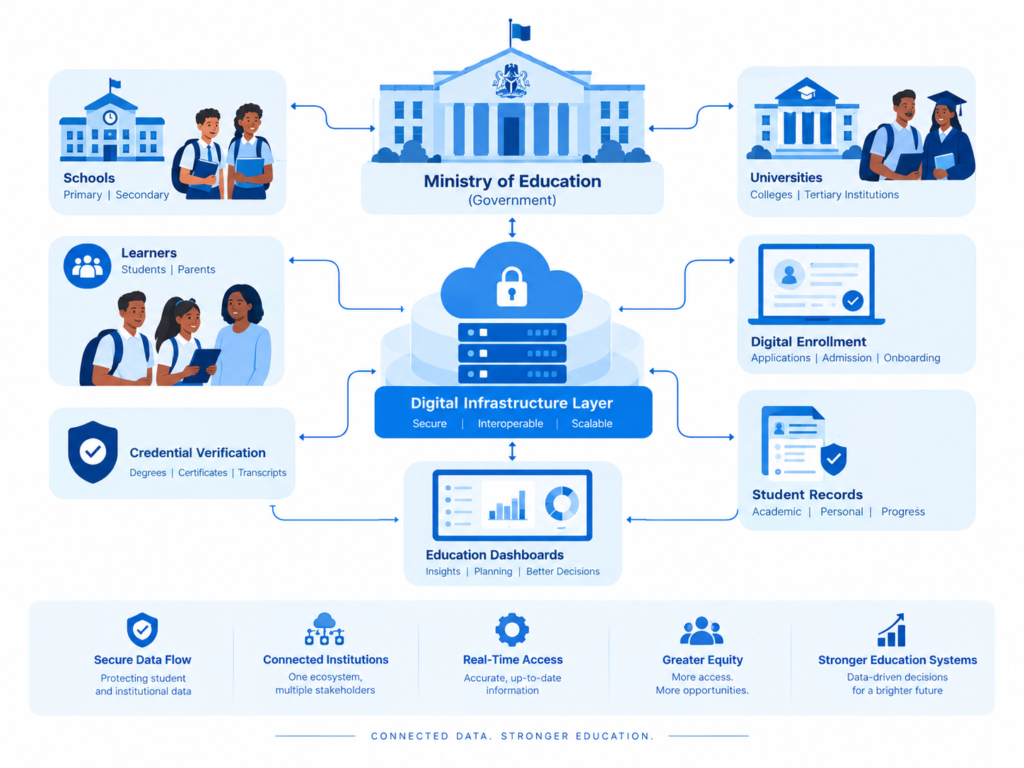
Education is one of the clearest illustrations of these principles in practice, and one of the hardest to get right, because the underlying data problem is enormous. A single ministry may be responsible for tens of thousands of schools, millions of learners, and enrolment figures that shift every term.
This is where education management information systems, digital enrolment and application platforms, and credential verification tools come in. Rather than treating education as a standalone digital project, the stronger approach connects it to the same underlying government digital transformation, shared identity, national data systems, and interoperable records that the rest of the public sector is building towards.
A national school census that feeds directly into planning dashboards, a digital application process that generates clean records instead of paper files, and academic credentials that can be verified electronically all reduce the same manual friction that these broader e-governance solutions address elsewhere in government. None of this requires an online learning platform; it requires reliable infrastructure that ministries, institutions and agencies can all draw on and trust, coordinated between the bodies that fund, regulate and deliver education.
The Biggest Challenges in Government Digital Transformation
Technology procurement is rarely the hardest part of a modernisation programme. The recurring obstacles are more structural, and each tends to resurface regardless of which technology a government eventually chooses:
- Legacy systems that hold years of critical data but cannot easily connect to newer platforms
- Fragmented databases across agencies that were never designed to share information
- Cybersecurity and privacy risks that scale up as more citizen data moves online
- Digital inclusion gaps, since a citizen-facing service is only as useful as the citizens who can actually reach it
- Procurement complexity and lengthy public-sector buying cycles
- Organisational resistance, particularly where new systems change long-established roles and reporting lines
None of these is solved by better software alone, which is why an implementation strategy has to sit alongside any technology decision, not follow after it.
How Governments Can Build a Modern Digital Service Infrastructure
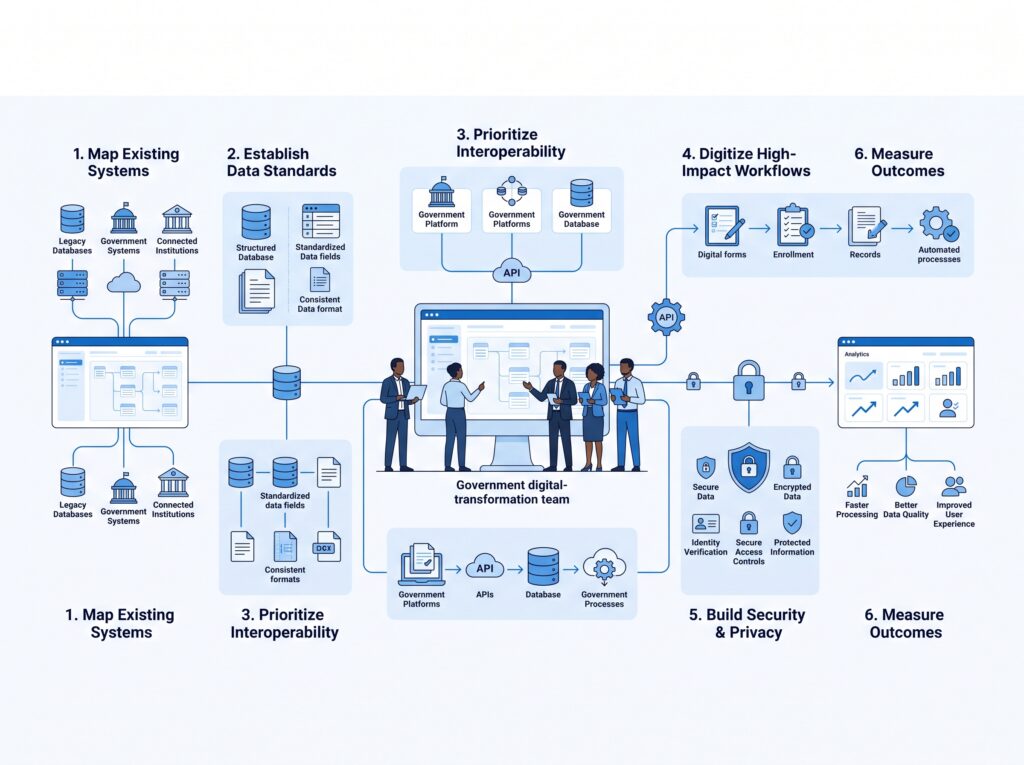
A staged approach tends to outperform a single, all-at-once overhaul:
- Map existing systems, workflows and data gaps before selecting any new platform.
- Establish shared data standards so information collected in one agency means the same thing in another.
- Prioritise interoperability, so systems can exchange the data they are authorised to share.
- Digitise the highest-impact workflows first, where the improvement will be immediately visible to citizens and staff alike.
- Build security and privacy into the architecture from the outset, rather than adding it later as a costly retrofit.
- Measure outcomes, tracking processing times, service usage and data quality over time rather than treating go-live as the finish line.
Read More: Compliance Training Software: What Banks and Fintechs Need to Meet Modern AML Standards
What Does the Future Hold?
The direction of travel points toward more connected government platforms, greater use of real-time data, AI-assisted administrative workflows, and digital credentials that can be verified instantly across borders and institutions. These are emerging directions rather than guaranteed outcomes, and progress will vary considerably between countries and sectors, shaped as much by institutional capacity and political will as by the technology itself.
What is already clear is that successful modernisation depends on reliable data, interoperable systems and citizen-centred design working together, not on any single piece of technology. Governments that treat GovTech as connected infrastructure, rather than a checklist of digital products, tend to be the ones whose services actually hold up once real demand arrives.
Modern government services need more than digital interfaces: they need connected infrastructure, reliable data, and systems built to work at scale. Explore how Vigilearn’s education infrastructure supports government-aligned data systems, digital enrolment and credential verification.
GovTech Frequently Asked Questions
What is GovTech? GovTech is the use of technology, data and digital infrastructure to modernise government operations and public service delivery, covering both citizen-facing services and back-end administrative systems.
What is an example of GovTech? A digital identity system that lets a citizen verify who they are once and reuse that verification across tax, health and education services is a common example, as is a national education data system that consolidates enrolment records across thousands of schools.
What is the difference between GovTech and e-government? Traditional e-government typically means putting individual services online. GovTech takes a broader, whole-of-government approach, redesigning processes around shared data, interoperable systems and digital identity rather than digitising services one at a time.
Why is GovTech important? It helps governments deliver services faster, coordinate more effectively across agencies, and manage growing volumes of citizen data more securely and transparently.
How does GovTech improve public services? By replacing manual, paper-based workflows with digital processes that are easier to track, faster to complete and less dependent on in-person visits.
What technologies are used in government digital transformation? Cloud computing, digital identity, APIs and interoperability layers, workflow automation, data analytics and cybersecurity technologies are among the most common.
How is GovTech used in education? Through national education data systems, digital enrolment and application platforms, and credential verification tools that give ministries a reliable, system-wide view of schools, learners and staff.
What are the challenges of government digital transformation? Legacy systems, fragmented databases, cybersecurity and privacy risks, digital inclusion gaps, procurement complexity and organisational resistance to change.
